

“A paste of lye and water can burn through an aluminum pan. A solution of lye and water will dissolve a wooden spoon. Combined with water, lye heats to over two hundred degrees, and as it heats it burns into the back of my hand…on the lap of my bloodstained pants…”
-Passage from Fight Club, by Chuck Palahniuk
If you’ve ever seen the movie or read the book Fight Club, then you know what a potentially volatile endeavor the making of soap can be. If you are careless with the sodium hydroxide (lye), a poisonous, caustic substance, you risk burning holes in your flesh, blinding yourself, and endangering others. But if you’re conscientious in your work, DIY soap-making can be a great hobby. Most soaps out there are designed for the ladies and have foo-fooey scents; making your own allows you to come up with your own manly concoctions. Your signature bars of soap can also make great inexpensive gifts. And most importantly, it provides an opportunity for a man to create instead of consume and enjoy some tangible fruits of his labors.
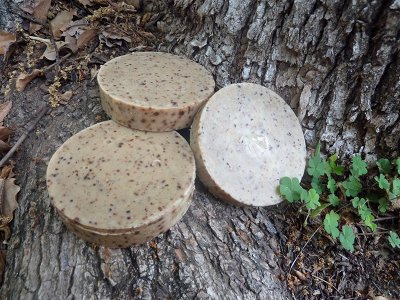
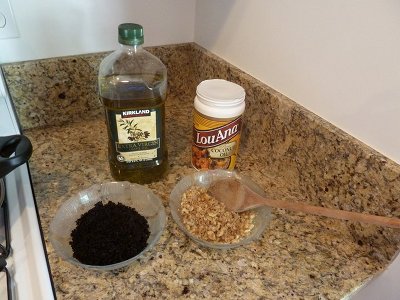
Today we’ll discuss how to make your own manly bar of soap. This bar of soap has a nice light coffee scent along with deodorizing exfoliates to clean your hands when the grease is ground deep into them from working in the garage. For the exfoliates, we’ve chosen coffee grounds and ground walnuts. Here’s why:
Coffee Grounds: Interestingly enough, the inclusion of coffee grounds makes for a powerfully deodorizing soap. Coffee grounds are a perfect ingredient for removing disagreeable scents from your hands after, say, you’ve been cooking with a lot of garlic or fish, working on your car, or fixing the lawnmower.
Walnuts: The walnut is a relatively soft nut and acts as a nice counter exfoliate to the slightly sharper, harder grounds of the coffee. Not only that, but the walnut is a rather ugly nut. It is wrinkled and imperfect–and let’s face it, most of us have similar aesthetic qualities–so it seems a fitting ingredient to include in a man’s soap.
What You Need
Aside from going around collecting your ingredients and equipment, you will need about two hours to make a batch of soap. This includes the preparation, the heating and mixing, pouring the molds, and the clean up. However, this assumes the use of a hand blender. If you whisk the ingredients by hand at the tracing stage, add several more hours to that.
The ingredients you will commonly see in bar soaps include oils and/or fats, sodium hydroxide (lye), a liquid base (which can be water, coffee, beer (if you use beer, make sure it is flat), etc.…), exfoliates (optional), essential oils, herbs, and fragrances (all optional), and so on.
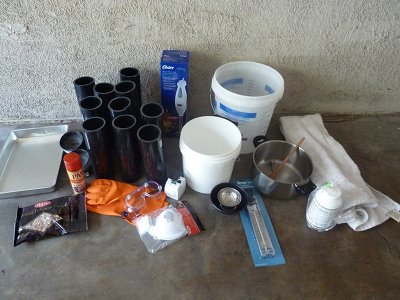
The equipment necessary for making your own soap includes:
- Three containers – (2) plastic buckets (one two-gallon, one five-gallon) and (1) large metal pot, more if you are making a large batch.
- Molds – Can be made from just about anything. We used a baking tin and 3-inch, capped Abs piping.
- Two thermometers
- One accurate scale
- Two wooden spoons
- Hand blender (It is possible to use a whisk, but you’ll be there for hours before your soap traces. Do yourself a favor and get a hand blender)
- Rubber gloves, goggles, face mask, long sleeve shirt and pants
- A big bottle of vinegar, which neutralizes lye. Don’t work with lye without it.
A quick note about cost: Unless you are buying your ingredients in bulk or are accustomed to paying top dollar for artisan soaps, this project is not necessarily a money saver. Most bars of artisan/handmade soap will go for between $5 and $9. These bars ended up setting us back about $2 each once everything was accounted for. That being said, if we were to take advantage of bulk purchases and considering that the equipment cost would be less and less, I can easily see the price coming down to around $.75 a bar.
Pre-Gaming
Preparation is crucial. Before getting down to the actual making of the soap, you need to consider and do several things. First, choose what types of oils/fats you want to use. Common choices include olive oil, coconut oil, palm oil, lard, soybean oil, and butter fat–they all have unique qualities when used for soap. If you aren’t interested in spending much money, just use what you already have at home–it may not be the best artisan soap, but it can work if you have enough.
Next, based on the type and quantity of your oils, calculate how much lye will be needed for the soap. Use the calculator at The Sage, which allows you to input the weight of your oils and gives you a readout for recommended lye quantities, as well as how much liquid base to use.
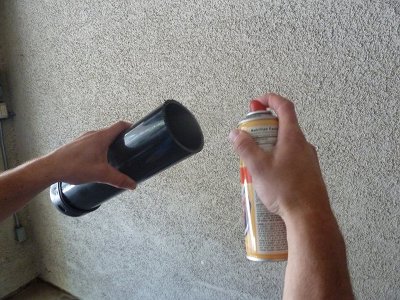
Last, prep your equipment and ingredients. Everything must be clean and completely dry. Again, lye mixed with water can erupt a volcano of unwanted chaos in your kitchen. Be careful with this stuff. Spray Pam (or some similar vegetable oil) into your molds so that your soap doesn’t stick. Chill your liquid base (for these bars we use coffee), and measure out all of your ingredients. When you are measuring out your lye, make sure you have your gloves and goggles on. Once completed, you’re ready to get started.
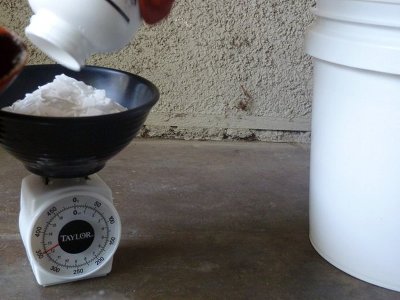
This specific soap batch uses (amounts can certainly be modified):
- 51 oz. of olive oil
- 31.5 oz. of coconut oil
- 28 oz. of chilled, brewed coffee (as the liquid base)
- 11.94 oz. of lye
- 3 tablespoons of ground coffee beans
- 1 cup of ground walnuts
The Process
Step 1: Heat the oils
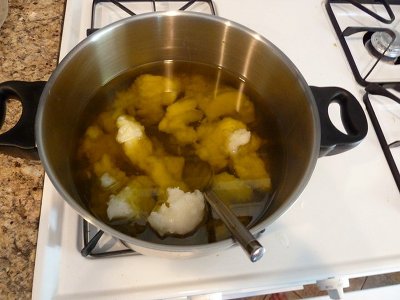
Pour your oils and fats into a metal pot and begin heating them at a low temperature. Though this soap only uses two oils –51 oz. of olive oil and 32 oz. of coconut oil–many artisan soaps will have upwards of five different oils. The choice is yours.
Step 2: Mix liquid base and lye
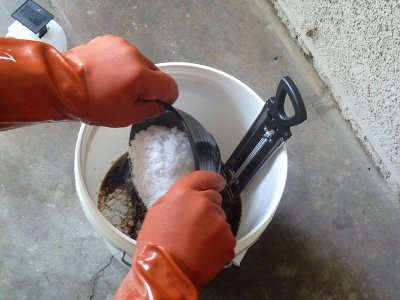
Pour your liquid base (28 oz. of chilled coffee–many suggest to double-brew it for a richer, darker color) into the two-gallon plastic bucket. Slowly, carefully, add your lye to the liquid base (11.61 oz. of lye). Always add lye to the liquid, not the other way around! Stir the lye-liquid mixture slowly until it mixes completely. The temperature will skyrocket at this stage, so let it cool down until it is between 100 and 125 degrees Fahrenheit after it is mixed completely.
Step 3: Mix oils and liquid/lye solution
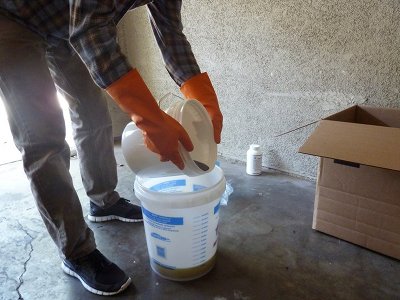
At 110-120 degrees, remove your oils from heat (they should all be completely melted at this point) and pour them into the large plastic bucket. Let the oil cool to 100-110 degrees, and then slowly, carefully, add the lye/liquid mixture to the oils.
Step 4: Tracing and Exfoliates
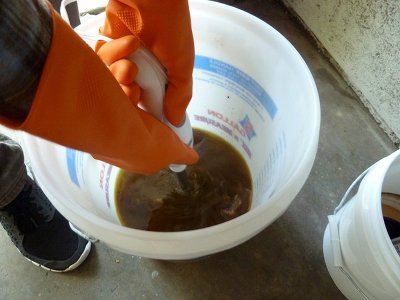
Stir all of the ingredients together and add your exfoliates.- Use a hand blender to mix your ingredients. Make sure the bottom of the blender is at the bottom of the bucket before turning it on and during use. You do not want your ingredients to splatter. Blend at five-minute intervals until your mixture traces. You know it is traced once the soap resembles soft paste/thick custard. It should be able to hold the crease from a spoon or support a drop for a few seconds before filling back in.
Step 5: Pour soap into molds
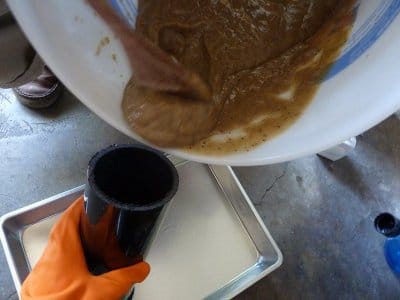
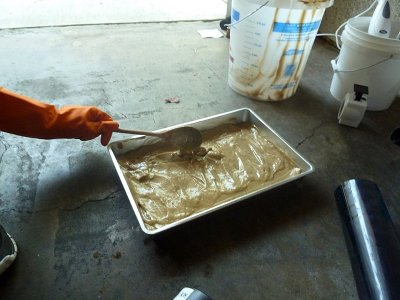
Your molds should be prepped and ready to go. We use a capped-3-inch Abs pipe for one mold and a 2-inch-deep baking tray for the other one. This way we were able to yield both circular and rectangular bars. Place the soap in a dry location and cover it with a towel.
Step 6: Wait and cut
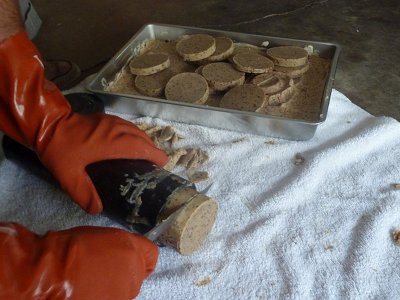
After two days your soap should be solidified enough to remove from the molds and cut into bars. You can do this with a thin, sharp knife. You don’t need to buy anything fancy for this unless it is important to you that your bars are shaped perfectly.
Step 7: Saponification
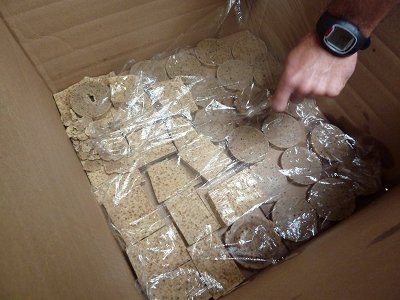
Place your bars of soap on a tray; cover them gently with a large towel. Let them sit for about four weeks so that all of the chemical reactions can occur. Lye mixed with oils creates a process called “saponification,” and once this process is complete, the ingredients in your soap no longer include “lye” itself, but “saponified oils.” Now your soap is set and you’re ready to scrub!

Step 8: Clean Up
The clean up is easy. Use cotton shop towels for the initial clean up to get rid of all the remaining raw soap and any lye/liquid mixtures. Let your equipment and shop towels sit overnight. The lye will mix with the oils and become soap (though still slightly caustic, the lye shouldn’t burn you but it can irritate your skin and eyes), and you can simply wash it all in a sink with A LOT of hot water and soap. Throw the shop towels in the washer after they’ve set overnight.
Final Thoughts
Keep in mind that there are literally dozens of ways to make soap. Different conditions, tools, and an individual’s skill as well as preferences may require a variation on the information and process provided here. That being said, has anyone else made some of their own soap? What suggestions do you have?


{ 63 comments… read them below or add one }
That’s all well and good, but how do you make dynamite?
How many bars did this make?
Years ago I used to make Biodiesel for my truck from used cooking grease. A byproduct of this process is Glycerol, which made some great shop/mechanic soap!
It could be a little harsh/greasy, but with added exfoliates and essential oils, it made for some great bars.
Great post, Orange/clove is a great “man scent”. I made a batch about a year ago Still have about twenty bars!. Let it dry is the key to great soap. You want to make sure you used a proper soap dish to let the bar dry after using, they tend to “melt” quicker than mass produced soap!.
Thermite recipe next?
did you know if you mix equal parts gasoline and frozen orange juice concentrate you can make napalm?
Lye reacts with aluminium, so using a baking tin is not a good idea. I did that a few times and firstly, over time, it reacted with the tin and turned it brown, despite the coating on the pan, and secondly, the brown discolouration penetrated the outer 2-3 mm of the soap (no harm, but looks very bad). Better is to use glass ceramic (Pyrex®) vessels.
If you have trouble getting the soap out of the mould after curing, put the mould into the freezer for a couple of hours and the soap will often drop out, helped with a little nudge with a butter knife. Coating the mould with some oil is also a good idea.
I have never bothered with a thermometer and I don’t like using a blender. I feel that stirring by hand is best. You don’t want the blender to fling the hot lye/oil mixture around the room or onto you.
Little droplets of clear moisture may form on the surface of the bars: this is natural glycerine, which is good for your skin.
I have tried adding grit (leaves, coffee grounds, etc.) to the soap, but I am not a fan of it. When you take a shower, you will have the stuff in the shower and going down the drain. I feel it makes more of a mess than the presumed benefit.
Essential oils are nice, but you have to use a lot, because the heat of soap-making seems to dissipate them quickly. I think a very pleasant, manly scent is the clean smell of home-made soap without any added scent. It is fresh and very appealing.
If you are after scent, you can try making your own cologne, which is a better way of using essential oils and requires almost no effort (a few teaspoons of essential oils of your choice in an equal amount of witch hazel, shake and spray).
Awesome post! I never considered this before but I’m intrigued. I can always count on AoM to find something interesting to bring to my attention.
If you can’t/wont make your own manly soap I would suggest checking out this site: http://www.soapshed.com/store/Manly-Soap-c-281.html
They have some good sounding manly scented soap (I am going to try the musk scented one) and they also have a good selection of shaving soap.
@Henry – About 30
@pcoq – Interesting note about aluminum, I hadn’t heard that before. Thanks.
I actually have a batch of bacon soap in my garage that has been curing for almost 5 weeks now. I plan on hand-milling it to add coffee grounds and oatmeal this weekend. I love this site!
Mama Bear’s has some great manly scents….
http://mamabearssoaps.com/
Nice article. I’ve been buying the Nancy Boy soaps for a while now, but this looks like a neat alternative. I have some spare 8oz canning jars that would probably make good molds.
Question, how much lye does this recipe require? In the ingredients list, you put it at 11.94 oz, while later in the instructions you put it at 11.61 oz.
Where does one purchase lye?
We made it in a Medieval Technology class back in college. I did not actually get to the soap making stage becasue I tried my hand at making homemade lye (tooks several tries to find the right wood and burning temps) but alas none of my lye turned out strong enough to make soap…..just enough to burn skin a little bit. Others in the class went the store bought lye route and made some good smelling soap just based off the oil they used. The best was one a guy made with rendered deer fat.
With regards to stirring you could try a drill-bit paint stirrer. A cordless drill might give you more control over the speed then a hand blender and it would be easier to clean.
Beer soap? For that freshly intoxicated scent :D
Great article and something I am definitely going to try. Just a couple of points to clarify – I take it the temperatures are in Fahrenheit? I’m from Australia where we use celcius so it would be good if you could put that in. Likewise if you could put future measurements in mls as well as oz would be fantastic as well. Are you going to do a future article on shaving soaps? Now THAT would be great!
Oddly convenient that I have started looking into making my own soap and there is a post on AOM.
Great post!
I am now officially your biggest fan!!! The posts are very informative and love the wit! Thanks you guys…I’ll be back often:)
Thanks! I’ve been wanting to make soap for ages, saving my fat scraps to be rendered. I’m intrigued by beer soap. I’m thinking handmade soap would make really great presents… I’ve been hooked for years, there’s nothing like the squeaky clean you get from home made soap.
Google will swap the temps for you from F to C, mate.
It should be noted that this is the cold process for soap making.
There is also a hot process for soap making which introduces heat which speeds the saponfication reaction, such that you go from base oils and lye to usable soap in a few hours.
It should also be pointed out for safety that all measurements in the article are measurements of mass not volume. You’ll need an accurate digital scale.
I’ve been making all of my own soap since last December. Its a great project, it keeps you busy and engaged, and makes you self sufficient in a way few of your peers will be able to match. If you get started you may well find yourself obsessed with the properties of different oils, trying them all and attempting to formulate the perfect soap. Right now I really love my tallow, coconut, olive and sandalwood oil soap with honey added as a humectant, and oats as an exfoliant.
My current project is formulating a good shaving soap. Shaving soaps are so much trickier than regular soaps, as there are so many specific and hard to get properties you must marry and balance.
Oh I forgot, lye can be a bit hard to find as many states have passed laws restricting its sale (its frequently used in the manufacture of methamphetamine). It was once available in every grocery store and hardware store, as a common cleaning product and/or drain clog remover. These days its mostly available online or through dedicated soapmaking specialty stores, sometimes you can find it in craft stores too. Make sure whatever you pick up is 100% sodium hydroxide (unless you’re an advanced soaper who know’s what he’s doing and wants to experiment with potassium hydroxide).
I’ve made a few batches on a very small scale. For the fat I use kitchen waste (mostly bacon grease with some beef and chicken fat) with some olive oil to round it up to a certain amount. I only make enough for 4 or 5 medium sized bars at a time. My wife won’t touch it so there’s plenty of time to whip up and cure a new batch before I run out.
Since I’m using kitchen waste with no exfoliates or scents the only expense is the lye that cost a few dollars at ACE Hardware. My operation is well below $0.75 a bar. And I also use the lye on the bath tub drain when my wife clogs it with hair.
Nice work! Sounds like a hell of a project
Good article but the warnings are VERY important. My uncle lost an eye with caustic soda when he mixed it the wrong way round with water. Putting caustic soda into a damp bucket caused a violent expulsion of the contents. BE CAREFUL.
The way to remember that I was taught in college is alphabetically ie. ‘a to w’ . Alcalli to water. Applies equally with ‘acid to water’.
Steve
That’s all well and good, but where is the recipe for the whiskey soap? Or motor oil and chainsaws?
From a friend:
Years ago I made my own soap. I even gave a bar away to a friend at her birthday party. All the women were fascinated by a guy who could make soap. They’d ask me how I did it, and I told them:
I saved up all the little pieces of leftover soap, and when I had enough I would melt them all in a scavenged coffee tin with some water. As I explained the process, I watched their faces start turning from interest to disgust. The kicker was when I told them it was 99% hair-free!
The one bar I gave away, the recipient kept in her kitchen cupboard, and when her kids misbehaved, she would threaten to make them wash up with it.
Now, that was manly soap! Who would have the guts to use it? Only a real man!
Neat article – I think I’ll stick to fly-fishing for a hobby though ;-)
Where’s the post on how to start a meth lab?!?!
Where’s the post on how to start a meth lab?!?! Lol
Were you using the actual ground nuts or the ground up walnut shells? and by metal pan it looks like you mean stainless steel is that right?
Seems like it could be fun. I think I’ll stick to brewing beer, though.
For those afraid to use lye,you could always make glycerine soap. The ingrediants are widely available and creates a great soap, especially for shaving.
what about homemade shaving soap????
also check out http://www.etsy.com for homemade soaps
i really like this site for home made soaps http://www.etsy.com/shop/HeartJCreations?section_id=5542526
@ Shane Corder May 12, 2011 at 2:58 pm
Sounds like that would be perfect for a morning shower!
@ Theseus May 13, 2011 at 12:20 pm
I’ve thought about this. I assume the process is quite different. I currently use Col. Conk’s, but a coffee shave soap sounds pretty good to me.
@ Rob
Thermite isn’t hard to make; it’s just a matter of getting the materials. Powdered Aluminium isn’t easy to get your hands on.
@ Joe
You wouldn’t want grounds in a shave soap, they’d cause all sorts of problems, and just using coffee as a base liquid doesn’t impart much scent at all. For a coffee shave soap you’d need either coffee essential oil or coffee fragrance oil. Additionally you’d likely want to do some research into base oils to pick the right blend for a shave soap (I’m still dialing my mix in but I use tallow, coconut, olive, and sunflower kernel oils in mine) and also consider adding a cosmetic clay (such as bentonite) to increase razor slip.
An interesting note about Lye and Aluminum: The resulting byproduct is hydrogen, so that reaction is a good way to produce it in a pinch. Exploding balloons and soap bubbles make a great activity for kids who are interested in science!
To make shaving soap, you would use primarily or solely castor oil. Castor oil soap produces a very thick lather.
I buy castor oil (and a lot of other unusual oils) in an East Indian grocery store, but you can also try stores providing raw ingredients for soap-making. Make sure to adjust your lye+water/oil ratios when using different oils. Each oil has a different saponification value. There are many free charts on the web providing saponification values and allowing you to mix oils.
Might be a silly question, but would bacon grease work? I’ve got a fair amount of the stuff in the fridge.
How about if you use cheap canola oil or leftover cooking grease instead of the *much* more expensive coconut and olive oils? Wouldn’t that make old fashioned soap-making more practical for today’s man?
do you know how to make svaving soap
Kool, never made soap, I’ll have to give it a try. Back when I was a very young kid in the Bicentenial days of the late 70′s, my father made soap and all types of candles. Doing anything from the colonial era was considered “in” at the time and he also made his own black power and gun balls for his rifles and pistols which were colonial flintlocks. For anyone who likes guns or wants to try guns flintlocks are lots of fun and don’t come with all the red tape like registration, permits, etc. Blackpowder is mostly unregulated. Pennsylvania/Kentucky rifles are also great for hunting and very accurate.
A few articles on making your own candles and Flintlocks would be cool as my father doesn’t pass on skills or arts to anyone.
My wife has just started a soap making business, I’ve given over one of the rooms in our basement to be a soap making factory. These directions are spot on. DO NOT allow any aluminum to come in contact with the lye. Stainless steel, glass or enamelware are your best bet.
For a shave soap, she uses a length of 3″ PVC pipe. The soaps from this mold are the perfect size (2 1/2″ for my shave soap mug.
She scents the soaps with essential oils, for those of you who like the smell of clove – clove essential oil will ruin soap. Use ground clove instead of essential oil.
We used to use lye to strip anodizing off of aluminum so , yes, it is quite the nasty substance. Be careful with that stuff. And don’t do it in an enclosed area.
An easy way to remember the safety measure is you ALWAYS add a little of the dangerous stuff (lye) to a large amount of safe stuff (coffee). Thanks to my HS chem teacher for that advice!
What a great piece. I will definitely try out the recipe. Funny enough I first heard of beer soap last week so this is going to be a fun project. One thing though, where can I source lye?
anyone have a good recipe to make shaving soap?
Here are more Manly Products.
http://www.cafepress.com/Man_Night
This is great! What girl doesn’t like a manly man with manly soap?
Anyone know of a liposuction clinic giving away bags of the “richest creamiest fat in the world? Fat of the land?”
What are some options for adding a scent
Is there anyway to recombine left over bits of soap into one usable bar?
I love the combo of coffee and walnut. However, did this contribute to the overall scent of the candle? If not, what would you suggest to make it smell like coffee walnut?
whats a smaller recipe for about 3 lbs?
use soapcalc.com to calculate oils and lye.
Use castor oil to increase lather and bubblyness.
I use pig tarrow. It gives a very moisturizing soap because coconut oil will dry your skin. Creates a good shaving soap.
40% Pig Lard
30%coconut oil
20%olive oil
10%castor
Then add scent
How do you get the soap out of the pipe? I couldn’t find Abs pipe so I used PVC, 3′ length. I sprayed the inside with olive oil, but I couldn’t push the soap out – it was too soft. I ended up cutting the pipe off with an oscillating tool, which was really messy and got little pieces of plastic in the soap.
I like the shape though, so I would like to try it again.
Also, you ingredients list and your instructions give different quantities for coconut oil and lye.
Thanks!!
I followed this.recipe to the letter and my soap would not trace. I am leaving it out.over night to see if it does anything. No idea what I did wrong
Somebody forgot the first rule.
I tried the recipe, and it worked just fantastic. Alternately, you can cook the final product down to finished soap and simply let it dry and cure for a few days instead of a few weeks. Check out sites that can give actual instructions on this, but the results were fantastic! Albeit, my soap didn’t smell so awesome. I smell a little like olive oil every time I use it. But that’s life. I can’t wait to try it again soon!
To remember the sequence of which comes first. You always add Acid-or Alkali (which is what lye is)-to Water.“ AW“-I didn’t know that.
If you do it the other way around, adding Water to Acid, get ready to scream:“WA“-that hurts!
Whiskey soap: we did it. It is very awesome. However, don’t use real whiskey or you’ll end up with a gross mess (gross mess: https://www.facebook.com/photo.php?fbid=586415868042691&set=a.586415468042731.152126.577784945572450&type=3&theater).
Successful whiskey soap:
http://www.outlawsoaps.com/lifestyle-soap/hair-of-the-dog/
I’m not trying to spam, i just saw that someone had asked for a whiskey soap earlier and that’s why I tried it in the first place.
In other notes: Yes, bacon grease works great. You absolutely must purify it first by adding 50% water and 50% bacon grease. Boil it for a while (I think I boiled it for about 30 minutes) and then stick it all in the freezer. The fat will float and get kind of like a big fatty puck. The water will keep all the salt and gross bits. Do that one more time just to be sure there aren’t gross bits in the fat.
In soap calculators (just google it, there are tons… there’s even an app), the bacon fat is just lard, so calculate accordingly. Easy peasy. And it makes a really nice frothy lather.
It doesn’t smell like bacon, though. I know this is disappointing. We had to find bacon fragrance, and even that doesn’t smell just like bacon (close enough, imo). And no, it doesn’t taste like bacon. Yes, of course I tried it.
Another memory aid for how to mix acid and water, courtesy of my old chemistry teacher:
“Do what you oughta, add acid to wata” (said with a slight accent to make it rhyme)
and also,
“If you add water to acid, your wrist will be raw and placid”
(doesn’t quite have the same ring, but you get the idea)