


Unless you’ve spent a lot of time in the woods on longer trips, you’re probably unfamiliar with bannock. Bannock is a Gaelic-rooted word that comes from the Latin panecium, which means baked things. Add a thousand years of passing the word from Hadrian’s soldiers to Scottish ones and you see how panecium became bannock.
A bannock is a small, flat loaf of bread risen by a leavening agent, most often a chemical one, although yeasty bannocks are sometimes baked, as in a sourdough recipe. They are meant to be cooked hearth-side, whether a fireplace or a campfire. They are simple, and in the woods, simple is good. Add some honey to some simple bread and after a few days or weeks of bagels and Wasa bread, it tastes like manna from heaven. It’s hot, light, and comforting.
About twenty years ago I shared a workspace with a really cool woman. Frieda ran across an article in an old, dog-eared copy of Outdoor Life regarding dutch ovens and skillet cooking. Freida thought I would like it. She was right.
Until then I had been using a bannock recipe that came from old-style camping legend, Calvin Rutstrum. Frankly, it was a chemical bomb using horrendous amounts of baking powder and no shortening, so it was dry and metallic. If anything contains a tablespoon of baking powder, run the other way unless you like the taste of aluminum.
I took home the recipes from the article and whipped up a few batches of bannock on the stovetop. It was a vast improvement over what I had been using. What’s better is that the basic recipe is also good for pancakes, fish batter, etc. Think Bisquick or Krusteaz without 10,000% of your daily recommended dosage of salt. Sure, you can use those pre-made mixes, but this recipe is so simple, it’s a shame to subject your tastebuds to pre-packaged sodium bombs.
How to Make Bannock Bread
Ingredients
- Bannock Mix
- Water
Basic Bannock Mix
1 cup flour (white or a mixture of white and whole wheat)
1 tsp. baking powder
1/4 tsp. salt
1/4 cup dry milk powder
1 tbsp. shortening
Make the mix at home ahead of time. Sift dry ingredients, and cut shortening in with a pastry cutter or two knives until you have a granular, corn meal-like mixture. Package in zip-lock freezer bags. Double bag it if you’re going to be on a long trip. I’ve found that you can make large batches at once and make enough bannock mix for a trip in about fifteen minutes. Just make sure you sift the dry ingredients well, so you don’t get leavening problems.
Directions
Baking bannock is relatively simple once you get the hang of it. Your first ones will be dark and maybe burnt on the outside and gooey on the inside. Don’t despair, just pretend it’s a jelly donut and try again. The key is a consistent heat. While flames don’t indicate a bad cooking fire, red glowing fires from hardwood are best.
1. Start with a small cast iron frying pan and oil it well.
2. Pour some water into the bag and squoosh it around in the bag (squooshing is a technical term). Because the water and baking powder form carbon dioxide to make the bread light, the faster you go from mixing to skillet, the lighter your bannock will be. There will be lumps, of course, but we call them flavor bursts. I say “some water” because how much you add depends on the humidity and of course, personal taste. You don’t want it any thinner than a muffin consistency. If you’ve never baked a muffin, think spackle. You can distribute the dough with a poke of a finger or a stick or a spoon if you’re the civilized sort. Remember, it’s always easier to add water than take it out, right?
3. Squeeze the mix out of the bag and onto the warmed pan (not scalding hot — if the oil is smoking, it’s way too hot). The pan can be warmed over the fire if you have a grate, or leaned against a few logs near the heat source. It shouldn’t hiss or sizzle like a pancake batter…that means things are too hot. Cool it off and be patient. The bread will start to rise slowly.
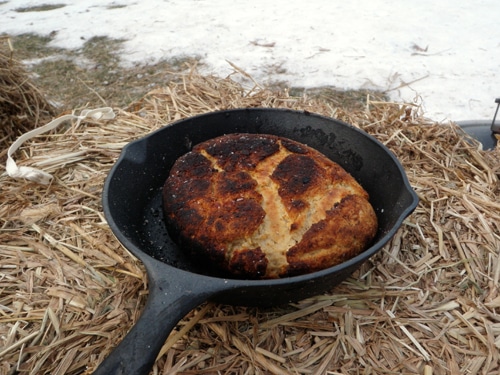
4. Your bannock will start to look loaf-like. At this point you’ll want to flip your loaf. A little shake of the pan and flick of the wrist can turn it over, but a spatula is fair game too. At this point, just keep turning it. You’ll know when it’s done. It’ll look a lot like the picture here.
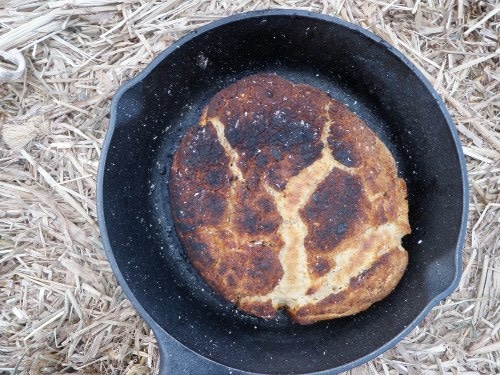
If you have a lid, you can try to cook your bannock dutch oven-style and put coals onto your skillet lid. Otherwise, you can turn it over to cook the top (carefully!) or else when the bottom is done, prop the pan up against a log with the top facing the fire. This is my favorite sort of “semi-reflector-oven” method. I believe it also makes a lighter bannock.
Baking bread in the wilderness is about taking the comforts of home with you and enjoying yourself, not choking down some freeze-dried Hungarian goulash that tastes like wallpaper paste. You can still eat tasty grub while getting in touch with your wild man.
___________________________________________________________________________________

Darren Bush is the owner and Chief Paddling Evangelist of Rutabaga, but he’s also an amateur blacksmith, longbow shooter, and primitive skill aficionado. He believes primitive skills are highly undervalued in modern society.



{ 34 comments… read them below or add one }
Hello! Love the recipe. About the dry milk powder: Is this instant powdered milk, such as what you get from a grocery story, or dry milk powder, such as what you get from an LDS cannery or online?
~~Mrs. Blessed
I’ve heard of people putting the dough on sticks and cooking it over the fire that way. Has anyone tried that; if so, did it work?
@ Emily- I have tried that method, and it turned out awesome for cooking dough on a stick. Watched someone make Bannock bread in hunting camp a few years back, tasted great. Good article.
Good timing! I’m going camping this weekend, and damn if I’m not planning on making some bannock while I’m out.
@ Emily
Sorry I don’t have any tips on how to do it, but I remember having bannock cooked for me on a stick with my scout troop when I was young. I would imagine you just need a thick batter. (and some blue berry Jam, mmm…)
Great article BTW
Some additional add on extras….
1) Bread on a stick = damper, a VERY big Australian bush favorite.
2) You don’t have to be all that fast with the mixing, but you have to be gentle. While some of the gas generation starts to take place immediately, it is typically very little since heat is required for the chemical reaction to truly kick in. But if you use double-acting baking powder then you do get immediate gas action.
3) If you have a true dutch oven with a cast iron lid, then you can also put coals right on to the lid to get heat from both sides at once. You’ll need a hook or something to take the lid off later though.
4) You can throw dried fruit into the mix too for a taste sensation….
Good suggestions! I usually don’t mix in dried fruit for one simple reason: I hate dried fruit in bread. I bet craisins would be good, though.
Mrs. Blessed, the powdered milk can be either, I’ve done both and it seems to work fine, so go with the cheap stuff.
It’s fun to wrap it around a stick. Make sure the stick is not poison ivy.
P.S. Remember Bannockburn? Anyone know why it was called that?
while in the Canadian Rockies backpacking, we made bannock every day. Brought along some squeeze pizza sauce and pepperoni- viola! bannock pizza!
Wow, this brings back memories! Bannock on a stick is the best — nice woodsy taste. Hm, bannock burn? Don’t know.
Bannockburn is named after Bannock Burn, a small stream near the city. It’s a Scottish city, and as referenced in the article, the word comes from the Scots.
http://en.wikipedia.org/wiki/Bannockburn
Great post. I like the fact that any cooking tool will work for bannock – skillet, dutch oven, sauce pan, Coleman stove, green stick or solar oven – bread is on the menu.
Try this link http://goo.gl/djQHn for another easy camp bread recipe. This has worked well for me several times.
The best advice I ever got for camp cooking was “practice in the back yard”. Try it in the kitchen for sure first, then working over charcoal, propane, or wood coals at home in the back yard, before the field trip, is the best way to work out the kinks.
I’ll have to try this some time. How many servings do you think it makes?
First had this in 1995 on an arctic fishing trip to Qikiqtarjuaq, Nunavut, Canada. Tried to recreate it at home, but could not duplicate the old Inuit woman’s recipe. Serve with arctic char and raw seal, for great expedition feast.
I baked chocolate chip cokes with an oven I made out of stone while camping, used soda cans to make a baking sheet. They were good.
During the American War of 1861-’65 some of the Confederate troops made “sloosh” which was mostly corn meal with egg or enough wheat flour to hold it together. They would fry up some bacon and then mix the corn meal mix in the pan & sloosh it around. Then they would wrap the dough around their musket ramrods & bake it over the campfire.
Sounds like another version of Australian damper.
That looks great, can’t wait to try it.
God I love getting back to basics. Cheers boys
Good stuff, thanks Darren.
While not bannock-related (which is quite good done right) i can attest to finding out at age 14 that cooking mac and cheese using nacho cheese (not the supplied cheese, due to someone packing wrong) at 8,000 feet leads to something that can be used for concrete, and/or superglue, and is inedible….. sticking a fork in it and turning a plate over would lead to gravity defying macaroni.
Field cooking leads to some interesting discoveries.
A few days too late you use on the Boy Scout camp I just lead. Maybe next time.
Great recipe. It looks really simple and delicious. I’ll have to try it on my next camping trip. It will go great with my bacon wrapped, cream cheese stuffed jalapenos cooked over a hot grill. The bread should take a little of the edge off.
I’m about to head into the field for a month for some military training. I ought to give this a shot. It’ll be a nice change from rations all the time, haha.
Great article. I hope to try it sometime.
In case anyone is wondering:
If you want to cook your bannock on a stick the best way to keep it from falling off is to roll it out long and skinny like a snake and then wind it around the stick. You squish the ends into the rest of the dough to keep it from unwinding.
This technique requires a thicker type of bannock dough, more like the First Nations (Native American) frybread bannock we make here in Western Canada. I’m sure I could rustle up a recipe if anyone wants one. :)
One tip anytime you’re baking anything with baking powder in the backcountry (or your kitchen), DO NOT USE HOT OR EVEN WARM WATER. Warmer water will speed up the chemical reaction that occurs between the water and baking powder meaning that less of the gas will be available to form air bubbles when you’re baking your goodies. Cold water = fluffier eats.
The comment about running the other way with regards to a tablespoon of baking powder is a bit inaccurate. Baking Powder does not generally contain aluminium and will not have the metallic taste you speak of. Basic baking powder is sodium bicarbonate and cream of tartar. It would have the combined chemical formula:
CHNaO3
KC4H5O6
Both potassium and sodium are commonly found in table salts so may present that kind of taste but certainly not a metallic one despite technically being metals. A table spoon of baking powder is a common addition to the flour component of a victoria sponge and does not taste at all metallic.
If you’re traveling light and don’t feel like carrying something made out of cast iron, you can make do with aluminum foil, a la shepherd’s stew. Just open out a hot bed of coals flanked by the fire on one side and a reflective rock wall on the other (or fire on both sides, if rocks are unavailable). This works better, though, if you have a risen loaf beforehand. You can actually do this with yeast, as yeast is easy to pack if you keep it dry (those little individual packets from the grocery store work great). Just keep in mind that the temperature of the water you use has to be just right, which can be hard to do with a tin pot over a fire, but it is possible. Also, you’ll need an hour or two in camp to let it rise. Do it right, though, and you will have a nice loaf of bread. Wrap in foil, place in coals for 10 min, and voila. The genuine article. Nothing better than fresh homemade bread on a cold night in the mountains!
Interesting version of the recipe. I’ve more often seen more milk powder than a 1/4cup.
Firstly @ Owen. Damper is not made on a stick. Damper is essentially Bannock with out the milk power or shortening and is cooked in the coals of a fire much the same as Bannock is.
The old bushmen of a bygone era would cook it in any number of ways from just putting the dough mix straight into the hot coals and shovelling more on top, or if they had something to save having to break off an inch thick burnt crust from doing it that way, say a Billy can, which is just a large open topped tin can with a length of wire for a handle. Then you would chuck your dough in that after giving it a coating of flour, and sit it in the coals. Putting something over the top to act as a lid would even up the cooking. These days, as well as those of the bygone era that had them, a Camp or dutch oven is the cooking tool of choice.
Secondly, I really want to try this Bannock stuff, it sounds like the lap of luxury after eating so much Damper in my life. :-)
Dough on a stick does work. I’ve tried it. Use biscuit dough, about one biscuit’s worth, wrap it around a sick much like a wide thin snake, and toast it like a marshmallow. They taste great!
Thanks for the recipe, I can’t wait to try it!
@Marked One: Most commercial baking powder does, in fact, contain aluminum. It’s in the higher temperature acid – salts such as sodium aluminum phosphate or sulfate. It’s used as the “hot” action in the double action – when the dough hits the heat.
They do make aluminum-free baking powder, but you have to check the cans.
@Marked one: You said that salt may contain potassium which if true, will kill you by inducing a heart attack. KCL is extremely poisonous and is used to execute by injecting in to the vain.
Aluminum of any kind is also poisonous not to mention it has been linked to on set of alzheimer.
Easy to make. I use all kinds of different additives like raisins, flax seed, sesame seeds, raspberries, strawberries, blue berries, etc. Tried lots of different sugars as two of the kids that live with me have VERY restrictive diet issues. I have cooked it on just about any flat surface or shallow pan, a little corn meal or oats under the loaf adds to the texture.
1. Ray Mears makes bannock and adds brandy or rum to it once cooked. I will try adding bacon to the dough, and pouring whiskey on once cooked.
2. bannock on stick = no cast iron pans