





With this crummy economy, we’re all looking for ways to save money. One way to save a few bucks is doing your own auto maintenance. We’ve already discussed how to change your own oil. Today we’re going to tackle another maintenance job that you can easily do yourself.
If you’re not careful, your car’s tires can become a big money pit. Tires aren’t cheap. A new one can set you back at least $80. If you go through a new set of tires every year, you’re looking at dropping at least $400. Boo.
One simple way you can extend the life of your tires is regularly rotating them on your car. Tire rotation means changing where the individual tire is mounted on the car. Some men don’t ever have their tires rotated, and those that do usually let a quick lube take care of it. But this simple 15 minute job will set them back at least $20 at most places. Save yourself the money by doing it yourself. In today’s post we show you how.
Why Rotate Your Tires?
Front and rear tires wear differently. For example, the front tires carry more than 60% of your car’s weight; consequently, front tires wear down faster than the rear ones. Also, turning wears the front tires at different rates. In America, we generally take left turns faster than we do right turns. This puts more load on the right front tire which results in the right tire wearing faster than your left. After thousands of miles of driving, you end up with uneven tread wear.
Rotating tires equalizes these natural wear patterns by changing the positions of your tires. By rotating your tires regularly, you’ll ensure yourself a smoother and safer ride. And more importantly (for me at least) you’ll save money in the long run by extending the life of your tires.
Oh, and it feels manly to flip tires around, too.
How Often Should You Rotate Tires?
Check your car’s owner’s manual for the recommended tire rotation schedule. Most manufacturers recommend that you rotate your tires every 5,000 miles. An easy way to remember to rotate your tires is to do it whenever you change the oil on your car.
Tools Needed
Car jack. Using the jack that comes with your car can work, but it isn’t recommended for rotating your tires. It’s designed to lift up your car for a short amount of time so you can quickly change a tire. The safer route is to use a hydraulic floor jack. A good floor jack will set you back about $100, but your safety is well well worth the investment. A car jack will come in handy for other maintenance jobs as well.
Jack stands. You’ll need some jack stands so you can rest the car on top of them while you switch the tires out. You can buy a decent set of jack stands for about $30.
If you don’t want to fork over the dough, you can jerry rig a jack stand with a cinderblock and a two by four. Just place the cinderblock under a wheel and place the two by four on top of the cinderblock to prevent scratching the bottom of your car. Lower the car jack so the car rests on the cinderblock and two by four. Wala! Instant jack stands!
Rotation Pattern: Directional or Non-directional Tires?
Before we start loosening those lug nuts, we need to know what pattern we’re going to use to rotate our tires. The way you rotate your tires depends on a few factors, the biggest one being whether your car has directional or non-directional tires.
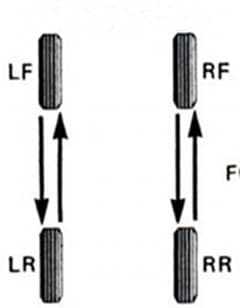
How to Rotate Directional Tires. Directional tires have a “one-way” tread pattern that are optimized for the direction the tires rotate on the car, so they’re specifically made for either the left or right side. The grooves are angled to optimize handling, and they also do a good job of channeling water out from under the tire on wet surfaces, reducing hydroplaning and improving wet traction.
Little arrows or triangles on the sidewall indicate which way the tire is supposed to turn.
To rotate directional tires, just switch the front right tire for the back right tire, and the front left tire for the back left tire, like this:
How to Rotate Non-directional Tires. The tread pattern on non-directional tires is designed in such a way that the tire can be mounted on the wheel for any direction of rotation. So you can switch which side the tires are on when you rotate them.
To rotate non-directional tires, use the cross pattern. For cars with rear-wheel drive, move the front tires to the opposite sides of the rear: left-front to right-rear and right-front to left-rear. The rear tires are moved straight forward. Here’s how it looks visually:
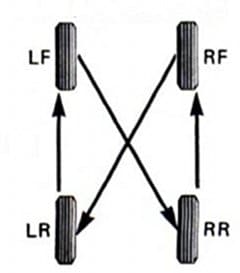
On vehicles with front-wheel drive, just do the opposite. Move the rear tires to the opposite sides of the front and move the front tires straight back.
Rotate the Spare In?
Some old car maintenance guides recommend that drivers rotate their spare tire into use in order to give one of the tires a much needed break. The problem with this advice is that the vast majority of modern spare tires aren’t designed for extended driving. They’re often smaller and feature a lighter-weight construction and shallower tread depth. They’re designed to simply get you to a shop to fix the original tire. That’s it.
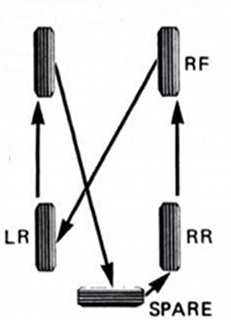
Some cars still come equipped with full-size matching spare tires. Off road vehicles and many SUVs usually have them. If you have a car that has a matching spare tire, it isn’t a bad idea to rotate it into use. Here’s a diagram for the suggested rotation:
How to Rotate Your Tires
Time needed: 20 minutes.
1. Engage parking break. Just for your safety.
2. Loosen the lug nuts on all your wheels. You don’t want to take them completely off yet. Loosening them now will make unscrewing them when the car is elevated much easier.
3. Lift up one wheel with car jack and place jack stand underneath it. If you just have one or two jack stands (or cinder blocks) you’ll need to do a bit of mental work before you start jacking so you know how you’re going to proceed with lowering and raising your car. Because you have fewer stands, you’ll also spend more time lowering and raising your car in order to switch them out. Despite the extra effort, you still won’t spend much more than 20 minutes on the job. I’ve seen some people place their car on all four jack stands. It’s not exactly the safest thing to do, but it will definitely help you get the job done faster because you don’t have to switch out jack stands.
4. Remove the tires and rotate them according to the appropriate pattern for your type of tires. When you place a tire back onto the wheel mount, screw the lug nuts on by hand as much as you can.
5. Lower the car from the jack stands. Take the lug wrench and tighten the nuts even more. It’s best to work the lug nuts diagonally from one to another. It looks like a star pattern. This ensures even tightening. Tightening the lug nuts unevenly can warp the brake rotor.

Star pattern when tightening lug nuts
That’s it! Now just mark down the mileage when you rotated your tires and remember to do it again in another 5,000 miles.


{ 40 comments… read them below or add one }
Can anyone tell me how you would get your car on to 4 jack stands safely?
Ha! I was just saying to my less than manly roommate yesterday (as I taught him to shovel snow) that one thing all men should knwo how to do is rotate their tires. Perfect timing. Dittos from this mountain man.
Nice nostalgic post. Unfortunately it overlooks a couple of very salient points.
(I worked for a tire company a couple of decades ago, so some of my knowledge is a bit dated.)
1. Get the wheel alignment checked and reset. Yes, it’s expensive, but it can save a bunch of tire wear. At the same time, get the tires balanced. And don’t get the old fashioned bubble balance, either. You want a dynamic or spin balance. That will also identify a seriously bent rim or a bad tire (The indication is lots of weight needed to correct an imbalance.).
2. On some front wheel drive vehicles (particularly older ones), the front tires will wear out lots faster than the rear tires. Get a tread wear guage and check the tread depth from time to time.
3. And the #1 method to keeping the tires from wearing out too soon. Get and use an air pressure guage. Proper inflation is a key. My experience has been that the tires last longer and the gas mileage is better when you run at or near (but not over) the maximum cold tire pressure limit. Caveat: Some vehicles require a specific front to rear difference in tire pressure to ensure safe handling. Go with that recommendation.
@Greg-
Why is this is a nostalgic post? This is what I do right now in the modern age. Also your points are definitely good tips but not really salient when it comes to “how to rotate your tires,” which is the subject of this post.
Interestingly, in Britain we are recommended never to rotate tyres. It makes them wear out more quickly because any unevenness that has developed to suit the tyre in one position, rapidly wears off when you move the tyre to a different position.
Presumably manufacturers that have the same car in Britain and the US make different recommendations in the owner’s manuals. I wonder which one is right.
Right on. I always rotate my own tires and it’s a good skill to have.
“because any unevenness that has developed to suit the tyre in one position, rapidly wears off when you move the tyre to a different position.”
That’s actually the whole idea-the tires wear on certain parts in one position so that when you change them, the worn down parts get a break, while the fresh parts take their turn.
Something that I think should be brought up is that not only is it good to know how to rotate your own tires, you should only rotate them if you can do it yourself. It does lengthen the life of the tires, but if you have to pay $20 every 5,000 miles, then you negate the savings. So man up and be self-sufficient!
The car talk guys back me up!
http://cars.cartalk.com/content/advice/rotatingtires.html
(They also say that you don’t need to get your tires balanced unless you feel a shimmy or shake).
To Drew Garrison: The easiest way to get a car up on four jack stands is to jack up the front of the car and support it on two stands. Then repeat with the rear end of the car.
As for the article: it’s pretty good. But one thing that should be mentioned is that some cars have different backspacing on the front and rear wheels. Which means the wheels can’t be swapped front to back (or vice versa).
It’s not ‘wala’, it’s ‘voila!’
The word is a loan word from the French.
Nice, practical article. This would definitely save some money if you can keep your tires from wearing down prematurely.
@Kaylie, Thanks for pointing that out.
They say…
“In America, we generally take left turns faster than we do right turns. This puts more load on the right front tire which results in the right tire wearing faster than your left.“
Okay, so my right front tire wears the most. I get that. But when you choose to rotate your full size spare into the mix, then why wouldn’t you put the spare in and pull the right front tire out? Maybe there is a reason. I don’t know. Do you?
I can’t believe you suggest using cinder blocks to support a car. Jack stands are really cheap, really simple to use, and don’t have the unsavory attribute of crumbling.
Here’s my advice: Never put your self under a car unless it’s supported by jack stands. Many experts and shadetree mechanics will echo this statement.
Some of you are no doubt thinking that you don’t have to get under a car to rotate tires. This is true, but trying to lift a car that has fallen with no tires is not fun. There’s no good way to get the jack under and you end up needing two jacks, or one and a set of stands. So here’s my next bit of advice:
Don’t use cinder blocks to support a raised vehicle unless you also have a set of jack stands handy.
If your vehicle has AWD or full time 4WD, manufacturers do not recommend rotating in the spare, or mixing different types of tires. New and old tires have different diameters due to wear, and even tires from different manufacturers can vary slightly from what they say.
This difference in diameter causes the AWD components to rotate at different speeds and therefor wear and create heat. Over time this will destroy your AWD system, which will cost way more than a new set of tires (unfortunately, this means if you ruin one tire you really should buy 4 new tires, or get one ‘shaved’).
There are several very important items the author left out of this article. Please make sure you are prepared to do this job properly or you risk being seriously injured or killed. If you are unsure, please let a pro do it. $20 is nothing compared to a serious injury.
1) As already mentioned in another comment, do NOT use cinderblocks to support your car. Cinderblocks are not designed to hold that much weight, are formed by pouring concrete into a mold and will easily crush. Try dropping one from 5 or 6 feet up onto a hard surface and see for yourself.
2) NEVER get under a car that isn’t properly supported by jackstands. DO NOT get under your car if it is only supported by a jack. Even a good, heavy duty floor jack is not enough to ensure a kid won’t turn the handle and lower it while you are under the car.
3) Know where the jack points are on your vehicle by looking in the owners manual or online. You can easily jack your car up (literally) by not placing the jack in the right place.
4) Make SURE you tighten the lug nuts properly when you put the tires back on. I’ve seen numerous instances of lug nuts not being tightened properly resulting in a tire COMING OFF THE VEHICLE while it is in motion down the road. Most manuals list 75-80 ft. lbs. of force for proper lug nut tightening. It can be difficult to get this right without a torque wrench as it is possible to over-tighten lug nuts. Over tightening can lead to breaking lugs or as some people believe warping brake rotors. If you don’t know how to get the proper tension on the lug nuts, don’t do this yourself.
5) Invest in a good lug wrench. Cars are notorious for coming with a completely ineffective lug wrench that at best will be difficult to use and at worst can lead to injury as you try to loosen the lug nuts. A proper wrench which can be had at any auto parts store will greatly reduce your frustration with lug nuts that have been on for a while.
As a general opinion, I have to disagree with the author and say that tire rotation in most cases is better left to professionals. Lifting a two ton vehicle and removing/replacing the only thing keeping it off the ground is not for the faint hearted, and doing this job wrong can get you a trip to the emergency room in a hurry. Even one injury isn’t worth the money saved from a lifetime of doing this yourself. As a side note, I’ve never paid for a tire rotation and I’ve always done it myself, but I’m also an experienced mechanic and understand the risk and how to do the job properly. Please be careful if you try this for the first time, and plan for the job taking no less than 30 minutes. Hurrying this job is a very good way to get hurt.
I will echo the sentiments about cinder blocks. Supporting a car on cinder blocks is a good way to become dead. Don’t.
If you *have* to use an ersatz jack stand instead of The Real McCoy, use nothing less than a log of 12″ in diameter that has been end-sawn perfectly flat and parallel. Preferably from a dense species of hardwood. Or if time was no object, you could employ blocking and cribbing with 2X4s. A properly constructed crib made out of 2X4s will support 20,000 pounds. Blocking and cribbing is a manly skill that more should know about. It built the pyramids in Egypt, and it will rescue you should you ever be trapped in a building collapse.
Then again, just go to Wal-Mart and spend the $20. And when you do go to lift the car, make sure you do so on flat, level ground, preferably on pavement. Trying to do this on soft earth might result in the jack and stands sinking into the ground. Not good.
Wheel lugs should be torqued down properly as someone else said. The correct tool to use is a torque wrench, and in fact, that’s what the line drawing in the article depicts. $20 will buy an inexpensive torque wrench with adequate accuracy to deal with wheel lugs. Don’t use “torque sticks” and an impact gun, they’re woefully inaccurate.
It needs to be said that a wheel and tire assembly can be quite heavy by itself. If you have a truck, the weight can easily exceed 75 pounds. Even the wheels off of a typical midsize car can be surprisingly heavy. Don’t try performing your own tire rotation unless you are healthy enough to lift at least 100 pounds at least several times without straining. Wheels should always be laid down flat when they’re not installed on a vehicle, otherwise they can and *will* roll down the driveway at the precise moment a semi is rumbling by.
In Re: cinder blocks- I’m not suggesting people place their entire car on cinderblocks or even getting under a car that is supported by cinderblocks.
I’ve always used a cinder block to support the part of the car that doesn’t have a wheel while I’m switching out tires. I’ve never had a problem with it. That’s the way my dad, uncle, and grandpa have done it, too and they haven’t been killed or maimed by a falling car after a cinderblock has collapsed. Because it’s never collapsed.
Brian B has some very good points.
Personally, I’m rather new to DIY mechanic-ing, so most of what I know comes from 1) reading manuals, 2) my father-in-law, and 3) my grandfather (who has worked on cars his entire life). However, even with that, there were a few things that bothered me here. Brian B has already pointed out some of them, but one that I was concerned about was the suggestion that some people put the car on all 4 jackstands. While it is noted in the article that this isn’t the “safest” way to do it (but it can speed things up), it seems to me a bit irresponsible to even suggest it. Then again, cinderblocks are a bad idea, too.
I have not yet gotten around to actually doing my own tire rotation (the shop I usually buy tires from will do it for free if you bought the tires there), but my thought on the safest way to do this would be to get out the spare, and use it in place of one of the tires until the proper tire is available to be put back on. My understanding is that it’s probably not a good idea to introduce the spare into the rotation pattern (as noted, definately if you don’t have a full-sized spare).
As far as tightening the lug nuts, a torque wrench is pretty much essential. They’re not terribly expensive; a wrench that goes up to 100ft/lbs will probably run you around $50-$60, IIRC, and that will likely be all you need for most backyard mechanic jobs. As such, it really pays for itself; you can do about as much damage (maybe more) by over-torquing as you can by under-torquing (had to replace a brand-new radiator recently because I over-torqued the cooling fan mounting bolts and broke the plastic on the radiator that held the nuts).
Oh, and, again to echo Brian B, never hurry a job, especially one you’ve never done before. Take your time and make sure everything is done correctly. Maybe it *should* only take 20 minutes to rotate your tires, but expect it to take much longer. I’ve had things that *should* have only taken an hour or so take three evenings, partly due to my inexperience, and partly due to unexpected things happening (for example, a bolt that doesn’t seem to be frozen suddenly breaks off).
A key point that I haven’t seen mentioned: get wheel chocks so your car will not roll on you while you are jacking it up.
Wheel chocks essentially sit behind the wheels of whatever end of the car you aren’t jacking up (so jacking up the front, but the chocks behind the rear wheels). The last thing you need is the car rocking/rolling while up on a jack stand. The stand will tip, the car will roll, and you can be injured.
Am I on the right site? I thought this was the Art of Manliness but we’ve got a lady holding court on proper French words and a bunch of men going on and on about the so-called dangers of rotating one’s tires. Rotating tires is a pretty simple job-if you can change your oil, you can do it. I just taught my 14 year old son how to do it a few weeks ago and he was up for the task. I’ve used cinder blocks for more than 20 years and never had even a minor incident while using them. Can anyone point me to a documented story where the cinder blocks collapsed and hurt or killed someone? I tried googling the topic and got zero results. This is a good example of “common knowledge” that gets repeated over and over again but lacks any kind of basis.
Now of course mechanics are going to tell you that you should really leave stuff like this to the professionals…they want your business! I would tell people to pay no attention to the doom and gloomers above-any man would with some sense and a little strength can rotate their own tires!
I agree with Charles. It’s not rocket science, just use proper tools and precautions and keep in mind you’re dealing with a 3500lb machine.
Brett,
Thanks for the good article and thought provoking commentary. As usual, it gives us the most salient points, and provides a jumping-off place for a discussion based on our knowledge and experience. And, as usual, I’m starting from my own knowledge for my comments.
Here in the West we have a tire company, Les Schwab, who will do tire rotations for free. They’ll sometimes even do this if you don’t have their brand of tires on your vehicle. They rightly believe that this kind of customer service goes a long way toward creating and retaining loyal customers.
This move has caused many other vendors to provide the same service. It isn’t universal, but there’s no need to pay a professional to rotate your tires if you hunt around out here. It certainly is one of the things that has made me a loyal fan of Les Schwab!
On the other hand, I sometimes do my own rotations. It is as easy and simple as you describe, and quite safe with the right tools. I’m whole-heartedly with the commenter above to ditch the cinder blocks! I nearly destroyed a $20,000 camper because I was too cheap and too much in a hurry to use the proper tool for the job. The cinder blocks on one side crushed and broke while I was raising the camper to load. The only reason it didn’t was because I put my weight on the opposite side. Dangerous(!) but it worked that time. My wife grabbed some dunnage and propped the heavy bugger up, While I held firmly to a support jack. Whew!
Disaster averted–but I placed both of us in unnecessary danger and the possibly of a trip ruined by the expense of repairing the camper. Jack stands are cheap and easily obtainable. Tires will wait a week or two until you have them, and it’s a secure feeling, knowing that the vehicle probably won’t fall and crush you.
I noticed that you have a picture of a torque wrench in the article, although you didn’t mention it. Torque wrenches are cool, manly tools that are easily acquired and cheaper than a visit to the machine shop. Over- or under-torquing a nut or a bolt can lead to
Digging through my owner’s manuals, I see that every one of our vehicles has a torque specification for the tires. I believe that part of doing the job right is using the wrench to get the lug nuts to specified torque, then rechecking them at the interval from the book. I think the design engineer probably knew what he was doing when he came up with those numbers.
Torque wrenches are relatively inexpensive and often on sale at auto parts stores. In my experience, investing in a set could save time and money in the long run over guessing how far to tighten that bolt. Your picture shows the beam type of wrench, which I’ve used in my youth. I now prefer the click type, because I can see and feel the alert to stop.
There’s my two cents worth, and I hope you all enjoy the season-whatever holiday you celebrate. Who knows, maybe someone will gift you with tools?
Another good article on DIY manliness lifestyle, but after reading the whole comments thread I feel like somebody should point out that while there is something to be said for self-sufficiency, choosing to pay a professional in no way makes you less of a man.
A few people have implied that if you can’t or don’t do your own auto maintenance you aren’t “manning up” and are somehow giving in to the auto mechanic industry who want you to pay them exorbitant sums of money for something you can do yourself.
That’s not exactly true. I think a $25 quick lube every 5,000 miles is a pretty reasonable maintenance cost when compared with the cost of of the car itself. Considering they do the tires in addition to the oil change for that price you could do some simple math weighing the cost of your time and the equipment you’d need to buy and come out ahead pretty easily on the whole monthly auto-maintenance question.
Specialization of labor exists for a reason. Unlike you, the auto mechanic already owns the facilities and skills and is compelled by the market to offer his services at a price people will be willing to pay. It’s a 20 minute job for the mechanic, for you it will probably take an hour. Not that there isn’t value in doing it yourself and cultivating that self-sufficiency. I intend to learn one day, perhaps when I have a driveway of my own to work in. But as a city dweller without the tools or space, well for me the equation is simple.
When I was younger, we always visited the local tire shop (locally owned by an old school mechanic) and since we got all of our tires there, he would rotate tires or even fix a flat for free.
There is something to be said for making friends with your local craftsmen and artisans!
@Brett:
Cinder blocks are porous. If they are left outside in the wintertime, the trapped moisture inside will freeze, which can compromise their structural integrity. They are also subject to abuse. Being dropped on the ground compromises their structural integrity.
If you have a cinder block that is purchased new, has been kept indoors the entire time you’ve had it, and has never been dropped, kicked up against a wall, or used to support a piece of lumber while pounding a nail into it, then yes, your cinder block is probably as safe as a $20 pair of jackstands. If you don’t know all of these things for certain, then you are taking on a level of risk by using one instead of what the proper tool is for the job.
I understand you are not advocating getting under the car while supported on cinder blocks. I have wrassled many a heavy wheel on and off of vehicles in the 20+ years I’ve been working on cars, and I know from experience that people are sometimes prone to leaving an arm, a foot, or even just a digit underneath a wheel hub while struggling to put a heavy tire/wheel assembly on. When the car is not supported by its wheels, being within a couple of feet of it carries the same sort of inherent risks that being underneath does, just to a lesser degree.
Now granddad might have gotten away with using an old cinder block from out in the yard every year when he rotated his tires. He might have smoked 4 packs a day and lived to age 90 too. Risks do not imply a disaster at every occurrence. They imply a likelihood of something bad happening. Considering the low cost of using the right tools in the place of a cinder block, relying upon one for your personal safety implies an unacceptable level of risk. Whether something bad happens or not.
Young men become old men by not taking on unacceptable risks. Bank on it.
@Carl Trimble
Adding the full size 5th tire into the mix extends the life of your tires. Think about it this way – each time you rotate your tires, say 5000 miles between rotations, one of them sits out. with 5 tires in four locations, that means when you’ve driven your car 25,000 miles, each tire only has 20,000 miles on it. If you just swapped the spare and the front right tire, those two would wear out unevenly, as would the other three, and this wouldn’t provide any advantage to rotating them.
@Geoff – Excellently stated
@Craig – Carl wasn’t saying you would just swap the spare with the front-right. He was asking why the diagram has the front-left tire go out of service for that rotation, instead of having the front-right go out of service. Why not let tire that was most worn in the last rotation, sit out as the spare in your next rotation? I wondered the same thing.
Good tip. Another easy thing you can do yourself to save big bucks is change your own rotors and brake pads. I just started a series of posts on how to do it! http://homeowned.blogspot.com/2009/12/no-skid-ro-tor-part-1.html
If you Google search “cinderblock break tire rotation” this is the first article that pops up! Ha. I think it’s a matter of comfort: if you feel comfortable using a cinder block because you learned it that way and have no problem with it, great, if you’re new to working on cars or whatever spend the $20 for the car stand.
@ Brett–
I’ll admit to being inclined to go overboard on checking tire condition, etc., when rotating tires. Coming from a background that has one also pulling the brake drums to check the shoes during a tire rotation has sort of stuck with me. I’ll even admit that the 5 tire rotation diagram probably put me in a ‘nostaglic’ frame of mind. My apologies for exceeding the subject matter of the post.
A cinderblock is fine under a solid truck axle, but if you have a smaller unibody car there’s not much room to safely put it. There’s usually one small jack point surrounded by a bunch of sheet metal that was not designed to have a quarter of your car’s weight on it. I’ve always just used the spare with three lug nuts as a jack stand. This also forces me to check the condition of the spare regularly.
Two further points for anybody wanting to try this:
Firstly, most garages or tyre centres will use a pneumatic tool to tighten and loosen a wheel’s lug nuts. Undoing this with a wrench will require a lot of effort and applying a steady or constantly increasing force to the tyre iron runs the risk of bending or even snapping the tool. Instead, use very short, sharp pushes to loosen each lug fractionally until it can be turned more easily.
Secondly, and this applies to all kinds of nuts, loosen each lug only half or one full turn of the wrench at a time, skip the next nut and continue with the one after. The aim is to only undo each second nut by the same amount until all have been loosened to the same point. As wheels have five lugs, you will get around to all of them easily. Having the whole weight of the tyre resting on progressively fewer tightened nuts makes each, in turn, harder to loosen. Repeat this pattern when tightening the lugs up once the wheel is swapped.
The only thing I will point out is some tire manufactures will void the warranty. Where we get our tires the will rotate and balance them for free to keep the warranty valid. Just check before you start so you don’t mess it up. Other than that the premise for the how to part is spot on. This isn’t a step by step guide just a general overview.
@Nik
Thanks Nik! Still wondering this. I have been thinking about it quite a bit.
I can say that the little emergency jack that comes with most cars isn’t good for much more than that – emergencies. I used one to rotate my tires a year or two ago and it was an immense pain in the ass. If you don’t have a real jack you should just save yourself the aggravation.
This is a great tutorial!
I love these tutorials on car maintenance. Hope to see another one soon. =)
If you have manly chrome or other well dressed wheels, cleaning them is easier while rotating your tires. Lay the tire down on top of two saw horses and clean off all the foreign road [and off road] matter.
Since the wheels are already off, this is a good time to inspect other mechanical parts:
1) visually inspect the rubber covers on CV or universal joints. Broken covers let abrasive materials in which will degrade bearings.
2) Look at your shocks. Although not a normal occurrence, broken shock housings, leaking shocks, or bent shocks can cause tires to wear out quickly.
3) For more involved maintenance, buy a micrometer or calipers and measure your pads and rotors on the brakes. Measure at the thinnest section of pad or rotor.
4) Inspect wheel housings and/or mud flaps. Much easier to see when that big round thing is not in the way.
I know how good it feels to turn your own wrench, and manhandle a tire, but here’s a brain tops brawn idea:
Most local tire dealers offer free rotation, for the life of your tires, when you buy a set from them. You can roll your car to the shop every 5K miles, get it done by a licensed technician. Easy, fast, and you get to pick up cool tips from seasoned mechanics.
Manly.
Let’s change the subject a little. Please read the following and comment.
Recently I purchased new wheels for my 2004 Expedition and the local company that put my existing tires on the new wheels placed them on the opposite side of the vehicle than where they had been located, left side on right side and vise versa. These tires are directional Yokohama parada’s 20″ 305 50. The proper direction was maintained so when I picked up the vehicle the dirty side of the tires were now facing outward and the clean side facing inward. I have never seen it done like this before. Shortly after this work I noticed a very prominent vibration starting around 40 MPH thru 85 MPH in 5 MPH increments seemingly from one or maybe both front tires in the steering wheel movement. I had them re-balance all four tires twice over a two week period but not rotate and the vibration would seem to be lessened for a time then after a short while return. Thinking that I may have an alignment issue I took the vehicle to another shop where they performed the alignment and found only the right rear to have a slight toe in and was corrected. This had no effect on the vibration. This company then noticed that the front right tire had a slipped belt evident by a raised area on the inner tread that was approximately 3″ wide and 12″ circumferential. This tire was replaced and most of the vibration disappeared for a time then gradually it started getting worse again. I then took the vehicle back to the alignment shop and had the front wheel bearings inspected and they were just fine. The alignment shop then rebalanced both front tires, 1 old left side and 1 new right side tires. This minimized the vibration to almost being gone but it was still present. I then replaced all of the remaining old tires and the vibration disappeared but there was no visual problems with any of these three remaining tires like the first one that was replaced earlier. It’s now finally driving perfectly again. My question posed is will switching left side tires from those wheels to the right side wheels, maintaining rotational direction, and vise versa right to left side create new acute stresses on the tire belts and cause belt separation creating a vibration problem? Thank you for your help.
cinder blocks are fine if used correctly. cinder block are designed to distribute force vertically down through the walls of the block. the weakest part of a block is the side walls (flat sides) and a car can break a cinder block if it’s resting on the flat side of a block. if you use a cinder block to support a vehicle, make sure the vehicle is resting on a wall of the block that runs vertical all the way to the ground (same as when using a block in home construction) — again, don’t rest a car on the “flat” side of a cinder block as this is the weakest point….this is where martial arts experts attack a block to break it
I’ll echo the advice to AVOID concrete blocks as jack stands!!! This is dangerous. First, concrete blocks are designed to take “uniformy distributed loads” when flat…that is, when the cell holes are oriented up and down. If you use the block in a vertical orientation you will be applying “point loads” onto a portion of the block that was NEVER DESIGNED to take these loads (depending on the vehicle, you can impose a load of over a ton on each block)…onto a thin little 1 1/2″ segment. Additionally if the blocks have been sitting around outside, moisture and other factors can seriously degrade the strength. Don’t take a chance that your leg or torso gets trapped under a vehicle! This is not manly.
Rotating the tires in a cross pattern makes no sense unless the tires wear unevenly. Just switch the front and rear tires on each side, and stop obsessing about tires wearing more because we make more left or right turns. Unless you are talking about Nascar tires. Absolutely use certified jack stands and only when the car is on a perfectly plane surface with hand brake on.