




How To Sharpen a Pocket Knife

by Brett & Kate McKay on March 5, 2009 · 52 comments

in Manly Skills, Outdoors, Toolmanship

sharpenknife

About a year ago, we wrote an article on why every man should carry a pocket knife. A lot of you out there agreed that the pocket knife deserves a permanent place in every man’s pocket. After we wrote the post, we started getting emails from men who were first time pocket knife owners asking how to sharpen their new prized possession. Well today we’re going to answer that question.

Important Caveats

Before we start, I want to make clear that there are dozens of different ways to sharpen a knife. Everyone has a way they think is best, and men have all sorts  of techniques and tools that they feel are essential in getting a sharp blade. In the end, much of it comes down to personal preference. I’m going to show you the way I learned how to sharpen a pocket knife. It’s very basic, good for beginners, and best of all, it works. If you have an alternative method that you prefer, great. Share it with us in the comments. I’d love to hear your tips.

Also, there are different ways to sharpen a blade depending on what you’ll be using your knife for- whittling, cooking, etc.  So unless you plan on cooking world class meals with your pocket knife, you don’t need to sharpen it the same way you would an expensive chef knife.

Tools Needed

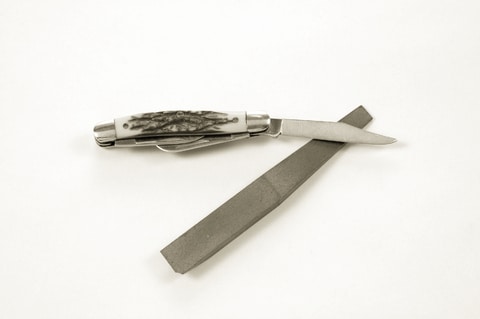
To sharpen a pocket knife you don’t need much. Just two things: a sharpening stone and a lubricant.

Sharpening stone/whetstones. Just as there are dozens of different ways to sharpen a knife, there are dozens of different sharpening stones. There are Japanese water stones, stones with diamond encrusted surfaces, and stones with different grades of grit. Again, choosing a stone is a matter of function and preference. Play around with different kinds of stones to find the one that gives you the results you’re looking for.

If you’re sharpening high quality knives, you probably don’t want to use a cheapo sharpening stone. But if you’re just getting started with sharpening your pocket knife, there’s no need to get too fancy right off the bat. You can find a sharpening stone at most hardware stores for about $10. This one is very similar to the one I use. Nothing fancy. Most basic sharpening stones come with two sides: a rough grit and a fine grit. The finer the grit, the finer or sharper you can get your blade. You usually start off sharpening on the rough grit and then finish sharpening it on the finer grit.

Lubricant. Most knife sharpening experts recommend you use some sort of lubricant when sharpening your knife. The lubricant can come in a variety of forms, from water to oil. Most of the literature out there recommends mineral oil to be used for knife sharpening. The lubricant reduces heat from the friction that is created from sharpening your knife. Too much heat can actually warp your blade. Lubrication also helps clear out the debris, or swarf, that is created as you grind your knife blade on the stone. You can pick this up at most hardware stores for about $5. I used Norton Sharpening Stone Oil in the video.

I should note, however, that lubricant isn’t necessary with most basic stones. So if you’re out in the field and need to sharpen your knife, don’t stop yourself just because you don’t have some mineral oil handy.

How to Sharpen a Pocket Knife

You’re in luck. You get to see my ugly mug. I’ve made a video demonstrating how to sharpen a knife for all you visual learners out there. If you don’t want to watch the video, I’ve provided written instructions after the video.

1. Start off with the rough grit. If you have a particularly dull blade, start off with the rough grit side of your sharpening stone. How do you tell which side is the rough grit? Sometimes you can tell by sight. If you can’t do that, do a thumbnail test. Scratch the surface with your thumbnail and whichever side feels rougher, that’s the side you want to start off with. Also, rough grits tend to be more porous than finer grits. So if you put water on one side and the stone really drinks it up, chances are it’s the rough grit.

2. Prep the stone. If you’re using a lubricant, get it out. Pour an ample amount of mineral oil all over the surface of the stone. You don’t need to drench it, but don’t be stingy either.

3. Place the knife blade flat on the stone and raise it to a 10 to 15 degree angle. The key to knife sharpening is maintaining a constant angle. Different knives require different sharpening angles. For a pocket knife, shoot for a 10 to 15 degree angle. This will give you an edge that’s sharp enough for most daily needs, but not sharp enough to perform heart surgery.  Keeping a constant angle by hand takes a lot of practice. If you’re having difficulty, you might consider investing in a sharpening guide. It takes all the guess work out of maintaining the needed angle. They cost about $10.

4. Start sharpening the first side of the blade. With your blade set at the prefect angle, you’re ready to start sharpening. Imagine you’re carving off a slim piece of the stone’s surface. Personally, I bring the blade into the stone. Other people stroke the blade away from the stone. Both ways work, so just use whatever technique you prefer. If the knife blade is curved or if it’s longer than the stone, you’ll need to sweep the blade sideways as you work, so the entire edge is sharpened evenly. Apply moderate pressure as you sharpen. No need to bear down hard on the blade. After you make one stroke, start back at the beginning and repeat. Do this about 6-12 times.

5. Sharpen the other side of the blade. Flip the blade and do the same thing on the other side.

6. Take alternating strokes. After you’ve sharpened each side, make several alternating strokes- sharpening one side and then sharpening the other successively.

7. Flip the stone over on the fine grit and repeat above process.

8. That’s it… for a basic sharpening.

If you’re looking for advanced techniques, check out Knife Sharpening by Steve Bottorff. It’s a very thorough website that provides detailed guides on advanced knife sharpening techniques.

Alright, I know you all have your own personal tricks on getting a nice sharp blade. Share them with us in the comments.

Help support Art of Manliness by sharing it with others.

Update: Many readers recommend the Spyderco Sharpmaker for all your knife sharpening needs. Check it out.

{ 52 comments… read them below or add one }

1 Brett C. March 5, 2009 at 6:47 pm

ouch…this article seems like a bad joke to me. two days ago while cleaning off a foot of snow from my car i lost my 10 year old Swiss Army Knife i got when i was 13. still cant find it. now that i’m in the search of a new one any recommendations?

2 Brett McKay March 5, 2009 at 6:51 pm

@ Brett C. Sorry to hear about your loss. I’m a fan of Case Pocket knives. High quality and made in the good ol’ U.S. of A.

3 Chris Wilcox March 5, 2009 at 7:01 pm

I’ve happily owned (and used practically daily) a “Benchmade” folding knife for over a year now and it’s almost as sharp as it was when I received it.

4 David March 5, 2009 at 7:09 pm

The article gives a great way to sharpen but sometimes freehand can be really tough and inconsistent. This means you need a guide or some kind of system and I would recommend the Spyderco Sharpmaker to all you gents. It’s a little pricey but the results speak for themselves.

5 mac March 5, 2009 at 7:24 pm

Spyderco Sharpmaker is an ideal way to get into sharpening. Sharpen your pocketknives and kitchen knives!

After that, I’d go with diamond stones. They’re synthetic, relatively cheap, and last a very long while. The ones I use are a set of 3 different grits I got at Harbor Freight for less than $25. Beyond that, I’d use a fine to very fine grit stone. This will help remove the wire edge that the rougher stones just bend back and forth.

If you want a blade that needs fairly minimal care, buy a decent ($50+) Spyderco/Benchmade/Kershaw. in general, cheap steel doesn’t hold an edge well and is difficult to sharpen.

6 RagPicker March 5, 2009 at 10:17 pm

I use a modified 1″ belt sander with 5 different belts plus a set of cardboard sharpening wheels.

Run the knife edge along your skin without touching your skin and it will “pop” off hairs, yet it’s a sturdy edge.

The Spyderco Sharpmaker is a great choice too. Some may be happy with the Lansky system too. Watch out for cheap knock-offs though.

Brett C, get a good case. It’s a thing of joy.

7 Desi Quintans March 6, 2009 at 3:28 am

@ BrettC: I highly recommend Columbia River Knife And Tool’s K.I.S.S. skeleton folding knives. They don’t have handle scales, which makes them incredibly thin. The only parts of the knife are the frame with pocket clip, the blade, and the pin that connects the blade to the frame. The blade is chisel-ground (ground on only one side) and when the blade is folded it is uncovered (no handle scales), but the blade and frame fit together so snugly that you simply cannot get cut.

http://www.crkt.com/kiss.html

Regarding knife sharpening, if anyone ever has the opportunity, buy a knife with a chisel grind. Only one side of the blade is angled (the other is left flat), which simplifies sharpening since you simply lay the top of the blade flat on a stone and rub gently. I also have this strange multi-sided tool for sharpening secateurs which comes with a hard steel edge and a soft ceramic edge. In a pinch, I cut an edge with the steel and smooth it with the ceramic.

8 Mike March 6, 2009 at 3:35 am

Good article. As an office worker I carry a plastic handle single blade knife. The blade is less than 2 inches, so I don’t have to give it up when going through government security. ( I don’t take it on airplanes.)
I sharpen it the lazy man’s way. I am right-handed, so I take either a sharpening steel or small whetstone in my right hand and run it across the blade held stationary in my left hand.

9 Desi Quintans March 6, 2009 at 4:26 am

I forgot to mention that you can easily make a rounded multi-bevel edge that is tougher than ordinary single-angle edges by putting a fine belt on a belt sander and rocking the blade very gently back and forth along its cutting edge. The blade should not be raised higher than 20 degrees and the cutting edge should be towards the directing the belt is moving so that the burr is ‘thrown out’ of the edge, and not forced underneath or cut off entirely.

10 Paul Manogue March 6, 2009 at 5:01 am

Something else that will help with keeping your sharpening to a minimum is to stell or strop your knife daily if you use it a lot, or weekley if you dont. A kitchen steel works well for a basic blade with medium steel, but if you favor a hard steel or acute edge I reccomend a leather strop like for a stright razor. I have a japanese carpenters knife ( http://www.japanwoodworker.com/product.asp?s=JapanWoodworker&pf_id=02%2E040&dept_id=13305) I like, but the steel is so hard on the edge that a sharpening steel is too harsh, the strop works best for that. If you do this regularly real sharpening will only occaisionally be needed.

11 Scott King March 6, 2009 at 5:21 am

Good stuff, and as both a knife collector and publisher of Cutlery News Journal, an online knife collectors news source, allow me to interject a healthy perspective- knives lose value, from a pure collector’s perspective, once they are used and or sharpened.

I know we are talking about using knives here, hence the need for sharpening, but I am thankful we still have excellent examples of 100 year old “working knives” in excellent and some even in unsharpened condition.

As you can imagine, excellent unsharpened condition old knives bring a fortune nowadays. I know of several selling for $4000 to $5000. I’m talking hard core work knives too, of course they are 90- 100 years old now though.

Keep up the good work and thanks for keeping pocket knives a friendly topic.
Scott

12 Mike March 6, 2009 at 5:30 am

I use the same method for my pcket knives and kitchen knives.

AFTER preforming the author’s standard sharpening process:

Start in the auto department of you local big box store, or by the paint, and look for a package of assorted black sandpaper in 600, 800, and 1000 grit. If you do NOT have a hard FLAT surface in your house [I use the granite kitchen countertop], then also buy a piece of glass or small mirror.

If necessary, separate the sandpaper sheets into pieces that fit on your glass or hard surface.

Wet the sandpaper with water, lay flat on the glass.

Keeping the edge at a constant angle [some say 10 degrees, I use 7] sharpen forward along the paper. Use 4-5 strokes on the 600 grit, 3-4 on the 800 and 1-2 on the 1000. Rinse/dry/oil the blade, then rinse/dry/store the paper for next time.

You now have one scary sharp blade.

13 Jason March 6, 2009 at 5:35 am

Another nod to the Spyderco Sharpmaker for knives.
It can sharpen plain edge, serrations, fish hooks, fingernail clippers, scissors, arrow heads and almost anything else; But the best thing to use is a friend who knows how to sharpen a knife. I think I keep about 10-15 knives sharp for friends and family.

14 Britt March 6, 2009 at 5:36 am

First off, I own no stock in Spyderco! Secondly, I am not related to anyone there and don’t know anyone there personally!

I do highly recommend their Sharpmaker product, I have found that if you just can’t get the hang of sharpening that that product will ensure you always have a good, shaving sharp, edge on your knife. It comes with a video that shows you just what you need to do to sharpen just about anything you need to sharpen!

If you find you just can’t get a stone to work for you for one reason or another, or want a tool that is great for knives as well as scissors and other things, try a SpyderCo Sharpmaker.

15 Rick aka nifenerd March 6, 2009 at 5:57 am

Here is the simple test I use to see if my knife needs sharpening or if my sharpening job is complete. Just hold your knife blade at 90 degrees to your thumbnail and rest it lightly on the nail. now try to move the knife gently to the left and to the right. If the blade tries to stick it is a good sharp edge. If it slides freely you have a flat spot or a rolled edge on the blade in that particular place. Test the entire length of the blade in both directions to see where touch up s are needed. This is a really easy test to perform, but correcting the angle of the edge to make the blade stick on your nail is often difficult. But once the entire blade passes the test you have an edge that should actually shave the hair on you forearm (the ‘real’ man test) with ease and hold an edge for a long time if you have a good quality steel in your knife.
PS: On the issue of steel, if you but a cheap knife and get what you pay for then you may find it impossible to get it to pass the ‘nail drag’ test. The edge on these cheap steels will rollover on you as they get thinned out by the sharening stone. If you want to keep a sharp knife that is not difficult to sharpen then I suggest a good German ‘high carbon’ (non-stainless) steel knife like those still made by Eye Brand and some others. They will rust but not if you keep them dry but it only take a few swipes on the stone to get them sharp and they hold and edge very well.
Just remember that whatever method you use to sharpen your knife, the real key is holding exactly the same angle everytime you drag the blade over the sharpener. If you cannot do this invest in a sharpening system that maintains the angle for you. I beleive it takes years to develop a hand to hold the edge at the proper angle, but once you get it, you will be revered as a man for your ability to keep a sharp tool/weapon at all times. You may also get swamped with request for you to “just touch up my knife a bit” by your friends. Just wait until you see there faces light up when you finish sharpening and testing their knife and then stick out you nearly bald forearm and easily roll off the remaiing hair in front of thier unbelieving eyes. It’s a definate wow factor! Have fun with it!

nifenerd

16 Jack McNiel March 6, 2009 at 8:32 am

I find that a butcher’s steel is handy for returning your knife to razor sharp after light use. Or after a round of sharpening by Brett’s method to fine tune the blade to razor sharp.

17 Jerrick March 6, 2009 at 9:52 am

Another shout out for the Sypderco Sharpmaker. Stupid easy to use and can sharpen anything you that will hold an edge.

After getting my Sharpmaker, there isn’t a blade (knives, scissors, pruning shears) that haven’t received some much needed TLC.

18 Scott McRae March 6, 2009 at 2:14 pm

A dull tool is a dangerous tool, so I was glad to see this article. Just to give a bit of a different perspective: though I have my favourite methods, the process of sharpening matters way less than the end result. Dull is just a way to say ’rounded edge’, while sharpness is nothing more than two planes intersecting at a point. When sharpening all you are doing is removing metal until the bevels on both sides of the blade meet at a point. This can take six strokes, sixty, or six hundred depending on the condition of the blade and the type and grit of stone you are using.

To check if you have come to a point you can:

* look directly at the edge with a light behind you: rounded areas will catch the light. Keep sharpening until no light gets reflected;

*sight along the blade: the image reflected in the shiny sharpened section should disappear cleanly at the edge, not bend or distort slightly. Distortion indicates that the edge is still rounded;

*take a marker and draw down both sides of the edge; this way you can see where material is being removed and where it isn’t

*_carefully_ feel the edge with a finger. Does it feel rounded? Is there a burr? Are the bevels even on both sides of the blade? Your fingers will pick up a surprising amount of information.

Once you have established a point, you can make the edge sharper by polishing it with higher and higher grits. I sharpen my tools until I can pop off an arm hair with no pressure. It’s a satisfying feeling.

19 jason March 6, 2009 at 3:54 pm

i use a pair of sissors for my blade and it works fine almost to fine i have to type with 1 hand because there is 4 cuts on the other 1

20 Jim March 7, 2009 at 4:27 am

Great post! As a professional sharpener, I always get excited when I see others interested in sharpening too.

21 mythago March 7, 2009 at 7:40 am

Great post, guys. I highly recommend talking to folks at a good cutlery store, or a professional sharpener like Jim, if you’re buying a stone (and perhaps a knife).

22 Chad March 8, 2009 at 1:48 am

I will second the Benchmade knives. If you are in search of a real good American made knife they are it. They have a life-sharp program so you can send it back anytime it gets dull and they will sharpen it like new. I have owned four of their knives and have only sent two back one time each to be sharpened.

23 Chad March 8, 2009 at 1:50 am

Oh yeah stay away from the Benchmade Red Class as they are foreign made knives and not as good of quality as the Blue and Black classes. Gold class is for collectors.

24 Tre March 10, 2009 at 4:59 pm

I bought the CRKT M21-14 (http://www.amazon.com/gp/product/B000WBECHO?ie=UTF8&tag=tremathoma-20&link_code=as3&camp=211189&creative=373489&creativeASIN=B000WBECHO) during my deployment to Iraq in 2007. It has served me quite well. Everything from slicing up watermelon to more serious matters – this knife can hold its own.

25 Darren March 12, 2009 at 8:44 am

It’s also important to note the difference between sharpening and honing.

The procedure described above is sharpening, and should not need to be done frequently.

Honing should be done regularly. Good kitchen knives should be honed after each use; pocket knives daily or weekly, depending on how and how often you use them.

When you use a knife, the thin, sharp edge warps and bends, making the knife cut poorly. This is not dulling — the sharp edge is still there, it’s just bent off to the side. Honing straightens the edge again, making your knife perform better and go longer without needing sharpening.

To hone a blade, acquire a honing steel (the rod that came with your knife set is a good example). The motion is the same as for sharpening: “slice” a bit of the honing rod while holding the blade at 10-15 degrees; be sure to slide the blade along the rod so that the entire blade is honed on each pass. Keep the rod as still as possible while doing this.

Each side should be done evenly. Make 4 passes on one side, then switch to the other and make 4 passes. Switch sides and repeat this pattern with 3 passes, then 2, then 1 on each side. Done!

26 JoeG March 12, 2009 at 2:04 pm

1). The Spyderco Sharpmaker is probably the best all around sharpener on the market period. I owned a cutlery business for several years and have sharpened thousands of knives with them. I sold many, just based on the “free sharpening demo” I’d do on request with them. As the article states, what you are going for is consistent angle. The Sharpmaker comes with a DVD (it was a VHS when I got my first one) video that explains very simply how to use it to keep a knife sharp.

2). The angle given in the article is kind of misleading. The overall angle should be 30 degrees or so (15 degrees on each side). I only mention this because it is very common to be told to sharpen a knife to 30 degrees. This is the total angle, or 15 degrees on each side. The smaller the angle the “sharper” the knife will be, but it will also dull much quicker. A 30 degree edge will hold up to vigorous use, but be hair shaving sharp when fresh.

3). I’ve got a Benchmade 710 in my pocket that I have carried and used daily for more than 10 years, and it is still my favorite pocket knife. Spyderco makes good knives, as does Cold Steel. If you are going to abuse your knife, get a Cold Steel knife.
Their ‘Proof” video is not fake, these knives WILL stand up to whatever you want to do to them. I have a voyager series pocket knife that I abuse regularly (knife as a screwdriver anyone?), and though the edge may get dulled up at times, a quick session with a sharpmaker will get it back to razor sharp with a quickness.

27 Richard March 12, 2009 at 2:10 pm

Lots of BS out there about knives and sharpening. Some of you on this thread are the real deal. I am highly impressed. Good company.

JoeG, yours was but the latest of great comments.

28 Jason March 16, 2009 at 3:21 pm

A professional knife maker taught me how to sharpen a knife. There is no question that a steady angle is of first importance, but the finishing is its equal. He told me to never us a steel. I have spoken with a professional knife sharpener to make sure my friend was on the mark – he was. Old timers (deepest respect implied) who shaved with a straight razor would finish up with a strop. A hardened, but not stiff piece of leather. When finishing, I was told to run ‘blade away’ several times after you have finished with the fine stone (or porcelain). That way, micro burrs are straightened. When I don’t have a strop, I use my jeans and they work nearly as well.

He used some sort of wheel and hand held for the angle. He was really good and didn’t need a guide.

29 Swiss April 27, 2009 at 12:05 am

I have 5 of Benchmade and i use the diamond sharpen stone, thank for trick

30 KnifeWorld May 2, 2009 at 7:56 am

This is a new trick for me
Thank for a high professional sharpener ^^

31 roger stanfield June 23, 2009 at 9:31 am

I am fond of using diamond grit coated sharpening tools (Eze-Fold sharpeners) hand held, with no fixture.

With good technique and a little practice, most men can quickly achieve a shaving edge. (given the blade being sharpened has this potential)

My area of inquiry is regarding the point at the tip of the blade. I have not been able to retain the very sharp point on my Kershaw “leek”. After successive sharpening sessions, the point gets “rounded” . Any recommendations?

32 Ralph November 3, 2009 at 10:59 pm

I’ve found that the bottom of a ceramic coffee mug serves as a great knife sharpener. I keep my knives and scissors sharpened by wetting the bottom of a coffee mug and using it like a whetstone exactly as the article describes. I really need to remember where I put that whetstone.

33 jody dyess November 4, 2009 at 10:18 am

In texas we use moore maker knives made in matador texas all the cowboys around here carry them they look cool and last forever the also make some real nice higher end knives as well as de-horners, fence pliers and stretchers, and other manly products.
http://www.mooremaker.com

34 Hank January 1, 2010 at 3:17 pm

You will make your sharpening job a lot easier if you buy knives with high carbon NON -stainless blades such as what Mooremaker, Case, German Eye, Great Eastern, Bear & Son, and others produce. Some types of stainless steel can be almost impossible to re-sharpen while the 1095 or CV steel is easy to re-sharpen.

35 Bill January 16, 2010 at 11:47 pm

I just tried the ‘bottom of the coffee mug’ trick and it worked very well … pulling up a wire edge almost immediately. For part of my blade, that is enough. But it has been a long time between ‘real’ sharpenings so I think it time to adjourn to the basement for some “quality time” with a stone.

BTW, I carry an old Case XX single blade in what I think is called “electricians” or “sheepsfoot” pattern — straight cutting edge, back curves down to meet the edge at the tip. Wooden scales in need of refurbishing (and, since I fool around with wood, I’ll probably give it a nice set of new scales someday). At the risk of igniting a controversy, this particular knife is marked “stainless”.

36 Chris Macey February 24, 2010 at 5:30 pm

Well I’ve always used my belt. It certainly works for me. To test this theory i found out that i can shave will the straight blade. Ahhh i love pocket knives.

37 SamPD February 26, 2010 at 3:45 pm

Well, the knife I am trying to sharpen is the MAXAM, from what the blade says.
Is it possible to use a kitch knife sharpener to sharpen my pocket knife?

38 Mark May 28, 2010 at 9:54 pm

Recieved a three stone sharpening set from family. My uncle’s father used in in the meat packing buiness (Midwest) from about 1915? Can’t remember what he used as an oil bath (as the unused stones sat in the oil). Nice family history!

39 Blade June 9, 2010 at 8:18 am

actually, the best way is with a piece of cardboard..do it once a week…. if it can make a knife dull it can sharpen it… ol way i learned from a Korean war vet.

40 Delilah Decimal July 14, 2010 at 9:32 pm

As an oboeist a sharp knife is essential for reed making… I have a metal sharpening rod (purchased for $20 from an oboe supply shop online) that I use to get a fine edge on my knives (gents, these knives could split a hair and have to be resharpened every 15-20 strokes!). I don’t have to be nearly as concerned about my angles as I do with my diamond and Arkansas stones and the edge still comes out wonderfully – it saved my reed making. The ceramic sharpening rods often sold in kitchen stores also work well for this.

41 Frank July 26, 2010 at 8:23 am

I might be in the minority here, but I’m partial to the “scary sharp” method of sharpening. It’s like the procedure above, but using various grits of sandpaper attached to a flat surface, like Mike outlined above (I use 60, 80, 120, 200, 400, 800, 1000, and finish up with 1200 grit ) I like the method because it gradually hones the edge. Also, I can control the grit depending on how dull the knife is.

Also, once I got past the basics, I learned how to make a convex edge. But that’s a bit too much for beginners. For the experienced, I’d recommend trying the convex/Moran edge on a decent, inexpensive knife. You might be converted to.

42 Chase September 20, 2012 at 9:57 pm

I beg to differ, sir, about the direction of the stroke. You will get a sharper, more consistent edge going in reverse, not like you’re shaving the stone.

The best way I have found is in the link below.

http://www.emersonknives.com/ekEK_Sharpening.php

43 AmberM.C. September 26, 2012 at 7:39 pm

I’ve always liked reading about knights and swords. But i’ve never had a blade till this year. I found a “pocket knife” (not sure if that’s officially the kind of knife it is or not or even what brand it is) in a river bed in Indiana. I’ve gotten most of the rust off of it but it’s got an almost yellow look to some of the blade. It’s pretty dull so i’m trying to sharpen it so I can use it. I’ve been using water and a stone, which seems to be working pretty well.

44 Wayne November 4, 2012 at 10:56 am

These are great tips, a great article and a much needed website for “men” in todays society (no future argument intended whatsoever). I’ve been sharpening blades these last six months way more often than I should. I’ve found that a carefully used file alone will make a blade razor sharp and pretty fairly even edge but.after going over it with that it’s important to even out the rest of the blade behind the edge with a course stone followed by a fine one to smooth it out.

From my personal experience that’s been the most convenient, easiest, cheapest way. I sharpen and throw a tomahawk daily, carry a Leatherman wave, Winchester skinning knife and a very thin lightweight Buck skinning/throwing knife. All of which can shave my arm.

If your starting out please don’t try mine first. Most of these guys have alot more knowledge on the subject, I’m just a patriot with a mark to hit.

45 Whittle Designs November 19, 2012 at 11:06 pm

To get the correct 10-12 degree angle on your blade:
1. Lay the blade on the stone
2. Raise the non-cutting edge
3. Slide a dime underneath the non-cutting edge
4. Lower the blade until the edge rests on the dime
5. Slide the blade across the stone, maintaining this angle.
This trick gives a quick estimate of the correct angle. Of course, if you have experienced the worst of the recession and don’t have a thin dime… go back to gess-itmating!

…WD n VA

46 beekeeperjr December 5, 2012 at 2:33 pm

Would 3-in-1 oil work as a lubricant?

47 Frank Symptoms January 19, 2013 at 6:28 am

One tool I have found to be indispensable in finishing the blade to a hair-splitting edge is The Buck Steelmaster. It’s no longer manufactured but it can be found online.
Also: I NEVER lubricate the stone. Sharpening is an abrasive act; why reduce the abrasive quality of your stone with oil? I clean the stone with powdered cleanser after several uses and it serves me for many years. (I use a 2 sided bench stone.)

48 MATT February 11, 2013 at 8:05 am

I carry a BUCK 110 as my every day knife I have one made in 19974 and a 2013 model. I sharpen with antique sharpening stones that came off a farm my neighbor grew up on he gave me all the sharpening equipment these stones are anywhere from 100 to 150 years old I use a regular bench stone made years ago then I use a Arkansas stone then a old antique Franz Swaty straight razor hone very last . No matter what brand I can get them sharp using these hones I even use a sharpening steel that came from a chef in a local bar he gave it to me about six yrs ago not sure what brand but it does a awesome job.. Depending on the brand of knife you have their are different types of steel case knives are 420 HC and very easy to hold a edge . Buck also uses the 420 HC steel this steel is easy to sharpen and holds a edge really well . The older Buck knives from the mid 60′s till 1980 was 440C steel and took a littler longer to sharpen if it was dull. The old schrade knives used 440A in the older LB5 and LB7 from the 1980′s then on the old timer series was a 1095 carbon steel and held a edge very nice as well. I own one of the LB7 from 80′s a friend gave me he owned it 30 years it has a serial number on it from factory I don’t carry it cause I don’t want to lose it I would rather carry my BUCK 110 . The Boker brand is made from GERMAN SOLIGAN STEEL that also gets sharp also. The key to sharpening a BUCK knife or any knife is a good quality stone and knowing what correct angle to hold the knife on a stone. You can use a stone without using oil or water on it that is how I sharpen with my stone I done use honing oil or water at all I just keep them cleaned using hot water and dawn dish soap and scrubbing them wit a old rag them leave them to dry by a space heater or register vent in kitchen. Take care of your knife and stones and they will take care of you and they will last a long time. I advise not using a electric sharpener I have seen these used and they take to much metal off the blade and will ruin a knife as I have seen it done I never used one and don’t plan on it either. Also stay away from the pull thru V sharpener’s as they are not worth the money and do not do a good job at all either. Just spend the extra money anywhere from $50 to $80 and get a good quality sharpening stone and also pick up a Arkansas stone and you will be set to keep a edge on your knife at all times.

49 dan johnson February 12, 2013 at 6:09 pm

I was in the special forces for 15 years and I used that way to sharpen my knife and I think its the best way

50 Tom D April 15, 2013 at 9:36 am

I use a car window, and I can get my knife sharp enough to shave with. And you can sharpen your knife while stuck in traffic.

51 Michael S. April 25, 2013 at 10:30 am

As for the type of oil for an oil stone, I use either linseed oil or bar and chain oil. Sometimes cooking oil works, but only in a pinch, but light weight oil works just fine.

52 Jason April 29, 2013 at 6:34 am

I was given my first knife around age six or seven, and immediately began learning both through trial and error and advice from others about sharpening. I currently carry a Kershaw Leek with a composite blade. (hard D2 steel edge brazed with a wiggly line to a softer, more flexible spine (14c28n, I think)
I love the Ken Onion opening assist, and the blade shape is perfect for a daily carry knife as far as I’m concerned. It’s almost straight, and the straighter the blade edge, the easier it is to sharpen uniformly, especially on flat stones. Which brings me to my point. I don’t use flat stones much anymore, since I’m also a convert to the Spyderco Sharpmaker. Two reasons: First, no matter how long you’ve been doing it, (decades, in my case) holding the angle on a flat stone is, let’s face it, kind of a pain in the butt. Also, blade shapes have been getting more and more exotic, and if the blade you’re sharpening has any kind of inward re-curve to it, flat stones are out. Try to picture sharpening a karambit on a flat stone. Doesn’t work. But the corners of the Sharpmaker work just fine, whatever the shape.
Couple of other things- Try to get a copy of The Razor Edge Book of Sharpening by John Juranich. You’ll get a lot of good basic theory from it, backed up by actual experimentation and testing.
Finally, the Sharpmaker comes with a “medium” and “fine” basic stone set. These are both synthetic sapphire, and the medium will remove a good bit of steel. But once you’ve become known as “the guy who can resharpen my knives”, you will find it quickly pays to invest in a set of their coarse diamond-coated steel rods. This is because since no one really knows much about sharpening anymore, they’ll be bringing you knives that are about as sharp on the back as they are on the edge. You’ll basically have to rebuild the edge, and the medium stone just won’t cut steel fast enough. All you’ll do is wear it out sooner. (This kind of thing is really a job for a knifemaker with a 2 X 72″ belt grinder, but the diamond rods will suffice for most jobs.

Leave a Comment

Previous post:

Next post:

Site Meter