
Every boy dreams of being a superhero, and knows that donning a cape or Spiderman costume is hardly just for Halloween.
But as we get older, we realize we don’t possess the supernatural powers of Spidey (or Batman’s primo cache of gadgets). And we notice the absence of the kind of otherwordly arch nemeses that plague our comic book heroes in the real world. The idea of being a hero is gradually put aside as “kid’s stuff.”
But while evildoers may not appear in the real world painted up as sadistic clowns or riding on the Goblin Glider, the world has never ceased its need for heroic men who are willing to come to the aid of those in danger and stand up for what is right.
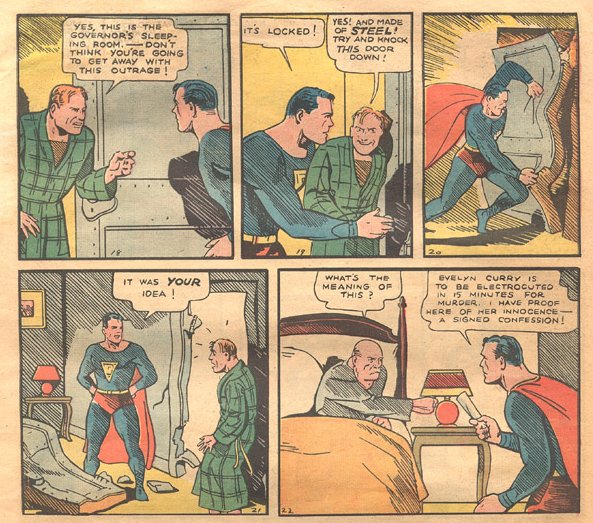
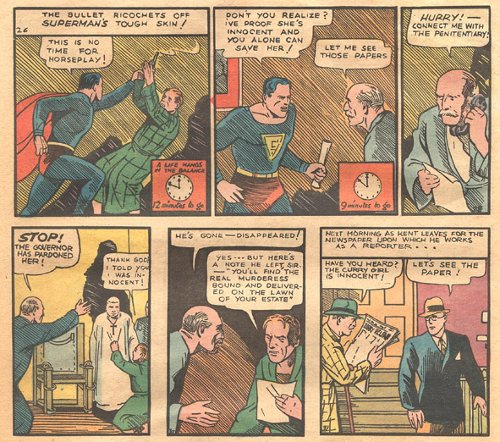
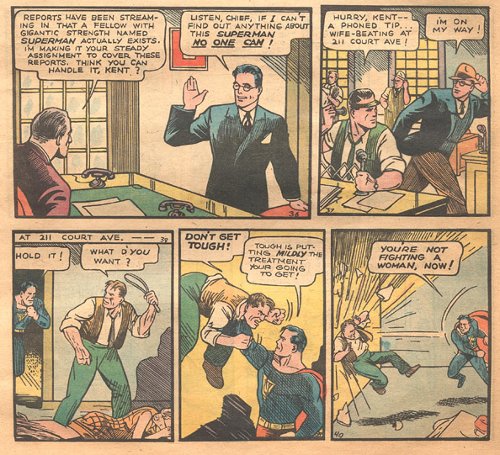
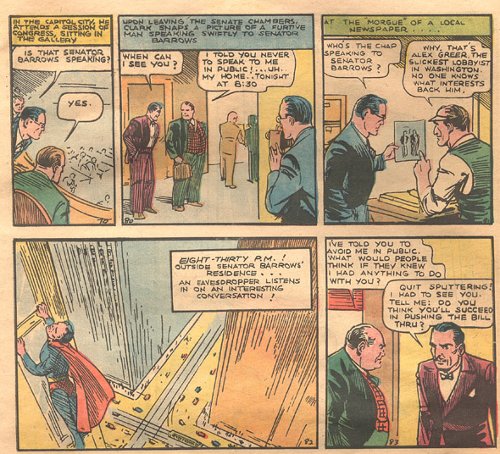
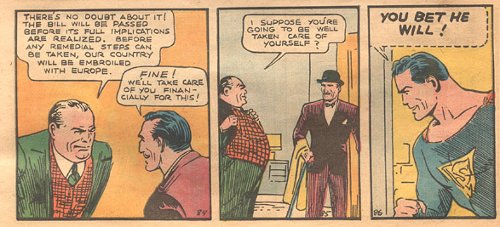
While we now think of the Man of Steel battling super villains like Lex Luthor and Bizarro, when Superman was introduced in 1938, he was a champion of the little guy, fighting for social justice and morality and against corruption. As you can see in Superman’s debut in Action Comics #1, the “Champion of the oppressed. The physical marvel who had sworn to devote his existence to helping those in need” was concerned with the execution of innocent people, corrupt legislation, and even wife-beating.
To a people demoralized by the Great Depression, this was truly a hero for the time. And amidst our current recession of both finances and morale, it’s the kind of hero we need today. Most encouragingly, while we probably shouldn’t go about fighting injustice by busting into the governor’s mansion, it’s the kind of heroism that is within the reach of every man.
But for many of us, engaging in even this kind of heroism seems as difficult as running faster than a speeding train.
What Makes a Man a Hero?
Why do some men stand by and watch an injustice or an emergency take place without doing anything, while other men spring to action and save the day?
Two researchers, Zeno Franco and Phillip Zimbardo, have taken up these very questions. Many of you might be familiar with Dr. Zimbardo’s famous 1971 Stanford Prison Experiment that showed good people turning into sadistic tyrants when placed in a position of authority over other human beings. However, one of the interesting observations of the experiment was that “good guards” did exist in the make-believe prison. These guards didn’t abuse or insult the student-prisoners, like the “evil guards” did, but they never tried to stop the abuse, either. Thus, the good guards actually ended up facilitating abuse by not taking action.
All that is necessary for evil to triumph is for good men to do nothing. ~ Edmund Burke
The Stanford Prison Experiment demonstrated that given certain circumstances and social pressures, normal, decent people can end up doing unspeakable things.
But it also showed that these same circumstances and social pressures can cause men to commit a different but equal wrong: not taking action when action is required.
We see this wrong all the time. I’m sure we can all remember a time when we saw another human needing assistance, but we simply stood by and did nothing. I’ll admit it. I’ve seen car accidents and just drove by. I’ve also seen people treated unfairly but didn’t say anything because I feared I would suffer social ostracization.
Forty years after his infamous Stanford Prison Experiment, Zimbardo has taken up the task of finding out what causes individuals to move from cowardly inaction, to heroic action. After analyzing the deeds of heroes both big and small, Zimbardo along with his research partner, Dr. Franco, argue that heroic individuals have a robust heroic imagination.
How to Develop Your Heroic Imagination
According to Zimbardo and Franco, the heroic imagination is “the capacity to imagine facing physically or socially risky situations, to struggle with the hypothetical problems these situations generate, and to consider one’s actions and the consequences.” It’s the ability to see oneself as a hero and capable of heroic action before the need for heroic action arises.
Okay, great. Heroic people can imagine themselves doing heroic things. But are some people born with more or less heroic imagination? If I was born with a weak heroic imagination, am I doomed to a lifetime of wienerdom?
Zimbardo argues that while some individuals may have a natural tendency for heroic behavior, all of us have the capacity to nurture and grow our inner hero. It’s a not a static characteristic. In his article “The Banality of Heroism,” Zimbardo lays out five concrete steps we can all take to develop our heroic imagination and thus be ready to take action when action is required.
Below are the five traits that will strengthen your heroic imagination and propel you into heroic action.
1. Maintain constant vigilance for situations that require heroic action. Every day we have opportunities to take a stand and be heroes. Sure, we probably won’t have to land a plane or fight off a ruffian, but we can be heroes by sticking up for a student being bullied by one’s peers, blowing the whistle on a supervisor who is engaging in shady and unethical business practices, or stopping to help a stranded driver. The more you develop your ability to spot situations to be heroic, the more chances you’ll get to take heroic action.
2. Learn not to fear conflict because you took a stand. When you see a situation that requires action, don’t wussy out because you’re afraid of what other people will say or do. A real man doesn’t give a damn if some people get upset or uncomfortable with doing the right thing. Don’t be afraid to stand by your principles and live with integrity.
3. Imagine alternative future scenarios beyond the present moment. We often fail to act because we’re too short-sighted. We think about the immediate consequences rather than the long-term ones. Sure, you might lose your job because you blew the whistle on unethical practices by your company. But think about the the long-term consequences if you don’t act. How many more people will be hurt if you don’t out your employer? Will you be able to look yourself in the mirror 20 years down the road knowing you didn’t do the right thing because it would have caused a couple of months of financial hardship?
Zimbardo also suggests we not only look to the future, but that we should “keep part of our minds on the past” as well. Study the lives of great men who performed heroic deeds. Studying their noble deeds will instill in us the virtues and values required for a heroic imagination and inspire us to take heroic action when needed.
4. Resist the urge to rationalize and justify inaction. Inaction is easy because it’s so easy to rationalize. The “bystander effect” is a perfect example of this. The bystander effect occurs when an emergency situation occurs in a large group of people and no one takes action to remedy the situation because they rationalize that someone else will take care of it.
Don’t be that person.
Instead of looking for ways to rationalize inaction, train yourself to rationalize action. Instead of thinking, “I won’t do anything because someone else will take care of it,” start thinking “I must take action because no one else will.”
5. Trust that people will appreciate heroic (and frequently unpopular) actions. In point number two, we’re told not to fear the conflict that might arise from doing the right thing. Conversely, we should also develop a confidence that people appreciate and honor heroic action. While your action may be unpopular at first, people eventually come around and appreciate and recognize true heroes.


{ 47 comments… read them below or add one }
I was just thinking about this myself. Especially now, when the economy is so bad and everyone is worried about taking care of their own. There’s always some impressionable kid or somebody looking at you for an example to go buy, even if you aren’t saving the world. The world is bigger than us and we forget that. Hell, I forgot that. And I’m realizing now that I have some work to do at home. Thanks for this. Really.
Interesting article, and glad you wrote it. I think another way, other than imagination, to develop a capacity to act when it’s needed for the sake of others is to have strong beliefs. If one develops strong beliefs about what should be done in a particular situation they will usually act as not to betray who they are and what they stand for. Without the belief that one must act out of personal responsibility, one won’t.
I would add another point — be careful to envision ways that you and those you care about can be harmed by your action, and mitigate that risk when intervening. Obviously, not all risks can be prevented, but you should be especially careful when inviting people, even decent people, into your home, car, or other forms of trust. Desperation causes good people to do bad things. Be careful with yourself.
I love the article, but your conclusion is incorrect.
People do NOT appreciate a hero. Yes, they’ll say ‘Thanks’ and love you for putting out that house fire, and we firefighters, in general, get a lot of thanks. But you can see men looking at you with LOATHING when they’re with their girl and she’s looking at you.
Big dramatic heroic acts will garner some thanks. The day-to-day stuff will piss people off. They will hate you, even when you help them. You will get fired or laid off first. You will get passed over for promotion because you are ‘inconvenient’ or ‘not a team player’. There is a line from the original ‘Dark Knight’ graphic novel that I love:
“The endless envy of those not blessed.”
Orion
Thanks for this! I really liked it.
It’s brave to admit your past inactions. I like the word “trust” in rule 5. Sometimes you just have to trust the good in humanity and act with your gut. The world will be a better place when you try. No one ever said being a hero is easy, and that’s why having one is ever so special.
I’ve been trying to write something like this myself, while it sits away in my drafts folder, ha! I promise it will come soon!
Excellent article, Brett!
Great article, thanks for this!
I think the line from the Boondock Saints is apt, where the priest was giving a sermon on the bystander effect as it pertained to Kitty Genovese (murdered in cold blood with several witnesses and no-one even called the police)
“We must all fear evil men, but there is an evil which we should fear most and that’s the INDIFFERENCE of GOOD men”
Orion, that’s not loathing, it’s envy, compounded by perhaps some self-loathing for not having done more himself. And it’s important with the “day-to-day stuff” that you understand whether it’s really necessary (i.e., heroic) or just self-important.
My concern is that we see a lot of people in the news doing something THEY think is heroic, but in reality is very poorly thought through – especially in politics. For example, people “taking a stand” where civil dialogue and critical thinking hasn’t even been tried.
It’s a complex subject for sure, and as usual the McKays have me thinking harder than I was 10 minutes ago.
This is just my opinion on the article… First of all, evil does exist, but its just not what were used to in comic books. Its a rotten stinking evil, that puts on a smile, claims its here to help us with one hand outstretched to greet us and another in our back pocket..
Also, I believe tattle telling on someone, and doing a heroic deed are two different things. What’s right and wrong is also a matter of perspective.
When I was young, my sense of right and wrong was black and white. Now that I am older I realize that what I believed was right and wrong, was something my parents had installed into me, but not particularly what I believed was right and wrong.
I think jumping into save someone, in away is its on evil. Because it doesn’t give that individual a chance to grow stronger, it takes that away from them.
Anyways, if someone was hanging on the side of a cliff edge and was hollering for help, or trapped in a car and I was there, yeah, I’d do my damnedest to save them.
@Orion
Nice quote, liked it. Although I think everything is earned…
@Orion: I’d have to agree and disagree with you.
(1) I think people are generally ungrateful for true heroism. However, I think part of heroism is a certain amount of stoicism – you don’t do heroic things to get accolades and impress the ladies. You do it because it’s the right thing to do, period.
(2) I don’t think guys look at you with loathing because you’re a hero. I think that at least some percentage of that is probably imagined and the rest is them wishing they were as manly as you. I’m a soldier, myself, so I know that sometimes women will look when they’re with their men and the the gentleman she’s with will get a bit peeved. The best thing to do is to just ignore her. Respecting their relationship more than she apparently does is real heroism.
@Orion: Some people just hate to see their own weakness in contrast to a more selfless person, makes them feel inferior. Like everything else in life, you can’t please everyone. But heroes inspire and attract other like-minded people into their circle, at least in time. Haters sort themselves out by not confusing with the great.
Thanks Brett. This is a timely article.
I have to agree with Brett and Kevin: “Trust” is the operative word in No. 5. Will there be people who hate you for heroic actions? Absolutely! How often do the bad guys thank the good guys for giving them a sound whooping? There are people who curse a sunny day. There are people who would have benefitted from getting themselves out of a jam. But I agree with Charlie: You’re not doing something heroic because at the time you’re trying to be heroic or because you want the attention. You do it because it’s right.
Core, I disagree with you on the issue of right and wrong. I agree that we don’t live in a world of pure black and white. That’s a naive viewpoint. However, that does not prove that there are no absolutes. Certain things are wrong and they are always wrong. Cold-blooded murder is a classic example. Even if htere was a case where it could be considered justified, the murderer still must live with his/her own conscious in the very least. At most, he must answer to a higher authority at some point.
Again you are not acting for what it brings you. You act because it’s right and because you must, no matter what the consequences to yourself or your reputation.
Orion is correct.
Heroes are seldom rewarded by ovation or accolades. It is often part of true heroism that such rewards are collected after their departure from the living.
I remember once as a teenager a local punk had been arrested after beating up an old lady in public while people stood by and watched.
My dad who was in poor health commented to me that had he been there “He might have killed me, but I would have had to get involved.”
I believed him.
My dad died maybe a year later from his heart trouble but 35 years of so later I still remember it, and hope I will do likewise if faced with a similar situation.
I’m not sure how many people on this site may or may not be familiar with the Ted lecture series, but Philip Zimbardo gave a talk back int 2008 on this exact topic. It’s a pretty interesting talk but be warned that some of the images shown in the presentation are very (VERY) graphic.
It’s sometimes frightening to think that placed in similar situations to those of the Stanford experiments how I, or anyone would act. After seeing that talk originally I spend a lot of time thinking about the very idea of what is good and evil and though we often imagine good and evil as two sides of the spectrum it is the enormous gray middle area where things get tricky, once you are in the gray it’s so easy to loose sight of things. Like being in the middle of the forest, you can move forward (towards the good side, or the evil side) and not even realized you moved because everything looks so similar.
I recommend the talk, but again, just a friendly warning especially if you are at work, or in front of kids. Some of these images are frightening.
http://www.ted.com/talks/lang/eng/philip_zimbardo_on_the_psychology_of_evil.html
I have a lot of “geek” friends that know *everything* about comic book and film super-heros, but they seem to know next-to-nothing about actual heroism.
That said, Orion brings up a very valid point. We give much lip service to rescue/firefighters and shallow “Support out troops” to our military. Yet the average self-centered “civilian,” in their heart-of-hearts, fears/envies/loathes the very people who keep them safe.
This issue is further compounded by the current vogue for the “Everyday Hero” posture. Under this mythos, one who merely slogs through his workday for 40 years and raises a family, is these days, supposedly a hero. Bah! Survivor, maybe. Contributor to his own family interests, certainly. Hero, … not.
Heroism, if I may borrow from military parlance, is going “above and beyond the call of duty.”
“When It Comes Crashing Down and it Hurts Inside/You’ve got to be a man it don’t help to hide. If you hurt my friends, then you hurt my pride/I’ve got to be a man, I can’t let it slide” – Real American (Hulk Hogan’s theme).
Going down the list of ways to improve your heroic imagination, I just kept thinking of Batman.
What makes him so tough is that, at the end of the latest picture and throughout the comics, he doesn’t care if he gets credit; in fact, he actually expects to be punished for being a hero. That’s one of the reasons I can’t wait for the next movie. Will he ever be rewarded for his sacrifices?
I wonder if that “damn the consequences” attitude is actually required for a healthy heroic imagination.
Bless you, Brett, for this challenging article.
This is awesome. No real woman can ignore/not admire a masculine and heroic action from a real man. Thanks for helping to bring out the better side in our men Brett.
@Orion: I can say that, regardless of whether people loathe your actions out of sheer jealousy and feelings of inadequacy;
if you have the best intentions for others, and truly care – that’s all that matters. I’d rather be hated for doing what’s right than be “accepted” for resigning to “blending in” and “fitting in” in order to feel a part of the clique or crowd.
Being heroic is about being a leader, and doing what 99% of other people will not do. And believing in it without question.
Just a side point, sometimes it is best to pass a car wreck. If your stopping could cause another wreck you should not stop. If a EMT is coming you should stay out of the way. If a person does not have the skill to help with medical stuff it might be best to keep the area clear for people who do. If someone has a broken neck you could do more harm than good.
That being said, if you see a person bleeding then go hold your shirt on their wounds.
What a fantastic post. It’s days like this I know exactly why I keep coming back – thanks Brett :D
Really loved this article! I’m going to start practicing this right away!
Warm Regards,
Gerald
This article was great timing for me (unfortunately) as this weekend my roommate went liquored up and berserko on our poor defenseless drywall. I sat in my room and pretended not to hear anything. When I think I am becoming more responsible and living with integrity, this non-action knocks me back a peg. Thanks for the tips.
http://www.youtube.com/watch?v=ouUbWUlHS6A
Here is an everyman hero.
I’m not sure if you’re aware, but Phil has launched the Heroic Imagination Project. The website went live last week – heroicimagination.org.
I’m working with him on that as well as running my own hero-based program for kids. I use that Edmund Burke quote in my presentations as well as one from Desmond Tutu – “If you are neutral in situations of injustice, you have chosen the side of the oppressor.”
Heroism is all about action when it’s needed. You do it for others without regard for reward or adulation. You did it despite the risk or sacrifice.
I’d love to hear from anyone interested in more on the project. Email is matt@theheroconstructioncompany.com
Some of you may be missing the point of the definition of a hero. It is not the once in a lifetime chance of saving someone from harm’s way. It is the way you go about your day-to-day life. Do you cheat, lie, swindle at every chance? Do you ignore your children, cavort with scum? Do you shirk your responsibilities at every opportunity?
If so, no matter how many little old ladies you ‘save’ you are a lowlife coward and will never be a hero.
Nice post. The reference to the Zimbardo experiment works perfectly along side the quote from Burke. I believe I’m a hero therefore I am – nice part on imagination. :)
Awesome! Reminds me of Pat Conroy’s The Lord of Disciplines. Closely related to the theme of this post, a person lacking in confidence or self-confidence will obviously be a clumsy, cart-before-the-horse type of hero,worsening matters. Cos, i want to live my life without that debilitating, paralysing fear of what people will say or think,speak up for myself or those whose voice have been silenced. We can use a little heroism in Africa/Nigeria particularly.
So then, is dutch courage advisable? Keep it up!
Re: Ungrateful people. What seems like ungrateful may actually be mortification that they got themselves in a position where they needed a hero in the first place. When my friend saved a lady’s life by yelling at people NOT to do CPR and doing the Heimlich maneuver on this lady, the woman didn’t say thank you or anything, and I think she was probably too in shock and embarassed to think about it. Not everything is thinking about the same things you’re thinking about, from their perspective something earth-shaking just happened and their first thought might not be to remember their manners or to be grateful.
I’ve always held on to that childhood dream of being a superhero (Batman, since I admire his mentality the most and also because he’s the only one who isn’t either an alien, mutant, or the result of some crazy experiment). I sometimes get strange looks and rolled-eyes when I talk about my motivations for maintaining high personal standards, but ultimately, people always end up admiring my discipline and ideals, so definitely expect heroism from yourself and don’t worry about being ostracized. If people do, it’s because their jealous of you, or resent that they can’t hold themselves to those same standards, but as long as you’re gracious, not arrogant, and don’t preach,, they will come around. I’ve actually ended up inspiring a lot of people who initially told me I was wasting my time, so now I write a lot about my personal quest for integrity on my blog, mainly focused on young men.
You look at heroes, most of them don’t want to be seen. They hide in the shadows or behind a mask, you never see Clark Kent or Bruce Wayne, proclaiming themselves as heroes, they want to live a normal life, but they fight for what is good and right even in the face of adversity.
Also, They don’t care about themselves in the least, ether their physical body or their normal life. When Batman had to choose between the woman he loved and helping others, he put himself aside, and helped others.
If you are a follower of Nietche, then you have no need for “heroes” nor are they desired both from his “perspective of the “superman” and from the rescued as they will eventually loath your assistance and existence.
My faith requires me to stand for the oppressed and my profession requires my defending those who can’t or won’t. That is my choice. Rather than thinking, or “imagining”, my being or becoming a hero, with my sons and those I train in this profession, I utilize the classical definition of “champion”. I am of the thought that I should position myself with acquired skills and the mindset of the servant/warrior so that I may be called upon and counted upon to stand in the face of social or physical injustice when others won’t or can’t. I understand the cost of this and have willingly paid its price in terms of blood, sweat and social separation.
All men and women do not possess the attributes to be great firefighters, military members and Law Enforcement Officers, but all have the ability to stand against injustice. Now are you willing to accept that responsibility and the associated cost? If so, the path of a “champion” you have chosen. If not, a sheep you are and subject to the depredation of wolves. I strive to be a “sheepdog”.
—–This is a great article, one of the most important reasons for fostering heroism, is the prevention of insecurities. One of the main reasons for “inaction” is insecurities. Some of the most heinous, and evil people throughout history, were actually really insecure. Although outwardly confident, Hitler himself was a very insecure and pathetic man, relying on fortune tellers and his intense medical therapy. Insecurities can make people do really evil things. It breeds selfish and irrational behavior. Heroism on the other hand breeds confidence, and by confidence I do not mean flamboyance or cockiness. Confidence in one’s self and acceptance of one’s self is extremely important to the stability of society. If you are comfortable with yourself and just being yourself, then it is easier to resist the common sins of man: Envy, Lust, Anger, Greed etc. The villain is always an insecure person, with some sort of traumatic history, that he or she could not overcome. When a confident person experiences an injustice, he accepts it for what it is, and fights the problem. The selfish nature of the insecure person, on the other hand, tries to connect the injustice with his or her self. This creates a fictitious correlation between the injustice and the insecurities, eventually resulting in irrational behavior. We live in an insecure world, were Prozac and lexapro are the number one prescribed drugs.
Unfortunately, I tend to stay in the background for fear of getting hurt.
One time I heard a scream come from a neighbor’s yard.
What did I do?
Yeah, yeah, I called the police. But I did it while hiding on the floor. I was too scared to go out and see if someone needed my help. I guess I am not much of a hero… That day still haunts me.
The following is my favorite heroic story. There’s even some Superman in it.
Back in the 40′s, one Stetson Kennedy infiltrated the KKK in an effort to learn their secrets and use those secrets against them. Long story short, this led to Superman vs. The KKK radio show, where the sheer ridiculousness of Klan rituals were exposed, and their mystique was obliterated.
This morning as I was walking to work in the rain I noticed two middle aged women struggling as they worked to push an elderly woman in a wheelchair up the hill. Normally I wouldn’t have done anything, but I decided to change my thinking from “they can handle it” to “they’ll never make it without my help.” So, I offered my help and got the nice old lady to her destination.
I’m not saying this to toot my own horn, but rather just to let you know that this web site is much more than a blog; it has touched people’s lives for the better. And I’m not just talking about the three ladies I met today. Keep up the good work.
@ Eddie M.
I believe, for Nietzsche, heroes wouldn’t be necessary because we would all be supermen, the strongest representation of ourselves. So in a way, we would all be heroes of sorts, if you take the word ‘hero’ to mean the boldest expression of self will (noting that Nietzsche doesn’t call us to be evil, though evil is always going to be a necessary consequence in human society). And the weak loathe the strong because they themselves aren’t strong, since they negate their own will (ppl of resentiment). But that loathe is no reason for him (or for us) to quit expressing our will–for expression of will is the highest form of human power.
Which in reality is what a hero kind of is. He has a clear idea of right and wrong, and he stands for it without fail. He is steadfast in his will, and his will is strong. Heroes function under a set of idealized beliefs, much as many people do, but they have the will power to pursue theirs. Most people believe theft is bad, but a ‘hero’ is the one who has the will to stand up and stop a thief.
The article is pretty thought provoking…but I feel if your goal is to be heroic, you may be misguided. I think the main thing to take away from it is have strong enough beliefs that you will stand up for them. If you don’t believe in anything enough to stand up for it, can you ever be heroic? The action of a “hero” stems from an underlying conviction that what they are doing is right, and should be done (funny enough, this is also the same conviction in most of the “villains” in history). So when thinking, “am I heroic?” maybe try thinking, “Is there anything that I find so wrong I couldn’t let it happen?” If not, it may be a good sign that it’s time for some self evaluation. Just my two cents.
I hate to even be pathetic enough to point this out, the first line of the article concerning ‘supernatural powers’ well thats not really the right description it should be ‘super-human’,the former gives the impression these superheros are under some kind of demonic possesion.
Anyway ,I’m going back to chronologically catalouging my ‘The Spirit’ collection (who for the record may have actually had super-natural powers, or was just very good at not dying)
I was just leaving a playground with my neice a few moments ago when I heard a child crying. My niece asked me, “Should we check it out?”
I started to say “No, she is probibly okay” but thought back to your article and said “yeah, lets see if we can help.” In the end, I couldn’t do more than assure the child that had bumped her head that it was not bleeding and she would be fine, but I left the park feeling more like a man.
Dear artofmanliness.com,
First off I’d like to say that I really like your website (oh, and I’m a girl), and now that we have both of those introductories out of the way, I’d like to ask you a question.
I have a little brother, and I feel that he might grow up to be a frou-frou, feminine sort of guy. I’d still love him whether he was or not, but I also know for a fact that he’s lacking in some of the essential ‘manly’ traits that most young boys learn and/ or have.
My dad doesn’t have a lot of time for us, especially since he’s really, really busy with work. He’s always in good spirits and when ever he does have time with us, he makes sure we have a good time. But still, there’s a definite lacking of contact between him and my brother.
So what I was wondering is, how can I help him y’know… man up? As his older sister I know that there’s only so much I can do, and that the rest is up to him, but if you could suggest anything that might help him I’d really appreciate it.
-Thank you and sincere regards.
Buy him the art of manliness and encourage him to join in on more manly activites. You may not be able to be an extra father but you can certainly be his biggest cheerleader.
I tried to stop a mugger once, as it turns out they were working in groups one of his pals from the back pulled out a gun and pointed it at my chest because i was about to subdue his friend (im a martial arts pratitioner/fanatic) after the incident i was told by my friends not to do that again because that can cause problems for my family, even my dad told me not to intervene anymore-is this right? this is my dilemma,
Dr Zimbardo’s “Lucifer Effect” speech at the TED conference was one of the more powerful ideas I’ve ever entertained. It helped me to understand the coercive nature of society, and the power of one man to do right and influence others. The insight I gained greatly improved my ability to be a Christian man and Soldier.
Thank your an interesting and inspiring read. It is nice to see that the notion of making the unpopular (right) decision still has credibility in this day and age.