





How Two World Wars Standardized the American Male Grooming Routine
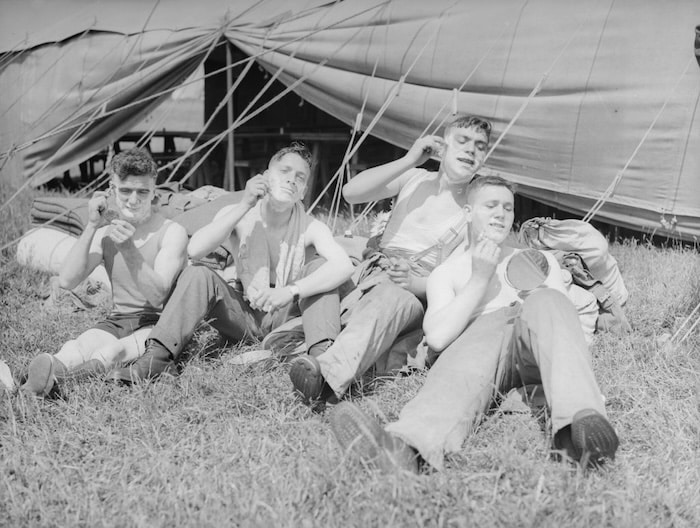
Every morning in America, a lot of men stand in front of their bathroom mirror, lather up with shaving cream, and scrape their face clean with a razor. Probably a multi-blade cartridge razor. If they’re old-school, a safety razor. If they’re old-old-school, a straight razor. After that, they brush their teeth. Then they run a comb through their hair (if they have any). When they travel, they pack all their grooming tools in a Dopp kit. This is the standard, normal grooming routine of the 21st century man.
But almost none of it was completely normal before 1945.
It took two world wars to standardize and popularize these practices among men.
Yes, your daily shave and teeth brushing routine was forged in battle.
Below, we take a look at how total war in the 20th century shaped how men take care of their personal hygiene.
Before World War I, Many Men Didn’t Shave Themselves
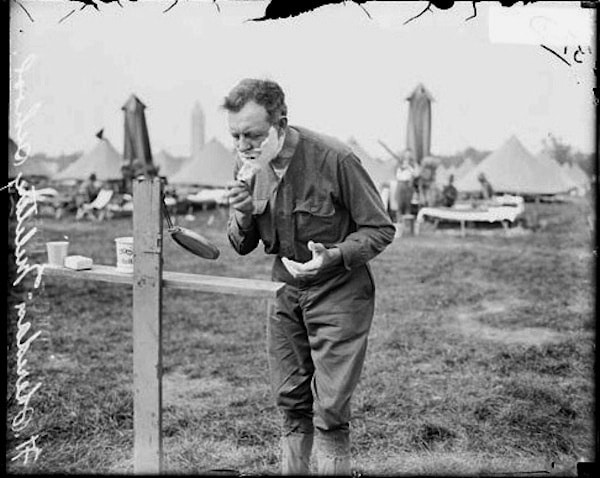
You think shaving today is a hassle? At the turn of the twentieth century, shaving at home was a much bigger one. The dominant tool was the straight razor. While many 21st-century dudes romanticize the pleasures of putting a cutthroat to their face (we’re guilty of this!), shaving with a straight razor is kind of a pain in the ass. Straight razors are difficult to shave with and require a lot of upkeep. You’ve got to sharpen and strop them on the regular. What’s more, if you wanted hot water to lather up, you had to heat it on the stove. Because it was a chore to shave, many men either wore beards or relied on regular visits to the barber, who scraped off their whiskers while they sat in his chair.
That started to change in 1904, when King Camp Gillette was awarded U.S. Patent No. 775,134 for the safety razor. This device shielded the skin from the blade’s edge while still allowing a close shave. Shaving got a whole lot easier. But Gillette’s real genius wasn’t the razor itself but the business model behind it. He sold the handle cheaply and made money on the replacement blades. It’s the same model your printer company uses to gouge you on ink cartridges, except Gillette thought of it first.
Advertisement
Initial sales were modest — just 51 razors and 168 blades in 1903. But by 1915, Gillette was selling 450,000 razors and 70 million blades a year. During WWI, the British and American governments required soldiers to be clean-shaven in order to ensure a proper seal on gas masks so they didn’t inhale poison gas in the trenches.
To that end, the government included safety razors in standard-issue kits during World War I, giving the product a massive trial run with millions of young men. When soldiers returned home, many kept up the daily DIY shaving habit. By 1926, American men were buying over two million blades a day.
The Dopp Kit and the Standardization of the American Male Grooming Routine
While WWI made shaving a more regular practice among American men, it took WWII to make it, and other hygiene habits, near universal.
By World War II, the U.S. Army had contracted with a leather goods maker named Charles Doppelt to manufacture toiletry bags for American servicemen. Known as ‘Dopp kits’ (Doppelt, Dopp kit — get it?), the bags were issued to millions of recruits during the war. Inside, soldiers carried the essentials of their new military grooming routine: a safety razor, shaving soap or brushless cream, a comb, toothpaste, a toothbrush, a mirror, and a bar of soap.
Gillette also shifted their production to meet the needs of the fighting men. The company switched to bakelite (an early plastic) and light alloy razors to conserve strategic metals like brass and aluminum, and ramped up production to fill those Dopp kits. Intelligence agencies even produced special shaving sets for POWs. What appeared to be a standard razor and brush hid compasses, counterfeit German currency, and silk maps of enemy territory that soldiers could use to escape.
The troops even found creative secondary uses for their shaving cream. War correspondent Ernie Pyle reported that frontline troops at Anzio used it to treat sunburn and soothe fleabites, and thought it prevented trench foot if you massaged it into your feet once a day.
Advertisement
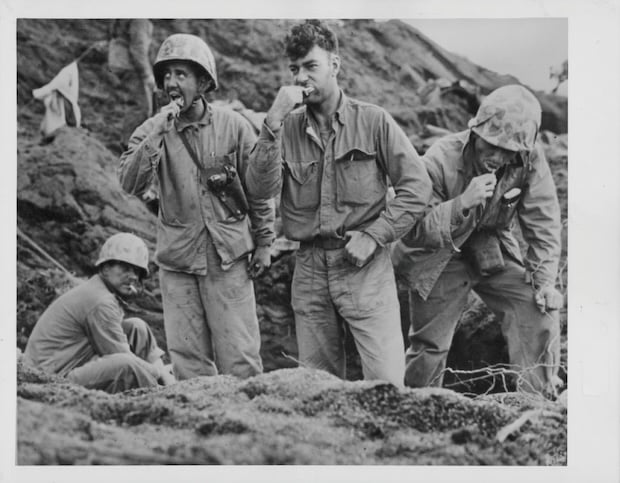
Besides shaving, daily toothbrushing was also mandated by the military. Before the war, most Americans didn’t brush their teeth every day. But the military required it to maintain overall dental hygiene and to prevent “trench mouth,” a debilitating infection involving bleeding gums and fever that had plagued troops in World War I. Soldiers were issued nylon-bristled brushes from DuPont.
When millions of veterans came home in 1945 and 1946, they brought their military-issued grooming habits with them. They were accustomed to being clean-shaven and fresh of breath and having easy access to the products that kept them that way.
While grooming practices have changed since then, the basics are still the same for most men. And those basics were established thanks to two world wars. So the next time you’re standing at your bathroom sink looking at your ugly mug while you shave or pack your Dopp kit for your next vacation, take a moment to think about the fact that the rituals you’re taking part in were forged in the trenches.


