




Editor’s note: This is a guest post from two-time USA Memory Champion, Ron White.
In 2009 I set a USA record for the fastest to memorize a deck of cards. I did it in 1 minute and 27 seconds. This record stood for two years in the United States. Now this may seem freakishly fast. But the good news for anyone attempting to memorize a deck of cards is that the first time I tried—just a year before—it took me over 6 minutes! I was not born with a natural ability; instead, I perfected a system that anyone can learn to memorize a deck of cards with seemingly superhuman speed.
The system consists of two main ingredients:
1. Creating a mental map
2. Creating substitute images for each playing card
Create a Mental Map
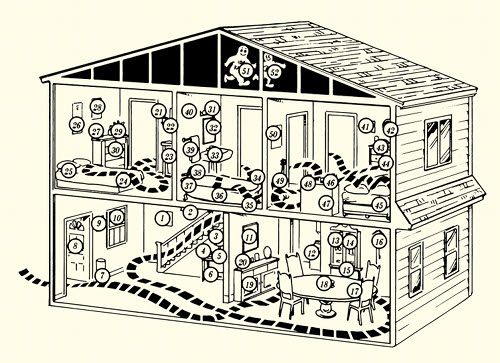
To create your mental map, you are going to take an imaginary walk, memorizing items as you go along. My suggestion is that you select a route you walk daily in your real life, such as a walk through your home. As you “walk,” you need to select 52 spots to store in your mental journal.
Here’s how it works:
1. Select 5 rooms in your house (i.e., bedroom, bathroom, kitchen, living room, garage).
2. Memorize 10 pieces of furniture in each room. Stand in the doorway of each room, and looking around the room, number 10 large items in a clockwise direction. For example, the first piece of furniture on your left may be a desk. Going around the room clockwise, #2 might be your bed, #3 could be a dresser, #4 a mirror, #5 a TV, etc. It really doesn’t matter which items you select, but if you use a television in one room, avoid using a television in another. And choose large items over small ones (e.g., the desk, not a pencil on the desk).
3. Repeat these 50 items over and over in your head until you can close your eyes and say them flawlessly and rapidly.
4. Now add 2 more pieces of furniture at the end—maybe in a new room or even 2 landmarks in your yard.
Create Images for Every Playing Card
This next part is where you use your creativity, and it is 100% up to you how you create the images. But every card needs to be turned into a noun (person, place, or thing). For example:
- King of Hearts could be your dad.
- Queen of Hearts could be your mom.
- Ace of Diamonds could be Donald Trump (diamonds = rich).
- 5 of Hearts could be your daughter Kailey because she is 5 years old and you love her (hearts could mean love for you).
- Queen of Clubs could be Madonna because she is a woman and sang in dance clubs.
- 3 of Diamonds could be a touchdown because three starts with a “T” and Diamonds a “D.” It’s a TD!
- King of Clubs could be Elvis because he is a male and sang in clubs.
- Ace of Hearts could be an airplane because they call a pilot who shoots down a lot of planes an “Ace,” and they stop hearts from beating.
- 6 of Hearts could be a tank because a 6 on its side kind of looks like a tank and tanks stop hearts from beating.
- 7 of Hearts could be dice because of “lucky 7″ and you love to play dice (again, hearts = love).
- Jack of Hearts could be someone named Jack or a name that starts with “J” that you love.
You get the idea; I just did 21% of the cards for you. There is no rhyme or reason to where these pictures come from and it doesn’t matter. All that matters is that you:
1. Create the images that make sense to YOU.
2. Spend time looking through a deck of cards over and over and over until you can recognize the image that goes with the card without hesitation.
Putting It All together
You have memorized a map of your home and have pictures for every playing card. Now for the fun part. You get a timer and hit start and then pick up a shuffled deck of cards. Going through the deck as fast as you can, imagine the pictures for the cards one by one on your furniture.
If the 1st card you see is the 7 of Hearts, and you are using the image of dice I suggested above, then imagine dice flying out of your #1 piece of furniture. The more action and emotion you can use the better. The more bizarre the image is the better chance it will stick in your mind.
If the 2nd card you see is the King of Clubs, then imagine Elvis dancing on your number two piece of furniture (if you decide to use my suggestion above for the King of Clubs).
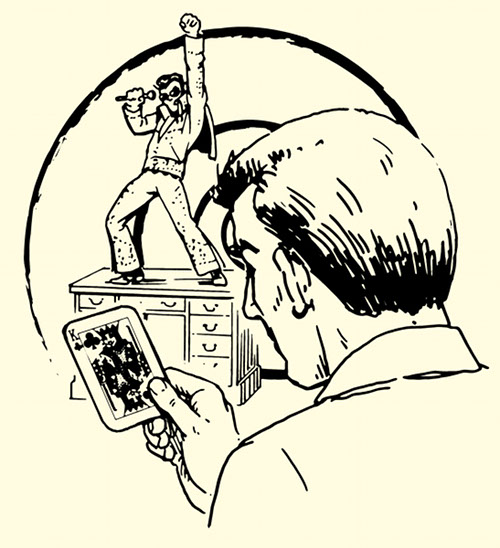
As you do this, make your pictures bizarre, unusual, and full of color and emotions. If you do, then you should be able to set the cards down, stop the timer and then pick up a second deck of cards and reassemble it to match the first deck by simply mentally walking through your home. Just like the top memory experts in the world do it.
1. Train to make sure you have your mental map and images for cards down cold.
2. Push your brain to go faster than you think is possible (you will be surprised).
3. HAVE FUN!!
___________________________________________________________
Ron White (not the cigar smoking, scotch drinking comedian, although he does write his own jokes) is a two time USA Memory Champion who held the record for the fastest to memorize a deck of cards in the USA (1 minute 27 seconds) for 2 years. Perhaps you saw him on the History Channel show, Stan Lee’s “Superhumans.” For more information on Ron White’s memory training system, visit MEMORY TRAINING COURSE.


{ 25 comments… read them below or add one }
Hah! I just saw a TED talk outlining this same method last week. Fascinating stuff! Also, the illustrations for this post are awesome.
The first time I tried to levitate, I only got two feet off the ground for about thirty seconds, so don’t get discouraged. ;-)
I doubt that I could memorize the order of a deck of cards in any given amount of time, but I do have a question about mental mapping. How do you erase the map once you’ve created it? It seems that these images would be pretty indelible. If I was able to use this technique to memorize something, I feel like I’d have to move before I could memorize something else.
@Bryan, I recently listened to a radio show about a guy who uses this same technique to memorize Pi to over 15k digits. He made a mental mansion with thousands of rooms and afterward spent countless hours re-touring his mental mansion erasing the data from each room in his mind.
how very cool.
This memory tool is called the “memory palace” or the “method of loci.” It has been in use for thousands of years. Very fascinating, very effective, and it can be fun to boot!
Good article.
Are you the same person who contributed to the article discussing this method in National Geographic a few issues back? I seem to remember that person also being a world champion. Either way, cool stuff!
In the Marines we use a similar method. Instead of “map” you would use an item as many as you want. For example your first item would be a cup. If you see something you want to remember you put that in the cup. Then later when you recall it by visualize the item in the cup. Next time you go out on patrol and want to remember something you put the new item in the cup erasing the old.
@Greg, that’s really interesting… they just had an article in National Geographic about how they think the reason we forget why we got up to get something is that our brains are wired to completely reassess a situation when we enter a new set of conditions, like entering a new room. They think it’s an evolutionary mechanism for helping think on our feet. Sounds like that method you talk about plays off of that mechanism maybe. Interesting stuff!
Learned this a couple of years ago though a bit different. Dominic O’Brien suggested that you’d use a person for every card because persons are more memorable.
The method I use relies on Mayor System (phonetic, a letter for each number, N=2, M=3 etc, GOOGLE).
In English every suit starts with a different letter (Clubs, Hearts, Spades, Diamonds).
The words (images) you assign to every card start with the same letter as the suit. The next consonant you take from the number the card is and turn it into a letter with Mayor System.
EXAMPLE:
Two of Hearts: HeN
Four of Clubs: CaR
As for the royal family, they are famous people, and aces are the things the suit represent: a huge diamond, or a heart with hands and legs smiling.
The post is going a bit too long so I’ll stop here.
I’ve done this and it does work.
I practiced daily for a couple weeks and then I did the entire deck. Unfortunately I haven’t done it since then, so it would take some work to get it back.
@ Jared, I am not the same person who was in Nat Geo magazine that was the 2011/2012 USA Memory Champion. I was 2009 and 2010. I was on the Nat Geo show Brain Games thought.
@ Eric, yes the TED talk was done by Joshua Foer. He was the 2006 USA Memory Champion
I just read Ron’s guest post from last Sept 30 (day after my birthday – easy association), and my unanswered question is about remebering numbers. I find numbers the easiest to remember (and everything else almost impossible) because of the ease with which numbers can form relationships among themselves: think additive, subtractive, multiplicative, and divisive. It sounds like most people function the opposite – ease of letters over numbers, and I wonder if anybody else can relate to ease with numbers. Also, does anyone know a ‘backwards system’ or a way to translate letters/words into numbers for memorization? The shortage of numbers compared with letters seems to present some difficulty, but there must be some way it can be done…
Must be nice to have the ability to visualize. Some of us can’t. :(
So Randal. You don’t have dreams when you sleep? You never day dreamed? You can’t close your eyes and visualize a pretty woman? If you think about it, you will have to admit that you can and do visualize :)
This method is effective IF one can create the mental map. What about those of us who can’t?
I’ve never been able to do rote memorization either.
The great thing about this system is that there are as many uses for it as you can come up with. I’ve read a few memory books over the years and each one has a variation of this procedure. British psychological illusionist Derren Brown does something similar with what are called Memory Palaces. Great to see this kind of multi-use brain stuff here along with the other great content on AoM.
For beginners I’d say the map described here is a bit too crowded. I personally like when observing the peg where I put the image is the only peg in sight, so there’s less chance of them disturbing each other.
And again I prefer to take journeys from video games because the world there is smaller and with less distractions. I’d recommend to give it a try.
Great book called Moonwalking with Einstein which is all about a guy who decides to enter the memory championships and learns techniques from the masters. Highly recommended read!
I have a hard time remembering the names of people I meet – let alone the order of a deck of cards. Maybe I need to check out your course.
I’d like to re-ask a question above. How do you empty out the map for your second attempt. If you ask me to tell you about my most recent visit to Yellowstone, I will inevitably accidentally recall memories from my previous visits… I can see a first run-through seeping into successive tries.
To empty a map you’d just walk it and imagine an empty peg. Works fairly well for me.
very interesting! thanks Ron!
android application for training
https://play.google.com/store/apps/details?id=com.avolodin.memory.cards
it took me 15 min to memorize card of deck. I was able to recall it in reverse order too :)
I have an even better system because after memorizing 52 playing cards, you can call out any number from 1-52 and I can tell you instantly what card it was. I don’t have to go through any mapping to get to the card! Look for my new book, “How to remember every card in the deck”. It is being published by Baron Barclay and should be out any day now.