The 4 Qualities of a True Statesman

by Brett & Kate McKay on January 30, 2012 · 213 comments

in A Man's Life

Here in the United States, the inauguration of our next president is a year away, and the Republican primary season is in full swing. Journalists and pundits dissect the candidates’ every speech, appearance, and debate, analyzing what they did right or wrong, and who is waxing and waning in the polls. These talking heads, along with the people watching and listening to them at home, evaluate the candidates on who seems the most “authentic,” had the best line of the evening, or released the hardest-hitting advertisement. The whole thing can oftentimes seem more like a sport or entertaining sideshow than the lead-up to an important election.

So what should the more serious-minded citizen be looking for in the next leader of the free world? What criteria beyond hair and quips might a man use to evaluate and judge candidates for office, or those already in office?

Opinions will certainly differ on such a significant and pressing question. But while I was in college, I was introduced to an excellent yardstick for measuring our leaders, one that has stuck with me ever since.

It was there I took a couple of courses with Dr. J. Rufus Fears, professor of an incredibly manly subject: the history of freedom. One of the things the good professor emphasized to us captivated students was that a politician and a statesman are not the same thing. A statesman, Fears argues, is not a tyrant; he is the free leader of a free people and he must possess four critical qualities:

  1. A bedrock of principles
  2. A moral compass
  3. A vision
  4. The ability to build a consensus to achieve that vision

Let us now explore these four criteria of a democratic statesman in greater depth.

1. A Bedrock of Principles

The statesman builds his platform on a foundation of firm, unchanging, fundamental truths. These are the things he believes at his very core, his overarching philosophy.  Just as in the foundation of a house, storms may buffet the structure, opposition and challenges may arise, times will change, but the foundation remains. A statesman may change the details of his policies and his methods for achieving those policies, but only inasmuch as those short-term tactics of expediency serve the purpose of furthering his bedrock of principles in the long run.

2.  A Moral Compass

Dr. Fears argues that the modern politician makes decisions by using “antennae.” He puts his feelers out there to gauge the public mood. Once he figures out which way the wind is blowing, he then shapes himself and his message to give the people exactly what they want. But as Dr. Fears would hammer home again and again to us: A statesman does not govern by public opinion polls.

No, the true statesman makes his decisions by following the dictates of his own moral compass. He is not a relativist; he believes in absolute truths, and his moral compass is rooted in a sense of absolute right and absolute wrong. When something is wrong, he plainly says it is wrong and does everything in his power to fight against it. When something is right, he is willing to overcome any opposition to preserve and spread it. The statesman is ambitious—he must be to obtain a position of power—but there are things he simply will and will not do to get to the top. He is a man of integrity; he speaks the truth. He leads by moral authority and represents all that is best in his countrymen.

3. A Vision

A statesman has a clear vision of what his country and his people can become. He knows where he wants to take them and what it will take to get there.

Fears argues that a statesman’s foresight is one of his most important qualities, as he must be able to recognize problems on the horizon and be able to come up with solutions that are good not only for the short-term, but for the long-term as well. The statesman keeps in mind not only the here and now, but the world future generations will inherit.

4.  The Ability to Build a Consensus to Achieve That Vision

A politician may have a bedrock of principles, a moral compass, and a vision, but if he lacks the ability to build a consensus around his vision, his efforts to change policies, laws, and the course of history will largely be in vain.

A statesman, who again is a free leader of a free people, must enlist those who serve with him in the government to support his initiatives, and their willingness to do so rests on the pressure they feel from their constituents to align themselves with the statesman’s vision. Thus, a statesman’s success in building a consensus ultimately hinges on his ability to convince his countrymen of the soundness of his philosophy.

To win their hearts, the statesman does not use slick advertisements and PR campaigns. Ads and propaganda, Fears argues, are the tools of the despot. Rather, the statesman harnesses the power of the written, and especially the spoken word. He is master orator. His lifelong study of great books and the lessons of history allow him to speak to the people in intelligent, potent, well-reasoned arguments.

Because a statesman follows his moral compass instead of opinion polls, his ideas are often initially out of step with the public mood. But instead of tailoring his rhetoric to that mood, he speaks to the very best within his countrymen. He understands that while their ideals may be deeply buried, powerful rhetoric can bring them forth and activate them. The strength of his words comes from the fact that he actually believes what he says. And he does not make his countrymen’s hearts soar and burn with empty promises; he keeps his word and does what he says he will do.

In considering these four qualities of a democratic statesman, it may seem like a real one has never existed, because if one had, surely everyone would be in agreement on his exalted place in history. But in truth, even those who agree on these criteria would have plenty of disagreement over what principles the statesman should espouse, what constitutes a moral right and wrong, and most importantly, what constitutes acceptable means in obtaining his vision.

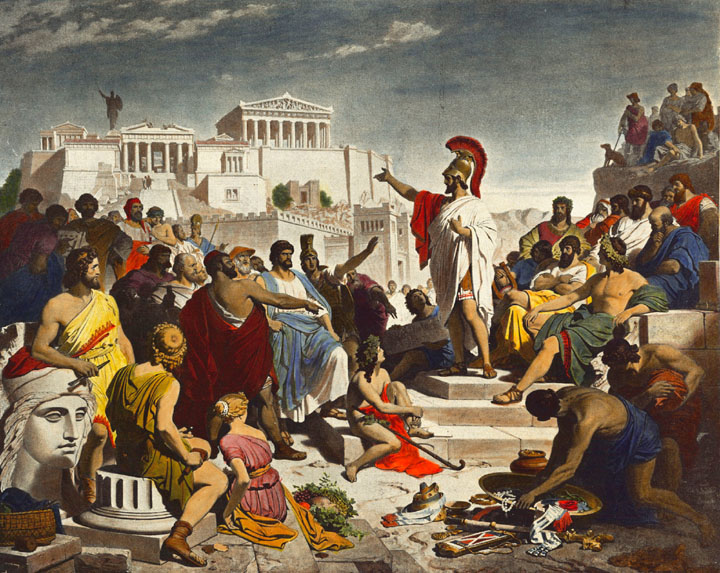
Professor Fears believes that the three greatest statesmen in history are Pericles of Athens, Abraham Lincoln, and Winston Churchill. For all three men, their bedrock of principles rested on the ideal of freedom: democratic liberty, equality under the law, and individual freedom—the freedom to live as you choose. And these men had a vision of expanding this liberty further, out to the common man. And yet they all courted controversy in some of the measures they deemed necessary in order to achieve their vision. Churchill is criticized for things like the Bombing of Dresden and his advocacy of imperialism (he did not believe that national independence and freedom were the same thing, and thought that British colonists would have more freedom and liberty under colonial rule than if a country was turned over to a small clique of its own that would rule with tyranny). And Lincoln suspended the right to habeaus corpus during the Civil War.

Some feel that such actions cannot be justified, no matter the end goal. But Dr. Fears, who from what I gather from his lectures and books leans libertarian, sees the broader picture—he argues that every statesman must set priorities, and this can sometimes mean “saying no to the aspirations of one people for another.” In other words, even if the methods of the statesmen he admires were not always very savory in the short-term, what matters most in his estimation is that they ultimately led to more freedom for more people in the long-term.

So who do you personally think are the great statesmen from history? Do you think there are true statesmen among us now? If not, which of these qualities are the politicians out there lacking?
**Please note: Obviously this discussion will be political in nature, and while you are welcome to share your opinion in a calm, intelligent, civil, and gentlemanly manner, even the slightest whiff of snark, rancor, or any kind of unmanly silliness will get your comment deleted. Statesmen are great, but on this thread I will be a tyrant, ruling with an iron fist. All of which is to say: no nincompoops allowed.**

{ 213 comments… read them below or add one }

1 Matt M. January 30, 2012 at 3:12 pm

What a excellent, excellent, much needed post. I freakin love AoM.

I myself am a huge Ron Paul supporter but I can see that he lacks on important quality of a statesman–#4 the ability to build a consensus to achieve his vision. People like myself are very attracted to his philosophy and his principles, but he just isn’t a very good orator. He doesn’t have any charisma so he hangs just outside viability as a candidate. Which is so frustrating!

2 Voice940 January 30, 2012 at 3:14 pm

A modern statesman among us with the aforementioned qualities? The only one who comes to mind is Congressman Ron Paul of Texas. 12 terms serving us, with a true bedrock of principals, a moral compass that is seemingly missing from most others in politics today, a vision, and the ability to build consensus as proven by his always growing groundswell of supporters in America. To me, he is the modern day version of Thomas Jefferson, or maybe James Madison.

3 John R. January 30, 2012 at 3:21 pm

@Matt M. – I agree completely. I’m a huge Ron Paul fan, but he unfortunately lacks clarity in presenting his ideas to the public. I must say that over the past 4 years, he has improved tremendously. Perhaps his son, who is a much better orator, will be the next champion of the cause.

4 Jeremy January 30, 2012 at 3:22 pm

I applaud you for taking on chance with this post. Hopefully the comments stay on the up and up. Keep up the great work!

5 Jeremy Blevins January 30, 2012 at 3:24 pm

When I was reading this, I was doing so with the four Republican contenders in mind. I couldn’t help but come to similar conclusions as Matt and Voice940. For me, a statesman doesn’t just go along to get along so as to keep his dinner invitations open with the Washington in crowd. I’m confident there are many politicians in Washington (and other loci of power) who fancy themselves as statesmen.

6 Will Russell January 30, 2012 at 3:27 pm

To the Matt M.: Congressman Paul, the greatest statesman(lower case) in the history of our country, is trying to reverse 100 years of history. Certainly a lot has to change in order for that to happen. I think he has done a wonderful job with #4 because no one can argue that he has brought the debate his way. When was the last time the Federal Reserve was mentioned in a Presidential Debate? Never.

Ron Paul 2012

7 Anthony January 30, 2012 at 3:27 pm

A true statesman, as opposed to a politician who looks like one for a while, will only be revealed over time. Like all other greats, he or she will be a rarity.

Among recent politicians, Reagan, Thatcher, and Vaclav Havel come to mind. Out of today’s politicians, I can’t think of one that is a true statesman. Hopefully there are such men and women out there who just haven’t yet had the opportunity to shine. Unfair though it is to men who live in less interesting times, first-rank statesmen need a first-rate crisis in order to show their quality (as with Pericles, Lincoln, and Churchill).

8 Will Russell January 30, 2012 at 3:43 pm

Greatest Statesmen in History:

1. Cincinatus, hero of the Roman Republic. Was tending his fields when they said invaders were coming to conquer the Republic. He left his fields, led the army to victory, then returned to his fields.

2. Ron Paul, while he doesn’t always deliver the best, no modern politician more exemplifies what was written above more than him. Never flip flopping on any issues, devoting his entire life to study, always voting the way he believes.

3. Nathaniel Macon, North Carolina born, served in the Revolutionary War before being asked to serve in the North Carolina Congress before turning 30. Never campaigned, yet served in Congress for 37 years, 15 of them Speaker of the House. Only had his portrait done once in his entire life, when he was required to as Speaker.

4. John Randolph, Virginia born, boisterous, always carried his hunting dogs everywhere, including the Congress. Founded the “Old Republican” section of the Democratic-Republican party when he felt Jefferson was allowing the Federal government to grow too much. A quick witted and wonderful orator.

9 Roger Sommerstedt January 30, 2012 at 3:52 pm

I have never commented on any of the articles on AoM, although I am an avid follower. I read this, as I do many of your articles, expecting to learn something, and I did. The difference this time was seeing how many of your readers responded with Ron Paul. I too am a supporter of the Gentleman from Texas, and I for one hope he is able to gain some strength in quality 4, as he possesses the other qualities in spades.

Ron Paul 2012

10 john January 30, 2012 at 3:56 pm

To Anthony,

I think history may show that today is “at least” as monumental as Lincoln’s, or Churchill’s times.

11 Oscar January 30, 2012 at 3:56 pm

I can honestly say that one of the greatest Statesman in American history is alive today. His name is Ron Paul.

12 Leo January 30, 2012 at 4:04 pm

Sorry, but I have to agree with Matt M: Ron Paul is not a statesman, at least according to this criteria. He only meets 3/4 requirements. Yes, he’s changed the conversation in some ways and made a lot more people aware of important issues, but he’s not a good orator. He’s not. And because of that our government will remain a morass of failed policies. He will not win the election and thus will not have the power to bring about the changes needed. Sorry, just being honest here folks.

13 Matt January 30, 2012 at 4:20 pm

Anytime I see an article dealing with politics and absolutes I tend to run the other way. In a world as open and varied as ours, for a statesman, who represents all of his constituents, to say something is absolutely right or absolutely wrong, especially when dealing with issues of morality, seems at best naive and at worst tyrannical.

With that being said:
1) There were plenty of wonderful statesmen in the history of the world, and many other people will list them.
2)At this time, I can’t name anyone that I would consider a great statesman. There are a lot of people who’s views I agree with, but they all seem to be missing the key component: the ability to build consensus. As I watch and listen to my fellow humans, I’m becoming less and less convinced that anyone has the ability to build consensus about any single topic. I think that says something more about evolved human nature clashing with our relatively new information society, than about any politician.

14 Dan F. January 30, 2012 at 4:26 pm

I agree with Leo in terms of definition, however, I still believe that a statesman is more a state of mind, heart and action as opposed to adherence to a set of definitions. That being said, the above list is still important in order to better differentiate statesmen and politicians. I do believe that Ron and Rand Paul both have the statesman mindset, at least much more so than most, if not all, Washington congressmen. In any case, I still agree with the point that Ron Paul is struggling with point 4, at least on a large-scale basis. I think that he has a core following, but unfortunately not a great deal more than that. Perhaps this election will turn that around and electrify the people. Time will tell.

@Brett and Kate: Excellent article, I would definitely love to see more on this topic. Leadership is a word that is thrown around haphazardly these days, but true Leadership is something that I fear is being lost in favor of thievery. Thank you.

15 Shawn January 30, 2012 at 4:35 pm

There are many Statesman out there; they are not “famous” or “well known” as they work at local/grassroot levels. Abe, Ron, Winston, Pericles, Alexander the Great (although he may of lacked a decent Moral Compass) are all historically famous ones. I wish we would speak to the ones we don’t hear about; men / women who embody this, affecting people and missions at a “local” or grassroots level. Those are the statesmen that make a difference.

And I do have to agree with Matt, that the clashing of human nature with the “information age” may change the rules for statesman, especially with consensus building.

16 Kyle F. January 30, 2012 at 4:53 pm

The idea that you cannot build consensus in the information age is silly. If a people cannot find consensus on anything than society would be absolutely chaotic, and government would get absolutely nothing done. People might say, “well that exactly describes the state of our current government.” But that is not because people can’t agree on anything–I honestly think there’s tons that most Americans agree on (and consensus is majority not everyone)–it’s just that our politicians are failures and are beholden to corporate interests and not to the interests of the people. Also, people who work at the local or grassroots level may be great people, but they are not “statesmen.” A states-man governs a state.

17 Matt January 30, 2012 at 5:07 pm

@Kyle F.

When I talk about it being difficult to build consensus, I obviously don’t mean 100%, but ask 4 Americans what they think about any given subject, and you’ll probably get 5 opinions…and an interpretation of actual data that supports any one of those opinions. Human nature is to reinforce ones own beliefs while, for the most part, rejecting outside beliefs. This is how families, groups, and tribes, the basic building blocks of civilizations, are formed. What the information age has allowed us is rapid access to data and opinion that further reinforce our already held beliefs. So when a politician, or anyone for that matter, tries to sway an audience, he/she must now compete with a massive base of often imperfect knowledge.

18 Brett McKay January 30, 2012 at 5:49 pm

@Matt-

Just to interject my two cents here…Your argument rests of the premise that there used to be more agreement on issues but now there is less agreement because there is more information out there, allowing people to become more entrenched in their position. But it can hardly be said that there was consensus when Abraham Lincoln took office–the whole country split they were so divided! Who can imagine a state seceding now? When Churchill took office, most higher ups in the British government thought they should give up and negotiate a peace with Germany, and the citizenry was split too, with the majority also favoring appeasement. The idea that people used to be a monolithic block of opinion is not supported by the historical record. From my reading of history, there was certainly just as much divisiveness throughout history on issues as there is now. And yet a statesman is able to overcome these rifts and build a consensus–that’s what makes him so remarkable.

19 Jordanjm January 30, 2012 at 5:50 pm

I believe that the difference between a statesman and a politician is this:
A politician tries to represent everyone. He looks at polls and tries to change himself to meet the beliefs of the people. A statesman will say this is who I am and this is what I will do. He then tries to show why he has the best ideas, and get people on board with him.

20 Dimitar January 30, 2012 at 6:02 pm

I think the best statesman right now is Obama.

He has his moral compass, principles (being compassionate, respecting everyone, even those who spare no effort of hurling mud on you)

He also has his vision of recreating America as a modern and a progressive nation, while keeping it united and achieving the progress through dialog, compromise and consensus.

And there has never been a president who insists so much on bipartisanship, even if it costs points in rating from your own party, to make sure as much as possible from the nation agrees.

21 DenPratt January 30, 2012 at 6:03 pm

Dr. Paul is not a statesman according to these four criteria. Unquestionably, he has both the bedrock of principles and the moral compass — more so than any other leader today.

I think he lacks in the last two. The “Vision” might be hard because he fights for freedom of individuals, so it’s hard to “see” the outcome of freeing 300 million individuals will create. (No central planner envisions Apple.) Reporters will demand of him, “What will happen with X.” and his answer, given his philosophy, can only be, “What will *you* create about X?” That’s not much a vision; it’s a framework to get to an unknowable future.

He has maintained his principle and his moral compass for decades whilst in a den of thieves, but he failed to convert those thieves. This fact perhaps argues against the last criterion. One perspective is that that is like criticizing a nun in a whore house for not turning tricks. Now, he has created a new consensus, outside of the thieves’ den, sparking a whole movement, but that movement will take a while to achieve “consensus” status, given decades of indoctrination to the contrary.

And it’s hard to claim that he has superior eloquence. As he has admitted, he’s a poor messenger, but his message is great.

22 Dan January 30, 2012 at 6:11 pm

As I read these I thought of George II of America. He believed we were in a war against terrorism, that we had the moral high ground, had a vision of eradicating it in Iraq & Afghanistan and got congress and many of our allies to sign up for those wars. Say what you want about him and his policies, but I do believe that he was a statesmen

23 Dom January 30, 2012 at 6:19 pm

Great post at a great time. Thanks Brett and Kate.

I’m in the midst of battling a Leviathan at my University right now. Fortunately I’m involved in my student government so I have an impact. This post is exactly what I needed to mobilize my comrades and win this fight.

24 D. Witt January 30, 2012 at 6:19 pm

Quite right, Brett. I’m an amateur history buff, and have read lots and lots about politics in many different eras. And there was never a time where opinion wasn’t very, very divided on issues. People tend to think of the people of the past as more simple than us. But they were up on the issues–maybe more than us! Especially if we go all the way back to the Greeks. They knew the issues and they were engaged with them! It is has always always always been hard for statesmen to build a consensus, they always had very vocal critics and still do.

And I actually agree with the above commenter about Americans agreeing on tons of stuff–a great majority of us want to balance the budget, get the country out of debt, improve education, get the influence of lobbyists out of government, solve immigration problems, boost the economy. Now there is a bunch of disagreement on exactly how to do that–no doubt about it. But that’s what a statesman does–he comes up with a workable solution, and convinces people to go for it! I think people are so hungry for anyone, from either party to talk straight to them, be honest, and follow-through. I really went for Obama in 2008 because I thought he would do that. But he didn’t. And now I’m into Ron Paul. And they couldn’t be more different! But I think a lot of people are like me, they don’t care how they’re going to get it done, just get it done! Just do something, instead of mucking around. just be honest and straightforward! Sigh. A Man can dream.

25 Harry R. Burger January 30, 2012 at 6:28 pm

For Statesmen in in history, I think we can’t go wrong with Teddy Roosevelt. I’ve never heard a story about him that didn’t make me think more highly of him than I did before. He was undoubtedly a man of vision, among other things the entire National Parks system.

As for today, the only one I see is Buddy Roemer. Unfortunately, the Republican party and the media ignore him almost completely. He has pledged since the beginning to take contributions only from real people, not corporations, and only up to $100 per person. He therefore has no corporate masters to owe favors to – he is Free to Lead. He has pledged if elected to Veto EVERYTHING Congress passes until they give him real campaign finance reform, overturning the Citizens United decision that has flooded the campaigns with corporate money.

26 David S January 30, 2012 at 6:33 pm

Great Article!
Although you didn’t mention doing this on purpose, it seems like they are well listed in order of importance.
It does seem interesting, to me, that your professor would list Lincoln as a great statesmen.
He suspended Habeaus Corpus, which is the most fundamental right in America, allowing him to throw Americans in jail without trial. I don’t understand how this gives him the first two qualities you listed. I think it also belies the point that we should never sacrifice those first two qualities, no matter what.

27 Doc January 30, 2012 at 6:34 pm

I’m not sure it matters if we have any statesemen or stateswomen. Look at what is on the news and how campaigns are run. Too many people are one issue and nothing else matters. In Dr. Fears course he talked of people going home and using the internet and other social media to debate the pressing issues of the day. Instead we watch The Bachelor, American Idol and other superficial programs at the expense of really learning the issues and and looking at the overall landscape of politics. I think a true statesman would be left in the superficial dust of celebrity. I truly hope I am proven wrong.

28 Robert P January 30, 2012 at 6:52 pm

Great post at a good time. I have your manvotionals book, love it.

One thing of note that comes to my mind though. A statesmen to me is a person who does not build an entire life around politics. When you do it’s almost impossible to accurately achieve these 4 principles. Sin creeps into us all after a while. G Washington and T Jefferson arguably had a stronger passion for farming than at any moment than in to their presidency. To represent the people you have to be happily WITH the people (in my humble opinion)

29 Zack January 30, 2012 at 6:53 pm

I take issue with being a great speaker, Moses said he was a poor speaker, but would anyone argue that he was not a great statesman? We have had many great statesmen in our past and I think I might have a different list than most of the other commenters of who my best would be.

#1 George Washington- strong moral compass, he saw that America could be the greatest society the world has ever seen, he was principled, and he could reach a consensus.

#2 James Madison- all of his policies weren’t great, but he saw America through one of its most volatile periods and he embodies all of the qualities mentioned in the article.

#3 Calvin Coolidge- I know most people know little to nothing about the man, but I would recommend that you learn about him. He embodied everything that we strive to be and that this site advocates. He was principled, and I know several historians who say that he was one of the most morally good Presidents we have ever had. If you want to learn about him, Claude Fuess’ Calvin Coolidge The Man From Vermont is a great bio of him.

#4 Dwight Eisenhower- he was a great speaker who was principled and would have given everything for his country. He embodies what any good statesman should be.

#5 Henry Clay- if reaching a consensus is a attribute, you have to include the man known as “The Great Compromiser”. I don’t agree with all of what he did, but he was one of the greatest statesmen in our history.

Today in this race, I see one who matches the qualities the article mentioned, and that is Ron Paul. He isn’t the best speaker but he is principled, he has a vision of a prosperous America that can be the greatest civilization the world has ever seen or will see. Although he doesnt want to achieve this by planning, I think that is what gives him vision, he sees people building a livelihood for themselves and growing prosperous by taking government out of their lives. He sees that no vision of a perfect society will ever come to fruition from government. His whole platform is based on morals as well, he doesn’t advocate anything he sees as immoral, his stance on abortion is a prime example of this. He lives his life in a moral way, we see this by how long his marriage has lasted and how in love with each other him and his wife. This is made apparent by his message and can be seen when they are in public. The only problem is speaking, but a lot of great statesmen havent been the best public speakers.

30 Michael-James January 30, 2012 at 6:54 pm

It’s a tough call deciding who the best statesmen of history were, but if I had to pick, I would pick one for each circumstance; wartime statesmen, peacetime statesmen, and those who walked the fine line in between, keeping their nation out of a potentially atrocious conflict.

I wouldn’t pick Churchill though, despite his very quotable witticisms and iconic legacy, he was as much a fascist as his enemies, he just happened to sell it in that appealing British fashion. If he were to be on the list, it would have to be a tie between all the main players of WWII, axis and allies, each as dynamic and influential as the other.

I’d definitely say Lincoln deserves to be up there, as does Teddy Roosevelt. The late Jack Layton of Canada’s NDP certainly made the grade, and had the makings of a peacetime statesman on all 4 qualities. Ron Paul definitely deserves some recognition as well, I’ve never seen him shake on any issue, he knows what he wants to do, and makes a point to make sure everybody knows, very rare these days.

Another great article Brett & Kate! I don’t know what I’d do without you guys putting out such great topics to think about! “Manliness” has been my unofficial 6th course all through university! ;D

31 Cody Bruce January 30, 2012 at 7:05 pm

I’m on board with the Ron Paul sentiment here too. However, I do contend that he does possess skill #4. This is evidenced by his extreme popularity with the youth and free-thinkers. Other, more ideologically entrenched segments of the population do not embrace him because of the uniqueness of his policies and his boldness. I believe that it is only a matter of time before his ideology is fully mainstream.

32 Matt January 30, 2012 at 7:30 pm

@Cody Bruce-

I disagree that it is a matter of time before Paul’s ideology if fully mainstream. During this campaign I have heard him repeatedly say things very rancorous (within the GOP) regarding illegal immigration, the occupy movement and the middle east. Even while knowing he had a real chance to win Iowa this time he refused to be tactful about topics that serve to alienate most members of his party. He is too bull-headed to succeed.

33 Matt January 30, 2012 at 7:36 pm

…for example, he said that he’s more concerned about border fences being used someday to keep Americans in than keeping illegal aliens and what not out. Most Americans, let alone GOP primary voters, are in favor of stepping up border control, which is a federal responsibility.

34 DMWyatt January 30, 2012 at 7:45 pm

A statesman, as outlined in this article, is indeed hard to come by… because no such person exists. Even the people we hold up as being great statesmen of their times never lived up to all 4 of the listed traits. You can count on humans to be ultimately human.

I also have to take issue with the concept that the broader picture can often excuse a breakdown of principle or morality in the short term. Using Lincoln as an example:

Did Lincoln preserve the Union? Yes.
Did this bring more freedom or less freedom?

There’s no possible way to answer this question without knowing how the alternate outcomes would have played out. What can be seen is that we’re still recovering from the scars of reconstruction, and the balance of power as defined in the Constitution was never fully restored.

When morals and principles are set aside for expediency in the short term, it often leaves scars in the historical record. When we try and justify those scars, it leads to revisionist history and romanticizing the past.

I can think of nothing less manly than having to make excuses to explain why we failed to hold to our principles. I can think of nothing less helpful for spreading the virtue of manliness to successive generations than teaching them to do the same.

35 Elly January 30, 2012 at 7:45 pm

Thought provoking articles like this one are typical for this site which is why I enjoy it so much. By the way, thank you for the “**Please note” at the end. Civility is the best way we can learn from one another.
From personal study, Jesus of Nazareth fulfills all the criteria perfectly. As mentioned above, Cincinatus, Washington, Roosevelt, and Churchill are some examples of statesmen. I think Ronald Reagan can be classified as a statesman as well. I haven’t witnessed much statesmanship lately. I don’t consider Mr. Obama one nor do I consider candidates to be statesmen because they are not yet in the office. It’s all just talk and our perceptions right now.

36 Zack January 30, 2012 at 7:53 pm

@Matt, he may be too bull headed to succeed but that doesn’t mean his message is. I am an economics professor and for the first time, libertarian ideas are in vogue among intellectuals. This doesn’t by any means say that if you disagree you are dumb, but when ideas begin to gain momentum among people who have influence on the given field, that translates into momentum politically. Anyone in or associated with academia will tell you that libertarian ideas are gaining steam faster than any other ideology, so much so that it is being noticed in the new generation. Most of them are very libertarian and considering they are future voters, the future of Ron Paul’s ideas is very bright.

37 Jeff January 30, 2012 at 7:58 pm

Ron Paul certainly has the ability to build a consensus to achieve his vision… He is an author. He has the hardest-working, most dedicated and passionate supporters. He is swimming upstream against a lack of press and debate time. Even if he fails in his bid for the Presidency, his cause has won…

38 Bruce January 30, 2012 at 8:00 pm

Adams and Jefferson demonstrated in their relationship an excellent model of civil discourse between parties with very different political stances. They didn’t like each other personally, but they did extend to one another the respect due a fellow citizen. And they did it without resorting to cheap personal attacks. They faced off on the battleground of ideas, not attempts at destroying one anothers’ character or reputation. They sought common ground wherever possible. And they did it for over 50 years, not just one campaign season. That is statesmanship.

39 Kevin Daley January 30, 2012 at 8:05 pm

I totally agree with the criteria, and of course regardless of your opinion of Ron Paul’s political positions (I happen to support many of them, but that’s just me), I think it’s pretty evident that he has a strong moral compass and is able to rally people together behind a cause. Don’t know as much about his son, but he seems to follow in that same mold.

I’ll concede that many people on the other side of the political spectrum (Dennis Kucinich comes to mind) have similar qualities.

But ultimately I think our society has become so free, individualistic, and information-rich that there are now statesmen well outside of government. This was even the case back in 1770; Ben Franklin isn’t well known for holding public office, and yet as I read more about him I find he was as much of a “statesman” as any of the other founders. Same with people like Thomas Paine. And it’s definitely true of many people of every political stripe; on the progressive end I immediately think of Larry Lessig, a very respectable activist and ideas man, while on the right, Tom Woods and Michael Boldin come to the top of my head.

40 Brandon January 30, 2012 at 8:22 pm

I don’t think I agree with the last paragraph of the article. It sounds to me as if we are condoning a consequentialist form of governance. The means by which you reach your end does matter, not only in the long term, but the short term as well.
As the article states, there must be a bedrock of principles and, if that is so, the statesman should not put those aside to reach his vision.

41 andrew.miller20 January 30, 2012 at 8:30 pm

I agree that Dr. Paul is the only politician that came to mind when I read this article. (Great article by the way) However, I disagree that he lacks the ability to build a consensus around his beliefs; non-interventionism, fiscal responsibility, limited government, and above all liberty are all very popular ideas. In fact Ron Paul has already built a popular following for his platform. However, there is a good reason to believe that he has not built the following needed. Dr. Paul isn’t controversial and that means that the media has nothing to report on. Because of this we rarely get to see the support that Ron Paul has from the general public. The grass root movement is the best way to get his message out there and it can be done. Ron Paul 2012!

42 John Bryan January 30, 2012 at 8:53 pm

As a dyed-in-the-wool Southerner and Evangelical Christian, I take a lot of heat and insults from my peers for my support of Ron Paul. As a result, I am preparing to author an article explaining why I lean to libertarianism and Dr. Paul. For many years, I have tried to stress to my friends and family the difference between a statesman and a politician and the need for the latter. What a great article! For the first time in my life…

…Ron Paul 2012!

43 Thax January 30, 2012 at 9:12 pm

I think to truly be a statesman you need to know when you are unqualified to have more than an opinion on certain subjects. My largest complaint about modern politicians is that they need to have a steadfast opinion on everything, even if they have no experience in the matter. I am a microbiologist and plant pathologist, i understand microbes and their effects on ornamental and food crops, and wood stands. I however know nothing of economics or business. Why then does every senator, governor, and presidential candidate have some offhand opinion on scientific practice and involvement and feel the need to push legislation despite those of us who do this for a living. The sign of a rea man is to know when he’s right, and i havent seen that in a politician in a long time. My vote for favorite statesman? Daniel Shays. Call me biased but he knew what he wanted and did it, and didnt involve himself in other matters.

44 Julio CG January 30, 2012 at 9:54 pm

First off, I love how often Ron Paul has been mentioned here. I’m another supporter, and hope that he wins the primary. However, I agree that his skills as an orator need improving. Even if he doesn’t win, though, he may have inspired a future leader who will win, and lead our country in that direction.
Second, Kudos to Brett and Kay-this was a great article. Hopefully this gets more people thinking about the elections.

45 RP2012 January 30, 2012 at 10:30 pm

Ron freakin’ Paul!

46 ARthur is 15 January 30, 2012 at 10:37 pm

Ok. Everyone here is missing the point!

To be president, being a statesman is pretty useful, but not completely necessary. Ron Paul doesn’t need a consensus. All he needs to do is veto congress’s bad bills and pass congress’s good bills. We’ll be halfway to complete freedom if he does just that. And the other half? That’ll come if the president after Ron Paul will be just as good.

47 Cameron January 30, 2012 at 10:50 pm

In the point of having a moral compass, I agree that a statesman should have his own values that he should use to govern, but I also think he should respect the will of the people and not come off as a stubborn control-freak. I think this would hinder progress in his administration. Gradually introducing governance by the guidance of one’s moral compass, though, would probably persuade opposition stalwarts even to support their leader.

48 Paul A. January 30, 2012 at 10:55 pm

An interesting article, Brett. It does, however, beg a question. Are we calling these individuals statesmen because these four traits are objective? They seem strikingly subjective to me. Would the various people here supporting Ron Paul call him a statesman if they did not support him politically? I consider Barack Obama a statesman, and I wager there are more than a few people who would disagree with that statement. With all due respect to Prof. Fears, I am sure his own political views shape his definition of a statesman and who fits that definition.

49 Ben from SC January 30, 2012 at 10:57 pm

fine stateman=Ron Paul

50 J.C. January 30, 2012 at 11:26 pm

@Brett-Great to see Dr. Fears getting some coverage. Hands down the best lecturer I’ve ever listened to. I wish you would provide more material from his class(es) on here. It could provide for great discussion.

@Paul A-As a former student of Dr. Fears I feel it safe to say he uses history as his guide when he provides examples of great statesmen and the qualities that make them great. That’s why I think it is hard to tell who qualifies as a great statesmen. It is easy for us to look back on great men from history and classify them, but passing judgment on someone during their lifetime is difficult and often incorrect. (See JFK’s Profiles in Courage for plenty of examples)

51 Domenico January 30, 2012 at 11:27 pm

If one would care about their freedom, liberty and free markets without the interference of big government and big business, Ron Paul is the only candidate. I am supporting him and only him. No other candidate has the courage, the integrity and the conviction. Thanks to Obama’s empty promises and countless lies (apparently too much of a polititian not statesman) Americans a waking up like never before.

52 Robert January 30, 2012 at 11:37 pm

@ Paul A.
The traits are objective. While partisans will always proclaim their politicians as statesmen and decry the other side as nothing but politicians, it does not mean that rational men cannot apply the criteria objectively.

For example, it is easy to see that most of the prominent politicians fit the criteria. Ron Paul and Obama both fit the criteria, as do people like Elizabeth Warren. That said, it is important to remember that just because someone is a statesman does not mean that they would make a good leader, or that their policies would be beneficial.

53 Silviu Tulbya January 30, 2012 at 11:38 pm

Just give me George Washington, the Uniter. (Contrast to Obama, the Divider)

54 Brett McKay January 30, 2012 at 11:45 pm

@Paul A.

As Robert notes, I think the criteria are objective. And what I was trying to get at in the last paragraph is that although Dr. Fears leans libertarian, his picks for the greatest statesmen in history are those that many fellow libertarians absolutely detest. For example while Fears says that Churchill thought that real socialism and communism constituted moral wrongs because they denied the right to property, he readily admits that Churchill was not at all opposed to benefits and security for the unemployed and the elderly and was one of the “architects of the modern welfare state.” Fears is able to admire these men as great statesmen even if he does not necessarily agree with all their policies. I think the ability to do this is an admirable and fairly rare quality in a man, much like being able to admire the worthy characteristics of the great men in history, despite their flaws.

55 Will January 30, 2012 at 11:51 pm

I loved this article. This is only the second place I have ever seen someone make the distiinction between a politicain and a statesman. A shorter definition then the one he presented, but not one that cotradicts, is that a statesman works for the good of his nation (and all of its citizens) while a politician works for his own good.

There have been quite a few statesmen throughout history. I believe my favorite might be George Washington. He was an amazing man. It is no exageration to say that this country would not exist if it were not for what he did. From leading us to victory in the War for Independence, to lending legitimacy to the Constituiton by presiding over the convention, to leading strongly and excelently throughout his Presidency. The only other leader this nation has ever produced that compares with him is propbably Lincoln, another statesman, not politician.

56 travis January 31, 2012 at 12:04 am

From a Canadian perspective i would go with pierre elliott trudeau.

57 Chad January 31, 2012 at 12:07 am

Great article Brett! this is why I love this site! It’s nice to see people discussing such a hot topic in an adult & respectful manner. As soon as I read the title of the article I immediately thought Ron Paul! I have never come across anyone in my lifetime that I feelLives up to these traits other than Dr. Paul. I agree that he may not fully possess #4 but he is improving. I think that this is just the beginning of this man’s legacy. I think Dr. Paul embodies many of the traits that we readers of AOM admire. Dig into the mans Decades of work and this will become all the more apparent. Keep it up Brett!

58 Jack January 31, 2012 at 12:39 am

Also from a Canadian perspective, John A. MacDonald, our first PM, united two opposing political parties, as well as Upper and Lower Canada and played a major role in forming the Confederation.

59 BenG January 31, 2012 at 12:52 am

Like many of you, I find myself deeply enriched by the content of this article and website as a whole. I don’t comment often, but do follow the comments with a keen eye and I have to say the opinions above (on such a potentially difficult topic) are a fine example of the intelligent, thoughtful, and generous minds I’ve come to recognize by reading the blog regularly. My hat’s off to you gentlemen–and women, for instilling hope and inspiration to this reader. Here’s to the next great statesman, I believe with all my heart he or she is out there.

60 Dave January 31, 2012 at 1:22 am

I know this has already been wrangled over, but it seems to me like the moral compass and bedrock of principles only matter when there isn’t any consensus. It’s the lack of requirement 4 which reveals 1 and 2.

For an Australian example, I’d say John Howard. He was our longest-serving Prime Minister, and while some of his stances were extremely unpopular (especially around indigenous affairs and industrial relations), he was respected for the fact that he didn’t waver at all based on the reaction of the public. In his own words, “You need to spend your political capital on something.”

If he was lacking in any of those requirements, number 4 was probably it, which was revealed in the fallout from his departure. There seemed to be no succession plan, and his party descended into turmoil once he was voted out of office and retired.

61 Mac January 31, 2012 at 7:00 am

For me there are two current candidates who are running as statesmen, though each has a share of politician in their backgrounds: Governors Gary Johnson and Buddy Roehmer. Of the two, I find more agreement with Governor Johnson but really enjoy the ideals of campaign reform that Governor Roehmer espouses. Neither would be beholden to a party, in any case.

62 Keith January 31, 2012 at 7:22 am

Saint Thomas More.

63 David January 31, 2012 at 8:03 am

Somebody mentioned Thatcher earlier in the thread, and if we’re going on the criteria set out in the post, she definitely wasn’t a ‘statesman’.

Thatcher ruled with an iron fist and disposed of anyone who disagreed with her. It was this style of leadership that eventually led to nearly all the MPs in her party forcing her out.

I wouldn’t describe any of the politicians active in the UK today as true statesmen.

Tony Blair had a vision and could build consensus, unfortunately he had neither a bedrock of principles nor a moral compass.

64 Matt B January 31, 2012 at 8:05 am

I’m keeping my political affiliation out of this discussion. I look around today’s political landscape both at the party I support and those I do not, and I cannot find a single statesman among them.

And I would also include in the arena of statesman someone who has be mentioned several times in an AoM article – Teddy Roosevelt.

65 David Y January 31, 2012 at 8:19 am

I agree with Prof. Fears criteria for what makes a true statesman. They tend to be rare. That is why the great ones stand out in our minds.

We can argue about which men and women mentioned in comments are true statesmen(there have been some excellent names mentioned). Some that stand out for me are Reagan, Thatcher, John Paul II, Havel, Walesa, both Roosevelts, Lincoln, Franklin, Washington, Jefferson. There are others that I am missing that should be here also.

I won’t comment on current politics because sometimes we need to step back and view someone from a distance of time to see if they are true statement(and women).

Also wonder if the amount of money, special interests, and the neverending campaigns may discourage statesmen from coming forward.

66 Phil January 31, 2012 at 8:24 am

It’s not that he doesn’t have charisma because he does. The media refuses to acknowledge him because he wouldn’t be a good puppet like the other candidates.

67 Phil January 31, 2012 at 8:24 am

It’s not that Ron Paul doesn’t have charisma because he does. The media refuses to acknowledge him because he wouldn’t be a good puppet like the other candidates.

68 Jason January 31, 2012 at 8:26 am

@Brett,

I can believe a state seceding today. If memory serves I believe a Southern state, perhaps South Carolina, mentioned it with Obamacare’s passing.

I agree Ron Paul is one, and I second earlier sentiments for George Washington. Can’t believe he wasn’t mentioned.

I get the love for Lincoln, but when you jail reporters who oppose you and suspend habeus corpus, I don’t see how those are actions of a democratic leader in a republic.

69 Matt January 31, 2012 at 8:31 am

I am truly surprised that only one comment so far has nominated Jesus Christ. Jesus is and will be the only person to ever live that fulfills all of the criteria mentioned in your article. All men will fail in comparison, as it should be in life. We strive to achieve that which is like Christ.

70 David January 31, 2012 at 8:40 am

A fine article, indeed. The only true statesman left, certainly in this election year of laughable candidates, is Ron Paul. A man who has never compromised on the principles of liberty and economic freedom. A man who takes his oath to uphold the Constitution seriously, and who actually KNOWS the Constitution.

71 Bruce January 31, 2012 at 8:44 am

David Y makes an excellent point above: “Also wonder if the amount of money, special interests, and the neverending campaigns may discourage statesmen from coming forward.”

I also think that our best candidates won’t run because they don’t want to have their lives (and those of their family members) micro-analyzed, torn to shreds, completely bent and twisted, then left destroyed by a press that has left the concept of “right” behind. Let the press behave well, and I think we’ll see outstanding candidates step up. As it is now, the good ones would rather stay behind the scenes and influence things in other ways.

72 Grant January 31, 2012 at 9:01 am

the question of a great statesman is easy : Ron Paul.

He is no political messiah( as some compare our current president to be), but he is the only man I can think of that lets principles and not circumstances direct his leadership.

73 Peter Samuel January 31, 2012 at 9:01 am

Ron Paul: a strong moral compass? I’m not so sure. Regardless of his libertarian leanings, or maybe in direct opposition to them, this is a man who would take away a women’s right to police her own body (among other things).

While maybe a “moral compass is rooted in a sense of absolute right and absolute wrong” and is then defined by a person’s actions concerning those beliefs, I find it hard to argue that someone who is wrong yet still stands by their beliefs has a “strong moral compass.”

74 Fred January 31, 2012 at 9:11 am

Great article!

Ben Franklin comes to mind for these qualities. Here’s a model American who never held office yet had his fingerprints all over our country and helped bring it to life. John Adams also comes to mind after seeing the HBO mini-series and better understanding his role in America. In fact, you could make a case for many of the founding fathers who held the course and came together to birth our country under extremely difficult circumstances. It would truly be a great trip back in history to see who were THE statesmen that made our country happen as we only see it now through various readings and documentaries.

I also ponder the difficulty in today’s America of actually finding these qualities in politicians. Don’t get me wrong as I love our country, but I can’t help but see how difficult it is to find these qualities in today’s society with all of the dogma, propaganda and super-pac money swaying opinions and truths. We see and hear so much more today than anyone ever did in the times of Lincoln, Pericles and Churchill. For instance, where do you draw the line on “moral compass?” Does it start or end with marital infidelity?

Another thought: You can apply statesmen logic to the operation of companies and businesses many of which are mini-countries. Visionaries like Steve Jobs, Warren Buffett and Sam Walton come to mind here. Of course, you could argue that building a consensus to achieve a vision is a bit easier with employees versus constituents, but the other three points have application.

75 Grant January 31, 2012 at 9:21 am

I would also like to comment on the nomination of Lincoln to the list.

Lincoln, no doubt, possessed all of the qualities above to qualify for statesmanship. However, Lincolns absolute perversion of the US constitution that resulted in the death of close to 700,000 of those who he called his people and the fact that he never legally emancipated any slaves( in fact wanted to remove all blacks, free and slave, from America back to Africa) arguably puts him as one of the greatest failures of statesmanship, politicians, and men in American history.

This only scratches the surface of the failures of Lincolns presidency.

My intention is not to inflame, but Lincoln often makes the lists of American Heroes…I think we need to stop deifying someone who carelessly allowed (on the rounded up side of) 1 million americans to be killed or seriously wounded over political issues and start viewing him more rationaly and fairly.

76 John January 31, 2012 at 9:25 am

What about George Washington? Being elected unanimously twice seems like youre pretty good at persuasion. Had a moral compass. Certainly a vision for america by stepping down from power. I would think he had a bedrock of principles, but I know the stories are exagerated. Apologies for any misspelling or grammer.

77 Sean January 31, 2012 at 9:25 am

Sounds like a Ron Paul endorsement to me :) the only candidate for a looong time with a moral compass, the only one with a vision for our country that will save us from what has destroyed so many civilizations in the past. The only candidate with any principles at all. I honestly don’t know why people are afraid of him…wars are unnecessary people die, and not just the bad guys. its time to end this and worry about fixing the problems we have at home. and to lead by example…
RON PAUL 2012!!

78 John January 31, 2012 at 9:29 am

You know, I just had a thought… Maybe instead of arguing who was or wasn’t a statsmen, we should be trying instead to instill statesmen qualities into our own lives. Instead of complaining that there are no candidates that are statesmen, We should be candidates that are statesmen.

79 R***** January 31, 2012 at 9:33 am

Article pretty much describes Ron Paul :)

Ron Paul 2012!

80 Grant January 31, 2012 at 9:37 am

Peter Samuel:

I would like to respond to your post with civility:

Ron Paul is the only candidate who is running for president that claims to be a christian and has a statement of faith on his official campaign website.

Therefore he openly admits his moral compass is a third party, the Bible, and he is not the author of his own moral compass. If ones moral compass is the bible, it is not generated from ones own intellect and does more to guarantee objectivity and unbiased leadership. Unbiased, that is, from self interest or interest of the mob( which is a statesman quality noted above “A statesman does not govern by public opinion polls.”)

I’m not sure why your taking up the banner for a woman’s right over her body, but I would like to note that Ron Paul was a female doctor for many years, delivered 4,000 babies and says( per his campaign site) that he never found one instance where the life of the child should have been taken to preserve the mothers life…in over 4000 different circumstances.

I believe real men should take up the banner for the weak and defenseless, the next generations.

It would be a very interesting to hear elabortion on the authoritative basis you have that a woman has so liberal a right over her body, that she can end a life to preserve her own. Seems oxymornic to me.

81 Samuel Warren January 31, 2012 at 9:50 am

Unfortunately having a strong statesman is not always a good thing. By the criteria listed here, Adolf Hitler was a strong statesman. While I don’t agree with what he did, the only difference between him and some of the others listed here was the direction his moral compass pointed, and some fallacies in his bedrock of truth. Other than that he fits all four of the points about a statesman. The key is, that JUST being a statesman isn’t enough. We need a statesman with correct truths, and a moral compass that points the right way.

82 Will January 31, 2012 at 10:00 am

@Grant:

All your posts are on point. Great job.

83 Tom King January 31, 2012 at 10:32 am

You certainly picked a subject that would get a lot of comments. I agree with your analysis as to what a statesman is. The top 4 American statesmen who made president in the 1800s are carved on Mt. Rushmore. I think you could add Daniel Webster and Henry Clay to that list whether you like their politics or not.

In the 20th century, I’d pick FDR, Eisenhower and Reagan. Reagan – and possibly Harry Truman. Reagan always befuddled politicians because he really believed what he was saying and people believed him when he said it. I believe the others I mentioned did as well, with differing abilities to carry public opinion along with them. Truman believed the buck stopped with him and that is very statesmanlike and all kind of manly.

In the 20th century we’ve had a shortage of statesmen. I’ll give you Ron Paul as statesmanlike, but no more. He’s as principled in what he believes ought to be done as George W. Bush was on the war on terrorism. GW was wrong on some issues as is Ron Paul. Both have fatal flaws in that they fall short in the consensus building department. I don’t think the 21st century has yet seen its first great statesman yet. The closest to a principled politician I’ve seen so far is Sarah Palin. That woman really believes what she says, though I’m not sure we’re ready to hear it from a woman quite yet, despite our efforts to change our culture in that regard. We’re not ready for an American Margaret Thatcher. I do hope one will take the stage. It would be nice to add an American iron lady to that list of iron men. I do believe that when we need a statesman, God will raise one up.

“The greatest want of the world is the want of men—men who will not be bought or sold, men who in their inmost souls are true and honest, men who do not fear to call sin by its right name, men whose conscience is as true to duty as the needle to the pole, men who will stand for the right though the heavens fall.” Oddly enough, it was a woman who wrote that. but then who better to recognize a real man when she sees one?

84 Terry January 31, 2012 at 10:34 am

Refreshing article! Unfortunately in today’s political climate, I don’t think even Abraham Lincoln can get elected. The cards are stacked against anyone with moral fiber and fortitude to be a statesman. You end up prostituting yourself just to garner the huge amount of campaign funds to win your political seat. “Corporations are people, my friend” and they got wads of cash. When people vote for you based on how “presidential” you look on TV instead of what you believe in, our country is in serious trouble.

85 Tom King January 31, 2012 at 10:42 am

I, of course, meant 21st century in reference to GW and RP…

86 Dave M January 31, 2012 at 10:47 am

@Grant, A+. IMHO Loncoln doesn’t belong on this list. “The ends justifies the means”. This is a false and dangerous statement. Every despot in history has used a version of that statement throughout history to pertepuate some of the greatest evil acts our planet has witnessed. Lincoln was no different. Our founding fathers would risen up with fury had they witnessed what he did to our constitution.

The only statesman in my lifetime was Reagan. No one today fits the bill. RP may come close, but he’s still not there. he lacks #4.

87 Thomas Brown January 31, 2012 at 10:55 am

The comments seem to echo what I was thinking when I read this article. I too thought of Ron Paul while reading this piece. He is the embodiment of modern statesmen. As for other statesman I would have to add John Adams to this list. He is a true statesmen.

88 Kevin Daley January 31, 2012 at 10:59 am

I’m totally with those who argue that Lincoln’s /decisions/ don’t deserve half the respect we give them. And I could totally see a state seceding today; in fact, I wish they’d all do it. But I still do think he should be on this list; he was an inspiring historical figure and he did display a surprising amount of character given the twisted circumstances.

89 Chris Whitening January 31, 2012 at 11:03 am

I don’t think I agree with the statement “A statesman does not govern by public opinion polls”.
A statesman is the representative of the public. He must govern for the good of the people that elected him.

Or, once he is elected, he knows better whatţs best for the public and doesn’t care to ask his electors anymore?

90 Peter Samuel January 31, 2012 at 11:03 am

@Grant,

I bring up Ron Paul’s position on abortion for two reasons. Firstly, it is a reminder that he is not the infallible libertarian flag bearer that some would like to make him out to be — he argues for a hands off approach to government and yet still proclaims (and legislates) in direct opposition to his own stated libertarian ideals. And secondly, it is an observation about, as you stated, an external moral compass to which he relies. Why should we praise any man who would (and has stated as much) spend his presidency upholding some outside morality? God or “the mob,” either way he has failed to follow “the dictates of his own moral compass.” [This is not to say that our religious or cultural beliefs do not or ought not shape our thinking, but that they ought not be used to justly the stigmatization and unequal treatment of a class of people.]

Finally, you say that you, “believe real men should take up the banner for the weak and defenseless, the next generations.” I would argue that real men, whatever that actually means, have a responsibility to protect the rights and freedoms of the living: be it the poor, the weak, the defenseless, or in this case, those whose rights are being infringed upon.

91 Ben January 31, 2012 at 11:06 am

Sadly,I must say that our last election left a bad taste in my mouth, but I must admit that in the end both candidates possessed these qualities. John McCains concession speech was one of the finest and most dignified pieces of American rhetoric I have heard in years. It inspired me to remember what our true goal is in the election process. They reminded me that we are one nation of often diverging views moving forward in time together in a strangely unique unity. It only took a short time for the pop media culture and power brokers to undermine that truth from our civic dialogue. I am sure that most would not agree but then I don’t watch cable news either.

92 Grant January 31, 2012 at 11:10 am

Jason:
I’m writing this not as a rebutle but just to share my thoughts on a issue you mentioned.

Many people today treat the word secession as if it is or was an immoral act. I find this amusing seeing how the divorce rate in america is around 50% and all other parties under voluntary compacts utilize the right of disassociation on a daily and frequent basis, according to their own self interest.

For instance, Heraldo once told Shawn Hannity( on the issue of Texas’s secession/ Rick Perry) on Fox News that “the word secession has connotations of racism.”

I wonder if Heraldo also thinks that divorce has connotations of racism…because both acts are same, the only difference being that in the political realm the word secession is used and in ecclesiastical ( and legal ) realms the terms divorce is used.

Why divorce is immoral and secession is not is because political entities are not sacred and marriages are. To purport differently puts one deifying the state to the level of the romans or nazi’s.

Secession is simply an act of dissolution; if it happens, it may be unfortunate, but not impossible or immoral. We Americans often do not make the( we often havn’t been trained to) delineation between a sacred and political compact and hence we end up associating dissolution and secession with immorality and somehow end up seeing divorce less immoral because there is hardly any emphasis made on the sacred nature of the institution of marriage.

93 Dave January 31, 2012 at 11:16 am

As I was reading the article, I couldn’t keep from thinking about Ron Paul. He’s a student of the constitution, economics, and history. His positions are very well informed, and he won’t be influenced by money from special interests. About his ability to build a consensus, his following is growing every day, despite the efforts in the media to cast doubt on him. Americans should look closely at how our media influences our opinions.

94 Grant January 31, 2012 at 11:20 am

Peter Samuel:

I think I agree with you on both counts if I could paraphrase what your saying:
1.) Ron Paul isnt perfect
2.) All life is worth protecting( I would add except for cases of capital crimes).

95 Griz January 31, 2012 at 11:23 am

Calvin Coolidge…dig ‘em up, clone him and let him fix our financial woes.

96 Peter Samuel January 31, 2012 at 11:35 am

@Grant,

No, that is not correct. Although, to be perfectly frank, I am unsure that my time is well spent explaining in any more detail why I believe Ron Paul oughtn’t be put on the “statesman” pedestal others in these comments have.

Additionally, although off topic, I do not believe that all life is worth protecting and I do not believe that it is logically or morally consistent to except “capital crimes” from those whose lives ought be spared. Furthermore, you, not I, brought up abortion in cases where the mother’s life is in danger — I continue to uphold a woman’s right to her body regardless.

[My sincere apologies to Kate & Brett for taking the conversation slightly off topic with this post; however, I dislike my statements being misrepresented.]

97 Ian January 31, 2012 at 11:38 am

Agree: Ron Paul 2012.

98 Scott January 31, 2012 at 11:42 am

I believe the only Statesman we have seen in recent history that fits this description is Ronald Reagan.

99 Patrick Shield January 31, 2012 at 11:52 am

Teddy Roosevelt with his moral compass on public opinion:

In a letter to Ray Stannard Baker-
“I do not represent public opinion. I represent the public. There is a wide difference between the two, between the real interests of the public and the public’s opinion of those interests.”

100 Ian January 31, 2012 at 11:54 am

Great article. My only peeve is that the President of the USA is NOT “leader of the free world” – try telling that to a European, Australian, etc. etc.! :-)

Leave a Comment

Previous post:

Next post:

Site Meter