

Editor’s note: This is a guest post by John Berardi, PhD.
When we were kids, Mom was always looking out for our health. Chew your food. Eat your vegetables. And always eat breakfast because it’s the most important meal of the day.
As busy grown-ups, a good breakfast often falls victim to the time crunch. Who has time to cook and eat a breakfast of champions? It’s so much faster and more convenient to just grab a coffee and a bran muffin.
Of course, deep down we know it’s not right. Not only would Mom disapprove, that pudgy physique in the mirror deserves better, too.
So what’s a guy to do? Get up earlier and make it happen, right? Perhaps not.
Lately, some really fit guys–men with muscles, visible veins, and abs so sharp you can grate carrots on them–are doing something a whole lot different. They’re not eating breakfast. Healthy or otherwise. In fact, they’re not eating at all for extended stretches. And they’re getting leaner, more muscular, even healthier.
This practice is called Intermittent Fasting–IF for short–and it’s challenging everything nutritionists, dieticians, and your Mom ever told you about healthy eating.
Going Against the Grain
Typical dietician dogma involves eating small meals spread two to four hours apart, starting with a nutritious breakfast. This, we’re told, stimulates the metabolism, so we burn more calories throughout the day. It’s also supposed to make us less likely to binge on cookies and ice cream at night.
It’s sound advice that’s been field-tested by thousands of fit, healthy, hard-bodied people.
Proponents of IF, on the other hand, eschew the idea of small, frequent meals. They claim to have achieved quicker fat loss and better health by deliberately skipping breakfast. Some even go entire days without eating.
The experts are skeptical. They call IF extreme, impractical, even harebrained–and yet no one can dispute their results. Or that the number of IF converts is growing.
I was also a skeptic. I built my reputation on recommending small, healthy, frequent meals, starting with breakfast. And that strategy has definitely worked well for most of my clients.
But the track record of certain Intermittent Fasting protocols, both in scientific publications and in real-world practice, seems pretty impressive too. That’s why I decided to put some of these protocols to the test. I wanted to answer the following questions: “Is IF just another fad diet? Or is it something health and body conscious people should consider?”
My Fasting Experiments
To this end, I spent the last 9 months testing the most popular Intermittent Fasting protocols on myself. In the end, I tried 8 different fasting protocols.
At times I was consuming nothing but calorie-free beverages for a full 24-36 hours. (Mercifully that was only once per week.) Other methods had me fasting for much shorter periods, yet more frequently.
While each method was basically a spin on not eating a thing, the varying effects were fascinating. Some methods made me feel energized, strong, and focused. Others simply left me lethargic, weak, and very, very hungry.
Of the 8 different protocols I tried, there are three main variations:
The trial fast: This is where I recommend you start if you’re interested in this approach. Just try going 24 hours without food. I did my first trial fast on a Sunday. I set it up by having a small meal on Saturday night at 10pm, and then didn’t eat again until another small meal on Sunday night at 10pm. (I did drink green tea and water throughout the day.)
The periodic fast: If you survived the trial fast without breaking down and cleaning out the refrigerator, then you can try this. Simply do the trial fast above once in a while. It could be once per month. It could be once per week. (More frequently than once a week, however, is a mistake. I tried to do it twice a week and it was a disaster. More isn’t better.)
The daily fast: This is a more advanced way of doing things. Here we cut the fast from 24 hours to 16-20 hours (say 8pm to noon to 4pm the following day) but we do it every day. Ideally, most days there’s a workout at the end of the fast, followed by some pretty large meals during the 4-8 hour feeding window. (As complicated as this system sounds, I found myself actually gaining muscle and losing fat at an alarming rate.)
So what’s the conclusion? What did I learn?
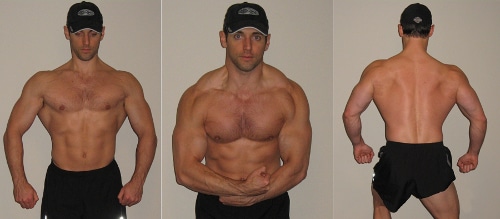
Well, for body transformation, Intermittent Fasting works. Over the course of my experiments, I dropped twenty pounds of weight, from 190 pounds to 170 pounds, and I was pretty lean to start with. I also reduced my body fat from 10% to 4% (measured via a well-validated ultrasound protocol) while maintaining most of my lean mass. And I kept it off. In addition, I saw some interesting improvements in my health profile.
You can check out my before and after pics below for some visual evidence:
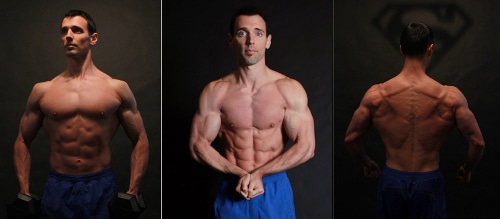
Beyond vanity, the reported health effects of an intelligently designed Intermittent Fasting program read like a laundry list of live longer, live better benefits including: reduced blood lipids, blood pressure, markers of inflammation, oxidative stress, and cancer. Increased cell turnover and repair, fat burning, growth hormone release, and metabolic rate. And improved appetite control, blood sugar control, cardiovascular function, and neuronal plasticity.
Wow is right! At this point, if your wheels are turning, that’s a good thing. But be careful. This article isn’t designed to persuade you to try Intermittent Fasting right away. Rather, it’s designed to simply get you thinking about your own eating plan. And, if it needs improvement, how you can think about starting.
Fasting Best Practices
If you’re a busy guy, work 50 plus hours a week, and spend most of your free time shuttling kids around and working the honey-do list, working out daily and eating 6 meals a day may be challenging. So skipping a few meals and looking like the Men’s Health cover model may sound pretty appealing.
But not so fast. You can’t just skip meals willy-nilly and get awesome results.
Remember, some of these fasts follow very specific protocols. Just eating haphazardly and then not eating is what gets many people overweight in the first place. But if you’re keen on giving IF a try, here are 9 things that you must first consider.
1. Food choices matter. Just because you’re not eating often doesn’t mean the basic rules of good nutrition don’t apply. Fasting for 20 hours and then spending 4 hours eating pizza, Twinkies, and half your kid’s Halloween loot won’t get you lean. You need to focus on good sources of protein, healthy fats, high quality carbohydrates, and lots of fruits and veggies. (Your mom was right about that one.)
2. Be patient. If you’re a big fan of breakfast, fasting is going to be a major test of willpower–especially for the first few weeks. In my case, the early stages left me suffering from massive stomach rumblings, hunger cravings, and big-time morning moodiness. I did my best to stave off the breakfast cravings with a few cups of green tea or coffee, but I still felt really bad. Luckily, I told my friends and family what was going on, and they’re a pretty understanding bunch. But here’s the good part. It gets better–much better–after 14 days or so. Stick it out. You’re not dying –you’re just hungry.
3. Exercise helps. The best fasting protocols had me hitting the gym as hard as ever, empty stomach be damned. There’s a reason for that –exercise drives the fat loss bus.
4. Timing is everything, but not the only thing. I experienced the best results when I fasted for around 16-hours per day, followed by an 8 hour eating window. I usually ended my 16-hour fasts with a workout. Then I ate my largest meal of the day. However, other less stringent protocols also delivered results. Experimentation is the key.
5. Progress slowly. It’s important to start with the trial fast and allow yourself to get “good at it” before graduating to more frequent or complicated fasting protocols. Many find going just a few hours without eating unbearable. It takes practice and willpower, so be patient. Dominate the easy steps before moving further up the fasting ladder.
6. Don’t overdo it. In my case, after achieving great results with a weekly fast, I tried doubling the frequency to twice a week to see if I’d get twice the results. It didn’t happen. More isn’t necessarily better.
7. Eat meat. I ate upwards of three pounds of meat a day to get my calorie and protein requirements. Now, I’ve always been an omnivore, but during extended fasts, where meals are so infrequent, eating meat is even more important. Of course, you can still do this if you’re following a vegetarian diet. It’s just more difficult to meet your calorie needs for the day.
8. It’s still a lifestyle. There are no diets, only lifestyles. And any diet that you couldn’t theoretically follow for the rest of your life is doomed to failure. During my first few fasts I was convinced that there was no way I could eat like this for life. But after a few weeks, I was loving it, and it was a breeze.
9. Some shouldn’t do it. I think anyone and everyone should attempt the trial fast. Trust me, you learn a lot about yourself when you go without food for a full day. However, for the more regular or more extreme forms of fasting, I’ve found they’re more successful when:
- You have a history of monitoring calorie/food intake (i.e. you’ve “dieted” before).
- You’re an experienced exerciser.
- You’re single or you don’t have children.
- Your partner (if you have one) is extremely supportive.
- Your job allows you to have periods of low performance while you adapt to a new plan.
Granted, these are just observations. There are folks who have kids, busy careers, and tons of responsibility who love IF. And again, the real rough period usually ends after two weeks or so. However, if it’s not for you, it’s not for you. Again, there are other ways to eat and exercise to develop a lean, strong, healthy body.
Remember the Basics
One more thing. It’s important to remember that there’s no magic pill (or magic eating plan), and when all’s said and done, mastering the basics is still your best approach. What are the basics?
- Eating good quality food. Fresh, unprocessed, nutrient-dense food is a must, regardless of eating style. So make food awareness a priority and make the best choices you can afford.
- Eating slowly. Rushing through meals impairs digestion and confuses satiety centers in the brain. So slow down. It helps control intake and improve your enjoyment of eating.
- Eating reasonable portions. When calories are controlled, progress is made. Overeating is still possible with IF, just as it is with every other eating style. So pay attention to food amount.
- Eating when you’re hungry, and not eating when you’re not. Learning to tune into your appetite and listen to your true hunger is important. Using mindfulness during meals is a best practice for healthy eating.
- Regular exercise. Of course, exercise and healthy eating are two sides of the same coin. They both help promote health and a lean body but in different ways. So use both.
Interestingly, these things are enough for most people to get in the best shape of their lives. No Intermittent Fasting required. I know that because I’ve been in this business for 20 years and have helped a lot of clients achieve success in fat loss and improving health. Very few of them did any more than the trial fast, but all of them are taught those essentials. So, if you’re a beginner, please start with these.
However, if you’re a little further down the fitness path, I will say this. For a very specific demographic–people with fitness and exercise experience who also consider breakfast 15 minutes they’ll never get back–IF could be a very effective approach. Maybe even the best approach.
Just don’t tell Mom, okay?
_______________________________________
If you’re intrigued by Intermittent Fasting and want to learn more, Dr. Berardi has published an absolutely free e-book on the subject called Experiments with Intermittent Fasting. In the book, he gets into all the different fasting approaches he tried, including details of his exercise programs and his exact eating plans, as well as which ones could work best for you. There’s also a great section on nutrition best practices and self-experimentation.


{ 187 comments… read them below or add one }
← Previous Comments
This is an interesting article, however I’m skeptical. Not just of this, but of ANY study that shows that one way is healthier than another.
As this article states, for years we’ve been getting the “importance of breakfast” speech. This article doesn’t prove that false, but it does prove that it’s not the “best” way. I think the human body is designed in such a way that it can prosper under most moderate lifestyles, this one included.
That’s why I’m not one for dieting advice, whether it’s traditional or radical. Use logic, moderation, and eat in whatever way best fits your lifestyle.
BTW Thanks for the article guys and John thanks for responding so well to all the comments.
@Kyle…I agree 110% Crossfit does interest me, I’ve been seeing new advertisements for a gym in my area regarding Crossfit.
@Derek, you are correct, however, and this is sad, logic escapes many people, which is why we are seeing such high rates of obesity,Type 2 diabetes in children and heart disease. These conditions are all preventable (to a certain extent) by, exactly as you said, logic and moderation. The key is teaching those virtues to people, especially children.
Disappointing, Brett. Add me to those who think this is below AOM (unless there’s a rebuttal article coming up).
This sort of thing doesn’t belong on AoM. Not because it’s about health and fitness, but because the author is trying to sell me a product and/or philosophy. Someone already said it but this is as bad as an infomercial. I’ll stop reading AoM if I continue to see articles like this.
I find the timing of your article interesting since I was just talking to a doctor about this (who also works out) just last week. He described the fasting period as an ‘alert’ that tells the body, you are out of food. You start to produce HGH to prepare for the hunt. You use energy (your workout) when you burn fat – just like you are on the hunt. Once the hunt is successful (the workout ends) your body is rewarded with protein, which it uses to build muscle since muscles were used to acquire the food and stopped the potential starvation. The more you do this exact pattern, the more the body feels it is doing the right thing, produce HGH, burn fat, make more muscle and starvation is kept at bay.
I’m very puzzled by the negative reaction to this post. I thought it was really interesting. So thanks Brett. And maybe I’m missing it, but I don’t see where the guy is trying to sell anything–the only thing he links to is a free ebook.
Actually, you can tell by the number of tweets and Facebook likes that lots of other people liked it too. The naysayers are simply a vocal minority that should be dismissed. I imagine they’re a bunch of fat nerds. Correct me if I’m wrong fellas.
I’m not quite sure how anything ‘fitness’ related is ‘below the AoM website’ or how it ‘doesn’t belong’ here. I’m SO confused that those comments. I happen to think that ANY man who is interested in improving his overall health and wellbeing is being VERY MUCH a manly man.
Having participated in one of JB’s programs through Precision Nutrition, I can verify that there is, in fact, a WEALTH of FREE information on his website, right along with the paid-for programs.
I’m proud to associate myself with the good doctor in that he has replied to so many of the negative (and positive) responses here with the utmost grace, honesty, and ‘manliness’.
Well done JB.
~January 2011 Lean Eating graduate :)
I too didn’t see any advertising of products… I concur with Traci, a manly man cares about his health! Also, JB did the experiments on himself, and is sharing his findings… so many health “gurus” don’t do it this way (they’d much prefer to write about stuff).
I think the negativity on this site stems from a minority of misinformed readers (or people disinterested in health).
This article makes sense, but I question the author. Is this the same John Berardi who co-authored a critique of IF less than a year ago? See http://www.jissn.com/content/8/1/4, the abstract of which states regarding IF, “Until more research is available in the physically active and athletic populations, definitive conclusions cannot be made.” More on this from Martin Berkhan, a legitimate proponent of IF for years: http://www.leangains.com/2011/04/critique-of-issn-position-stand-on-meal.html.
I’ve also used this method to get lean and I prefer it over other forms of dieting (lowcarb, etc).
@Cameron: yes it is the same John Berardi. To your question: the ISSN paper is a research review of meal frequency and does not speak at all to intermittent fasting. And the free IF e-book is a self-experiment (case study) designed to explore the topic. I’m imagining you’re a fan of Martin’s and are championing his cause here. However, if you’re a proponent of IF, it’d benefit you to read BOTH resources: the ISSN paper (which is a detailed scientific review published in a well-respected journal) and the free e-book (which is an objective review of intermittent fasting, all its forms).
@Braden: you’re doctor summarizes some of the benefits of IF quite well.
Solid article. Thanks for posting.
Cameron, this is standard practice in statistic based research. Look up any statistics textbook or simply wikipedia some of the major topics in the subject area.
Definite conclusions simply cannot be made without proper assumptions being met. That article isn’t saying that it’s wrong, just that there isn’t yet enough evidence to fully support the new ideas.
Dr. Berardi (and Chris): point well taken. My comment was unfair and I apologize. It had been awhile since I read the ISSN paper and my memory of it was not accurate. I don’t particularly champion Berkham’s method (I have a very high metabolism and very girly appetite, so I have have trouble getting enough quality cals in the feeding window.) But, having taken a closer look at your ebook, you two obviously agree on an awful lot. Props to defending your article in the comboxes.
Great Article!! I’ve been IFing for the last year and a half. I usually Fast 16 hours a day, with a 20-22 hour fast once a week. When I first started IFing; I lost 27 pounds in 60 days…I was working out 6 days a week at that time, but those are real numbers . Skeptics be damned, the results speak for themselves, IFing works.
Cool article, but I’m a little confused. Is this a daily fasting regimen (fast for 16 hrs of each day), or weekly?
I’ve been doing this for years, I was under the impression it was called “college poverty.” Hell, I’m going through a particularly rough monetary patch right now and I didn’t eat for 48 hours straight this week. At least I can take solace in the fact that I’m apparently getting ripped.
Thanks for this interesting article! This approach makes sense if you consider our evolutionary background. For a very long time, our species existed as hunters/gatherers, and I strongly doubt that there was a constant flow of meals/food. I’m sure that people experienced frequent periods of short-term fasting, followed by times of gorging themselves (with natural foods, mind you). Since, with this method, the fasting is always followed eating, the metabolism will not slow down. I was also strongly impressed by you results. While already in a good shape before the fasting regime, the after pic’s are truly impressive. Did you sneak in “cheat days” on a regular basis?
@Cameron: no problem, thanks for the follow-up.
Personally, I do not see anything wrong with this article. I’ve been a AoM reader for some time now and thought this was right in line with standard AoM stuff. The author gave a caveat at the beginning that these things aren’t for everyone and he was simply bringing new ideas to the table. That is all.
On a different note, his back in the after pics is ripped!!
@TT: The experiments I tried included a once weekly fast, a twice weekly fast, and some shorter daily fasts. I’ve documented the effects of each one in the free e-book. So, if you’re curious, please check it out.
@Mike: there were “cheat days” or as I prefer to call them, overfeeding days. The free e-book shares all the specifics of my workouts and eating strategies. Very detailed stuff in there.
John pay no attention to the whiners I am a huge supporter of this method. Herschel Walker actually does something similar where he doesn’t eat until 5 pm and then eats bread, salad, and meats. The guy is pushing 50 and is still huge and shredded. It’s also amazing how much clearer your mind works following a fasting routine.
Ive been doing crossfit and eating a healthy paleo diet for 7 months now. Lost 30 pounds of fat and feel better than I have ever before. This article has a completely valid point to this website. Being fit for any type of situate nature or society throws at us is part of the art of manliness. There’s always skeptics and people who will dis agree but they are also the type of people who wouldn’t try something new… Or so old mankind has forgotten about it.
To those who threaten to not read AoM because of this article go right ahead, you shouldn’t read this website if it bothers you that much… Or just man up!
Keep it coming!!
For years I stayed at a steady 165 lbs on a 5’8″ frame and I never ate breakfast. A couple of years ago I had to start taking a medication in the morning WITH FOOD! Within 6 months I had developed a stout pot-belly despite my best efforts. I moved my med taking to after lunch and stopped breakfast and guess what, belly gone! In my case, no breakfast does work.
thanks for the great article and e-book doc. truly impressive.
Great article. I just read Loren Cordain’s latest Paleo Diet book, “The Paleo Answer”, and it briefly touches on IF as being a more natural, evolutionarily-based lifestyle that was probably the norm for Paleolithic man (and even what few modern hunter-gatherer tribes are left on the planet) for hundreds of thousands of years: Primitive man didn’t eat 3-6 meals a day–he most likely spent the day hunting, perhaps “grazing” a bit on a couple handfuls of nuts and fruits, before gorging himself in the evening after a successful hunt. He would drag or carry the kill back to the tribe. This process would continue each day. Breakfast and lunch were probably not normal. And I agree–it’s crucial to cut out the processed crap foods–anything with grains (flour), high fructose corn syrup, etc.–even processed meats (salami, hot dogs, etc.). Keep it simple–lean meat, fish, shrimp, veggies and fruits. I’ve been eating a very small breakfast of 2 eggs and an apple or banana or tomato, and skipping lunch, then having a LATE dinner (8:00pm) of lots of meat and veggies, and have lost 20 pounds in 5 weeks. I lift and practice judo all week too.
Here’s a great way to lost weight quickly, one that works for me…eat very little. I’ve done that myself, & it work quite well.
This is Ori Hofmeckler’s Warrior Diet.
LOL!
Like WILL just said above me,
Ori Hofmekler has a book out on this very subject. “The Warrior Diet”. Its a pretty good read, and he does a good job of convincing you of how Intermittent Fasting is a more natural and evolutionarily logical way to eat.
He offers analogies, anecdotal, and scientific evidence for his claim.
One of the most powerful of which being that humans today, especially Americans, are nothing more than scavengers, pacing through grocery stores trying to pick out which of the Nutritionally defecient, dead foods they are going to buy for the rest of the week.
“If your not actively surviving, your passively dying”
The commenters on here who seem to be almost violently against this idea need to step outside of their box for a couple.
I had a friend that lost 60 pounds doing something similar…he called it cycling his calories.
He would limit his calories on one day, eating a mostly liquid diet, and then the next day would eat a regular, healthy diet.
The idea was that your body was always guessing as to to the calorie content it would receive and never be able to adapt and plateau. It worked for him and the advice in this article is very similar.
I´m gonna try this week and report!!! No eating all day, box training and a big dinner with meat or fish, vegetables, brown rice and fruits!!!
Sound like IF is keeping you in a ketonic state more often. All the same principles as low-carb diets seem to be in play.
Great article for AOM, not sure why people are complaining.
To all those accusing AoM of selling or pandering a product/philosophy, breeze over the topics for the last 100 entries. Ways to improve yourself as a man mentally, physically, emotionally and spiritually. Fasting is as old a practice as making wooden swords and throwing knives and is proven to be extremely healthy for your physiology. This is just a recent study by a doctor who has personally tested and documented a process. I didn’t see complaints like this on the zombie survival shotgun. That was a clear cut product!
Well I just think this works simply by negative energetic balance.
You dont eat calories, you lose weight.
Off Course, no carbs etc = Fat loss.
Simple as that.
I always thought not eating to lose weight was called anorexia. In fact the dictionary describes anorexia as an emotional disorder characterized by an obsession to lose weight by refusing to eat. Now I get that this is a choice and it’s a here and there sort of thing but it really just sounds like a bunch of Hollywood stars trying to make there obsessesions with not eating to be discustingly skinny,justified. “it’s not anorexia it’s IF, you should all do it too.” scary scary dangerous slope if you asked me. The life of a man is about balance. It’s not about being an underware model, it’s about being responsible and it’s about being fit. This story belongs on a health and fitness specific site. It’s about obtaining a specific look, not about being the best man you can be. And all the people I know that have avoided eating for long periods of time off and on have all ended up gaining wait in the long run because it becomes a quick fix instead of a healthy life style choice.
I’m a chemist and it funny that six weeks ago I reread my biochemistry text to better understand metabolic pathways and I thought this whole eat many small meals makes no sense at all because we just feed our body constant glucose and never burn fat. So I started eating less, less often and it is going great. I really didn’t think of the window but my window has been from 6:00 to 6:00 and now I’m going to cut that down to 10:00 to 6:00.
The hardest part for me is not the fasting (I’ve been doing that since I was 10), but it has been hard to learn how to do a hard fat burning workout while hungry but I’m getting it slowly.
@ Dan Byl\
I totally disagree and agree at the same time. If someone is just starving themselves then it is a problem. But I met an anorexic once that was eating like 500-1000 calories a day and her body was just destroying itself and had to be hospitalized.
Since I’ve started doing less meals and less calories, I’ve become more disciplined. I track my calories and I use a Heart rate monitor to track how much I burn. This is not a matter of starving myself and devoiding myself of calories but choosing when to consume those calories. The best part about restricting myself from eating outside that window is I’ve learned to control snacking which is a huge problem because that’s where chips and cookies come in.
This diet is working well for me, I eat breakast and lunch every day. My grocery bill has gone down over 50%, and I have more time and energy.
I have never seen a before/after picture done right: same lighting, same background etc. The before picture is always wearing a cap with dim lighting. The after is always bright lighting, well combed hair etc. At least in a blog that does not have any commercial incentive you could have done the before/after picture correctly.
From the “About” page: “My idea for the Art of Manliness came about as I was standing in Borders bookstore looking at the men’s magazines [...] with more and more articles about sex and how to get six pack abs. Was this all there was to being a man?”
This article seems to be just the kind of thing one would find in the aforementioned magazines.
@Michael
I agree with you, im not getting the negativity. I find this article interesting. When i was in the military this IF was a practice i saw in many people. I don’t think this article is trying to say that IF is the miracle cure all, i think its just putting it out there for people to try. Everyone is built differently, and IF may not work for some, my uncle eats around 6 times a day, thin and fit he is! That wouldn’t work for me, I’ve tried it.
It’s sad to me that so many people have complained about:
-the before/after pictures (I’m pretty sure it’s not lighting tricks that got Dr. Berardi’s erectors, traps, and lats to look as shredded as they are)
-an article encouraging people to learn more about nutrition
-looking at the title of the article and assuming ‘Fasting’ means starving yourself
-Thinking that Dr. Berardi is a huckster as opposed to a scientist and a coach
I just imagine a bunch of overweight Internet Tough Guys getting their panties in a knot about this article and thinking how not-manly that is.
The before/after lighting is ridiculous! When I saw that, the article lost what little credibility I gave it.
The after photo uses a single light source with no ambient light, which creates heavy shadows. Heavy shadows exaggerate features. Art 101.
Side observation: Why is there a hidden Superman logo in the background?
Ori Hofmekler created a similar fasting concept. “The warrior diet” the reasoning behind why it works is a bit sketchy, but it really works. I lost a good amount of fat doing the diet, I got shredded actually… but I crashed. Literally. I was pulling out of the parking lot, and turned right into a parked truck. However, during this time I was also working at a meat market, which can be pretty tiring in itself at times. :) The good think about the diet was that it allowed me to eat whatever I wanted for supper for 3 hours! I gorged and gorged at night. From 6-9 And still lost weight. It was nice to have a feast every night.
i love stuff like this ill be starting today
Just began this fast last night at 6pm. Woke up this morning a pond less. Hoping this will help me break a Plato I have hit for the last few weeks. I’m at 206 (well 205 this morning) and trying to drop to 195. Started at 290.
Hi just wondering what is the green drink stuff you talked about in the ebook?
Is this necessary?
This article sounds like complete quakery to me. Fasting WILL cause you to lose muscle, no matter the other effects.
The benefits of intermittent fasting are the real deal and we are all going to hear about them more and more in the next couple of years. We are trying to integrating IF in cancer treatment as it likely increases the effect of radiation and chemotherapy and actually may help fight cancer.
Hypoglycemia anyone?
Thank you, John, for the interesting article giving a new perspective on the dietary standards that are practically dogma for us who pursue physical fitness. I follow the programming for Crossfit Football. It is essentially a Crossfit style conditioning program geared towards developing strength and power for those who compete in sports where such attributes are a high commodity. It involves a linear progression of strength development in both traditional power lifting and olympic weightlifting, along with metabolic conditioning like the typical crossfit workout, except with heavier weights, shorter sprints, and for shorter durations. In your experience, would you recommend the IF protocol to someone looking to primarily develop greater strength and athleticism over aesthetics, or would the more traditional dietary habits be more beneficial?
This is a very interesting article. Up until I graduated college and “got a real job”, I wouldn’t eat until about 4pm each day – then, ate a substantial relatively healthy meal. I had about 7% body fat and was very healthy. I started gaining weight gradually as I started eating lunches with colleagues and breakfast. Hmmmmm.
This makes total sense when we think about how humans evolved. It’s hard to imagine that hunter/gatherer cultures had an ingrained “Breakfast, Lunch, Dinner” thing. They ate when they had food, and fasted when they did not.
More often than not, that food was a mixture of meats/fish they’d hunted and vegetables/fruits they’d gathered.
It makes total sense, then, that the human body reacts favorably to IF. It most closely mimics the intermittent fasting of hunter/gatherer societies.
Good read, comments included. I have enjoyed the benefits of fasting for a few years now, clarity of mind, attitude of gratitude, and leaner physique to name a few. Coincedentally, I am coming off of a 24 hour fast this morning, and feeling like a million bucks. Historically speaking, the idea of three meals a day and few snacks is a newer concept than fasting. Not to mention the appearance of 100 flavors of everything and sedentary lifestyles. I suspect western societies have more food choices today than all other time periods combined. I wonder where morbid obesity falls in that timeline? Frankly, most people need to stop eating.lThe biological argument is, if it is true the human body naturally stores fat for energy reserves, then fasting creates the setting for this function. So doing what your body has prepared you to do is very natural. An argument can be made that since this is a built in feature of the human body, then it is more natural not to eat on occasion.
I’ve had success for a long time incorporating what I call “mini meals” when my weight goes up a few pounds and I need to get back on track. Usually, I’ll replace my normal dinner with a cup of yogurt and an apple or something similar. This might work better for those who want to start with something easier than a fast.
So this all sounds great but would drinking a protein shakes/meal drinks be “cheating”?
I was skeptical at first, but I decided to put that away and give it a try. I kept working out the same as I had previously (bodyweight exercises (some weighted), intense cardio) 5 days a week and in 2 weeks with this lifestyle I have lost 5 pounds. At first it’s horrible and you want to eat A LOT, but I never like giving up on anything and it pays off.
With this said, I did NOT change my workout for this diet or did I change my diet at all. With my workout and previous diet I hovered around 200-203 at 6ft tall. 2 weeks later I am 195 and dropping. My abs are showing much better and am getting alot of vascularity in my biceps that was previously not there.
Stop being a critic (teddy roosevelt) and step into the arena!
Gentlemen,
This article is life changing and groundbreaking. Feel lucky that you read it on this website. It has changed my life. I didn’t buy a thing. I feel better. I lost some stupid stubborn pounds that I have been struggling to get off (28 years old 6ft 1in 240lbs in 2006 185 in 2012) It builds discipline (which every man needs) Thank you AoM!!! And John Berardi! P.S. Doing 20 off 4 on…..5 days a week…free weekends……MAKE IT WORK FOR YOU!!
@Ben: If I recall correctly the Zombie Survival Shotgun post attracted so many negative comments and they were so vociferous that a number of them were deleted.
@Stephen-
Comments are not deleted for disagreeing with the author of a post. They are only removed if they violate the comment policy. No comments have been deleted from this thread.
I have Type-II diabetes and have found fasting lowers my sugars and allows me to feel better, more alert, and able to go out and eat that high-protein steak and dessert without fear of my glucose going through the roof.
So yes, I do recommend fasting, especially in diabetics to flush the toxins out.
I used to eat like this and i was in the best shape of my life. only 3% body fat and i could work out all day long. I have since stopped and began to eat like a normal person. I feel more sluggish then ever. I can verify that this works when done properly and i am very happy AoM put this up. He is not selling anything, i do not understand the confusion. Great Article!
I am in my second week of the program. I fast 20 hours, eat 4 hours. I do not limit my diet during the feeding times, but try to keep a high intake of protein and vegetables. I lift 3 days, do HIIT 2 days and run 5 miles every Saturday (I am training for Tough Mudder). I have kept detailed notes and weigh/measure every week.
I can say that I have felt great for the duration (I am going to do a full 30 days as a test). I only get “hungry” around 2 PM, but they quickly passes. I have a tendency to get irritable at times, so I have to keep an eye on that with my children, but otherwise everything else is fine. Also, an unexpected effect is I seem to sleep better and feel more rested in the morning.
And as a point of clarification, I downloaded the article from Precision Nutrition for free and without giving my email. The article is helpful and full of anecdotal and scientific information that is ultimately helpful if one is interested in this lifestyle (that’s what it is, do not confuse this with a diet).
Thanks AoM and John Berardi for this life-changing article!
Thank you for sharing your self-experimentation.
This has been a very intriguing topic as of late for me. I can’t wait to start my own experiment with IF in two weeks.
The “basics”, as you call them, are: eat less calories than you burn and you will lose weight.
How to achieve that is up to everyone’s personal taste, no matter if it’s low carb, low fat, South Beach etc. The diet you lose weight on simply is the one you can sustain.
To sell people that intermittent fasting is the premier way to go, is a bit farfetched – for some it might not be ideal.
@Evilcyber- this is true, but this isn’t a regular diet perse. If you want to lose weight and go from fat to lean…try something else. But if you are lean and want muscle definition and striations and vascularity…I am living proof that this is the ideal. I went from 205 to 194 in 3 weeks and it was ALL FAT pounds. I didnt change what I ate or my workouts, just simply the times in which I ate and utilized that food energy to my advantage. Trust me….this works.
I’ve been doing this ‘fad’ on and off for the last 2 years or so… I will say. I’m 6’1″ and when I decided to start and lose the weight, I was at 221. The lowest I ever got was 184. And I by no means looked ‘unhealthy’. Now I hover around the 190-195 mark at any given time… It does work.
this is a great article, i have been researching IF for a couple of months and will begin October 1st by skipping 1 days meal p/week, along with my normal routine of muscle building and minor cardio at the gym 3 times p/week,
i look forward to getting rid of some stubborn tummy fat!
I like the article and dislike the pictures. They are intentionally set up to have the second set look better. Different background which brings your eyes to the subject, hat vs no hat, in the second picture his chest is shaved and the lighting is better. Plus all three poses are different. The few tricks you didn’t use includes smiling more and additional tanning. Why not intentionally keep the variables listed the same to really illustrate the gain from IF. Instead you choose the same deceptive pictures that a generic diet pill company would use, so you cheapen yourself and lose readers trust.
Love it!
Ive been a yo yo dieter for years and always been into fitness ( or enjoyed it) I finally decided enough of counting calories and eliminating the world from my diet.
I got a trainer and he has me set up on IF for 12-15 hours a day ( which isnt that hard when you have kids as long as you have access to a microwave and fridge at work) I make my breakfast the night before and dont eat till after 9 am and before 1030 am. It took me a few days to adjust to the change and plate fulls of vegetables I eat with every meal as well.
However, 4 week… 10 lbs lost.. one dress size gone and my weight lifting has went up 125% in most of the exercises!
Its a great lifestyle change I wont go back!
I’ve been doing 24 hours on, 24 hours off fasting for a bit over a month now, only I make the change-over between the days at 12 noon instead of 12 midnight. That basically means I alternate between 1 meal and 2 meals per day.
The results have been fantastic. I’ve lost just over 2 lbs a week. I feel great, with a lot more energy than I had before. I don’t feel more than pleasantly hungry at any time. There’s no temptation to binge on the non-diet days. And I actually enjoy being on the diet more than being off it!
if i fast from 8-12 can i take a preworkout before my workout ?
This article isn’t about manliness, it’s about vanity.
I’m a firm believer in IF an promote it on my personal blog too. What I don’t understand it why people are willing to kill themselves by ‘trying out’ all kinds of drugs but when it comes to IF, they start ranting about how bad it is when they don’t even give THAT a try…! I always advise trying it for at least 7 days and the ones that do, will decide for themselves.. for sure!
Hi,
I’m finding a hard time placing the workout at the end of the fasting period, followed by the big meal.
I leave for work at 8:30 AM and arrive home at 7:00 PM, some times later.
Supposing I start eating my big meal after workout at 9 PM… that means that will be my only meal in the day, because at 11 PM I go to sleep.
Do you have any suggestions?
Thanks!
Very solid article about a current topic.
I have been using IF for 9 moths coupled with a Paleo diet.
45 lbs and counting. It works and MUCH more important are the incredible health marker benefits you laid out. Superb book, “Eat Stop Eat” by Brad Pillion.
For those who are upset – buy some new panties and go elsewhere.
I gotta say this worked for me! I was doing the IF for the past year without even realizing it. My lifestyle had me busy and eating once a day was about all I had time for. I was also walking 2 miles a day to get to my job. When i did eat, it was high protein and dense in calories. What I found was I had more energy, was building muscle very quickly and by about the 9 month mark, I had dropped roughly 50+ pounds! I have spent years trying everything to drop my weight down; exercise, diet, etc……you name it, i tried it. This was the only thing that worked for me. I will stress everybody’s body is vastly different so what works for one may not work for another. My body just seems to respond well to this method. It was easy for me to maintain, and i see and feel the results!
The only thing I disagree with is the exhortation to eat meat: I get my protein macro number up through eating 93% WPI (93% protein, as opposed to the **less-than-manly** 28% for sirloin). Meat has a lower BV than WPI too – in fact Reggiano cheese has more protein per gram, and better BV, than steak.
I don’t wash it into my system as a liquid: I make protein bars using 1 tablespoon of rice milk on 40g of WPI per serve, plus some grated toasted coconut, some coconut oil and some toasted nuts… you get a forearm workout just from mixing it up and if you buy Choc-Honeycomb flavoured WPI93, it’s tasty as hell.
That’s the ONLY departure from almost-vegan that I make, and I’m 6’1″, 225lb (still WAY fat, but hella strong), RHR 58 and V02max 47 (so passably fit at 48 years old next Feb).
IF works, but it can be derailed easily in the early going… life gets in the road a lot, and it gets in the road of new stuff first. I dropped 14lb in the first 2 weeks, then our household went into slight disarray as The Lovely prepared for the Bar Exam (she aced it of course) and I fell off the IF wagon. I deliberately ‘punted’ during the festive season, but will get back to IF in the next week or so.
My ad hoc anecdotal comparison: IF (+HIIT) works better than Spectriol/Stanazol (I used that in the late 80s) and better than ECA (I used that in the 90s… I hated cardio until I discovered HIIT).
Had to post my results thus far for the week.
I’ve had some very stubborn love handles and lower body fat that has been driving me crazy for months regardless of what I do in the gym and following the “6 meal” throughout the day plan.
Monday, I started IF doing the four hour window program making sure right after my workouts, and during my window, I eat solid proteins (tuna, chicken, and beef are my main ones) with veggies/fruits/walnuts sprinkled in there. Today, Friday, I can already see impressive results not only in my problem areas I’m trying to melt off, but also in my overall muscularity.
For me, it’s working. You can’t argue with results just after one week. I’m very excited to see what happens after a month. I’m also very surprised that I do *not* feel hungry like I thought I would throughout the day. I think drinking 1.5 gallons of water daily mixed with either lemon/lime slices helps out.
Great article, thank you.
I am nearing the end of the trial fast period that was recommended in the article. One trick that works very well for me is to keep telling myself not to mind the feeling of hunger. The feeling of periodic hunger is nowhere near as bad as the feeling of physical and mental discomfort caused by constantly overweight…
I have a quick question about the 24hr fast. I do it once a week, usually my last meal is Tuesday at 4pm until Wednesday at 4pm. Wednesday is my rest day and I usually consume 1800 cals that day (-600 calorie deficit). Does not eating for 24 hours calculate into a -2400 calorie deficit? And, will it still be a 24hr fast if I eat the 1800 calories post fast?
Don’t discredit until you’ve tried it. And by ‘try’, I don’t mean skip breakfast once and gripe about how hungry you are – read up on fasting and do a one-day fast every week for a month. If you’re still not a believer (and I’m sure you would be), well now you have a little bit of credibility.
I took up fasting…oh, about three years ago now. I do a 36-hour fast once a week, and every few months I’ll do a three-day fast. I’ve gotten to the point where I can’t not fast – it increases my mental alertness and gives me more energy for the rest of the week. It’s amazing too – fasting periodically will recalibrate your stomach when you’re eating again. You’ll actually want to eat healthy stuff in healthy portions. For all those negative commenters, you don’t have to experience this all for yourselves, but don’t try to tell me it’s hogwash with no evidence.
Thanks for the article, John!
Thanks for providing the most succinct and accurate summary of IF protocols I’ve found to date–without any of the attitude that certain well-known proponents of this method seem to display! To augment what you’ve said, I note that I’ve had great results mixing it up with fasting periods. So I might do no fast one day, an 18 hour fast another day, all the way up to a 24 hour (sometimes a bit more) another day depending upon whether I feel hungry or my workload. I’ve lost about 35 lbs. of blubber this way. And of course, I lift heavy, 5×5, at least twice a week to keep my lean mass up, and avoid empty carbs like the plague.
So during the 8 hour re-feeding window do u basically just hit all ur macros u would usually be hitting throughout a whole day? and so in that 8 hours u just eat like almost every hour?
← Previous Comments