





A few months ago, Craftsman flew me up to Chicago to visit their Craftsman Experience shop for a blogger summit. (If you’re ever in Chicago, I definitely recommend stopping by the Craftsman Experience and checking it out. It’s free and open to the public.) I spent the day playing with tools and learning how to build various projects under the tutelage of several DIY bloggers. One project that I really enjoyed and found pretty dang useful was from Timothy Dahl, owner of the DIY blog Charles and Hudson.
Timothy showed us how to make a simple, yet sturdy sawhorse that even a handyman noob like myself could build without screwing up too much.
Why Do I Want to Build a Sawhorse?
Good question. Sawhorses come in handy in a variety of situations. The first and most obvious situation where a sawhorse is useful is when you need to saw something. Duh. A sawhorse gives the board you’re sawing the support and elevation you need to make a clean cut.
A pair of sawhorses can also be used to make a makeshift work table or scaffold. Just use the two sawhorses as the legs, and place a sheet of plywood over it. When I worked as a painter one summer back in high school, my boss would use a pair of sawhorses and an old door he found on the side of the road to make his worktable. Makeshift tables from sawhorses particularly come in handy when you’re setting up for a garage sale.
Let’s see. Other reasons you should build a sawhorse… How about for a makeshift seesaw? Or what about using it as the fulcrum for a home defense catapult? Just spitballin’ here.
And while you can certainly buy ready-made sawhorses at your local big box hardware store, you miss out on the fun and satisfaction of building a piece of equipment that will serve you for years to come.
Materials
Here are the materials Tim recommends for his sawhorses. It’s enough to make a pair.
- Six 32½-inch 2x4s (for the I-beams)
- Eight 30-inch 2x4s (for the legs)
- Twelve 3-inch wood screws
- Thirty-two 16D galvanized nails
How to Build a Sawhorse
Building a sawhorse is super easy. It makes for a great starter project for the man who has never really worked with tools, but wants to become handier around the home.
Note: This is one way to build a sawhorse. I know there are plenty of other ways to do it. This plan is great for everyday use in a typical suburban garage. If you plan on using your sawhorses for heavy work, you might try another design.
1. Measure and Cut Your Timber
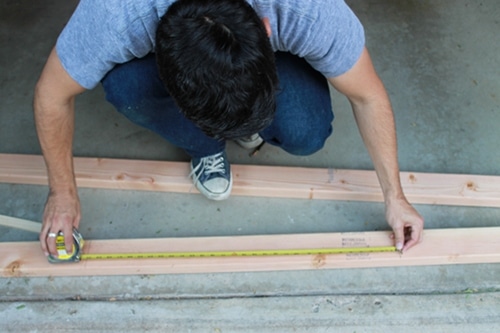
The 2x4s I bought came in lengths of sixteen feet, so I had to cut them down to the needed sizes. Here I am measuring and cutting 32½-inch pieces for the I-beams and 30-inch pieces for the legs. Remember to measure twice and cut once!
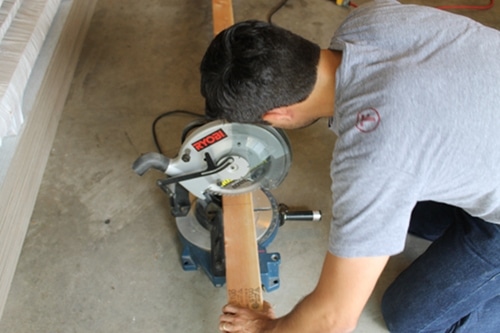
Here I am using a portable compound miter saw to cut the timber. You can use a hand-held circular saw or even an old-school handsaw.
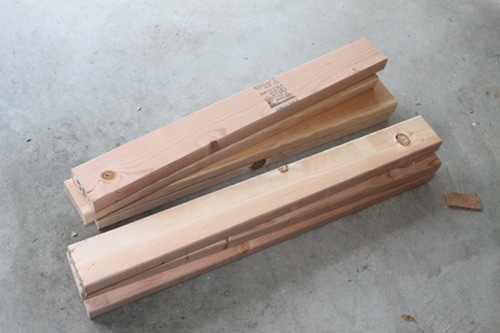
Ready to be turned into a sawhorse
2. Build I-Beams
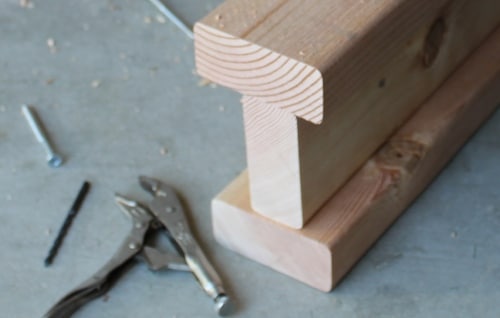
Take three of your 32½-inch 2x4s and screw them together in an "I" formation.

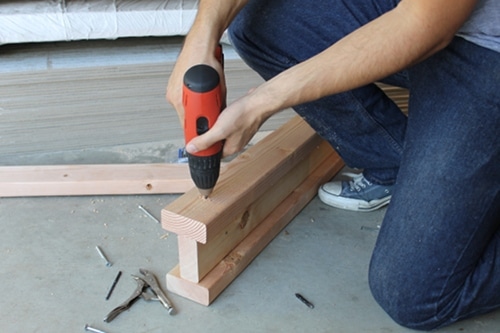
I found it helpful to drill a pilot hole before driving the screws in.
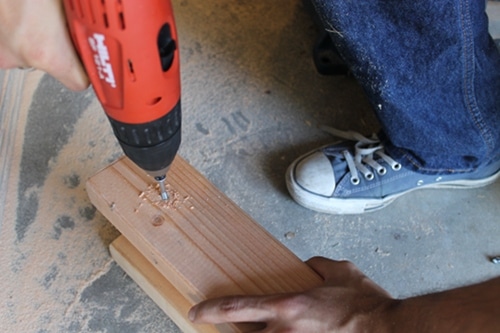
Drive three wood screws right down the middle on top and bottom of the I-beam. Place two of the screws near each end and drive the other one right in the middle of the I-beam.
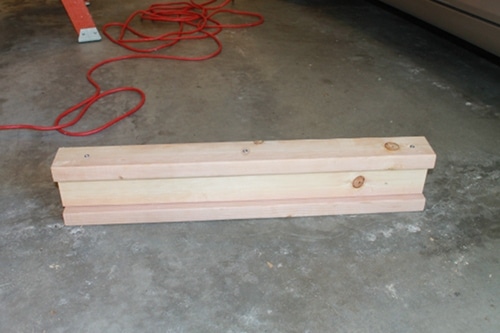
Finished I-Beam
3. Nail the Legs to I-Beam
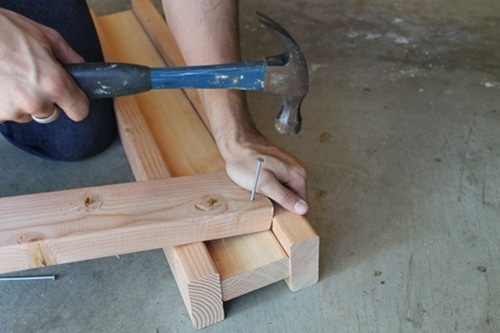
Butt the end of the 30" 2x4s into the top of the I-beam like so. Hammer two nails at the top of the leg so that they go into the middle I-beam piece.
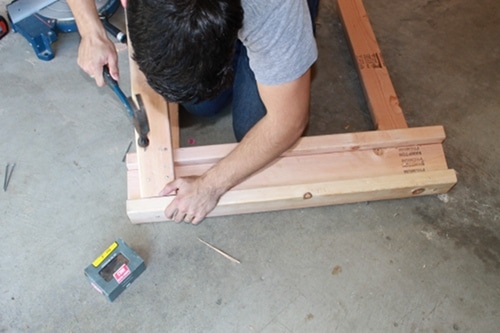
Nail two more nails into your leg so that they go through the bottom I-beam piece.
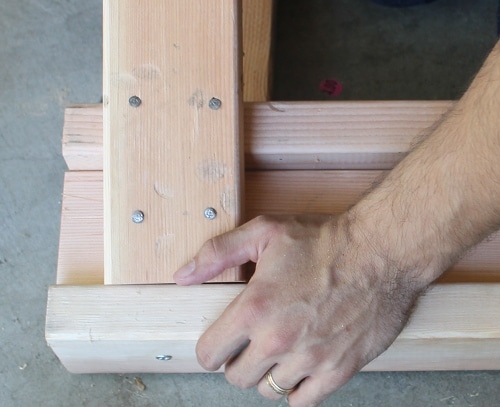
If you've done things correctly, you should form a box pattern with your nails. Notice my hammer dings in the wood. I need to practice.
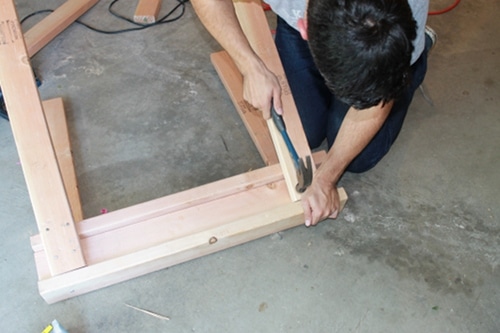
Repeat for each leg.
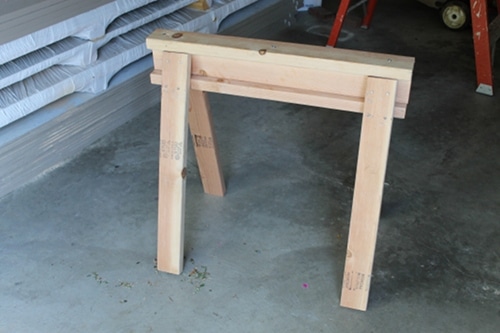
Completed Sawhorse

My finished sawhorse. Rinse, wash, and repeat to make your second sawhorse for a pair. To store these bad boys, just stack 'em.
Have fun!


How to Make an All-Purpose Work Bench


{ 50 comments… read them below or add one }
Nice post, that’ll work swell. I like to grab a pair of these to make sure the angles are perfect:
http://www.google.com/products/catalog?q=sawhorse+brackets&oe=utf-8&rls=org.mozilla:en-US:official&client=firefox-a&um=1&ie=UTF-8&tbm=shop&cid=5932783600227933773&sa=X&ei=w0dyTpKwKMylsQKmj8XVCQ&ved=0CHEQ8gIwAQ
For two bucks, can’t beat ‘em.
-Sam
Yep, the classic saw horse, couldn’t get much simpler.
Since you used screws to hold together the i-beam why not just use screws to attach the legs as well? They would certainly hold better.
What Tim said. Nails tend to pop out over time whereas wood screws stay put.
…or use a combination of screws and nails. Best of both worlds.
Well done Brett!
The above comments are right. You could certainly use screws for the entire job and it would definitely be more secure but this example demonstrates that how “quick and easy” this sawhorse is to build with whatever materials you have available, especially on a jobsite. Every jobsite typically has a framing nailer which also makes the setup even faster
Great work, as usual. keep it up!
Very well done indeed. This is an area of glaring deficiency for me, since my four year-old son is quickly becoming more tool savvy than I.
A Hilti, Brett? oh boy…..
I’d bury the screws on the top of the sawhorse halfway through the top most 2×4. Use a forstner bit or just a drill bit with a larger diameter than the head of the screw to create a 3/4″ deep ‘pocket’ before drilling and driving. Hitting a screw head with a circular saw is no fun!
Also, I think the idea of using nails rather than screws on the legs is so that they do work loose a bit. A little bit of flex in the legs makes it easier to set up on uneven ground. And you can always pound the nails back in when you need to.
This is actually one of the strongest ways to put together a sawhorse–fastening to the bottom of the I-beam ensures the strength. You can set an entire bunk of plywood on a pair of those! They’ll outlast the “heavy duty” plastic ones by a mile. I’ve had one pair in constant use for six years running, the only thing I do differently is add a couple of cross pieces toward the bottom of each pair of legs, and then a 2×4 across those (parallel to the I beam). Then you can store material under the saw horses too–off the ground.
Oh, and it’s easier on your back to make the legs 36″ tall unless you are exclusively using a handsaws.
A nice easy and quick way to build a saw horse. I agree with BenG to take it up a notch, nice, sturdy, and practical.
Very nice Brett, good job!!!
This is the best design for dead simple, cheap saw horses that I’ve seen and they are probably great if you have the floorspace, but I’ll stick with my trusty folding steel ones with the 2×4 screwed to the top. They hang on pegs when not in use
One detraction to bracing the legs, though, is that you can’t stack them.
Would it not be the easiest thing in the world if you cut 14 pieces that were all 33 inches long?
I agree with the above poster. Is there a benefit to having the legs a bit shorter than the i-beams are long?
@BenG
Not necessarily. You could put a box around the bottom on the outside of the legs. If you go low enough, you could still stack them.
At least, it works in my head.
If you put a compound angle on the legs, it will make a much stronger sawhorse. Not quite as simple, but worth it. I have a pair of trojans http://www.trojantools.com/catalog.htm they’re nice, but spendy
Nails vs Screws – It just wouldn’t be a complete “man project” if you didn’t get to swing a hammer at least a few times! LOL. The ladies and kiddies have to get the full experience by hearing the whirring, buzzing, and finally the “bam! bam!” of the hammer to truly respect and appreciate the manly skill! Hehee!
Man stuff is cool!!!
These look pretty Sweet. I made some myself a few years back and have used the heck out of them. I wonder how I got by without any for so many years. Great post!
Thanks for the article. I’m always looking for a fun little project and I just happen to need a saw horse for some other projects.
On my way to the lumber yard, making this today.
Love it…very simple design that doesn’t involve any miter or beveled cuts… The I-Beam is great because now you have an excellent surface to clamp to when working with other pieces of wood.
Now I just want a simple ‘sawbuck’ how-to :)
If you move the legs all the way out to the edge, you can add bracing on the outside and still allow for stacking.
As Emdash said above, the use of nails on the legs is to give some wiggle to the legs to make setup on uneven surfaces easier.
As said above, the use of nails on the legs is to give some wiggle to the legs to make setup on uneven surfaces easier.
Uh I just use the plastic manufactured kind from Stanley. The height is adjustable so I can make them the same height as my table saw and use them for in feed and out feed support. I have four of them for supporting 4×8 sheets when I need to cut them.
I just use a set of metal clamps designed to make a sawhorse. Just slip in the 2×4′s. Far easier to assemble and store. Not as manly though.
This reminds me of my dad and when I was younger. He was a carpenter and always had several sets at the house he was working on or a couple in his truck. This are fancier than the ones he ever made as he had the “i-beam” be one 2×4 that was vertical and the legs would be nailed or screwed directly to the side, but would have miter cuts on the ends to make the line up and angle out correctly. He would then take the 2×4 scraps he had and nail them on the legs as cross beams, maybe cutting them down a bit for a better fit. It wasn’t pretty, but he really didn’t want pretty. He could keep his skill saw at a deep level and if it cut through it would just hit the 2×4 underneath a bit. The would usually go in the scrap after the house was completed.
Thanks for the memory!
We’re planning to repurpose an old beat-up pair of sawhorses to support a double (meat) rabbit cage so bring it up to a better height. We’ll attach it to the the sawhorses to prevent it from being knocked off and probably tether the cage to the wall of our henhouse to keep it from tipping over. We keep worm compost bins beneath the cages to catch the droppings and use the resulting”black gold” in veggie beds.
I think that a saw horse should be collapsible for easy storage. It also makes sense if there is some kind of hold of the item to be worked.
I would thus suggest that you cross the legs close to the top, and bolt them together, so they can fold out, when used, creating a V on top, in which the item rests, secured while being worked. When storing, just fold together and put away flat.
Easier in every way.
emdash is right about the screws in the top. One of the main uses for a “sawhorse” is supporting wood that you are cutting with a saw. You will be running the saw blade through the top of the horse. And the screws, sooner or later.
Are you serious? First of all with the I beam they are too heavy. Secondly without any leg bracing they are going to fall apart with weight on them. Thirg the legs should be beaded so they spread apart. Plywood gussets would make things a lot more stable.
My uncle was a journeyman wood worker and carpenter foreman on a lot
of different kinds of jobs. When a new man would show up for work, he
would be sent to make up a couple of sawhorses. Uncle would know
in about ten minutes what kind of worker he had.
Great and simple collapsible horses!!!
Simply lie two 2×4′s on the ground parallel to eachother a bit longer than desired height of horses(these will be your verticals). Screw a 2×4 perpedicular to the other two, at their ends. It’s length is determined by the desired width of your horses(horizontal brace). Screw another 2×4 approx. half way down and perpendicular to your initial two parallel vertical supports. Repeat this process three times for a total of four matching. Next lay two of these end to end, horizontals facing up. The top horizontal braces should now be parallel and next to eachother. Attach with two old door hinges with the cylinder of the hinges facing down. Fold, the wings of the hinges should point down. Drill a hole through the center of each lower horizontal 2×4 brace. Feed a rope through both holes and knot one end. Open horse until you are satisfied it will be stable knot the other end. Repeat for your horse’s mate. Now you have collapsible horses!!
Always remember to set your saw blade to the correct depth!! This is important for cutting anything on any surface, be aware of what you’re doing and where you are cutting!! woodcutting blades and metal do not mix.
Yesterday I couldn’t spell carpentar today I is one!!
If you wanted to brace them in a way that would allow you to still stack them, use 1×2′s and angle the ends to match the angle of the legs and put them between the legs rather than the inside or outside.
Nice horse, hoss. If you prefer a folding variety, I’ve found a great guide at the teardrop trailer forum I frequent: http://www.mikenchell.com/forums/viewtopic.php?t=35699.
Thanks!
Gonna make these with the kids. They’ll continue to think I’m some kind of g-damned genius!
Just wanted to let you know that this site is still getting traction – whipped up two of these as a precurser to making a table this coming week. They have already proven themselves to be indispensible!
http://sphotos-c.ak.fbcdn.net/hphotos-ak-ash4/420473_10151042577931176_901537866_n.jpg
thats a great idea but it needs a few simple changes if you want it craftsman grade.
1st of all no nails. wobble you can get by loosening a screw. and as we all know undoing screws is a much more pleasant pastime. and sooner or later everything has to be disassembled.
2nd in agreement with post above, plywood gussets are a must for strength. that long lever arm even on a screw will loosen it in no time.
3rd you want the top rail of the i beam wider than the bottom, say top a 2×6 and bottom a 2×3. that will allow you to position a clamp anywhere along the top rail with no bottom interference.
4th the bottom rail should be not as long as the top rail for the same purpose on the ends.
5th the tops and bottoms (bottoms not as important as tops) of the legs should be mitered at 15 degrees so the legs fit snugly up to the top rail (assuming legs are 15 degrees from vertical).
6th for easy storage connect the gusseted legs to the ibeam with 2 screws into the middle and bottom piece ends of the the ibeam at each end. undo in 60 seconds and store anywhere. and even assembled they can be stacked with gussets of upper resting on top rail of lower horse.
words are good, but a picture is clearer. will post a picture on my website sometime later this week at http://www.panamrx.com/enter/catalog/images/horses.jpg
Once the nails pop out on the leg tops, one can hang a number of tools on them. (Coping saw, hack saw, etc.).
I am going to build one of these today. This design looks fast to construct.
Thank you!
The plans are good, but I changed it up a bit to use up recycled materials I have. I’m a newb to this stuff and this was my first job with my new Ridgid circ saw. Had a fun time. Enjoy! [IMG]http://i.imgur.com/oI09l.jpg[/IMG]
Woops. That link didnt work. This does though: http://imgur.com/oI09l
piece of junk don’t make something out of nails in less you only want it to hold for a little while, coming from a carpenter for thirty years buy the store bought ones and replace the board on top when is get old this wouldnt last 1 month
Cant the legs out wards at 5 degrees or so..
Don’t hold a hammer with your thumb along the back spine of the handle- you will break it eventually.
http://standup2p.wordpress.com/2011/07/31/hammer-2/
Glue the top flat Ibeam 2×4 and remove the screws on the top when you are done- then you can use these without destroying a skill saw blade..
If you can, do install plywood gussets.
If you must use nails to act as tool hangers, put them on the inside of the legs- or be prepared to rub your jeans on the protruding heads,
Hi, nice job.
Following these very measurements, how tall does it end up being?
Thanks for putting this up! It was just what I needed, I was in a hurry and this was just perfect. Have a great day and keep up the good work!!
Jim