I grew up around guns my entire childhood. My dad was a federal game warden, so seeing him holster up or clean his gun are some of my boyhood memories. Despite being around guns, I never really took an interest in them. I’m not sure why. I guess I just saw them as my dad’s work stuff. Nothing to get really excited about.
A few months ago, I had a sudden urge to shoot a gun. I called my dad on the phone. “Hey Dad. I want to learn to shoot a handgun. Can you teach me how?”
He was sort of surprised.
“Why do you want to learn to shoot a gun all of a sudden?” he asked.
“Oh, I don’t know. It’s just something I think I should know how to do.”
So my dad took me, my brother, and my wife, to the gun range and showed us how to fire a gun.
It got me thinking. I know I’m not the only man out there who has gone their entire life without shooting a gun. For some of these men it’s a deliberate choice. They don’t want anything to do with guns and that’s cool.
But I’m sure there are a lot of men out there who have never fired a gun, but like me have the desire to do so. Or maybe you never shot a gun, but got invited to the gun range by some buddies. You want to go, but you don’t want to look like an idiot when you handle the gun. You’d like to have an idea of how to fire a gun safely and correctly before you go.
To get the lowdown on how to shoot a handgun safely and correctly, I headed over to the United States Shooting Academy in Tulsa, OK and talked to Mike Seeklander, the Direct of Training at the Academy. He explained the basics of firing a handgun so a first-time shooter could do so safely and semi-accurately (the accuracy part will take some practice!).
The Four Cardinal Safety Rules of Firing a Handgun
The very first thing Mike brought up were four rules, that if followed strictly, will keep you and others safe so you can have a good time unloading a few rounds.
1. Always treat every firearm as if it were loaded. No ifs, ands, or buts. Even if you know the gun is unloaded, still handle it as if it were loaded.
2. Always keep the firearm pointed in a safe direction, a direction where a negligent discharge would cause minimum property damage and zero physical injury. According to Mike, even the most experienced gun handlers break this rule all the time. They’ll take a gun and start pointing it all over the place while exclaiming, “Ah, sweet bro, this gun is kickass.”
“They don’t even know they’re doing it,” says Mike, “which makes it even more dangerous.”
The safest direction to point a gun is always downrange (as long as there aren’t any people downrange!).
3. Always keep your trigger finger off the trigger and outside the trigger guard until you have made a conscious decision to shoot.
4. Always be sure of your target, backstop, and beyond. You want to be aware of what’s in your line of fire. This isn’t usually a concern if you go to a professional gun range. They make sure that people and property stay out of the path of the guns firing downrange. Where this becomes a concern is when you go shoot with your buddy out on his property.
“Ask your friend what exactly is beyond the target and backstop you’re shooting at, especially when you’re shooting into a wooded area. Don’t just settle for, ‘Oh, don’t worry. There’s nothing back there.’ Ask specifically if there are any houses, property, etc beyond your backstop. Err on the side of being overly cautious,” says Mike.
How to Grip a Handgun
Alright, let’s get down to business. How do you hold a handgun?
For beginners, Mike says a two-handed grip is a must.
1. The gun hand (your dominant hand) should grip the gun high on the back strap (the back strap is the back of the grip on the gun). This gives you more leverage against the weapon which will help you control recoil when you fire the gun.
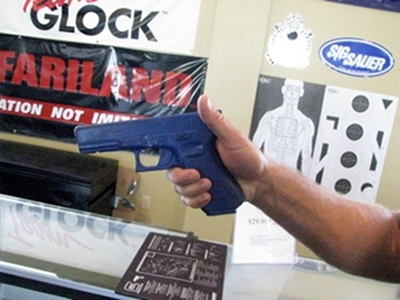
Mike showing how to hold the gun high on the gun’s grip with your gun hand.
2. Place your support hand (your non-dominant hand) so that it is pressed firmly against the exposed portion of the grip not covered by the gun hand. All four fingers of your support hand should be under the trigger guard with the index finger pressed hard underneath it. Here’s Mike demonstrating for us:
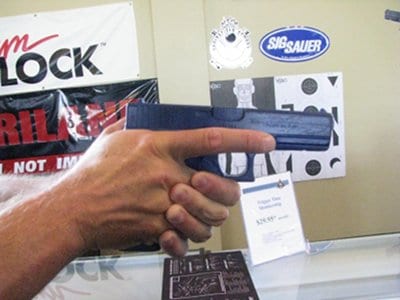
Fingers of support hand directly under the trigger guard. Notice Mike’s trigger finger is on the outside of the trigger guard. Safety first!
Like you did with your gun hand, you should place your support hand as high as possible on the grip with the thumb pointing forward, roughly below where the slide meets the frame. Look at the back of your hands. There should be a distinct fit, like the fit of a puzzle, with your gun and support hand, like so:
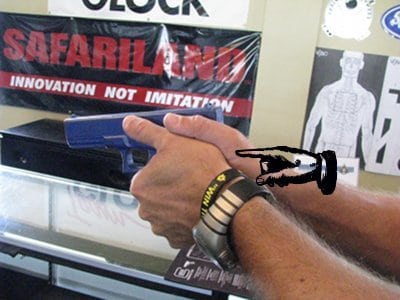
Notice how your hands fit together. Just like a puzzle.
Assume the Extended Shooting Position
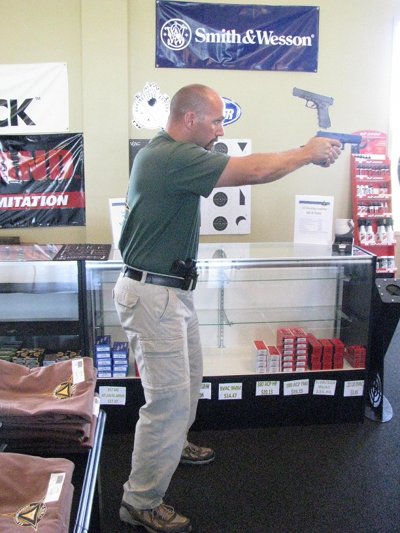
Stand with your feet and hips shoulder width apart. Bend your knees slightly. Mike calls it an “athletic stance.” It allows you to fire the weapon with stability and mobility. Raise the weapon toward your target. Here’s Mike showing us how it’s done:
How to Aim a Handgun
Use your dominant eye. You want to aim with your dominant eye. To figure out which of your eyes is the dominant one, perform a quick eye test by forming a one inch circle with your thumb and index finger. Hold the circle at arm’s length. Look at a distant object and look through your circle so that the object appears in the center of it. Keeping both eyes open, bring your circle toward your face slowly. Your hand will naturally gravitate toward one eye. That’s your dominant eye.
Align your sights. Your handgun has a front sight and a rear sight notch. Aim at your target and align the top of the front sight so that it lines up with the top of the rear sight. There should also be equal amounts of empty space on both sides of the front sight.
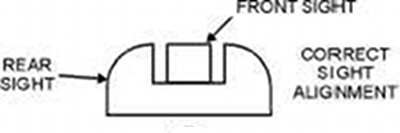
Proper sight alignment
Set your sight picture. The sight picture is the pattern of your gun’s sights in relation to your target. When you’re aiming a gun, you’re looking at three objects: the front sight, the rear sight, and your target. However, it’s not possible to focus simultaneously on all three objects. One of the objects will inevitably be blurry when you’re aiming. When you have a correct sight picture, your front and rear sight appears sharp and clear and your target appears to be a bit blurry. Like so:

Correct sight picture. The sights are in focus and the target is blurry.
According to Mike, the further away your target is, the greater the need for a clear focus on the front sight.
Trigger Management (aka Pulling the Trigger)
To fire a gun, we often use the popular phrase “pull the trigger.” However, to fire a gun properly, you don’t actually want to pull the trigger, but rather press it in a controlled fashion so you don’t disrupt your sights. Here’s a brief and very basic rundown on proper trigger control when firing a gun.
1. Press, don’t pull. Instead of pulling the trigger, press (or like my dad likes to say “squeeze”) the trigger straight to the rear. Apply constant, increasing reward pressure on the trigger until the weapon fires. Ensure that you’re only applying pressure to the front of the trigger and not the sides.
2. Take the slack out of the trigger. Squeeze the trigger to the point you start feeling resistance.
3. Surprise yourself. Keep pressing the trigger straight to the rear until the gun fires. Don’t anticipate when the gun will fire. You sort of want to surprise yourself as to when the gun actually discharges.
And there you go. Now you can go fire a gun at the gun range and look like you know what you’re doing. However, none of the information in this article can replace the instruction and supervision of a professional instructor. If you’ve never fired a gun before, we strongly suggest you visit a firing range and talk to an instructor who will walk you through the process.
Have any other tips for the first time shooter? Share them with us in the comments!
Editor’s note: This article is about how to fire a gun safely and correctly. It is not a debate about gun rights or whether guns are stupid or awesome. If you try bringing up that dead horse around here, your comment will be deleted. I will show no mercy. Keep it on topic, please.
_____________________________________________________________________________
Special thanks goes out to Mike and the crew at U.S. Shooting Academy for their help on this article. Mike along with the U.S. Shooting Academy Handgun Manual were the source of this article. If you’re ever in the Tulsa area, stop by their facility. It’s top notch and the staff and trainers are friendly, knowledgeable, and super badass.


{ 126 comments… read them below or add one }
← Previous Comments
It’s funny this is a website for manliness, because I’m a girl, and this is one of the first websites to help me and answer most of the questions I had. My dad is going to take me to the gun range for my first time this weekend, and hopefully I’ll remember some of this advice! :)
Thanks for the advice and pictues! I’m just learning too!
Thank you for sharing the info I’m working with police force like to a good shooter in the force kindly assist thank you.
Thanks, I love the smell of a discharge. So much I don’t think I could take a gun into the woods to take down game. I grew up with a single shot 22 rifle and dad’s 12 gage. Then the M16 in bootcamp, never fired a pistol then. Why is it so many people are alowed to buy guns and never have had proper instruction?
just a quick comment on testing for eye dominance. You will need to use both hands to form a small circle and look at a distant object, close one eye and then the other. The eye that you can still view the object with is your dominant eye. If you use just one hand and then the other, it will frequently flip your eye dominance from left to right (or vice versa)
I went to the firing range for the first time two days ago. I could not stop shaking with fear. I was so scared that I kept on missing the target.
This is website was very helpful (basic and to the point) on how to shoot a handgun.
Good instructions. Did I miss the placement of the trigger finger ? Make sure the trigger is touching your forefinger at the point between the tip of the finger and the first “crease/point of bending” or whatever the correct term is.
To expand on what Vern Rose said about finger placement, you can usually tell which way you need to adjust by looking at where your shots are hitting: If you press with your fingertip, your aim will be consistently off to the support-hand side, while if you pull with your knuckle, you’ll be off to your gun-hand side.
Another tip that was very helpful when I got started was regarding grip pressure: rather than trying to squeeze the grip with both hands, try creating a secure grip by pushing forward with your gun hand and pulling back with your support hand. This allows you to use the strength of your arms, rather than your fingers, to create a more stable shooting platform, resulting in much less shaky hands.
Im a retired Special Forces soldier, and then retired from the Fire Dept, this was a great article and If I may just add to it a little, when your firing your weapon, if your shots are to the right or left of the bullseye its probly your trigger squeeze, if your shot group is up and/or down its probly your breathing, you want to expell all the air from your lungs, then at that natural pause before inhalation, is the time to fire your weapon. Normaly shoot a 3 shot group ,clear the weapon and go look at your target, then make your adgustments. Thanks to the art of manliness, its a great website.
Your advice is spot on for beginners. Emphasize safety and just the basics. They can learn more later if they develop an interest. Awesome website with timeless practical advice. The topics are so relevant for all ages. I am 60 and my sons are 16 and 12 They also read it and we discuss as topics around meals. Keep up the good work.
This website is very helpful! I am going to take the test for my conceal and carry license tomorrow, but have only shot a gun a couple times. My Dad let me fire today to practice and i hit the target but all over the place, not in the same spot. The aiming instructions on this website is what i needed, and also the breathing and trigger pulling i think will benefit me greatly! I dont know why i was so nervous, but i feel more confident now. If anyone has any other tips it would be great!!
“I know I’m not the only man out there who has gone their entire life without shooting a gun. For some of these men it’s a deliberate choice. They don’t want anything to do with guns and that’s cool.”
That’s only cool until they decide that no one else should have that choice. Then it is decidedly uncool.
Oh, and leave the ‘gangsta,’ or ‘cowboy,’ or ‘mobsta’ bravado at home when you go to the range.
Holding the gun sideways is incredibly inefficient and disrupts aim.
For the noobs, shoot a small-caliber firearm first is a good rule whether handgun, rifle, or shotgun. This gets you used to the whole shooting iron thing.
And fathers, teach your daughters to shoot too- could save their honor and/or their life.
Trigger pull and sight picture are completely wrong if you think of using your gun for defense.
1. Keep the focus on the thread, let the sight be blurry.
2. Do not let the gun “surprise fire” on you! The last thing you want is for the gun to surprise you.
Eat the slack, fire exactly when you want to fire it, just like hitting a light switch, no surprise, you want to hit the target at the precise moment or you will miss.
There is no time to squeeze the trigger, it’s a binary operation with two steps:
1. Eat the slack
2. Fire
3. Reset the trigger (no slack to be eaten there)
4. Fire
Ah yes, and keep both your eyes open and always on the threat.
@Zoran: You’re right, but this article is not about self-defense, it’s about target shooting, right?
I miss a what-to-do-with-your-breath in here though. Some comments enlighten that a bit however.
I find it ironic that anything to do with guns is considered a manly thing. My boyfriend, an ex-Marine, suggested attending a gun show coming to town in a couple of weeks. Ever since, I have been completely intrigued. I have never even held a gun, let alone fire one, but I’ve asked him to take me to a firing range and teach me how. I used to be an excellent archer although I haven’t had the bow out in some time. I can’t wait to try firing a gun. This site was helpful. Maybe he’ll be impressed that I know a little about safety before we actually hit the range. Thanks!
I have some experience with guns and I have a slight problem. My left eye is the dominant one and I am right-handed. So it is pretty hard for me to shoot with my right eye closed. Does anyone know how to solve this problem, or if it is really a problem?
Thank you for the arcticle!
I’m writing a novel and I needed my character to teach another one how to shoot a gun. I’ve done it myself a few times before, but your article helped me to understand the proccess from theoretical point of view.
I teach shooting and the way I teach it is a bit different then most. All of the above it good but I find teaching that way does not turn out a marksmen. What follows is what I email someone before we meet for our first and only lesson because that is all it takes if taught correctly. In all my years of teaching I have only had one student not able to out shoot everyone else at the range their first time out. My style make a marksmen out of almost everyone in just one lesson.
Like ladies magazines that need to come up with a list like “20 ways to know if he is hot for you” every month. Gun magazines have to keep coming up with ways to tell you to stand or hold your gun to shoot better, and like the woman’s magazines most of what they say is garbage. 90% of how you shoot is mental.
Please don’t give up at this point. I am not one for finding your “center” and controlling the flow of good and bad energy or any of that nonsense. Yes there are ways of standing or holding your gun that might work better for you but that isn’t what is going to make you be able to shoot tight groups. I show this when I am at a range by shooting with ether hand or sometimes I will hold a gun upside down and shoot it that way to make my point which is your mind is the most important thing to learning to shoot well.
Most people that have shot a bit know to squeeze not yank the trigger but without realizing it they still yank a bit. There is a very strong tendency to be watching your sights and when you see everything line up pull right then. This is the root of the problem. I will often talk for 10 minutes or more with someone before going into a range and I will tell them even though I am telling you this and you will try not to yank the trigger you will find yourself yanking the trigger. You will get 2 or 3 nice shoots off and then way off. They will look at me funny and I will just say trust me you will fall into this trap. Everyone does.
I have shoot and taught shooting for years and I still have to fight this myself. Once we are in the range it always seems to work the same way. The first shot is close and then they start to get worse. I wait till they have one way off and then remind them of what I said and they get a sheepish look and say I am trying not to but it is so hard to fight it.
Here is the brake down of what happens. Your trying to line up the sights. This is tough because you can’t have the rear and front sight and the target in focus at the same time. So they are changing their focus point and trying to keep the gun from shaking. Then finally their eye sees it. Everything is lined up. The impulse to pull the trigger when you see that is very strong and most do. And most also shoot poorly. The reason is there is more time and more motion between when their hand had the gun just right and their finger pulled the trigger. Their brain sees the image and realizes everything is lined up, the brain sends the signal to the finger, and the finger reacts. If you shoot this way you will slowly get a bit better but you will never be a great shooter.
To get truly good you need to be two people at the same time. Picture this, in war a special forces solder will use a laser designator to mark a target. Over head a pilot will drop a bomb that will hit where ever that laser is. The solder on the ground doesn’t know the exact moment the bomb will hit. If he moves a bit his laser moves and the bomb will move as well. If the solder sneezes the bomb might hit the building next to the one he wanted. In the same way you job when shooting is to hold the gun on target not knowing when it will go off. With a different part of your brain you start slowly increasing pressure on the trigger. The trick is to not have your eye talk to your hand.
Think you don’t do this? The proof of this is I can have someone hold a laser pointer on a target and it will move at most an inch around the point they are aiming for. Then when they shoot they will go much wider then that inch. If I could find a range that would allow this I would modify a gun so the trigger could be pushed with a cable like old cameras. I would start by having the person aim the gun and then I would have the gun go off without them knowing when it would fire. Most people would be shocked at how well they would shoot with such a gun. However wide the laser from a little pointer moves around is how tight of a group you should be able to shoot. Any shots that are wider then that are caused by trying to time your shots, meaning pull the trigger at the right moment. Once you understand the idea then you just have to slit your mind into doing the two jobs at the same time. With one part of your mind you are holding the gun on target. With the other part you are slowly adding pressure to the trigger.
If this is the first time you have heard of shooting this way it may sound simple but it’s not. It can be exhausting. I have seen people be too mentally tired after a hour and a half to shoot any more. Once you learn to shoot this way more shooting will make it all happen faster. The interesting thing about this style of shooting is it often doesn’t matter much which hand you use. I often encourage those I am teaching to shoot with their off hand. The reason is they have to think more and have less muscle memory to rely on. The other odd thing about shooting this way is the person will shoot their best from the moment they learn this. Shooting more doesn’t help them shoot better only quicker. In order to shoot better they will need to develop muscles to hold the laser pointer better. A good way to practice is to use a 5 or 10lb weight and a laser pointer at home. With the weight on your wrest hold the pointer at a spot on a far wall. Use a weight that is heavier then the gun you shoot. It sounds simple but in reality it is quite hard but that’s the secret to shooting well. It’s all in your head.
With a semi auto weapon there is what is called a trigger reset. You can practice this with an unloaded weapon. Pull the trigger, keep the trigger pulled back with your finger, work the action again, and then slowly let the trigger forward. You will hear a very distinct click. That is the trigger reset. Once you hear the trigger reset you can pull the trigger again. This helps maintain accurate shooting because you don’t have to pull the trigger the long distance until the weapon were to fire. Once practiced enough it will also make you quicker.
No matter what your go to weapon is get some snap caps, which are basically just plastic rounds which do not fire because they are just plastic and have no primer or gun powder in them. Practice with those snap caps until everything is muscle memory. You will know how to work the action very well on your preferred weapon.
Don’t try to pull back the slide like a sling shot. That is what is shown on TV. Grip the top of the firearm with your hand and pull back. Don’t ride the slide forward. Let the weapon do what it was meant to do and go into battery itself.
Practice magazine release, and reloading. That is the part that takes up the most time in quick shooting.
There could be an entire article on malfunction clearing, but the most basic is tap/slap, rack, bang. Smack the bottom of the magazine to ensure that the magazine is seated correctly. Rack the slide for a fresh round. Bang is pretty self explanatory: shoot the weapon.
Most important is practice practice practice.
Sight picture sight picture squeeze trigger. Focus on sights let target blur
Mr. Andy, your question about dealing with cross-dominance is quite good. In your case, you said that you are right-hand and left-eye dominant. You, sir, are not alone, nor should you feel that cross-dominance a handicap.
How dominant is your master eye? Are you able to focus on the image from that eye, or does the image from the other eye confuse your sight picture?
If you can concentrate on the master eye’s image then you simply hold your pistol or revolver in your dominant hand and bring the target, front-sight, and rear-sight into alignment with the master eye.
If the weaker eye’s image interferes with your sight picture then I will recommend that you close the weaker eye. If you are unable to just close the one eye, do not worry! You only have a bit more work to do. Obscure the weak eye lens of your shooting glasses with a bit of tape.
If you forgot to bring any tape, you STILL are not out of the game! You will look very silly doing this, but consistent hits in the X-ring of your target will make you quickly forget your shooting buddies’ laughter.
You will get into your favored shooting stance (isosceles or Weaver) and turn your head toward the weak eye until that eye can no longer see the sights. Orthodox? Absolutely not! Effective? Most certainly!
If you can focus on the master eye’s image while working with a long-arm you have only to mount your rifle or shotgun to the dominant eye’s shoulder. It will feel odd to you at first, but you will soon become comfortable.
If you weak eye will not let you focus then use the tape on the weak eye lens trick. If you have no tape, then I must defer to someone more learned in remedial shooting techniques than me.
Mr. Andy, I hope this is useful to you as well as our other cross-dominant friends (and to those who have the privilege of instructing them).
Happy & Safe Shooting!
There is a important point in aiming that I think should be addressed more explicitly. It is shown in your “Correct sight picture” illustration, but warrants greater emphasis.
In the case of a front post sight, such as you’re discussing, in addition to the front and rear sights being lined up, the target should appear to rest upon the top of the post (front sight), just as you have it depicted.
This is a question for John. I found your insight very interesting and I just want to know if I understood correctly. Are you saying that the best way to achieve what you’re suggesting we should continue using a focused aim while slowly pulling on the trigger till it “surprise fires”? That is what it seemed you were saying , but I may have misunderstood. Thanks. All the advice was very helpful. Thank you everyone who commented.
This is interesting. I’ve only ever shot shotguns before, so maybe it’s time for to try things out
← Previous Comments