







PSA: Know What You’re Doing
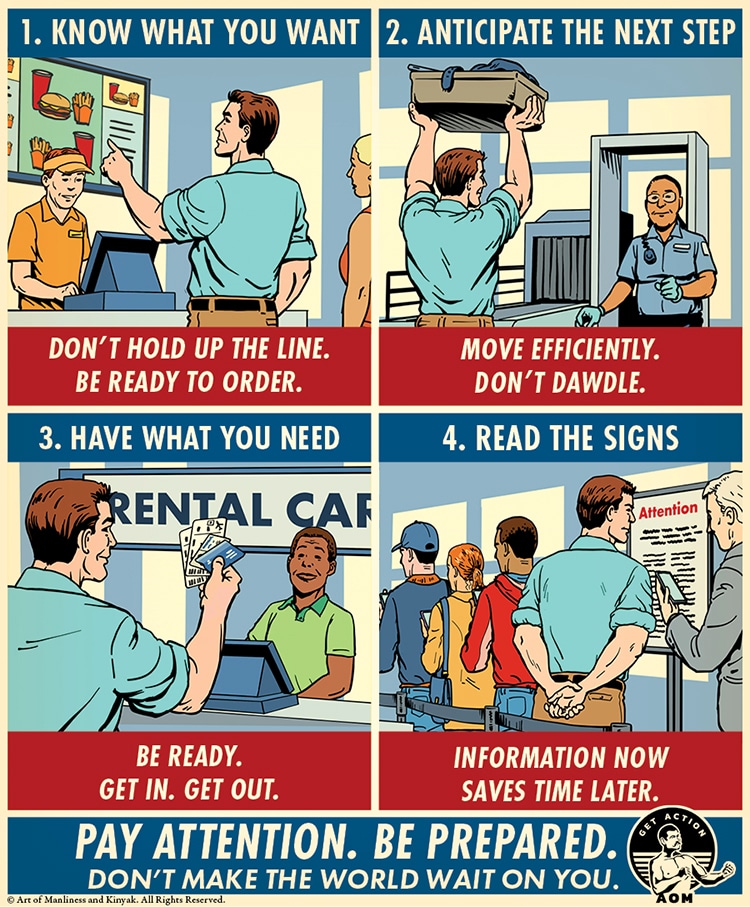
The comedian Sinbad had a bit where he talks about how much he hates standing in line behind people at McDonald’s. The fact that folks would be hemming and hawing about what to order left Sinbad shaking his head in frustration: “People act like they ain’t ever been to McDonald’s! They got the same menu! You know what they got!”
You’d think that by the time someone reached the front of a line at a restaurant, especially one that’s offered pretty much the same menu for decades, they’d be ready to shoot off their order. But instead, folks still seem to be caught flat-footed once they step up to the cashier.
Restaurants are hardly the only places where you see this phenomenon.
When you’re renting a car, you’ll often stand for ten minutes in a line, along which have been posted multiple signs indicating that you’ll need to show the counter rep a driver’s license, a credit card, and your return flight confirmation number to complete your rental. Yet, it’s only when people reach the desk that they start rooting around in their pockets and scrolling through their phones to retrieve what’s needed. They sometimes act surprised that they need to show the required information at all.
This kind of obliviousness is on display whenever I go to my local post office. They do passport applications there, but you need an appointment. It’s on the website, and there are signs everywhere that say “Passport by Appointment Only.” Yet without fail, there will be people who show up without an appointment to try to get their passport, only to be told they’re out of luck. They then get angry, cause a scene, slow things down for everyone standing in line to buy stamps, and generally spread bad vibes.
Everywhere you go, you can observe a lack of what might be called “social situational awareness.” People are looking down at their phones instead of what’s going on around them. And because technology takes care of so many details of our lives for us, we’re less vigilant about keeping track of them ourselves.
Advertisement
As a result, a lot of people are sleepwalking through their interactions with the world, which can cause delays and bottlenecks that muck things up. While every unnecessary delay is small, multiplied across hundreds of interactions, it becomes friction everyone has to bear.
The world would be a better place if we all committed to paying attention and knowing what we were doing.
Read any signage displayed behind the counter or on the wall while you wait in line for something. Consider what information you’ll need to have at the ready and what items you’ll need to have in your hand before you reach the front. Anticipate what will be required for the next step.
Pay attention to the interactions between other customers and service reps or cashiers to see if any friction points are causing holdups. If you notice something, figure out how to avoid running into that issue yourself.
If there’s a question about a protocol that you weren’t able to find out through prior research or from the signs, promptly ask the agent/cashier about it once it’s your turn. For example, different airports have different policies these days about whether things like laptops have to come out of your bag when you go through TSA. Listen for whether the agents are making announcements about that kind of thing as you approach the checkpoint, but if you haven’t heard anything, then as soon as you step up to the X-ray machine, ask the agent what the protocol is.
Cultivating your social situational awareness is a win-win-win for everyone.
The cashier or customer service rep gets an efficient interaction. You get what you need quickly. And other customers, passengers, and queue-standers can be on their way sooner.
And the art of paying attention doesn’t just apply to standing in line for a double quarter pounder with cheese. It’s about having the situational awareness that allows you to navigate the wider world more effectively. In my experience, the people who are “sharp,” or listo as they say in Spanish, have developed the skill of paying attention and creating mental models on the fly of how to handle themselves in whatever situation comes their way. If they can’t figure it out on their own, they’re quick to ask for clarification. It’s an element of agency.
Advertisement
Don’t be a clueless potato head. Be a high-agency man.
Pay attention; be prepared; don’t make the world wait on you.


