“The proper drinking of Scotch whisky is more than indulgence: it is a toast to civilization, a tribute to the continuity of culture, a manifesto of man’s determination to use the resources of nature to refresh mind and body and enjoy to the full the senses with which he has been endowed.” -David Daiches
No other spirit has been associated with manhood like Scotch whisky. Whether it’s the hooking punch in the mouth or just the raw and earthy process by which it is brought forth from barley and water, Scotch has held a prominent place in the lives of men from kings to authors to titans of industry. What separates Scotch from its alcoholic counterparts is not just its unique background (to be labeled Scotch, a whisky must be distilled and initially matured in Scotland), but the commonalities shared by the men who partake in its liquid mysteries.
The man who drinks Scotch is one who lives life to the hilt, savoring new challenges and discoveries on a daily basis. He doesn’t settle and he doesn’t drink something just because it’s there. Few men drink Scotch to get drunk. First off, it’s too expensive; the cheapest bottles of single malt cost around $40. But secondly, and much more importantly, each bottle of Scotch contains so much history, tradition, and attention to detail that the men who drink it are not just downing a beverage, but participating in a celebration of artisanship and the deep pleasures of life.
Becoming a Scotch drinker takes a little work and a bit of tongue maturity. The young man that saddles up for his first bout with the historic elixir is often taken back by its overt potency. But upon returning a second and third time, he slowly begins to get a sense of what makes Scotch so alluring and enjoyable. In developing a taste for Scotch, a man is embarking on a lifelong journey that will take him along the clear waters of the River Spey, the rugged Highlands, the Isle of Jura (which George Orwell described as “an extremely unget-at-able place”), and various other parts of Scotland where distillers like to say, “It’s as good as life used to be.”
Therefore, to truly appreciate a good Scotch, a man must have an understanding of its rich history and the process that transforms ordinary barley into an extraordinary drink.
With this idea in mind the Art of Manliness ventures into the world of scotch, not because we believe you must drink alcohol in order to be a man, but because if you choose to do so, it should be in the tradition of gentlemen, with a clear conscious and a full heart.
History
Originally known as “aqua vitae” or “water of life” for it’s healing properties, the first recorded reference to the substance is found in the Scottish Exchequer Rolls of 1494. The following, “Eight bolls of malt to Friar John Cor wherewith to make aqua vitae,” was the equivalent of several hundred bottles of whisky in today’s standards. This distilled beverage was used as a treatment for all kinds of ailments, with many of its users noticing the warm, calming sensation upon “treatment.”
Scotland’s King James IV was recorded as purchasing whisky from the local barber upon a visit to Dundee in 1506. That he purchased it from the barber would not have raised any eyebrows in that time period. “In 1505, the Guild of Surgeon Barbers in Edinburgh was granted a monopoly over the manufacture of aqua vitae – a fact that reflects the spirits perceived medicinal properties as well as the medicinal talents of the barbers.”
Royalty and the clergy were not the only ones to enjoy whisky, however. The farming community discovered new benefits of the distillation process near the end of the 16th century. Both barley and oats were staple crops of Scottish agriculture, but due to their cold, wet climate, the long-term storage of grain was nearly impossible.
“Maximizing the crop returns from this harsh Scottish soil and climate meant that some of the crop that could not be used immediately was turned into ale. Ale could be kept for longer than dry grain but not indefinitely so the farmers soon learned that turning the ale into alcohol was an even better solution.” –Loch Lomond Distillers
The growth of Scotch whisky distillation continued for the next several centuries, surviving taxes, cumbersome government regulation, and smuggling to become a commercial industry in the 1700s. In 1831, the Coffey (or Patent) still was produced, increasing whisky’s smoothness and drinkablity. This, in combination with the destruction of France’s wine and cognac industry at the hand (or claw) of the Phylloxera bug in 1880, helped ensure worldwide growth of the scotch industry.
Since that time, a lot has changed and a lot has stayed the same. Just as in any field, new techniques and practices have created a greater variety of products, but at the end of the day, distillers are still in the business of turning barley and water into a tasty concoction.
How Scotch Whisky is Made
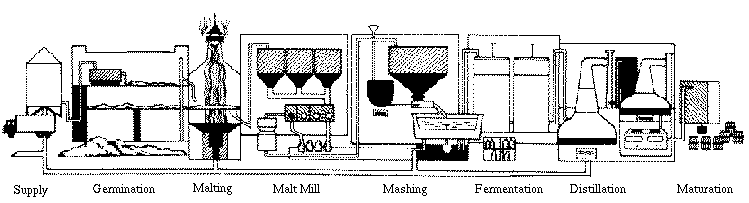
The production process of scotch whisky is surprisingly simple. It involves malting, mashing, fermentation, distillation, and maturation.
1) Malting — the process of turning barley into malt, very similar to the early stages of making beer. Barley is soaked or “steeped” in water, drained, then spread out on the malting floor to germinate. During the germination process (generally 6 or 7 days), enzymes are released, which convert the starches into maltose, a sugar. At this point, the malted barley is dried using the smoke from an underground furnace called a “kiln.” The fire for the furnace is often stoked with peat which is why you’ll hear scotch drinkers refer to a “smoky peat” flavor in many whiskies.
2) Mashing — the dried malt is then ground into a course flour with the consistency of oatmeal, called “grist.” The grist is then mixed with hot water and pumped into a vessel called a “mash tun.” In the mash tun, the water and ground malt is thoroughly mixed and allowed to steep so that the sugars in the malt are released into liquid. This sugary liquid is called “wort.”
3) Fermentation — the wort is then drawn off and pumped into large wooden or steel vessels called “washbacks.” Once there, it is combined with yeast and allowed to ferment. The length of fermentation can be different depending on the environment, but it generally takes about two days. “The living yeast feeds on the sugars, producing alcohol and small quantities of other compounds known as congeners, which contribute to the flavor of the whisky,” according to scotlandwhisky.com. The resulting liquid is anywhere from 5-8% alcohol by volume and is called “wash.”
4) Distillation — the wash is distilled twice (single malt in a pot still, grain whisky in a Coffey still). The first still is the wash still and is used to separate the water from the alcohol by boiling the wash, collecting the evaporated alcohol which condenses at the top and collecting it in a condenser. The resulting liquid is called “low wine” and is approximately 20% alcohol by volume.
The low wine is then sent through the second still, also called the “spirit still.” This process is slower and the climate must be very closely monitored. “The stillman discards the first part of the distillate, called ‘foreshots’ and the last part known as ‘feints,’ because these contain unpleasant higher alcohols. The center part of the distillation is preserved and this is the whisky we drink. This spirit is colorless and gets its color during maturing in oak barrels,” says expert Michael Moss.
5) Maturation — the unfinished Scotch is then placed in oak barrels, or casks, for the maturation process to begin. Throughout the maturation the whisky becomes much smoother, increases in flavor and begins to retain the golden color of the barrels inside which it rests. Traditionally second-hand sherry barrels were used to age whisky, but today bourbon barrels are also common. Some producers experiment with other varieties including port, beer, cognac, and even wine. Each barrel passes on a distinct flavor to its contents.
In order to be considered “Scotch” is must be aged in Scotland for at least three years. Though each whisky reaches its maturation at different ages, most are now aged anywhere from 8-20 years. Many feel that the longer a scotch is aged the smoother and more flavorful it becomes — old whiskies are also more rare and cost a quite a bit more. For example, a quick internet search brings up a bottle of 25-Year Highland Park Single Malt Scotch for $239.
Geography — The Scotch Regions and Their Distilleries

Just as in the wine world, where names like Napa Valley, Burgundy, or Rioja tell someone not just where a wine is made, but what to expect as far as variety and flavor, Scotch whisky has its own geographic intricacies.
“With the renewed appreciation of the variabilty of single malt brands there is new appreciation of the geographic guidestars that explain (in surprisingly intuitive ways) why a single malt like Talisker has a sharp saltiness in the flavor, why Speyside whiskies like Glenfiddich have a light, sweet characteristic, why a Campbeltown whisky like Springbank is different from a whisky of the peninsula to the north on the serrated coast, and why an open bottle of Islay whisky smells like your carpeting is on fire.” -Chris Cloud
- Lowland — the whisky of this region is generally considered to be more mild, mellow, and delicate. The three distilleries in operation include: Glenkinchie, Bladnoch, and Auchentoshan.
- Highland — the largest geographic region for Scotch includes well-known distilleries such as: Dalmore, Glenmorangie, Oban, Talisker, and Dalwhinnie.
- Islay — known for heavier, more smoky Scotch varieties, it has eight distilleries, each with their own unique character including: Ardbeg, Bowmore, and Laphroaig to name a few.
- Speyside — adjacent to the River Spey, the area with the largest number of distilleries to include: Glenfiddich, Aberlour, The Glenlivet, and The Macallan.
- Campbeltown — the smallest of the whisky producing regions, once home to several distilleries, but now only home to three: Glengyle, Glen Scotia, and Springbank
For a nice map displaying all the various distilleries throughout Scotland see http://www.scotlandwhisky.com/distilleries/
Drinking Scotch Whisky
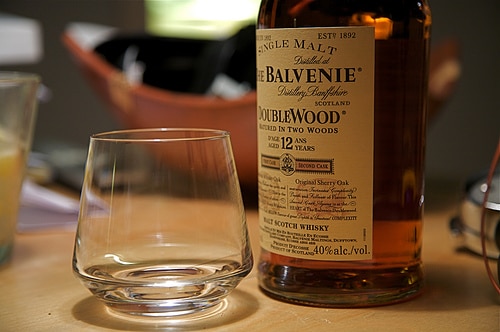
So, enough about all of the details on the where and the how — they don’t mean a whole lot unless you get to enjoy the final product. The drinking of Scotch whisky should be enjoyable, not intimidating. Everyone has their own opinions on how to drink Scotch, but the following are some general guidelines on the proper way to enjoy this storied spirit.
 Glass — While there’s nothing wrong with using a standard tumbler, many scotch experts recommend using a tulip-shaped glass which allows the whisky to be swirled without spilling and, more importantly, concentrates the aromas at the neck of the glass. As I’ve discovered during my own searches, these glasses are sometimes a bit difficult to find. The following are some great options for those not wanting to waste time searching high and low: Here, here, and here. We’ve also got a great resource on the best whiskey glasses.
Water — Some Scotch novices may sneer at the introduction of a small splash of water as not “manning up,” but they would be both stupid and mistaken. While water is not a must, many Scotchmen will throw a little water in with their scotch to help enhance their ability to taste the individual flavors that can often be masked by the well-known “burn.”
Ice — Many like to add ice, but it is generally considered poor form, simply because it lowers the temperature of the whisky, which in turn can hide or dull the flavors and aroma. If you really want ice, no problem, but definitely try it without sometime — you may be pleasantly surprised.
See our guide on how to drink whiskey.
Your First Bottle of Scotch
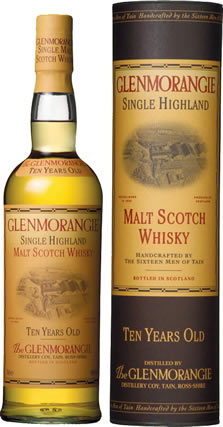
For many of us young men, buying our first bottle of Scotch can be a tough decision. The price is a bit higher than other spirits so we worry about choosing poorly. I have no doubt that there are as many opinions regarding a good “starter Scotch” as there are bottles of whisky (please leave your suggestions below), but for those wanting a recommendation, I would point them to my first, a bottle of Glenmorangie 10yr. And apparently the experts concur.
While Glenfiddich and The Glenlivet tend to be the most widely enjoyed, Glenmorangie is said to be the most popular among the Scottish themselves. Established in 1843, the Sixteen Men of Tain perfected this single malt Scotch whisky using their own Tarlogie Springs mineral water. Matured in bourbon oak casks, Glenmorangie is a light, sweet Scotch. Though I am still learning to “taste” Scotch, new flavors seem to come out each time, including — honey, almond, and some various citrusy flavors.
In the end it doesn’t matter so much which bottle you decide to buy, the key is trying all kinds of Scotch and expanding your palate. Each new bottle should give you its own unique education. Don’t worry if your first try with Scotch isn’t love at first taste. As mentioned above, it’s a taste that must be developed. In my own experience, each subsequent tasting made the whole affair much more enjoyable.
Finally, many men get confused on the issue of whether it should be rendered “whisky” or “whiskey.” Here’s a clever poem from the Bard of Banff, Stanley Bruce, to help you remember how to spell the word and what to look for when shopping for an authentic bottle of Scotch.
Whisky or Whiskey
A Scotsman who spells
Whisky with a n ‘e’,
should be hand cuffed
and thrown head first in the Dee,
In the USA and Ireland,
it’s spelt with an ‘e’
but in Scotland
it’s real ‘Whisky’.
So if you see Whisky
and it has an ‘e’,
only take it,
if you get it for free!
For the name is not the same
and it never will be,
a dram is only a real dram,
from a bottle of ‘Scotch Whisky’.
So what did I miss? Which bottle is your favorite? When it comes to Scotch there are millions of opinions so let’s hear yours!