Transcript
Brett McKay:
Brett McKay here and welcome to another edition of the Art of Manliness podcast. So if you’ve been following the Art of Manliness for a while, you know we’re big fans of Theodore Roosevelt around here. The guy crammed a lot into a lifetime. There’s a new biography out about him that takes a look at his life as a natural historian, conservationist, hunter, and it uses TR’s actual field notes that he took out in the field as the primary source to write this biography. It’s called Theodore Roosevelt in the Field. And today on the show, the author Michael Canfield and I discuss what we can learn about Teddy Roosevelt’s approach to life from his field notes that he meticulously began as a boy. He started this when he was like eight or nine years old, and he continued even throughout his presidency. We also talk about how his field notes that he took helped sharpen his keen sense of observation and how that helped him during his presidency and his political life.
And then finally, Michael and I discussed what life lessons men can take from the field notes of the Bull Moose himself, Theodore Roosevelt. Really interesting show. Be sure to check the show notes out after you listen because you can actually see actual scanned images of Teddy Roosevelt’s field notes as well as links to resources mentioned in the show. You can find the show notes at aom.is/canfield. And that’s spelled C-A-N-F-I-E-L-D.
Mike Canfield, welcome to the show.
Michael Canfield:
Thank you for having me.
Brett McKay:
So you got a great biography out about Theodore Roosevelt, but this one’s unique. It’s called Theodore Roosevelt in the Field. And it’s unique in that you focus on his life as a natural scientist, hunter, conservationist, using his field books, field notebooks that he kept all throughout his life as your primary source. I’m curious, how did you get interested in this part of Teddy Roosevelt’s life?
Michael Canfield:
That’s a good question. I got interested in his field notes from a previous project that I did on how currently living scientists and naturalists keep their notebooks in journals and kind of try to figure out how people would actually keep scientific and natural history information in the field as opposed to how we think they might or what we would imagine. And so out of that process and project, I did a little bit of consideration on historical field notes, Darwin, Laneus, even Lewis and Clark’s notes from their expedition and stumbled across Theodore Roosevelt’s notes, which are here at Harvard. About two thirds of the notebooks are in our Theodore Roosevelt collection. And I found them and I was actually just talking to somebody about them at one point describing the Africa diary, the 1909 Africa diary with these images that Roosevelt wrote, these little sort of scrawled images of all the animals he shot and it kind of just took off from there.
Brett McKay:
So yeah, you use these notebooks. They have some of them at the archives at Harvard University. It’s crazy. How do we have field note and field notebooks from when he was a nine year old boy? Because he started this as a very young man. We’ll talk about his career as a natural scientist or a naturalist as a child, but I had a journal when I was in second or third grade, so about the same age as Theodore Roosevelt when he was doing his field notebooks, but I threw ‘em away. So how did Teddy Roosevelt, why did he keep these field notebooks from when he was an eight, nine year old, 10 year old boy?
Michael Canfield:
I think that part of it was that he was very serious about his natural history study, his study of the world. There’s no question about that. He was very studious and I think there was more of a tradition back then of keeping diaries, in other words, writing in diaries and then maintaining them. One thing I found very interesting though was that there’s evidence that he actually copied over his diaries and journal accounts. So one of the earlier journals from what they call his grand tour, when he went off with his family to Europe the first time, he kept a diary and there is a diary actually which he kept as a little urbarium. He pressed plants in it, which still survives. We have this diary and we have the little pressed plants inside. And then there’s another journal which is not in the diary format that has the names or the dates and the lines printed on the pages, but just a blank journal that he wrote in.
And some of them are actually, some dates have a entry in the diary and then there’s in a separate journal, the same diary entry that’s been copied over, but actually the punctuation and the grammar is slightly better. So what Roosevelt had done is he’d gone back to some of his diaries and copied them over into journals, like actually copied over the accounts. So it’s not clear that all the original documents actually survived, but many of these journals and diaries survived and I think they were just very important to him and he was serious about his recording, partly because it allowed him to tell stories and narratives of his adventures, which we can get to later, but it certainly showed up in the Badlands and when he was doing more professional writing on his adventures.
Brett McKay:
Well, let’s talk about the seriousness that he took his… Even as a boy, he thought of himself as a natural scientist or I guess they’d call himself a natural historian. So how did this boy, he grew up in a brownstone in New York City, so an urban area. How did he develop this intense love for the outdoors and all things nature despite growing up in an urban area?
Michael Canfield:
Yeah, well that’s a great question and I think it probably has a number of potential answers, which I don’t think we can know for sure. Wilson and other people might call it biophilia, people just love nature and are naturally connected to nature. But Roosevelt obviously was an extreme case in this instance along with many others, but he loved it from a very young age. He was drawn to it and he had… So I guess what I would say is that he had a natural predisposition. He just seemed to love to go out and study nature, but it wasn’t just about studying nature. He just loved to go out and do things in the world. And that’s a facet that I think is people look to his early natural history study and say, “Oh, he was a naturalist from a young age.” I would agree that’s true.
Absolutely, he loved nature, but he also, I would say that’s a symptom of a larger character element in Roosevelt, that he loved to just go out to what I call the field. He loved to go out and do things in the greater world, connect directly with his greater world. The early natural history stuff was an example of that. His father especially, but his family made a lot of those early expeditions possible early on. He went to the great swamp area of New Jersey, this town called Lawanica. There’s a little brook called Lawanica Brook where they went and rented a house and he rambled around in nature looking at birds and cicadas and all the rest. Then later obviously they went to Oyster Bay and up into the Adirondacks. So his family took him out a lot away from New York City to natural areas and they spent a lot of time in the summers especially in those areas.
Brett McKay:
Speaking of how his father encouraged this, what other ways… I thought when I read this part of Roosevelt’s life, I really admired his father. He was actually a really great example of what it means to be a good dad. I mean, what were some of the other ways that Teddy Roosevelt’s father or Theodore Roosevelt’s father encouraged this love of nature in his son?
Michael Canfield:
Yeah. Well, I mean, certainly just making the expeditions happen, if you want to call them expeditions, going up to upstate New York, et cetera. I would say also his father, Theodore Sr. went with Roosevelt on some of these things. There’s a great passage where Roosevelt describes in his diary his father reading to him from the last of the Mohicans around a campfire in upstate New York while he fell asleep. So to me, that’s just such a great symbol or poignant moment when you see Roosevelt’s father instilling this love of the field in Roosevelt, what could be better than being out on a canoe trip with your dad and he reads Last of Mohicans to you and you fall asleep. It’s awesome.
Brett McKay:
Yeah, I love that.
Michael Canfield:
Another element I think that his dad, who was not a naturalist himself, but just saw this interest early on in Roosevelt when Theodore was carrying these books around his family’s library from David Livingstone about Africa and all these other things, he recognized in his son that this was an interest and he was going to foster it. Roosevelt Sr. helped found the American Museum of Natural History. So Albert S. Bickmore, who was an advocate, had come to see Theodore Senior for funding and support to create the AMNH in New York and Theodore Roosevelt’s dad really helped and helped found it in their living room at the Brownstone. Another example is when they came back from their trip to Roosevelt’s trip to Europe, his father actually hooked him up with John Bell, who was a taxidermist, who had worked with John James Audubon. He was the kind of Audubon’s right hand man, this being Bell, who had a taxidermy shop.
I interpret, it doesn’t say explicitly that his father made the connection, although Roosevelt sort of says that, it seems that Roosevelt’s father really got him a position working and learning from John Bell of how to prepare ornithological specimens. So there are a bunch of different ways that his dad really nurtured that. I guess the last thing is that when he went to college, his father said something like, I can’t quote it just off the top of my head, but he said something like, “If you want to be a scientist, you’re free to do so. I will support you in that. You’re not going to make as much money, you’re not going to have as elaborate a life as you have here, but you can make that decision.” I always thought that was a pretty nice thing for a father to do too, to be realistic, but put the decision in his son’s court.
Brett McKay:
Yeah, I love that. And going back to how serious Roosevelt took himself as a naturalist, even as a boy, you talk about in the book, he kept very detailed notes or records of animals he saw, the habitats, et cetera, but he even kept… He had a museum inside his house.
Michael Canfield:
Yeah, he did. And they called it the Roosevelt Museum of Natural History and he founded this with his cousins and a few other associated compatriots and they had a natural history society as well, a group. So they had this museum where they contributed their collected specimens and then they also had what they called a society where they actually would present papers to one another. So they would write up a little paper on… One of them is about the migration of whales and Roosevelt would read this paper and they would talk about it. So he wrote this thing out and they would present it to each other and talk about the finer points of whales migrating. So they were serious. They were modeling kind of what happened in the Lanean society and some of the professional natural history, biological societies in the world, but they were acting this out in a serious way, not just collecting a few shells and bird’s eggs and stuff.
And that really led to him studying with Bell and preparing specimens and as he went through his teenage years and into college, he then had a pretty extensive collection of bird skins and knowledge of birds that led to some of his first publications as well.
Brett McKay:
Right. Just to remind people, he was having these natural history society meetings when he was like eight or nine years old.
Michael Canfield:
Yeah, I mean that was a little… I think the main natural history society things when they presented papers were a little later, probably 13, 14-ish. But yeah, he started collecting and that whole question of childhood natural history museums was kind of a thing. Kids would do that, not everybody obviously, but other people who were his peers and that was kind of a reasonably common thing for kids to do who were really kind of biologically inclined would do some of that. But I think he took it to a little bit more of a professional sense than most kids. Most kids would just have stuff in their room or whatever, but they formalized this. There’s a document which you can read in the book and at Harvard that is the Roosevelt Museum of Natural History document that is sort of their charter where they wrote it all out.
So it wasn’t just an informal thing. They were serious about it.
Brett McKay:
Yeah. I thought there was a funny scene where I think someone, either a maid or his mother threw out some animals that he had collected.
Michael Canfield:
Right, the mice. Yeah. There were periodic examples of him butting up against these things. Some at home when he originally had the museum in his bedroom and then the maid sort of said, “This is not okay with us.” And so they had to move it up to a more remote location in the house. And then when he was in Dresden, he was keeping mice and other things and the family he was staying with just were trying to get rid of all these crazy animals that Roosevelt was keeping in the house. How should I say this? His tolerance and interest in having a little natural history museum in his room didn’t always fit with how other people thought about it. I guess even when he came to Harvard, his boarding house on Winthrop Street, which I’m actually just looking out the window right now and it’s at that site, the boarding house is no longer there, but where he lived here, if you look at the photographs, he brought a lot of that kind of thing into his boarding house room as well when he was in college.
Brett McKay:
So yeah, he brought his taxidermy kit.
Michael Canfield:
Yeah, all that kind of stuff. He’d bring in turtles or whatever kind of stuff he found into his room.
Brett McKay:
Yeah. So did Theodore Roosevelt actually make contributions to the field of natural history as a young man or was this just a hobby?
Michael Canfield:
Yeah, I think that you could make the case that he definitely did. Early on, in his teenage years, his collections were pretty, how should I say this, pretty professionalized for that age. He wrote species accounts, especially for the specimens that he collected on the trip to Egypt and the holy lands, for example. He has multiple accounts of them, multiple specimens that he’s dissected and documented the contents of the crops and all that. So there’s really good natural history information there. That set of information that he created there was never published in that form and isn’t a real scientific contribution, but it allowed him to then, when he came to Harvard, he ended up assessing the, I guess you’d call it the ornithological fauna, the birds of the Adirondacks and the birds of Oyster Bay where he’d spend a lot of the summers and then they published a couple of bird lists, which are a true contribution to natural history because when you make a list, a fauna list of say the Adirondacks or Oyster Bay, then that gives sort of a snapshot in time of what organisms live there, in this case birds, that people then can compare to later on or can go down there and know what’s there.
So yes, he absolutely did. And some of the work he did as a late teen in Oyster Bay folded into that stuff that he then published in the Oyster Bay bird list.
Brett McKay:
Very cool. So you mentioned earlier that pivotal moment where Roosevelt’s father told him, “You can be a natural scientist and I’ll support you.” That was his career trajectory, but at what point did Roosevelt decide that he wasn’t going to be a full-time natural historian and instead devote himself to politics?
Michael Canfield:
That’s a great moment, I think, in Roosevelt’s development. When he came to Harvard, he really was interested in becoming a scientist and he did enjoy his natural history courses here for sure. There’s clear evidence of that in his notebooks, but also in how he talked about his time. But my interpretation is there are a few pieces that caused him to pivot away from that. One caused him to pivot away from becoming a full-time sort of naturalist scientist of the day. One was the studies that were going on here and the way that natural history and science was being taught in the museum of comparative zoology, which is sort of the natural history museum at Harvard, the way it was being taught at the time really grew out of a German school where they were doing a lot of section cutting and pulling organisms apart and looking at very small things under the microscope, et cetera, and with a lower, how should I say this, with a lower focus on field work and field work was really where Roosevelt wanted to be.
He wanted to be out in the field looking at animals and their natural habitat, et cetera. I think over time he enjoyed his natural history courses, but that just wasn’t for him sitting in the museum a lot. So that’s one piece. He also had an interest, I think, in politics and history and other things, but that came, I think, out of partly when his father died around Christmas 1877, his father became sick and Roosevelt went home and of course his dad gave him a shotgun for Christmas, which is a good Rooseveltian present. But then Roosevelt came back afterwards to Harvard and it wasn’t long that his father really descended into… Had a stomach tumor, an intestinal tumor, and ended up dying in February. And so Roosevelt, I think at that point, it changed a lot of things, but he became the head of the family, and I think it changed the optics of how it looked to be, say, a natural historian who’s not going to make a whole lot of money.
I think that helped him pivot toward doing something that was a career in what he though of as public service going into politics, the law, et cetera. After graduation, he immediately started law school but didn’t finish because he started in the legislature. So that’s one thing. I think the third thing is that he met Alice Lee, he fell in love and he got a girlfriend. I think that also in some of the writings and some of the things in his letters and in his notebooks, you can see him completely falling head over heels for Alice Lee and realizing that he wanted to have a settled existence and that going off to Germany to do graduate work in natural history study or all these other things was not going to be the kind of life that he wanted with his darling little sweetheart, Alice Lee. I think all those things kind of came together and caused him to move more toward what at that point was called political economy.
He started writing the Naval War of 1812 and some of those things, and then pretty quickly after he graduated, did law school and then became an assemblyman.
Brett McKay:
But at the same time, he didn’t abandon the field completely. He always looked for ways to get back out there and continue in some small ways work as a natural historian.
Michael Canfield:
Absolutely. Yeah. I think that’s kind of the argument that I’m trying to advance for consideration is that you can see at all these little turning points, even though he didn’t decide to be a professional naturalist or professional natural history writer for his full career, he was president at one point, at all these points along the way, he took the opportunity to turn back to the field and do things. For example, it wasn’t long after… He hadn’t been an assemblyman that long until he met this guy at one of his free trade club meeting who had a place in the Badlands and had bought land in the Badlands and Roosevelt had always wanted to go out and shoot a buffalo or a bison as it’s called. And he quickly signed up and went out there on his own it turns out in the end, the Man Grinch didn’t decide to go with him, but that’s what Roosevelt did. Even before Alice Lee died, Roosevelt just turned from the assemblyman stuff at one of their breaks to go out to the field to shoot a buffalo. And that is a perfect example of the kind of thing that he wanted to do. Then later on, he obviously expanded on that work in the Badlands, which we can talk about more, but I think that was just a feature. If you start adding it up over his life, it’s no mistake. That the way he lived. He would do things sort of in the office, professionally, et cetera, but even while president, he would escape to the field to hunt, to do conservation work, to do whatever it was.
Brett McKay:
Yeah, let’s talk about his Badlands experience. The thing that kicked that off was both his wife and his mother died on the same day and Roosevelt decided to get out of Dodge, needed a change. So he went out to the Dakotas, to the Badlands, bought a ranch, tried his hand as a cattle rancher, and then the process had some adventures along the way. How did that experience in the Badlands shape Roosevelt’s life? I mean, what insights did you get from his field notes that you saw that a transformation was taking place?
Michael Canfield:
Yeah. Well, there are a whole bunch of elements, and I think one of the things is that the Badlands destination and Badlands piece of his life started before Alice Lee and his mother died, died on the same day. He had gone out, as we said, to go shoot a buffalo and bought the ranch, right? So he had already invested and wanted to go out there and had written to Alice Lee about this saying this is really important to me basically, and he had already envisioned the Badlands being a destination where he wanted to explore. It obviously took on a different place once Alice died. It was a place where he went out for seclusion and to sort of work through the grief. There’s no question about that. But that had been set in motion, going to Badlands that is, well before Alice Lee died. So sometimes people tell the story that that’s the place where he went to deal with this grief, which is absolutely true, but he had already set that place up before he knew Alice was going to die, obviously.
The question you have, I think, is what did it do for him? How did it shape his life? Well, there are a lot of different pieces of that. One that I really focused on in the book is Roosevelt, I think, originally purchased the land and bought the stake in the ranch, in the Badlands, to go out and tell stories. He wanted to tell stories about the American West. He was fascinated with the frontier literature, and he wanted to be someone who acted out these hunting narratives, et cetera, and then write them. And that’s exactly what he did. He went out there for periods of time, ranched, and then wrote about it. Wrote about it in magazine articles, and then those got clumped into books, Ranch Life and the Hunting Trail and The Wilderness Hunter, et cetera. These really pretty fascinating books, sizable volumes that he wrote.
And what I found really interesting is, if you look at his field notes, for example, you can see the early versions. I mean, his diaries are really, in some cases, early drafts of the chapters in his books. They’re the kind of brief notes that then led to the stories he told in his books.
Brett McKay:
So he was finding fodder for his stories that he wanted to tell?
Michael Canfield:
Yeah, I think so. I mean, again, I think he wanted to live that way, and then he saw it was also a money making proposition. He made money off of his books, and he wanted to be one of the people telling those stories and living them out, and he’s gotten criticism for that, certainly early on, especially some people like Grinnell and others would give him a hard time in a way, sort of saying he was acting as if he’d been out there longer than he had, that he knew more about these animals than he did. But he certainly went out there and collected some really, really interesting stories that he told the rest of his life. Certainly the boat thieves story is one of the best ones, if these guys stole his boat and he went after them.
Brett McKay:
Yeah, and he arrested them. I thought it was interesting too, being the storyteller, there’s that famous picture that everyone’s probably seen of Roosevelt with his gun, and he’s got the two guys looking sad. It was like it was a posed picture. I don’t even think the people… They weren’t even like the real criminals were there. It was just some other stand-ins.
Michael Canfield:
Yeah, stand-ins for sure. Yep.
Brett McKay:
And it was just him trying to tell a story. I mean, I think that’s another thing people don’t know about Roosevelt. The way he made his living mostly was through writing.
Michael Canfield:
A huge bit of it, yeah. He made a lot of his actual income through his written work, and it’s fascinating to me when you look across his writings, just his natural history writings are massive. The number of books and articles that he wrote is incredible. It’s actually hard to quantify. It’s hard to actually write down. I included a selected set of writings, sort of bibliography in my work, but actually the definitive bibliography of all his writings has never been published because it’s too big. Wow. I mean, whatever he wrote, like 43 books or similar, depending on how you quantify them, are the edited books, because he edited some with Henry Kavaloge and other people, but all the articles that he wrote have never been fully put into a list. I think there’s a set of index cards in Holton Library that has that, but it’s thousands and thousands of them.
Brett McKay:
Wow. So starting as a boy, Roosevelt was an avid hunter. Remember he had a gun at a young age and he would kill… Even in Egypt, he was shooting birds, and then that love of hunting grew as he got older. And one of the criticisms thrown at Roosevelt that he had an insatiable blood lust, because some of these trips, maybe you can talk about some of his hunting trips, like the amount of trophies he would collect. I mean, what was a typical hunting trip like for Roosevelt?
Michael Canfield:
Well, it’s funny, what is a typical hunting trip? I think there are a few that were pretty iconic or ones that were the most extreme. Obviously the African safari, when he finished as president, he went on this year long African safari where there was a joint expedition really with the Smithsonian and he shot many, many hundreds of animals. And there was also a couple of naturalists that went along that were collecting other things like small mammals and things like that. Edgar Mearns and Edmund Heller and some people who were professional naturalists went along. So it was a big expedition. But even on that, there were a number of instances where one can point to and really ask legitimate questions about the amount of things, animals that Roosevelt shot and whether they were really a reasonable number given the aims even of a collecting expedition for a museum.
For example, the white rhino, even at that time was extremely rare. And Roosevelt knew this, he wrote about it being very rare, but then he also wrote that he wanted to get some basically, I mean the subtext is he wanted to get some before they were gone for these museums in the United States and a few other places. So there’s a question there whether he really should have done that or done that in the extensive way that he did. The white rhino obviously is an endangered species even at that time. So there’s a big question about that. I mean that question links even back to when he was going out to shoot the buffalo or the bison, if you want to call it by its scientific name. He knew at that point that they were gone and there’s even a quote that’s sort of attributed to him that he wanted to get one while they were still buffalo left to shoot.
Not a really great justification for shooting up buffalo from a conservationist standpoint. But Roosevelt’s full of contradictions as many historians have pointed out that he’s this many sided American. And he also then later established all these lands where the bison then came back, that these were the places that he established for them to basically repopulate the plains in certain contexts. So there are different pieces of this, but certainly you can see in his notes places where he overshot for sure.
Brett McKay:
And that is the contrary because he was one of the big people involved in laying the conservation movement here in the United States. I mean he loved animals. He genuinely loved animals. And I heard someone say he loved them so much he had to kill them, which is sort of weird. He just wanted to bag them.
Michael Canfield:
Yeah. I mean it’s a really hard contradiction, especially for us now. I think earlier on around Roosevelt’s time, less people saw that as quite so incongruous, although Mark Twain sort of really went after Roosevelt about it. There were animal rights people then who really felt like he was really brutal and kind of a barbarian. And it’s a complicated question and I think the question of hunting just in general, whether it’s okay, what the moral aspects of hunting even in the first place of any mammal, although even now there are groups that are opposed to butterfly collecting. So it’s not even just mammals. So that’s a big question and I tried not to sort of carve that piece off so to speak of trying to get through all those aspects of the morality, the manliness aspects of hunting, if you will. There’s certainly a question around the literature around gender identity that looks at historically hunting.
But I tried to not delve into that too much, but just try to understand a little bit about how Roosevelt sort of though about it, if there are any echoes of that. And certainly later in his life, especially around birds, there’s some passages where he clearly indicated that they no longer really should be shooting songbirds for example. And he looked back and saw that he probably collected more than he needed to and that that wasn’t really appropriate anymore, for example.
Brett McKay:
Yeah. And I think there’s a few moments you see in his diaries that you mentioned in his book where these two competing drives that he had with him to hunt but to also protect animals. There was that moment in Africa with the hippo that he ended up shooting a hippo that, and you could tell that he wasn’t really happy that he did it because he tried to hunt.
Michael Canfield:
That moment when he was trying to get hippo and he wanted to get a bull and all that stuff, he was in a boat where this launch and hippos are actually one of the more dangerous things to hunt partly if you’re in a boat because you can’t figure out where they are and they’re submerged below you and if they surface, they can knock the boat over, knock you into the water and then you’re in the water with a school of hippos. So this happened to him that he was in this launch and they were going out to shoot one but then he found that this school of hippos started to surface or at least one under the boat and the story goes the other men in the boat started to shout that he should shoot. And so he shot and he shot several of them and he was trying to shoot the one that was coming up below it but he ended up shooting four or five hippos that once the boat sort of settled back down, he didn’t realize it at first but then slowly hippo carcasses started to come to the surface and he felt very bad about it. One, because he didn’t need all those and two, because he knew that he was already under the spotlight for his hunting there and didn’t want to be seen as what they called a game butcher. And he didn’t want that to get out to the press and have that be another example of how he was a game butcher and not just selecting things for the museum at the Smithsonian.
Brett McKay:
Interesting. So yeah, a lot of things you can glean from his field notes. And what I love about his field notes too and you have them in your book is that on his hunting trips he would draw pictures, these very rudimentary pictures of the animals that he bagged, but then he’d show where he shot them at. So again, the meticulousness that began as a child, he carried that with him even after, I guess he’s in his 50s by now.
Michael Canfield:
Yeah. I mean he was a very keen observer and he would really pay attention to whatever he was doing. And I think that’s another piece of what I really learned about Roosevelt by looking at his field notes and by kind of examining what they meant. He clearly was someone who had a careful eye, spent a lot of time trying to understand what was going on around him and documenting it, which doesn’t seem to just apply in his work in nature or out in the field. I think there’s a case to be made, which I didn’t make in the book explicitly. I didn’t go through this part, but I think if you look at those features of a naturalist being observe things, collect a bunch of different parts and elements and then try to make sense of them, that’s something that he did in all sorts of parts of his life.
When he was looking to enact conservation legislation, he went out and tried to understand John Muir, for example, but he also tried to understand lumbermen and ranchers and collect all that information from those observations and then decide what to do with it. So those things to me aren’t totally separate from one another, but the fact that he went out to the field with John Muir to understand what Yosemite was all about, he wanted to go there and sleep outside. That’s an element of his sort of political and professional pursuits as president that hearkens back to this mode that we’ve been talking about, the mode of the naturalist observer.
Brett McKay:
So we talked about his Africa trip after he was president. What was his other final big expeditions that he took before he died?
Michael Canfield:
Yeah. Well, so he did the Africa expedition, then he came back and had the bull moose party, got shot. And then after that he did the River of Doubt expedition, which was down this unknown river into the Amazon, which has been really written about a lot and it’s an incredible story. And then after that, there were a few more that haven’t been written about nearly as much, but I find extremely interesting. He went on a moose hunt in Quebec, which has some great stories in it, one being chased by this moose, which was kind of a wild running moose and rut and it kind of went after them and Roosevelt ended up shooting it, which is a great story. And then I think my favorite one actually is his trip to Sanibel and Captiva Island with this man named Russell Coles, who was a tobacco dealer by trade, but was someone who was a hunter of manta rays and became sort of an expert on how to hunt these giant mantas, which can have what you think of as wingspans of like 18 feet.
They’re huge. And they would go out and basically harpoon them and ride them, hold onto this harpoon and throw these droves into the water to try to slow them down and eventually they would just expire. And when Roosevelt heard about this, he thought that is really amazing. I want to try that. And so he ended up going down and doing this and hunting some giant mantas off the coast of Captiva Island. So I think that’s a great story and just as far as how it fits into his life. So when Roosevelt did that, it was 1917 and Roosevelt then didn’t die until the early days of 1919. But one of the last letters he wrote before he died, Roosevelt, was to Russell Coles. And he was saying to Russell that he felt utterly worthless at that point because he was sick, but he was planning on coming back down for another manta hunt with Archie, his son who had been injured in World War I, and he really wanted to get Archie out to the field with him to go hunting with Russell Coles.
So his mind, even though his body was really expiring, his mind was going back to the field with his own son to do another manta hunt. And that’s why I think that one’s so important when you look at those letters, they’re really moving because you see a dad who was trying to get his veteran son who’d been injured significantly in World War I out to the field with him on this experience. So he had a few other trips too. He’d gone to the Caribbean to visit William Bebe, who was a big naturalist at the time.
Brett McKay:
And did he continue his field notes with these trips as well?
Michael Canfield:
Not so much. At least they don’t survive. His later field notes, and this is something I think is pretty fascinating to me, is that when he was in Africa, you can see in the book and otherwise you can see his 1909 and 1910 diary. He filled them up. The days he was in Africa, he wrote profusely in his diary of the things he collected, observations, the stomach contents of lions, et cetera. And then also in Africa, he kept a manuscript pad that he would write on, a pad of paper that was carbon and had three copies. So he would write the chapters of African Game Trails, which was his book on Africa. He would write them in the field. So his field notes also were manuscript pages and he would send them off and triplicate in three different directions actually in Africa so that one would survive and got back to Robert Bridges in New York so that they could publish these. First they published them in Scribner’s magazine and then as a bound book, African Game Trails. So in Africa, he has both the field notes in his diaries and then these other field notes, which were manuscripts. On the River of Doubt, no diary accounts survive from him. Kermit, his son, who went along, kept a diary and we have those at the Library of Congress, but Roosevelt doesn’t seem to have kept any diaries, but he just did the same thing he did in Africa.
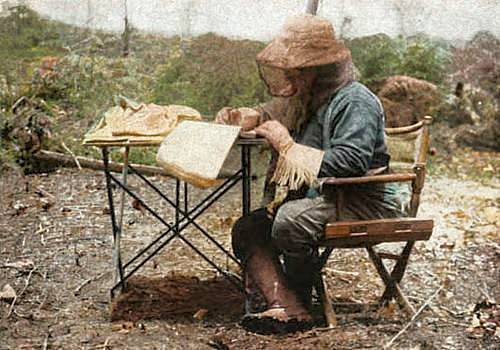
He wrote these manuscript pages while he was in the field. There’s an iconic photo of Roosevelt sitting at a folding table with a head net and gauntlet gloves to keep biting insects off of him in the jungle kind of when he was on the River of Doubt. So it seems like later in his life, as he progressed further, he did much more just keeping manuscript notes, et cetera. So we don’t have notebooks or field notes from his later expeditions.
Brett McKay:
It’s interesting. So Michael, we really just scratched the surface here of what you can find in Roosevelt’s field notes. But I’m curious as you read through them, I mean, these are things that Roosevelt actually touched, he actually wrote down and studied his life. Were there a few lessons, life lessons that you gleaned or took away from looking at Roosevelt’s life through his field notes?
Michael Canfield:
Yeah, I think so. I mean, aside from just being sort of a manuscript nerd and finding it really inspiring to look at them, which in fact, the Harvard ones are scanned. Almost all of them are scanned and you can look at them, they’re freely available. It’s not quite as good as looking at them directly, but it’s still pretty moving. I think that the biggest lesson that I took and the thing I learned about Roosevelt as a personal lesson was his dedication to going directly to the source, to directly connecting with his world, that he went out and with whatever it was, yes, he was really fascinated with hunting and doing these kinds of things. But the conservation thing was something he went out and met with John Muir in Yosemite. He didn’t just think about it. He didn’t just read about it. He wanted to understand lions.
So he went to Africa and he went face to face with lions. Dramatic, yes. But when you look at his notes, there’s a credibility to that. And we didn’t talk much about the trip to Cuba in the Spanish American war, but he left his post as the assistant secretary of the Navy, much to the chagrin of his friends and family to go be on the front lines in Cuba. And you see that in his notebooks, his documents that he was there and he wanted to be there on the front lines in the battlefield. People have made a lot of reasons why that was the case, some that he was sort of mad, but he lived his life by connecting with his world and going out there and observing it directly and understanding it firsthand. That’s what I find most inspiring about Roosevelt. And the thing I take from him and try to remind myself of is it’s important to go to the source and to not live just in a secondary fashion, but to experience our world and that’s what it’s going to take.
I think it’s really important that our leaders do that as much as possible.
Brett McKay:
Well, Michael Canfield, thank you so much for your time. It’s been a pleasure.
Michael Canfield:
Thank you. I really appreciate you having me and I hope that things continue to go well with the Art of Manliness. It’s a great site.
Brett McKay:
I appreciate that. My guest today is Michael Canfield. He’s the author of the book, Theodore Roosevelt in the Field. You can find it on amazon.com and bookstores everywhere.