
Editor’s Note: This is an excerpt from Tim Ferriss‘ new book, The Four Hour Chef.
An Introduction to Dehydrating Food
Dehydration is all about removing water from food. Doing this helps to preserve the food (bacteria need water) and concentrate flavor. It’s a common misconception that you need heat to dehydrate food. But low humidity, not heat, is the driving force behind dehydration. Warming the air surrounding the food helps keep it dry, but if the air doesn’t move, the food will stay wet. So when dehydrating food in the kitchen, make certain that air can freely circulate around it.
Sidenote: You can achieve the same preservation of dehydration by leaving the water in food but making it unavailable to bacteria. Just add substances like sugar and salt, which bind to water molecules and lock them away. Lox (salt-cured salmon) and salted butter are safe to keep at room temperature for this reason—but unsalted butter is not!
The Best Jerky in the World
Sometimes a survival skill isn’t just about preparing for hard times. Six-time New York Times best-selling author Neil Strauss learned this while writing about apocalypse-proofing your life in his book Emergency. Yes, learning to preserve meat was useful. But learning to flavor meat was an art.
In search of the perfect marinade, he polled everyone: hard-core survivalists, friends’ grandfathers, chefs, and beyond. Then he split-tested the best and simplest recipes that didn’t require a smoker or a food dehydrator. He submerged near-identical meat slices into 2–5 containers of marinade at a time. Sometimes he tested a different brand or amount of teriyaki sauce, and other times he added a random ingredient like truffle oil or mustard. It became something of an obsession.
The following recipe is what won all the taste tests.
This recipe is intended for home cooking, not for the wilderness, but it can be adapted for the wild.
Hands-on Time
15 minutes
Total Time
15 minutes plus 24 hours for marinating and up to 24 hours for drying and cooling
Gear
- Knife
- Large container with lid
- Aluminum foil
- Wooden or plastic serving spoon
Ingredients (to make 2.3kg (5lb))
- 2 kg (5 lb) lean brisket
- 470 ml (2 c) Kikkoman soy sauce
- 470 ml (2 c) Worcestershire sauce (Neil likes Lea & Perrins)
- 470 ml (2 c) thick, flavorful teriyaki sauce (Kikkoman Takumi Garlic & Green Onion or, Soy Vay Veri Veri Teriyaki)
- 240 ml (1 c) liquid smoke (it’s not always easy to find, so any brand will do)
- 120 ml (1/2 c) Karo dark corn syrup (you can also try blackstrap molasses)
- 3T garlic powder
- 3T onion powder
- 3T sesame seeds
- 3T brown sugar
- 1t cayenne pepper
PREP
00
Put the meat in the freezer for an hour to make slicing easier. Slice meat with the grain as thin as possible (less than 0.6 cm or 1⁄4″). If you’re lazy or not great with the knife, call the butcher ahead of time and ask him to slice 2 kg (5 lb) of lean brisket at this thickness. The leaner the meat, the better and longer-lasting the jerky.
PICKUP
00
In a large container, mix the 470 ml (2 c) soy sauce, 470 ml (2 c) Worcestershire sauce, 470 ml (2 c) teriyaki sauce, 240 ml (1 c) liquid smoke, and 120 ml (1/2 c) dark corn syrup.
01
Add the 3 T garlic powder, 3 T onion powder, 3 T sesame seeds, and 3 T brown sugar. Throw in 1 t of cayenne pepper. Add more if you like it spicy, but a little goes a long way. Note: cayenne pepper is also great for putting on a cut to stop bleeding, and it doesn’t sting.
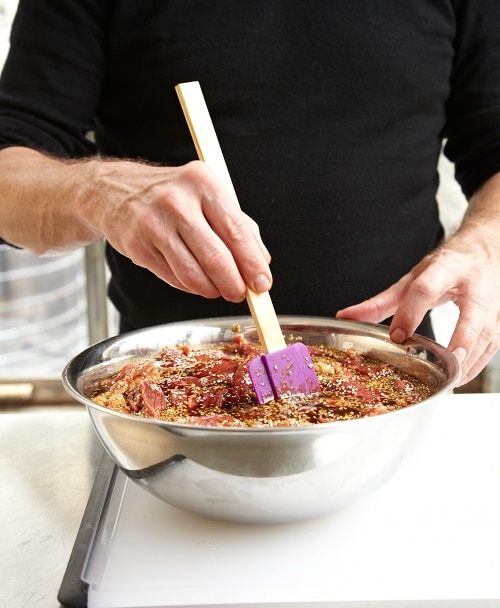
Make sure your meat is completely submerged in the marinade.
02
Stir well, then drop your meat into the marinade. Your meat should be fully submerged.
03
Optional: Sometimes I’ll take a smaller container and play with a slightly different marinade, adding in different oils, spices, and notes (even soda, wine, or beer) to the same base marinade. I’ll add in a little of the sliced meat for a batch of experimental jerky.
04
Close or cover the container(s), then leave in the refrigerator for at least 24 hours.
05
Once the meat is well marinated, it’s time to dry it: Cover the bottom of your oven with aluminum foil. Things will get mess
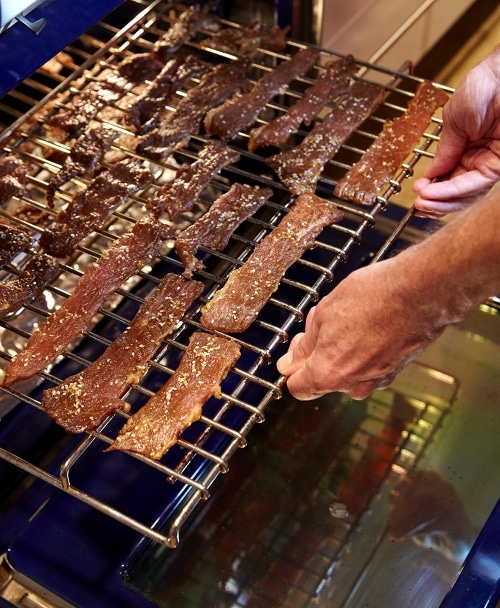
The higher the racks are placed in the oven, the better.
06
Place the meat on the racks of your oven, one next to the other (see pic above). The higher the racks are placed in the oven, the better. If you like, you can put the meat on aluminum foil or hardware cloth.
07
Set your oven temperature to 70°C (160°F), or 80°C (180°F) if you’re in a rush. Crack open the oven door by sticking a wooden or plastic serving spoon in the top of the door. Steve Rinella uses a crunched beer can. The goal is to dry the meat but avoid cooking it.
08
Let it dry for 3 hours, then turn over the jerky. After another 3 hours, it should be done. The total time, however, is dependent on the thickness of the meat and the temperature of the oven. The jerky is done when it’s dry enough that you can rip off a piece easily, but before it snaps when you bend it.
09
Leave meat out in the air to cool. It is now ready to eat. The longer you leave it out to cool, the drier it will get. After no longer than 24 hours, store it in sealed Ziploc bags. Without refrigeration, it will be good for 4–6 months.
Have any other jerky-making tips? Share them with us in the comments!
__________________
Available now, The Four Hour Chef by Tim Ferriss isn’t just a cookbook (though, you’ll find plenty of recipes in it like this one for beef jerky). It’s a guide on how to learn anything (like cooking) as quickly as possible using a simple system Ferriss has designed to master a wide range of skills.



{ 57 comments… read them below or add one }
Use a convection oven, although the “foil lining” part of the article is 100% correct. Maxim makes one which you can take down to 110-120 degrees, but either way, convection drying is a LOT faster because the air is being blown around.
Best post ever! Cant wait to make this. Store bought jerky is an atrocity.
I’m going to do this for Thanksgiving. It will be my manly contribution – we’ll eat it while we watch football (beats talking to my in-laws!).
there’s a butcher/country store in South Georgia called Striplings that makes my favorite jerky. The marinade is less soy and more black pepper. I wish I lived closer to buy some and try to replicate it.
Better than using your oven (which no matter how well you control it will cause your meat to cook), try this hack from Alton Brown…
Software:
One batch of sliced an marinated meat (follow recipe until step 04)
Hardware:
1 box fan
2 bungee cords
Cellulose-based furnace filters (available at the hardware store)
line your meat in the ridges of the furnace filter (use as many as needed) and stack the filters on top of one another. Then take an empty filter and place it on the top of the stack. Secure your filters to the fan using the bungee cords so that the fan will blow air through the filters. Turn on your fan and let the meat dry for 8-12 hours (to quote AB, “your patience will be rewarded”). When jerky is dried out, place in an air-tight container (zip-top bags have the tendency to hold moisture against the meat which will re-hydrate it) and consume at your leisure.
The only thing to note about this method, is that your living space will smell of drying meat. If that’s something you and your loved ones want to avoid, just place the fan by a window so that it’s blowing out.
Question: How do you do this without electricity? That would be useful after the powergrid fails during the zombiepocalypse.
Instead of putting the foil on the bottom of the oven, you can use a drying rack to hold the meat and put it on top of a sheet pan. This has the added benefit of shielding the meat from direct heat.
The best meat for jerky is venison. I use a dehydrator, but the stove works just fine. For the marinade you want something that compliments the meat not smashes the original flavour into oblivion. Good jerky is hard to keep in stock between my daughter, my scouts and my friends.
A couple points from my own jerkying experience:
1) Brisket is pretty good, but I’ve found that top round (or bottom round) roasts tend to have less fat in inconvenient spots (I prefer leaner jerky).
2) If you maintain your kitchen knives properly there is no need to partly freeze the meet prior to slicing. Just use a good sized knife (a sharp one) and slice using the full length of the blade; don’t saw the meat.
3) In my opinion, there is a lot of needless sweet stuff in this recipe. The 470ml teriyaki sauce is probably something like 60-100g sugar already. Add the 3T brown sugar and 120ml corn syrup/molasses… if you want candy, why not just eat candy?
Anyone have any recipes that don’t include any soy products (allergens) or corn syrup (enough has been said on this) or liquid smoke? I’m looking for a more “natural” beef jerky.
alton brown doesnt use heat at all. uses cotton air conditioner filters strapped to a box fan. set to high in the garage or hanging out a window for 12 to 24 hours. worked for me.
I normally like your articels but I think this ain’t the “real stuff”. BEST beef-jerky is natural or peppered. Way to many ingredients from my point of view. Greets from Germany Max
Call me old-fashioned, but you really don’t need to muck up your recipe with all those sweet ingredients. The best beef jerkey I’ve ever had is dry rubbed with season salt and black pepper, that’s it.
And there is simply no substitute for real smoked jerkey
My grampa and I used to make beef jerky… now I have another excuse to spend time with him
I would really be interested in reading a follow up from Creek about Jerky Making.
Brisket can be a little pricey. Top round or if you find it on sale, eye of round is just as lean if not leaner. Cutting the meat with the grain cannot be over emphasized. If you cut it across the grain you will end up with meat powder.
My son and I love making (and eating) jerky together.
A coworker makes jerky using ground meat and an extruder. He adds awesome flavoring like bourbon and ghost peppers. Since he works the overnight shift, when I come in in the morning and he’s brought jerky to share, I get quite a jolt to wake up.
How about adding some Franks Red Hot and/or Tabasco sauce into the marinade?
Eye od round is a great cut to use. Its very lean and cheaper than brisket. You want the leanest meat you can get because fat goes rancid, so the storage life will be much shorter. If you have a good butcher he will take an eye of round roast and slice it into thin pieces for you using the deli slicer. It does a beautiful job and saves a lot of work.
I work at a local grocery store in the meat department. I’d highly recommend using eye of round as it is very lean and easy to trim the small amount of fat off the one side. I actually cut meat for one of the regulars who makes and sells a lot of his own jerky. Based on his experience (and mine), I’d recommend getting to know the employees at your local butcher shop and have them cut the meat for you. They can be very helpful when trying to cook or prepare something for the first time. Also, if they cut the meat on a slicer instead of with a knife, remember to ask for it cut with the grain and ask what setting they put it on after to get a consistent slice every time. Trust me, it’s a lot easier to go in and say you want your meat cut at an 18 than by trying to show with your fingers how small you want it cut.
Looks like a pretty decent recipe but rather than using the oven I’d suggest picking up a dehydrator for like 30-40 bucks and use that.
You guys here at AOM always know how to brighten up my day. Keep it up!
Why have beef jerky when you can have biltong?
http://en.wikipedia.org/wiki/Biltong
Teriyaki flavor with a little spice is ok, but try something really good:
Hands on time: 30 minutes
turn on the gas grill or gas stove element and using tongs, fire roast two jalapenoes, one serrano, and one passilla chili until the skins are blackened. Place them in a closed or covered glass container for ten minutes. Peel your chilis.
Chop them up really small, almost to mash and add sea salt and pepper.
Squeeze in a lime, and toss in a shot of tequila and a splash of agave syrup.
Allow your meat to rest in this for three days, then jerk it.
What, you ain’t laughin yet? Maaaaan get your head right re read this, laugh your ass off, then get to making some really spicy butt kickin jerky
Since I’m living in Mediterranean Europe I had to make my own Jerky dehydrator since no one here what beef jerky is.I made a wood cabinet with a grill and a now illegal incandescent light bulb inside.I don’t like the recipe posted here because beef jerky is not supposed to be candy,liquid smoke is not even close to the real deal,and don’t be lazy to slice fresh onion and garlic for marinade.
This is for Patrick, who asked about not using electricity. You can hang your meat high over a campfire. The heat, smoke, and air will dry it out in a few hours.
@ Justin, GREAT Advice, that what I’ve been doing for 20 years. Eye of round sliced @ 25
You can also use a fridge to dry your meat. Thread it on a few strings and let it hang in there. I let the door open a bit, but it could be better to put a bowl with salt in, or any material which can absorb the humidity.
Thank you.
I will pass this on.
K, bye
I’ve been doing jerky for years and use a large dehydrator so I can make enough to last! I look for london broil on sale as its pricey, it is already about the right width and can be sliced with or against the grain. Either way will work, the key is to dry it properly. I’ve got a kllier recipe, but its top secret, so I would have to kill you if I posted it.
marinades are many and varied, i use simple korean bulgogi marinade, and let it rest 24 hrs, then box cure it for 5 hrs. but i do 5 lbs at a time.
my jerk box was built with plans from internet , and includes a 1/2 gallon steel bucket to use for smoke additions to jerked meats ,just place a layer of well lit charcoal lumps in bottom of bucket, then i add mesquite chips soaked in water or bourbon to 3/4 mark in bucket. you get very little added heat and about 2 hrs of decent smoke from a single loading. You can also use applewood,walnut,cherry or larch, but do not use pine(makes everything taste like pine-sol cleaner)
Homemade jerky is something I had made a mental note of to try one day, so when I saw this article I decided to give it a go. I followed the procedure with the minor deviations being 1) my oven only goes down to 170, 2) I went for the aluminum foil on each rack option because I’m lazy and didn’t want to scrub the wires after, and 3) out of habit I accidentally closed the oven door a few times, probably for a total of 20-30 minutes…
None of these seemed to make a difference, however, as the jerky came out with the right texture and delicious 6 hours later. It’ll be hard to eat store-bought again!
Next time I will definitely be trying out some of the alternative methods mentioned in the other comments, trying to do it for cheaper ($45 for all the ingredients this go-around… for a lot of jerky, mind you), and experimenting with subtler marinades (the one in the article is really tasty, but a bit more intense than I prefer).
So yeah, I highly recommend the whole getting off your butt and making jerky thing. Do it!
The best jerky I ever had was the South African kind…called Biltong and made from kudu meat (that’s a local wild deer)…it’s almost black and they make it traditionally by burying it underground for a few months :-)
I informed some coworkers today that I was going to try this. One of them said “Beef jerkey is like… … a meat rasin”. I found this extremely funny.
If you vacuumed sealed this jerky, how long would it last?
OK, I tried this last week. Maybe I didn’t crack my oven enough, but at 170* in convection mode, the jerky turned to a black, carbonized mess after 4.5 hours. I used eye round sliced at 1/4″ thickness.
I come from the biltong school. For my mix I use 1/6 salt, 1/6 brown sugar, 2/3 pepper and 2/3 coriander. Slice the meat and soak it in vinegar overnight, then take it out and try to get the liquid off the surface (so its not dripping wet) then roll it in the mix. I then hang it to dry for 48 – 72 hours (in a specially designed plastic box with a fan on the top called a Biltong King) and its ready to go.
I took an old computer fan and attached it to the base of my dehydrator and put short legs on the dehydrator and it cut my time in half. So awesome!
I just tried this out today. Five pound brisket and pretty much followed the directions as written with a few small tweeks to the recipe (I added Tobasco and crushed red pepper). It’s currently out of the oven and drying on the counter. After eating a few pieces it really is a good recipe but I’ll probably play around with it as mentioned by some other comments to see if I can do it for a few bucks less.
After my wife’s latest baked creation was far too brown far too quickly, I bought an oven thermometer, set it smack in the middle of the oven and set it at 450* for over an hour. It hovered +/- 500* for that entire hour. I hope it isn’t consistently 50* hot across the board. Thankfully with the digital control, I can adjust it down.
My jerky cooked for a little over 6 hours total at 150 degrees, some pieces still have a slight pinkness in the middle, but they splinter when tearing.
Safe to eat or no?
My Waring 5 tray dehydrator has served me well for years and worth the small investment. I have part of a 5 lb batch of top round in there, now. I, too, like my jerky smoky and earthy, not sweet. I have not embarked on a true smoking, mostly because I’m not sure how to do it. I have a smoker, but probably need to wait for Spring to try it. My mixture varies, but normally includes worchestershire, liquid smoke, garlic powder, onion powder, and soy sauce. This time, I put in a bit of chipotle powder, Sriracha, a bit of honey, and a few crushed pepper flakes – got a little crazy on the ingredient count. I have found that both cutting with and against the grain works.
Its not too late! I’m in the middle of making 14 lbs today for Christmas presents!
Could this work with other types of meat, like venison or bison? Curious to try it out…
Instead of laying the strips across the grate in the oven, trying sliding a bamboo skewer through the end of the strips and then “hanging” them down between the grates (with aluminum foil or something to grab the drippings). That way you make more quicker!!
I feel like this recipe is better suited for a magazine in a grocery isle. I believe the art of manliness should not cut corners and use liquid smoke or teriyaki sauce. If you want it smoky, smoke it. Use real ingredients for real food…and be a real man.
When storing the jerky I use a brown paper lunch bags. I have found the the plastic ziploc bags can cause the jerky to mold.
Also if you over cook it place slice of bread or two in the paper bag. By doing this the jerky absorbs any of the moisture in the beard.
I have found over the years of making venison jerky that these work great.
I bought Jerky Bible book on Amazon. God, the jerky is SO good! I’ve tried several recipes for my friends. They want to buy a dehydrator so they can make their own jerky. LOL I never thought that jerky can be that good! I strongly recommend that book if you want to impress your guests.
The way I do it seems to be even better because nothing hot touches the meat “IE the racks”. Just put skewers through the piece one end of the meat and fill the whole skewer up leaving about 1/2 inch inbetween each one. Then hang the meat through the rack and the skewers will hold them in place. I did 7lbs at once with np. 160degrees for around 6 – 8 hours or until u can bend it and it cracks, but not break. nice recipe tho.. similar to waht I use
I pretty much did the same thing but used a toothpick to skewer each piece and hang from the oven racks. Tin foil on the bottom and all was well! ‘
Anyone know what I can replace liquid smoke with? You just can’t get it here in the UK
My Dad shot a bear while hunting once (defending himself and companions–not hunting bear) and we had a freezer full of bear meat. You can’t tell it from beef unless you’re a “foodie” and nobody likes them anyway. Mom made jerky from a lot of the meat and it was wonderful. I’d bring it to school and share with my friends and after they ate it and told me how much they liked it, then I’d tell them what it was. Good times…
Why would you use Brisket? It is very fatty relative to other meats (even if just the point of brisket), which will quickly turn rancid.
Also brisket is pretty tough until it is cooked to 180-190 degrees where the connective tissues start breaking down….which doesnt happen when drying. So I’d expect it to be really tough.
Does leaving it over the fire take significantly longer in Southern states? Reason I ask is because Louisiana always has very high rates of humidity. So, if I were to do this on a camping trip would it be wise to start early?
It can take longer in the South, yes- it’s 90% humidity in central Virginia today, & that would double my normal time. But unless you’re waiting on the breakdown of the social order it won’t matter much. Basically you’re making jerky cause jerky is good, not so your family can subsist on it during the Troubles, & a somewhat juicier jerky actually tastes better. If you want to avoid weird sugariness & fake smoke, do it Thai-style– for 3lbs london broil, use 5Tb soy sauce, 2 Tb fish sauce (enzymes help tenderise), 2 Tb whole coriander toasted & ground, 1/2c brown sugar (sugar also helps in preservation), 2 clove pounded garlic; marinate for 24 hours then either campfire smoke till done or cold smoke then oven dry. Thais then fry that mother up with a sweet chili sauce & eat it while swilling Mekhong whiskey, which just goes to show why everybody wants to go there.
I just made this and enjoyed the hell out of it. Great flavor, and I pulled any notable fat strips off the brisket pieces before drying. Thanks to my local butcher, the slices were extremely thin and it cut the drying time in half.
I’ve used this recipe a couple times, and it is really good.
However, rather than storing in plastic bags (which I find can sometimes lead to mold, as there is still some moisture in the meat even after drying), it is better to put the jerky in glass jars, or in cheesecloth bags.