Welcome to the first installment of Testosterone Week! Based on the reaction from yesterday’s announcement post, this is a subject that many of you are both interested in and passionate about. I’m looking forward to reading your constructive contributions to the discussion.
I know many of you are clamoring for the “how-to” part of this series (which will go up on Thursday), but before we get to that, it’s important to cover why you should even care about your testosterone levels in the first place, what T is and how it’s made, and how to get properly tested for it. Building a sound foundation before we dive into the nitty gritty details will be highly beneficial.
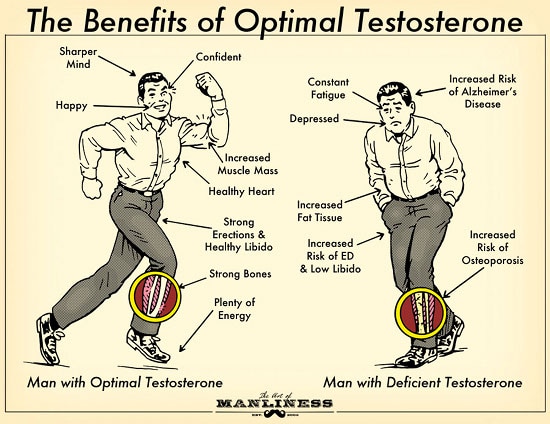
Today we take a look at some of the physical and psychological benefits that come with having optimal testosterone levels (I’ll talk about what “optimal” means regarding T later this week). You probably know about some of the benefits already, but some of the ones I discuss may surprise you. When appropriate, I’ll report any health benefits that I experienced during my own 90-day testosterone boosting experiment.
First, A Caveat…
Before we delve into the benefits, let me begin with a caveat. Research on the benefits of testosterone is inconclusive in some areas. You’ll find some research saying, “T gives you ‘x’ benefit,” but other research that says, “No, T actually does the opposite.”
The other problem researchers run into when studying the benefits of testosterone is distinguishing between “cause” and “effect.” Is it T that’s providing all these great health benefits or does simply being healthy give you optimal levels of testosterone? It’s tricky because in some instances the answer is “both.” Testosterone (like all hormones) often plays a part in a “virtuous cycle” that regulates a whole host of processes in our bodies — as you increase T, you get healthier; as you get healthier, your T levels rise. It can also play a part in a “vicious cycle” — as your T levels go down, your health suffers; as your health suffers, your T levels decrease even more.
Below, when a supposed benefit of testosterone is not 100% conclusive, I’ve used the modifier “may” in the opener.
The Benefits of Optimal Testosterone Levels
Testosterone may fight depression. If you’ve been battling the black dog of depression, it may be because of low testosterone levels. Researchers have found that men suffering from depression typically have deficient testosterone levels. While scientists haven’t been able to figure out whether it’s low testosterone that causes depression or if depression causes low T levels, preliminary research has shown that some men suffering depression report improvement in mood and other factors of depression after undergoing doctor-directed testosterone treatments.
As someone who’s prone to being an Eeyore, I can report that I definitely felt much more hearty and hopeful during my experiment. Kate also noticed that I was less moody and in better spirits.
Testosterone decreases body fat. Testosterone plays an important role in regulating insulin, glucose, and fat metabolism. As our T levels decrease, our body’s ability to regulate insulin, glucose, and fat metabolism decreases, which in turn causes adipose tissue (i.e. fat) to begin accumulating. To add insult to injury, that increased adipose tissue may also contribute to further decreasing testosterone levels because it converts testosterone into estrogen.
This negative feedback loop may explain why obese men typically have below-normal testosterone levels and higher levels of estrogen. However, research has shown that by taking steps to increase testosterone levels, you can break the vicious cycle of low T and high body fat and actually create a virtuous cycle of fat loss and increased T levels.
For an in-depth article on the interplay between testosterone and body fat, click here.
I can report that I saw decreased body fat during my three-month testosterone experiment. I started off with 18% body fat and ended the experiment with 12% body fat. I almost have a six-pack! This is the leanest I’ve ever been in my entire life. The funny thing is, I wasn’t even trying to shed body fat. It just happened. All hail, mighty testosterone!
Testosterone increases muscle mass. We all know about testosterone’s ability to increase muscle mass and strength. It works its muscle-building magic by increasing muscle protein synthesis.
I definitely enjoyed an increase in muscle mass during my experiment. Despite dropping six percentage points in body fat in three months, my weight stayed about the same; I began the experiment weighing 185 pounds and I ended it weighing the same. The body fat I lost was replaced with muscle. It was fun to see and hear Kate’s reaction when I’d take off my shirt to get into the shower. “Whoa! Your muscles have gotten huge!”
Another benefit of the increased muscle mass was that I got stronger. My bench press, squat, and deadlift all enjoyed significant gains during my experiment. It’s great to be able to bench press 225 pounds again for 5 sets of 5 like I used to in high school, and I’m on track to beat my maxes on the bench and squat that my 18-year-old self set over 12 years ago.
Testosterone may strengthen your heart. Research on testosterone’s relation to heart health is split. Some scientists have found that men with higher testosterone levels have an increased risk of heart disease, while recent studies have shown that men with below-normal T levels are more at risk for heart problems. The research is still on-going, but many doctors find the evidence compelling that optimal testosterone levels can help prevent cardiovascular disease.
To be clear, it’s not the testosterone hormone itself that strengthens your cardiovascular system, but rather the myriad of health benefits that come from optimal testosterone levels.
Testosterone strengthens bones. You may have thought of osteoporosis as a health problem that only women have to worry about, but men can suffer from this bone-weakening disease too. And low testosterone levels may be to blame. Testosterone has been shown to play an important role in bone health. It increases bone density by stimulating bone mineralization as well as decreases bone resorption. Elderly men suffering from osteoporosis typically have sub-optimal testosterone levels. If you want to enjoy strong, healthy bones well into old age, take steps to improve your testosterone levels now.
Testosterone increases libido and improves erections. Testosterone is a sex hormone, so it’s not surprising that low libido and erectile dysfunction are two of the first signs of low T that men notice. If you’ve noticed a sharp decrease in your interest in sex, you might have low testosterone.
When I told people that I was doing an experiment to increase my testosterone, the question that people would invariably ask in hushed tones was, “So, did it, you know, improve your sex life?” Honestly, I didn’t see too much change. I had a robust and healthy sex life before the experiment and continued to do so afterwards. I guess I was a bit more randier than usual, but not much. I’d imagine if you had been suffering from low T for a long time and took steps to increase it, you’d likely see improvement in the bedroom department.
Testosterone may decrease your chances of Alzheimer’s Disease. Several studies have linked low testosterone levels to an increased risk of Alzheimer’s disease. In a 2010 study by the University of Hong Kong, researchers studied 153 Chinese men who were recruited from social centers. They were at least 55 years and older, lived in the community, and didn’t have dementia. Of those men, 47 had mild cognitive impairment — or problems with clear thinking and memory loss.
Within a year, 10 men who were part of the cognitively-impaired group developed probable Alzheimer’s disease. These men also had low testosterone in their body tissues.
That study is not alone. Researchers at the University of Southern California have reported that increasing testosterone levels in mice with Alzheimer’s actually slows the progression of the disease. This observation has led scientists to hypothesize that maintaining optimal T levels into old age may help prevent Alzheimer’s in humans.
Testosterone may improve cognitive ability. Not only have studies shown that there is a link between testosterone levels and Alzheimer’s, they’ve also shown a link between T levels and overall cognitive ability, particularly in older men. One such study performed by Dutch researchers found a direct linear relationship between T levels and cognitive function, while other studies have found a linear relationship between memory loss and T levels. Because of these correlations, many researchers believe testosterone plays a role in preventing brain tissue decay in elderly men. The hormone’s connection to cognition explains why some of the symptoms of low T in men are memory loss, trouble concentrating, and “fogginess.”
While studies haven’t found a link between increased testosterone levels and cognitive ability in young men, that shouldn’t stop you young bucks from striving to achieve optimal T levels. It’s important to establish testosterone-healthy habits NOW, so you can reap the benefits in old age.
Testosterone may increase competitiveness. Men are known to be a competitive bunch and testosterone is likely responsible for our drive to win. Testosterone is linked with a man’s desire for power and status (Dabbs & Dabbs 2000). Testosterone ramps up before a fight or competition – producing effects on muscle mass and hemoglobin, quickening reactions, improving visual acuity, and increasing your feelings of endurance and indomitability. It also increases your “gameness:” One study showed that a man’s testosterone level after losing a game predicted whether or not he got back in for another round. Men who experienced a severe drop were less likely to play again, while men who experienced little or no drop in T levels got back into the game. Researchers concluded from this observation that T is one of the factors driving competitiveness in men.
Testosterone increases dominance and the desire for power. The link between testosterone and dominance has been demonstrated in numerous studies. T motivates men to gain and maintain social status. The desire for dominance can be a bad thing if it leads to criminal behavior, but it’s also what fuels the climb for success, motivates men to resist oppression and buck authority, and may even help you with the ladies…
Testosterone may help you woo a woman. In the animal kingdom, higher testosterone levels have long been shown to be associated with a male’s dominance in the competition for mates. But a recent study has shown this is true for human males as well. When a pair of men were instructed to compete for the affection of an attractive female undergraduate, the men’s assertiveness, ability to control the conversation, and ultimately, their chances of having the woman say she “clicked” with them most, were positively associated with their pre-competition testosterone levels. So there is truth to the idea that men with swagger get the girl, and this self-assuredness may be partly rooted in T.
Testosterone increases the tolerance for risk-taking. Testosterone has a strong link with one’s willingness to take risks. Studies show that men with low levels of power and status, but high levels of T, are motivated to take risks in order to gain status and power. On the other hand, men with high T, who already have power and status, are more risk-averse, because they want to hold on to what they have.
It has also been found that college graduates with higher levels of T (men and women alike) are more likely to go into riskier careers. Another study discovered that among financial traders, a trader’s morning level of testosterone accurately predicted his day’s profitability – higher levels of T mean he’s more likely to take risks that day and score big.
Finally, related to the point about competitiveness above, studies have shown that testosterone levels not only go up before a fight or competition, they increase after each win, and this gives the winner a much higher probability of winning his next round, and the next round after that, even against evenly matched competitors. This is called the “winner-effect,” and John Coates, author of The Hour Between Dog and Wolf: Risk Taking, Gut Feelings and the Biology of Boom and Bust, explains why it works:
“Life for the winner is more glorious. It enters the next round of competition with already elevated testosterone levels, and this androgenic priming gives it an edge that increases its chances of winning yet again. Through this process an animal can be drawn into a positive-feedback loop, in which victory leads to raised testosterone levels which in turn leads to further victory.”
The potential downside of this positive feedback loop, Coates argues, is that testosterone levels can eventually surge past optimal levels and have the opposite effect – leading to overconfidence and poor decision-making. When this happens to animals, Coates, observed, they “go out in the open, pick too many fights [and] patrol areas that are too large…Risk taking becomes risky behaviour.”
For this reason, after the 2008 financial market meltdown, some commentators put the blame for the crash on the male-dominated profession, arguing that men take too many risks, and the economy would do better and be more stable if it was run by women. Of course, risk-taking does come with inherent risk, but it has also been responsible for the lion’s share of society’s progress and innovation since the dawn of time. Financial markets would likely not exist – period – without testosterone-driven risk-taking.
Myths about Testosterone
Testosterone results in anti-social behavior. Testosterone gets a bad rap as causing antisocial behavior – bullying, aggression, not getting along with others, taking advantage of others, etc.
However, studies have found that social success among men is actually linked with high testosterone levels. For example, teenage boys who were perceived as socially adept and dominant had higher levels of testosterone than boys that were low on the totem pole. What’s even more interesting is that this same study found that teenage boys who had a history of being anti-social and displaying high physical aggression were found to have lower testosterone levels at age 13 compared with boys with no history of high physical aggression.
Testosterone’s pro-social effect can also be seen in grown men. Swiss researchers found that men with increased testosterone acted much more fairly in a bargaining game than men with lower T. The results were a surprise to researchers, who thought they’d see more unethical and anti-social behavior among men with higher testosterone.
In a similar study using a bargaining game, researchers found that aggressive social behavior occurred in men with high testosterone ONLY when there was a perceived unfairness in the bargaining situation. So if there’s a threat of getting bamboozled by someone, a man with high T gets unfriendly.
Testosterone makes you angry. This is probably the most common myth about T. The reality is that there’s no concrete evidence that high testosterone levels cause anger and violent outbursts. In fact, the opposite might be true; low testosterone, not high T, is what causes anger and irritability in men. As discussed above, having low T levels has been linked to depression in men and it just so happens that two of the primary symptoms of depression in men are increased angry outbursts and irritability. So if you’re chronically angry, you might be depressed, and you might be depressed because you have low T. As I mentioned above, I became less moody and irritable during my experiment, which I attribute to the boost in my testosterone levels.
Where did the myth about T and anger come from? It’s likely from people’s association of testosterone with steroid use and “roid rage.” What’s interesting is that the anger and aggressiveness that comes with steroid use is likely due to decreases in natural testosterone production that is a byproduct of artificially juicing. No T = roid rage.
Testosterone causes prostate cancer. Since the 1940s, it was commonly believed in the medical field that high testosterone levels were the cause of prostate cancer in men. Doctors reached this conclusion because two scientists in 1941 noticed that prostate cancer regressed in a patient after they castrated him and his T levels subsequently declined. This conclusion was based on the results from a single patient!
Since then, multiple studies have found no link between high testosterone levels and increasing your chances of developing prostate cancer. However — and this is a BIG however — if you already have prostate cancer, increased levels of testosterone may exacerbate the problem. It’s best to wait until after you treat your prostate cancer before you begin any T-boosting regimens. Tread carefully and talk with your doctor.
Testosterone Week Series:
The Declining Virility of Men and the Importance of T
The Benefits of Optimal Testosterone
A Short Primer on How T is Made
What’s a “Normal” Testosterone Level and How to Measure Your T
How I Doubled My Testosterone Levels Naturally and You Can Too
Any other benefits of testosterone that I forgot? What’s your experience with testosterone and your health? Share with us in the comments!


{ 65 comments… read them below or add one }
As someone who’s suffered from low testosterone since ’07 I can personally attest to the power of T.
I had my cancerous left testicle removed in ’07 and things only got worse from there. I immediately packed on 30 lbs, was always tired, depressed, and suffered from ED so bad that I was practically impotent.
Fortunately after arguing with various doctors I’ve finally been put on TRT. My only issue is that I seem to be allergic to every testosterone medication I’ve used so far. The patches and gels both left me red, swollen and extremely itchy.
Right now I’m on a monthly shot, but the dosage is way too low and probably won’t be adjusted until my next blood test (the shot itches as well, but it’s tolerable.)
Great post, Brett! I look forward to seeing how these posts play out. I’d love more information on how to test/increase my own testosterone levels.
I really enjoyed this article as I do most AoM articles. I studied statistics and I think the explanation in the caveat was well done. I was a little confused at some points in the article though. Phrases like “other studies have found a linear relationship between memory loss and T levels” weren’t complete because while the writing suggests a connection between T levels and memory loss, it did not indicate if this was a positive or negative relationship (ex: found a negative linear relationship) until a couple of sentences later, so I had to ‘punt’ at your meaning until I figured it out. Brilliant article though and I look forward to reading more from AoM
Brett, you forgot to include the benefit of being able to grow an impressive mustache like Ron Swanson. ;) In all seriousness, thanks for devoting the time to this subject. I’m learning a lot.
This is an excellent topic to cover. I believe there is a huge disconnect in our society between men and our natural selves. With testosterone being primarily male, it has been a scape goat for all things evil that any accuser has about a man, in turn pushing boys and men away from what is a major part of makes us what we are, our testosterone.
It is especially unfortunate that the result is the opposite of what is needed to achieve optimal health for males, and in turn a society as a whole. Mostly based on myths and guesses.
Tragic.
Greetings!
Will you be discussing DHT dihydrotestosterone and its relationship with testosterone?
Thanks
Great article. I’ve been nervous about getting back in shape because of increased T levels that could make me angry, but now I don’t need to worry about that. I can actually start living my life again!
I was JUST sitting down and reading on Friday about ways to increase Testosterone. Then you went and made a week out of it.
Well played, Brett, Well played!
I’ll have to make some time to look into the specifics of the studies you have used to write this, but the positives (and negatives from low T) seem to be impressive.
Great work with the science backed approach to writing this first article. Can’t wait for the following articles. Especially the one were you tell your approach to increasing your testosterone levels. I’m hoping to learn a few new things beside the things I already do to keep them high.
Thanks.
I occasionally suffer from mild boughts of depression. I don’t live a very healthy lifestyle- yet- which I’m sure is resulting in less than optimal T levels. I’m only 19 but sometimes I feel like I’m 90. I look forward to Thursday so I can start feeling better and maybe get rid of the pain in my feet when I walk.
Very well written article, I can’t get enough of this stuff! I am looking forward to the next ones and learning how to increases my “T” levels! As always keep up the good work man, and “May the T be with you!”
Will you be discussing DHT dihydrotestosterone and its relationship with testosterone?
Thanks
And its relationship to male pattern baldness? thanks
Understandably not the most important issue at all, but is there a scientifically proven link between increased T and better facial/body hair growth. Will increasing T significantly increase your bodies ability to grow a beard, Tom Selleck rug or the afore mentioned Swanson moustache?
Looks like an interesting series of articles to come; can’t wait. Do check out chriskresser.com; Chris had an excellent podcast on Testosterone a while back. Hugely informative.
Great post and well scientifically founded.
Does T level define the sexual orientation of a person?
Brett – Your timing is impeccable! I am certain that I have been plagued by this very thing! I am very anxious to hear how I can make changes to increase my T, as I am certain I need it. I thought I had read once that women can even suffer from low T?
Great article. So what do you use to increase the levels of tertosterone??
I hope that everyone takes this advice with a caveat: the author is not a physician. Many of these linked studies have strict inclusion criteria, which means that only a certain population was actually studied. Unless the study had sufficient power and you were in the studied population, you can’t extrapolate the results to yourself. Most of these sources are simply abstracts so you don’t know what populations were included or excluded, or more importantly the limitations of the study. You should speak with your physician if you need testosterone replacement therapy.
I am 56 and it takes me much longer to recover from hard physical labor and working out. However; I was told that taking testosterone supplements could shut down my natural production.
I read this blurb and wondered if some of the difficulties I have making progress with weight training, specifically bench press and pull-ups, have to do with the low-T-causes-poor-health-causes-low-T conundrum. I’ve been prone to depression my whole life, and really struggle with intense upper body exercises.
Excellent article, Brett. I have experience with Low T, and the treatment. Except for a little increase in anger, it’s been all good for me. Looking forward to reading other comments here.
Bret,
You sold me!! What do I need to do?
Timely article Brett, I am working on increasing mine, and have seen great results so far. I’m looking forward to seeing how your process aligns with mine. Keep it up!
Excellent article, looking forward to the rest of the series.
I was diagnosed with low T about 3 years ago. I tried patches, gel, now a shot every 10 days. I cannot overstate the difference in how I feel. Sadly, I haven’t been able to achieve 12% bodyfat…
T, like everything else associated with traditional manliness, has gotten a terrible rap.
As you said Brett, there is a debate about what is cause and what is effect.
I could see how having elevated T could lead some men to be active longer, hence warding off the Alzheimer’s and Osteoporosis.
I’ll keep reading.
I’m so grateful that you’re covering this topic. Low T runs in the family and I’ve been thinking about buying a self-test on Amazon. I’ll certainly be interested in hearing about your experience with testing and treatment.
Thank you for the great series. I have experienced low T after a vasectomy and Post Vasectomy Pain Syndrome (PVPS). I had a reversal and T levels increased. With the increase I experienced many of the benefits you’ve discussed. I am really looking forward to your Thursday post
This is a great series Brett and of natural interest to men. I have always said that testosterone is nature’s wonder drug. I think that is why men are basically happy creatures; when your T levels are where they are supposed to be, you can’t help but feel happy. I think that is also part of the reason why men love being men.
One of the fascinating things about T, which you alluded to in your article, is that it functions as both cause and effect. It is not just diet and exercise or other physical factors that can lift your T levels, social and psychological situations can as well. For example, when men are together in all-male groups–whether that be in sports, being out in the wilderness, the military, or simply enjoying a nude swim as men used to do at the Y or similar men’s organizations a few decades ago–your T level goes up. These situation create a positive feedback loop–testosterone is contagious! I know that one of the things I enjoy about my thrice-weekly workouts is the fraternity of the locker room for a shower and shave before heading out the door. I can definitely feel my T level go up.
Which brings me to my final point. Your article yesterday referred to declining testosterone levels among men. It is my belief that this has more social than physical causes. While environmental estrogens and the like may play a role, along with more sedentary lifestyles, I think it has been the devastation of the masculine social environment that has been a bigger cause. From militant feminism to economic upheavals to the encroaching nanny state, our society has become more adverse to men’s natural masculine proclivities. Our society no longer appears to value men or masculinity. Our fathers and grandfathers seem more manly to us because the social environment they grew up in encouraged them to be, including intact families with powerful fathers. Also, all-male activities and organizations were much more common then and are now very much in decline.
So, in addition to eating right and keeping fit, I would add frequent fraternizing with your brother males. It also wouldn’t hurt to push back against contemporary trends to diminish men and masculinity.
Regarding your point about prostate cancer: Graham Giles has found a negative correlation between ejaculation frequency, especially when younger, and prostate cancer risk: http://www.ncbi.nlm.nih.gov/pubmed/12887469
So increased randiness may help in more ways than one.
Testosterone makes you bald.
Thank you Brett for putting together these informative posts, and like the rest of us, looking forward to learning how to increase ‘T’ naturally on your Thurs post
@Rafael,
True. But, not much a contribution to the discussion. Maybe a mention of some guys like Bruce Willis or Jason Statham?
Well written Brett! It’s good to read a health related article that has excellent references to back it up.
If an individual does decide to go the testosterone replacement therapy route, then one benefit I would add is that it can lower your sperm count often times to zero.
I say “benefit” because there are some men (myself included) who longer wish to have any youngins.
Brett, thanks for these articles. I was 28, doing school full time and working full time. I gain weight, slept none and I noticed in my diet I was drinking soy milk because I have some lactose issues. My doc told me that with soy,estrogen was entering my system and with other lifestyles choices at that time, I had to take a gel to get my levels up again,
This is so overlooked and I am glad you brought this up. This is so important. Since I changed my lifestyle, I have lost weight and I do feel the difference in being more on top of things.
Another great article.
A minor nitpick:
Both feedback loops you describe (body fat and competitiveness) are technically “positive”. “Positive” in the Coates quote refers not to how “good” the effect is, but to the fact that the feedback pushes the system (fat gain or competitiveness) in the direction it was already going.
“Negative” feedback loops push the output in the opposite direction. A good example is your thermostat: the feedback (declining temperature reading in the house) causes the furnace to turn on and push the temperature in the opposite direction (toward a higher temperature).
Science!
Definitely a thing to mention in pairing with T helping you shed body fat: when your T levels suddenly increase, you get hungry. Remember how you could and often felt like you needed to eat constantly when you were in puberty?
T does that.
You’ll see some weight loss, but you have to keep an eye on how much you’re eating, because it’s really easy to counteract the fat loss when you’re munching on everything in sight.
You listed several benefits of which I was completely unaware. Really looking forward to the next installments. Thanks for the info. Great series so far.
-lf
I must say I’m very anxious for these articles.
I’m 23 and I have complete ED. Actually, I was never able to get full erection, so I never could have sex.
Attended a lot of doctors and tried a lot of tests. One testosterone test I did pointed me as having bellow-average testosterone. I took testo pills and now my testo is normal, but in the very lower limmit.
Other prescribed me an anti-deprecive medicine which almost killed me.
Last doc I saw recomended me to have a hormonal reposition, but I don’t really like the idea of taking strong medicine like this for the rest of my life.
One ex-girlfriend I had even choised to get engaged with someone else because having children in the future was important for her (not in the present, but it’s not like it SEEMS to have a future solution for my ED). In reallity, I understand her, and I think that’s very reasonable.
Maybe this serie is something which can help me out.
I’d be interested to read about the relationship between testosterone and cortisol, how one affects the other, and how to boost the one and regulate the other to enhance one’s life. Excellent series so far. Looking forward to the rest.
Great article Brett. You’re a really smart guy and now I’m going to take this to heart. Increasing my levels of T like a real man. Thanks a bunch Brett! Keep them coming! I love to read this when I’m away at college!
Slow down! I’m trying to get through a considerable backlog of AoM articles and series and you just keep piling on. Write something less interesting, for dang sakes!
Really looking forward to the rest of this series. My quest for self-improvement (for it’s own sake and to set a better example to my kids) starts at your site. Keep it up.
Brett,
FYI: Google-chrome has been blocking your site saying it is distributing malware. I had to go the backdoor route to get in an read this article (great article by the way). You may want to look into this!
Have you read any research on the possible connection a varicocele can have with low T levels?
I really enjoyed reading this article and i always enjoy the comments coz people of all walks of life share their experience.im ur loyal reader from lebanon.please keep the good work.
Very informative. I feel all the truisms and the mays of T for me a pretty much spot on. Has there anything that has come up to suggest that artificial estrogen’s effect T levels?
What are your vitals? Age, height, weight recent athletic activity (do you play softball go to the gym regularly).
One minor wrinkle in testosterone’s great role in our lives: it may be one of the primary reasons that men have a shorter life expectancy than women.
http://mullersratchet.wordpress.com/2013/01/14/the-toxic-sex/
I genuinely enjoyed the article and look foreword to Thursday’s conclusion, you did an excellent job creating anticipation for it.
Thanks so much for compiling this information! It’s been a few weeks since a series on tAoM has gripped me so (since the Greek Mythology primer).
I, like Abhishek Verma, am wondering how testosterone affects sexual orientation. I’m a gay man and quite enjoy being so. I’ve never been tested and have no idea of my current or past levels of T.
I’m also an educator who is invested in creating classrooms and schools where boys are nurtured and given the opportunity to develop their “boy energy” that is so often suppressed in public education. Perhaps some of the testosterone-increasing tips (which we’re all so excited to see!) could be adapted to use in education to foster healthier boys and young men.
Thanks again for a well-researched, well-written, and well-timely article!
Brett,
I’m glad you’re writing an article on this, it’s needed. I hope you won’t forget to tell us your former lifestyle compared to your new one (as your T improves) including your workout and such. Thanks.
Hey Brett,
You should include something about taking soy protein and if it affects testosterone. Ive heard mixed things. And personally I drink about 30grams every morning.
B
I’m really interested in this series and like the guy that I am I chuckled at the sex part. Seriously, I want the health benefits, the ambition (this one I seriously need), and the mentality to take risks.
I didn’t see this in the myth section and I heard this from one of my high school teachers: high levels of testosterone makes a man a homosexual, or at least, encourages homosexual feelings. I’ve never looked it up but it has always been in the back of mind. Has your research covered this?
Very interesting and timely article. On TV last night I saw part of an ad for prescription Testosterone. I don’t remember the name, however it’s administered via a container similar to under arm deodorant. What really caught my attention was the end of the ad which described the possible horrific side effects. First thought I had, is the risk worth the reward ? Obviously there are studies which show the positive effects of testosterone, are there any studies which show the possibility of dangerous side effects. ?
I had low T for a long long time. It was caused by a benign tumour on my pituitary gland called a Prolactinoma. Once that was treated, my T went back to normal.
I experienced almost all of the benefits listed in this article once my T returned.
I have always heard that testosterone supplements lower your life span. Does gaining T naturally have this same effect? I am 27 so at the point where I am starting to notice this becoming a problem. After reading another article on here I stopped going to bed at 3am and started waking up at 5:30am and eating more protein in my breakfast. After this I have noticed a huge difference in my energy levels. While, I would rather have more quality years than pure number of years, still curious about this.
I’ve already commented on another testosterone article here but I forgot to mention this.
I’ve used testosterone replacement therapy for the last twenty years. I use the real thing, not supplements. Weekly injections of testosterone cypionate have changed my life for the better. There are very real side effects to consider, gynomastia is one them. High levels can lead to swelling of the breast tissue. Further, hair loss is a possibility as is a compromised adrenal system and yes, there is a link to prostate issues.
There are risks involved with hormone replacement therapy and there are a lot of people looking to liberate money from your wallet with sketchy research quotes. Be smart, be safe. Talk to your doctor first. He or she just may be more willing to help than you think. Real testosterone therapy is much less expensive than over the counter supplements and has absolutely proven results.
Hm. I too tend to turn into an eeyore at times, however late last year I had a period of general okayness. It’s reverted again the past couple of weeks, and now I wonder if it’s because of the relatively short-lived change in diet – more low/slow carb food, bacon and eggs in the morning, steak, that kinda thing.
I think I’m going to try that dietary change again, see what the effect is.
Thanks Bret for this good series. I asked my doctor about testosterone therapy and he told me that medication therapy can put one at risk for all kinds of problems. So, I am happy to find a natural way to improve. Thank you!
Does high testosterone lead to hair loss?
After much badgering my doctor had a free testosterone test run on me. I came in at 127, which is really low. So I get a shot in the ass cheek every 2 weeks that makes me feel like I’m getting better for 3-4 days then it’s back into the dumps again. I’ve put on 60 pounds in 6 months, can’t walk 200 yards without having to stop and rest and I’m using a cane to walk with now. Can’t remember the last time I had a decent erection. The fatigue and weakness affects my work to the point that I’m considering claiming disability. I remind myself of those 90-y-o men you see standing in the front yard leaning on their cane watching their wives do all the yardwork. I thought they were being sexist asses, but now i realize that like me, they just can’t rake or push a lawnmower anymore. And I’m only 55.
I see my doctor this week and if the T level is still low I’m going to demand some changes in treatment or find another doctor who doesn’t think it’s normal to be washed up at 55.
To John Brookston:
Starting at age 34 (in 1999), I too suffered from many of the same symptoms you posted (plus many, many more bad things happening to my body, along with brain-busting headaches), and I have incredibly low T after being tested many times over the years, starting in 2005 and my most recent check in December 2012.
It took nine years of every medical test and treatment (from the conventional to the far-out) under the sun to get a correct diagnosis, and it turns out I have four tick-related diseases, including Lyme disease. Consider being tested for Lyme and other tick-related diseases John–I’m told that Lyme is rarely alone, that there is usually a co-infection involved, and in my case, three co-infections.
After four years of treatment for these tick-related diseases, and many years of T replacement therapy (gels, creams and now shots), I’m still not in the pink, but better than where I was four years ago-the longer the bugs have in your body, the longer it takes to get rid of them, mainly through off & on antibiotic treatment. Best of luck to you.
When I got to 39, I stopped smoking – hooray ! I was expecting to put on a few pounds, and sure enough 20 leaped straight on – but then another and another, I became slow and lethargic, my work as a computer programmer became really difficult and I lost all ambition. My personality changed – I became irritable and life, particularly setting goals or looking to the future seemed pointless. I became hopeless and sad and angry and pudgy – a pointless, weak little man who’d go along with anything, devoid of my own spirit. I finally got diagnosed with low T and my doc put me on the lowest grade of the gel. It really didn’t have any effect. He was a great doctor, except for the fact that he was extremely conservative with trying to adjust my levels. Every month I’d have a test done, then we’d have to wait until the next month to analyse the results – he would be concerned that there was no real change, so he’d up the dosage a fraction, then we’d go for a month, do another test, wait another month. After over a year of this he decided to switch me to the patches – again the same result and the month in between. If circumstances meant that I had to miss an appointment (couldn’t get a ride, or family commitments), then it’d go on again. Each time the dose would increase only a tiny amount. Eventually there was some movement, but only up to around 200. My readings had been between 26 and 130 until then. I still felt like a stupid useless, old man, embarrassed by my lack of motivation and having the mid of a simpleton. My lack of earning vigour meant we lost the house we lived in and had to move into a crummy rental – all that hard work down the drain, how useless was I ?
Desperate, I asked for the shot therapy and so the next month I got the lowest possible dose of the injection – and – phew ! Some relief, I could feel my body come back to life, I could exercise and relax and do my work, and it was great, for a few days. Then it tailed off.
So, back in the doctors office every 2 weeks for another round of testing and injections –
over the course of the next year he gradually increased my dose and I topped out at around a 300 blood level. Not brilliant, but a glimpse of what life could be like if only was normal and not this pathetic splodge. Then I lost my insurance and it’s been a year or so since I’ve had any treatments. I hate my stupid self at this point, my wife tries to understand but thinks I’m blaming all my feelings on my low T. She’s probably right, I can’t even be bothered to try and argue anymore, I feel like worthless stupid crap and she’s right, I don’t blame her for resenting this idiot that her once slim, funny, clever husband has become.
I now have my insurance back and am trying to find another doctor – it’s still going to be months before they’ve run tests and I’ve got enough regular treatments to bring me back up to the range of a 70 year old man. I hope I live long enough that my daughter grows up, and starts her own life, I can’t bear the thought of another 40 years of being like this. I’d settle for 10 years feeling human.
I have been taking ZMA for six weeks, an over-the-counter testosterone booster supplement to help with recovery and push through a strength plateau in the gym.
I sleep better and deeper so 7 hours is suddenly sufficient. But even better, I dream about sex every night!!! :-)
.. did I mention sex?
@Blake,
At the time that my hubby had the big V, we weren’t able to check whether his testosterone levels were low or not. Let’s just say that the only thing that we knew was that there was no fear of getting pregnant. Yes, he had the pain right after the procedure but when the pain subsided… it just got better. Anyway, he already had the reversal, which was successful since I’m already on the way. We got a good doctor – Dr. Wilson. For guys who are planning on getting a reversal, you can check out his site at http://www.microvasreversal.com and we got the reversal for only $1700. So I do think that his T levels increased after the reversal, my bulging tummy is the proof! :)