




8 Personal Finance Lessons from Benjamin Franklin
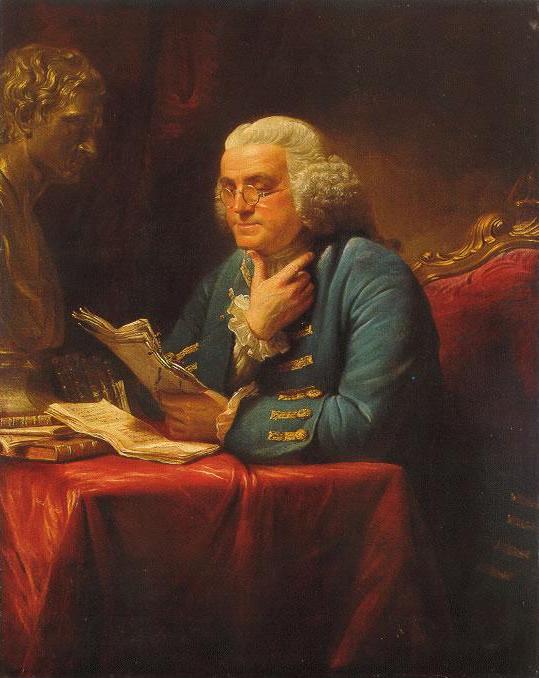
With our archives now 3,500+ articles deep, we’ve decided to republish a classic piece each Friday to help our newer readers discover some of the best, evergreen gems from the past. This article was originally published in February 2012.
Benjamin Franklin rose from 17-year-old runaway to successful printer, newspaperman, author, inventor, diplomat, and statesman. His great success came from living the virtues of frugality and industry, and his life offers us many personal finance lessons that apply to modern men just as much as they did to those living in colonial America. So without further ado, let’s dive right into uncovering some of Ben’s timeless wisdom:
1. Understand the True Value of Things
Benjamin Franklin learned one of his first, and most important, personal finance lessons as a boy. When he was seven, he saw another boy blowing a whistle and was so charmed by its sound that he offered the boy all the money in his pockets for it. The boy eagerly agreed to the deal. Young Franklin was delighted with his new possession and blew the whistle happily all over the house. But his satisfaction was cut short when his brothers and sisters, finding out how much he had paid for it, informed him that he had forked over four times as much money as it was worth. “The reflection gave me more chagrin,” Franklin recalled, “than the whistle gave me pleasure.”
But as Franklin shared in a letter to a friend, he took an invaluable lesson away from his youthful mistake:
This, however, was afterward of use to me, the impression continuing on my mind; so that often, when I was tempted to buy some unnecessary thing, I said to myself, Don’t give too much for the whistle; and I saved my money.
As I grew up, came into the world, and observed the actions of men, I thought I met with many, very many, who gave too much for the whistle.
When I saw one too ambitious of court favor, sacrificing his time in attendance on levees, his repose, his liberty, his virtue, and perhaps his friends, to attain it, I have said to myself, This man gives too much for his whistle.
When I saw another fond of popularity, constantly employing himself in political bustles, neglecting his own affairs, and ruining them by that neglect, He pays indeed, said I, too much for his whistle.
If I knew a miser, who gave up every kind of comfortable living, all the pleasure of doing good to others, all the esteem of his fellow-citizens, and the joys of benevolent friendship, for the sake of accumulating wealth, Poor man, said I, you pay too much for your whistle.
When I met with a man of pleasure, sacrificing every laudable improvement of the mind, or of his fortune, to mere corporeal sensations, and ruining his health in their pursuit, Mistaken man, said I, you are providing pain for yourself, instead of pleasure; you give too much for your whistle.
If I see one fond of appearance, or fine clothes, fine houses, fine furniture, fine equipages, all above his fortune, for which he contracts debts, and ends his career in a prison, Alas! say I, he has paid dear, very dear, for his whistle…
In short, I conceive that great part of the miseries of mankind are brought upon them by the false estimates they have made of the value of things, and by their giving too much for their whistles.
2. Be Self-Sufficient
Franklin’s father at first wanted him to go into the ministry, but then decided that the boy would follow in his own footsteps and become a candlemaker. But Franklin did not enjoy that trade, and his father, worried he’d go off to sea, took him around to observe other craftsmen at work, hoping that another trade might spark the young man’s interest. While Franklin did not become a bricklayer or carpenter, this experience did inspire the DIY spirit within him:
It has ever since been a pleasure to me to see good workmen handle their tools. And it has been often useful to me, to have learned so much by it, as to be able to do some trifling jobs in the house, when a workman was not at hand, and to construct little machines for my experiments, at the moment when the intention of making these was warm in my mind.
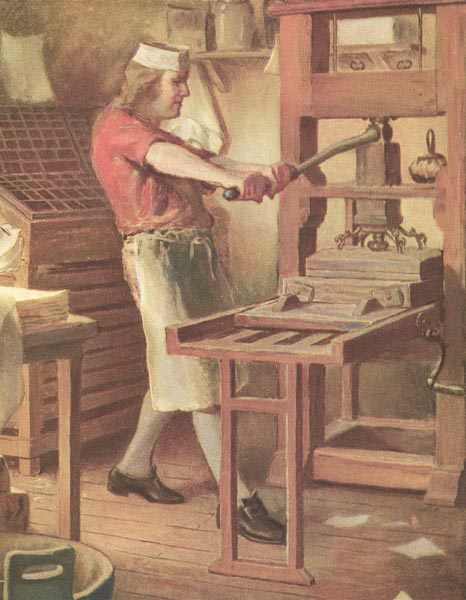
Franklin’s penchant for self-reliance also led him to learn how to make his own meals (using the money saved on boarding costs to buy more books), and perhaps most importantly, it helped propel his career as a printer. At the time, there was no foundry in America that made casting type, which was crucial for the printer’s trade. So instead of purchasing the equipment from England and waiting for it to arrive, Franklin initially crafted his own type — becoming the first person in America to do so — and also made his own woodcuts, printer’s ink, engraved copperplate vignettes, and plate-press.
As Franklin shared in his autobiography, he believed that learning to be self-sufficient not only saved you money, but led to greater happiness as well:
Human felicity is produced not so much by great pieces of good fortune that seldom happen, as by little advantages that occur every day. Thus, if you teach a poor young man to shave himself, and keep his razor in order, you may contribute more to the happiness of his life than in giving him a thousand guineas. This sum may be soon spent, the regret only remaining of having foolishly consumed it; but in the other case, he escapes the frequent vexation of waiting for barbers, and of their sometimes dirty fingers, offensive breaths, and dull razors; he shaves when most convenient to him, and enjoys daily the pleasure of its being done with a good instrument.
3. Invest in Yourself
From my infancy I was passionately fond of reading, and all the money that came into my hands was laid out in the purchasing of books.
This library afforded me the means of improvement by constant study, for which I set apart an hour or two each day, and thus repaired in some degree the loss of the learned education my father once intended for me. Reading was the only amusement I allowed myself. I spent no time in taverns, games, or frolics of any kind; and my industry in my business continued as indefatigable as it was necessary.
If you want to have more time and money in the long-term, then in the short-term you need to invest some of your money, and a lot of your time, in yourself. Instead of squandering these valuable resources on fleeting pleasures, invest them in things that further your health, relationships, education, and career and will reap rich dividends down the road.
Franklin invested in himself by becoming a voracious reader; all of his spare money and time went to accumulating as much knowledge about the world as possible; by wisely managing his expenditures in these vital departments of life, Franklin created a future for himself where it was possible for a man who had only a few years of formal education to become a world-renowned writer, scientist, and diplomat.
4. Surround Yourself with Friends Who Share Your Values
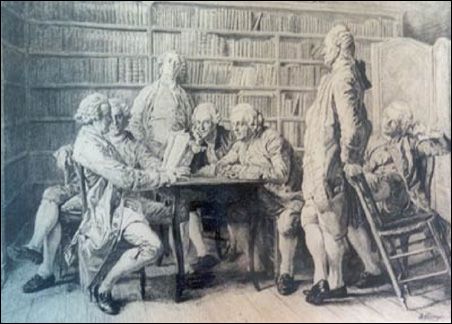
For myself, I immediately got into work at Palmer’s, a famous printing-house in Bartholomew Close, where I continued near a year. I was pretty diligent, but I spent with Ralph a good deal of my earnings at plays and public amusements. We had nearly consumed all my pistoles, and now just rubbed on from hand to mouth. He seemed quite to have forgotten his wife and child, and I by degrees my engagements with Miss Read, to whom I never wrote more than one letter, and that was to let her know I was not likely soon to return. This was another of the great errata of my life, which I could wish to correct if I were to live it over again. In fact, by our expenses, I was constantly kept unable to pay my passage.
When Franklin was still starting out in the printing business and living in London, he palled around with his friend, James Ralph. While Franklin worked hard at a printing house, the flighty Ralph, who had arrived in London without a dollar to his name, half-hardheartedly and unsuccessfully looked for work as an actor, clerk, and journalist, and borrowed money from Franklin to fund his unemployment.
The two friends later had a falling out, and Ralph never repaid Franklin the 27 pounds (“a great sum out of my small earnings!” Franklin recalled) that he owed him.
After this experience, Franklin was much more judicious about whom he associated with, and spent his life seeking out men and women who shared his high values and forming mutual self-improvement groups, like the Junto, where he and his friends could challenge each other’s ideas and help elevate each other’s hearts and minds.
5. Don’t Compromise Your Integrity for Money
While Benjamin Franklin had great ambitions to rise in the world, he was unwilling to compromise his integrity in order to do so. For Franklin, the key to being able to choose principles over filthy lucre was to not end up so enslaved to luxury that you become willing to do anything to maintain your lifestyle.
This is well-illustrated by Franklin’s response to a man who wished to pay to publish a piece in Franklin’s newly established newspaper, The Pennsylvania Gazette:
I have perused your piece, and find it to be scurrilous and defamatory. To determine whether I should publish it or not, I went home in the evening, purchased a two penny loaf at the baker’s, and with water from the pump made my supper; I then wrapped myself up in my great coat, and laid down on the floor and slept till morning, when, on another loaf and a mug of water, I made my breakfast. From this regimen I feel no inconvenience whatever. Finding I can live in this manner, I have formed a determination never to prostitute my press to the purposes of corruption, and abuse of this kind, for the sake of gaining a more comfortable subsistence.
6. Steady Diligence Is the Way to Wealth
To apply myself industriously to whatever business I take in hand, and not divert my mind from my business by any foolish project of suddenly growing rich; for industry and patience are the surest means of plenty. –From Franklin’s “Plan for Future Conduct,” written at age 20
Franklin’s was not an overnight success story; it took him a decade to move from runaway, to apprentice in many printing shops and houses both Stateside and in London (where he did the dirty jobs for superiors who were anything but), to opening his own shop, and turning it into a profitable business. During that time he lived a spartan lifestyle and was far more industrious than any of his competitors.
Thus he encouraged others to realize their ambitions as he had, with patient, steady efforts, and he did not turn a kind eye to the various “get-rich-quick” schemes that were put forth during his day.
In one of his “Busy-Body” essays, Franklin went after those who spent their time digging for pirate treasure that had supposedly been left buried along the river, lamenting that:
Men, otherwise of very good sense, have been drawn into this practice through an overweening desire of sudden wealth and an easy credulity of what they so earnestly wished might be true; while the rational and most certain methods of acquiring riches by industry and frugality are neglected or forgotten.
Franklin cleverly concluded his essay by quoting the words his imaginary friend “Agricola” offered his son when he gave him a good farm:
‘My son,’ said he, ‘I give thee now a valuable parcel of land; I assure thee I have found a considerable quantity of gold by digging there; thee mayest do the same; but thee must carefully observe this, never to dig more than plow-deep.’
7. Time Is Money
‘What price the price of that book?’ at length asked a man who had been dawdling for an hour in the front store of Benjamin Franklin’s newspaper establishment. ‘One dollar,’ replied the clerk. ‘One dollar,’ echoed the lounger; ‘can’t you take less than that?’ ‘One dollar is the price,’ was the answer.
The would-be purchaser looked over the books on sale a while longer, and then inquired: ‘Is Mr. Franklin in?’ ‘Yes,’ said the clerk, ‘he is very busy in the press-room.’ ‘Well, I want to see him,’ persisted the man. The proprietor was called, and the stranger asked: ‘What is the lowest, Mr. Franklin, that you can take for that book?’ ‘One dollar and a quarter,’ was the prompt rejoinder. ‘One dollar and a quarter! Why, your clerk asked me only a dollar just now.’ ‘True,” said Franklin,’ and I could have better afforded to take a dollar than to leave my work.’
The man seemed surprised; but, wishing to end a parley of his own seeking, he demanded: ‘Well, come now, tell me your lowest price for this book.’ ‘One dollar and a half,’ replied Franklin. ‘A dollar and a half! Why, you offered it yourself for a dollar and a quarter.’ ‘Yes,’ said Franklin coolly, ‘and I could better have taken that price than a dollar and a half now.’
The man silently laid the money on the counter, took his book, and left the store, having received a salutary lesson from a master in the art of transmuting time, at will, into either wealth or wisdom. –From Pushing to the Front by Orison Swett Marden
Time is money. It was Franklin who first promulgated this famous phrase. These days it’s not terribly fashionable to support this maxim; to some it makes you sound like a capitalistic drudge instead of a passionate adventurer; “Time is not money! It is an opportunity to swim with the dolphins!” Yet Franklin understood that wisely using one’s time was essential to building one’s wealth, and that the more wealth you acquired, the more of your passions you would be free to pursue. By hustling his colonial butt off, Franklin was able to retire from the printing business at age 42, leaving the next half of his life open for doing whatever he wished.
8. The Accumulation of Money Is a Means to an End
Your sentiments of the general Foible of Mankind, in the pursuit of wealth to no end, are expressed in a manner that gave me great pleasure in reading. They are extremely just; at least they are perfectly agreeable to mine. But London citizens, they say, are ambitious of what they call dying worth a great Sum: The very notion seems to me absurd; and just the same as if a man should run in debt for 1000 Superfluities, to the End that when he should be stript of all, and imprisoned by his Creditors, it might be said he broke worth a great Sum. I imagine that what we have above what we can use is not properly ours, tho’ we possess it, and that the rich Man, who must die, was no more worth what he leaves, than the debtor who must pay.” –From a letter from BF to William Strahan
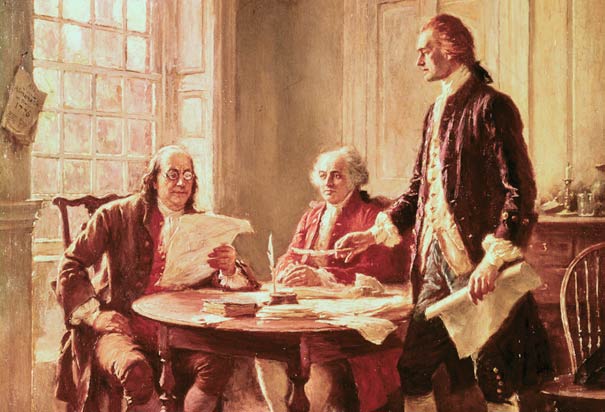
While someone who is only superficially familiar with Franklin’s biography and his famous maxims might come away with the notion that he was merely a prudish, penny-pinching acquisitive capitalist who thought only of money, nothing could be further from the truth. For Franklin the pursuit of wealth was merely a means to an end. And that end was gaining the “leisure to read, study, make experiments, and converse at large with such ingenious and worthy men, as are pleased to honor me with their friendship or acquaintance, on such points as may produce something for the common benefit of mankind, uninterrupted by the little cares and fatigues of business.” Franklin’s early retirement from the printing business did indeed produce numerous benefits for mankind, including the creation of several new inventions (none of which he patented — improving the lives of others was enough reward), and his service in helping to found a new country.
For Franklin the whole point of gaining wealth and developing virtue was not to live a life of luxury (although he did enjoy more creature comforts once he was able to) nor to become a moral prude, but to allow oneself to grow into the kind of man who had the character, wisdom, and time to become an involved and upright citizen, able to serve others and one’s country, which, Franklin also believed, was the best way to serve God.
Benjamin Franklin, who wrote to his mother while he was still in his early forties, that after his death he’d rather have it said of him “he lived useful,” than “he died rich.”


