





The Law of Sacrifice

by Brett & Kate McKay on July 17, 2011 · 88 comments

in A Man's Life, On Virtue

Last month, James “Jimmer” Fredette was selected in the NBA draft by the Sacramento Kings. It was a moment that capped off a breakout season for Jimmer. In his senior year, Fredette captured national attention with his dazzling three-point shooting and led the Brigham Young Cougars to a record-breaking number of wins and the school’s first trip to the Sweet Sixteen in thirty years.

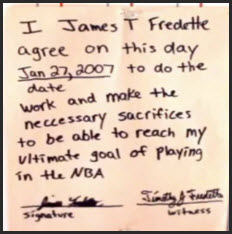
The moment also represented the fulfillment of a contract his older brother had drawn up and Jimmer had signed a few years before:

Jimmer hung this contract in his room and looked at it every single day. “It reminded me of what my goal was,” he said, “and if I didn’t want to work hard or practice that day, I would look at that and think, ‘You have to work as hard as you possibly can and do things other kids aren’t doing in order to be the best and reach your goal.’”

The things the other kids weren’t doing were drills like “The Gauntlet,” in which Jimmer would dribble down a pitch dark hallway at church, as his friends jumped out of classrooms in an attempt to throw him off his game. He also played pick-up games at the local prison, where he learned not to be intimidated by trash talk and extremely tough play.

When college recruiters didn’t come around, having deemed him too white and slow to be a viable prospect, he just kept on practicing and honing his game at one of the few schools to offer him a scholarship: BYU.  In the summer after his junior year, he attended predraft camps with NBA teams in order to find the weak spots in his game that needed improvement.

The work paid off when he got to don the Kings’ cap and hoist a NBA jersey on June 23rd.  He had made the necessary sacrifices to reach his goal.

What Is Sacrifice?

When we hear the word sacrifice, we often think of completely selfless acts in which someone does something for another entirely for the other person’s benefit. The image of a soldier sacrificing his life for his comrades frequently comes to mind.

But sacrifice isn’t purely altruistic. The best definition of sacrifice is this: “To forfeit something for something else considered to have a greater value.” (American Heritage Dictionary, emphasis mine). Sacrifice does not mean giving up something for nothing; it means giving up one thing for something else we believe is worth more.

This does not at all take away from the virtue of sacrificial acts. Instead of locating the merit of sacrifice in unselfishness, we can find it in a man’s chosen value system. The man who lays down his life for his family or for his comrades has chosen to place more value on their lives than on his own. What is more praiseworthy than that?

The Law of Sacrifice

So if that is the definition of sacrifice, what is the law of sacrifice? The law of sacrifice says that you cannot get something you want, without giving up something in return. In order to attain something you believe is of greater value, you must give up something you believe is of lesser value.

Society today tries to deny the law of sacrifice at every turn, promising people that they can fulfill their desires without having to forsake anything at all. “Lose weight without giving up your favorite foods!” “Get ripped without long workouts!” “Get rich without having to work hard!” The denial of the law of sacrifice is at the heart of things like our soaring credit card debt (US citizens currently hold $886 billion of it), not to mention our national debt. The fantasy that you can have whatever you’d like without ever paying for it is an incredibly seductive fantasy.

But it is only a fantasy. There is always a price to pay.

If you want to lose weight, you have to give up junk food. If you want to get ripped, you have to work out regularly. If you want the nice things in life, you have to work hard and save your money.

Sure, sometimes fame and good fortune seemingly drop into someone’s lap. The law of sacrifice is not as irrevocable, as say, the law of gravity. But as Frederick Douglass said:

“A man, at times, gets something for nothing, but it will, in his hands, amount to nothing.”

For proof of this, see the cases of folks who win the lottery and then squander it all away.

This is the beauty of the law of sacrifice. Not only is it the only path to achieving your goals, but the path itself prepares you to handle life at the top. Sacrificing not only gets you to your goals, but hones and shapes you as a man along the way.

Why Understanding the Law of Sacrifice Is So Vital to a Man’s Happiness and Success

A man’s ability to see through the cultural smokescreen that obscures the law of sacrifice is absolutely vital for a couple of reasons.

First, the denial of the law of sacrifice keeps a man from progressing in life. To reach your goals, you must move forward, which necessitates leaving some things behind. But the man who believes he can get whatever he desires without sacrifice tries to hold onto everything in an attempt to have it all. Instead of moving forward, he is stretched out horizontally and sitting on the fence.

Whenever I think of the law of sacrifice, I picture the scene at the end of Indiana Jones and the Last Crusade. Elsa, the hot Nazi babe, is dangling over the abyss; one of her hands is held by Indy while she grasps with the other to reach the Holy Grail, which is just out of reach. Believing she can have the grail and walk away with her life as well, she refuses to choose and give Indiana her other hand, and is thus rewarded with a plummet to her death. Indy almost suffers the same fate; as his dad holds onto him, he too reaches for the grail. But he listens to the advice of his father, and he sacrifices the thing that is worth less–the artifact–for the thing that he values more–his life and the chance for another adventure.

Failing to understand the law of sacrifice also leads to a life of restlessness and regret. When you believe you can have whatever you want, without giving up anything in return, you can never fully embrace and enjoy your choices. For example, sometimes I’ll have a moment where I miss the freedom of my childless days. But would I give up Gus to return to that time? Absolutely not. I sacrificed one thing—more freedom—for something I believe has greater value—a child.

Great unhappiness arises when we fail to acknowledge the necessity of sacrifice and subconsciously hold the idea in our heads that we can have both things at the same time. You move across the country for a new adventure, but you spend all your time missing your old family and friends. You must recognize that you wouldn’t be having the experience you are enjoying now if you had never left. You wish you could sow some more wild oats and sleep with a lot of women, but at the same time, you would never want to give up the incredible relationship you have with your wife. You must embrace the fact that there are trade-offs in life and that you can’t have one thing without giving up another.

The world class athlete or musician gives up time spent with family and friends for time spent honing their talent. The converted religious man gives up old habits for his new faith. The blockbuster actor gives up anonymity for fame and fortune. The burned out employee gives up his six-figure corporate salary to become a high school teacher.

If you are unhappy in your choice, it is because you chose something that you do not really believe to have higher value than that which you left behind. The law of sacrifice reveals and operates according to our personal value system. If we don’t have a cut physique, it is because we value the freedom to eat whatever we’d like more than six pack abs. If we don’t have a 4.0 GPA, it’s because we value time spent with friends more than grades. If you’ve ever wondered why you lack the discipline to attain a certain goal, it is likely because in your heart of hearts, you don’t really value that goal as much as you think you do.

At the end of the day then, the most important question we should ask ourselves when evaluating our dreams, desires, and goals, may not be, “What am I willing to do to attain them?” but “What am I willing to give up?”

{ 88 comments… read them below or add one }

1 James Usher July 17, 2011 at 5:52 pm

You have made me think about my life, very few people have done that successfully. Whether this will effect my choices I do not know but still, well done.

2 Joshua July 17, 2011 at 6:18 pm

Im about to embark on a one year long journey of a full 360degree change in all areas of my life and this post is came at the right time. see you at the top

3 Tom Meitner July 17, 2011 at 6:23 pm

This may be one of the best posts written on AoM! I loved it. What burns me is how many people suffer while they hang onto those things that keep them from getting ahead. For example, I know someone that is buried in debt and struggling to get by, yet hangs onto their cable TV and 2 cases of beer per week. Reaching ANY goal involves sacrificing other things to get there. It’s all about priorities!

4 Michael Boulding July 17, 2011 at 6:23 pm

I couldn’t have had this come at a better time. I have changed so much in my life right now, and I find myself slipping back into old habits that I have already decided mean less to me then what I really want. And it’s because of this belief that I should never have to give up something in order to get something else. This is a belief that has done me well at times, but has been slowly shifting out of my life. A good example is that I’ve always been a hoarder. I would collect random junk that I never use, simply because I didn’t want to give it up. I’ve been burdening myself down with all this junk, and not making the sacrifices I need in order to move forward. As an aspiring physicist, some of these simple but far reaching choices I’ve made are ludicrous. The Law of Sacrifice is truly universal, and while you say that it’s not as unrelenting as the Law of Gravity, I disagree. The Law of Gravity is governed by the Law of Sacrifice. The universe, our planet, our very bodies all tick because of the Law of Sacrifice. You can never get something from nothing, it is impossible. It’s time I learned that.

5 Dom July 17, 2011 at 6:35 pm

Great article Brett. I like almost all the articles on AoM but this one really hit close to home for some reason. It also came at a good time for me. My girlfriend just broke up with me- a girl I loved dearly- but now I see that in order to move forward I must give her up in order to attain another girlfriend, who could even be my spouse.

Thanks for the very insightful article.

6 James July 17, 2011 at 7:08 pm

Excellent analogies. As someone who is working hard to both lose weight and “tone up”, I can confidently say you are 100% correct. You must sacrifice things which you really do want and enjoy in order to achieve that which you want even more.

Great article

7 Chris July 17, 2011 at 7:30 pm

I agree with everything but the bit about attaining goals due to lack of discipline. If you lack discipline, there is a good chance you won’t achieve anything no matter how simple it might be or how much you desire it. On the flip side, you can have all the discipline and self motivation in the world and still never obtain something you truly desire due to unforeseen circumstances (having to pick up someone from a car accident instead of going to a business meeting etc.) Lack of discipline can certainly say that it isn’t something you want to do, but it’s not the only thing that determines it. There is a small “luck” factor to it.

8 Brian July 17, 2011 at 7:48 pm

I moved 1300 miles away from almost everyone I knew and gave up having a social life for 3 years. In addition to the other things I learned in grad school, I learned that you can’t just coast through. I wasn’t the smartest person in my class, nor the quickest learner. I was, however, willing to put in 10-12 hours or more a day, almost every day. The race may not go to the swiftest, nor the battle to the strongest; grit and shear bloody-minded stubbornness counts too.

9 Jeff July 17, 2011 at 7:50 pm

Wow! The most impressive part was that as a WHITE man he was drafted to the NBA, apparently. Usually the scouts would say “too white!!!” REVERSE RACISM LOL!!!

10 josh barkey July 17, 2011 at 7:57 pm

Thanks, Brett and Kate.

I needed that, today. I’ve actually made tremendous strides the past couple of years in applying the principle of sacrifice to myself in my vocation as a writer and artist, but was hit squarely between the eyes with the thought that I need to keep this in mind with relationships, as well.

It’s been nearly two years now since my ex-wife left, and as I have thought about my relational future, I have tended to focus on what I give up by allowing myself to trust and commit again. Thanks for the reminder that sacrifice is a choice for something I value more – not just writing a script over watching a movie, but loving a person over having gobs of delicious alone time. Color me blessed.

11 Mimi (Gingersnaps) July 17, 2011 at 8:31 pm

Love this!

It’s so true. I think it’s also important to remember to stay strong against people who try to sway you from your sacrifice. Most people are convinced there’s a way to get something for nothing but there simply isn’t. So irritating, like if you’re trying to lose weight and people try to cajole you into hitting up Fatburger with them. People I feel look down on those who “suffer” because they don’t have the balls to suffer themselves.

12 Yautja July 17, 2011 at 9:01 pm

“Indiana? Indiana…let it go”.

Dammit, AoM…you made me tear up a little bit.

13 Tony July 17, 2011 at 9:51 pm

Thank you Brett and Kate McKay!

This was needed for what I am going through in life right now. Loved the contract idea too. Excellent post, thanks again.

14 Bobby July 17, 2011 at 10:39 pm

Fantastic article, thank you. It really spoke to me and pulled together a lot of the theories and thoughts I’ve been having lately, at a time of great personal change. You have cemented a change in my thinking, and for that I am grateful.

Great post, great website.

15 Matt July 17, 2011 at 11:51 pm

What about those choices and sacrifices you make, that eventually keep you forced into one pattern for years to come? Say, a young married man joins the military, sacrificing time with his wife, in order to get a decent paycheck every month and support her? Then two years down the road, he’d rather be spending time with her, but the choice is no longer there?

Maybe I’m just getting wildly off topic. Ha.

16 Chris July 18, 2011 at 2:39 am

First, Jeff, there’s no such thing as ‘reverse racism.’ Racism is judging someone soley on the color of their skin or ethnicity.
Second, this quote. “The greatest sacrifice is one where nothing is lost.” This took forever to get my head wrapped around… but what it means is, in short, that the greatest sacrifice is often the simplest ones. Those split second decisions– parents who shove their kids out of the way of a car, choosing to get hit by that car instead, for example. It isn’t trivializing what is left behind or burnt… it’s saying that even though something is valued, there is something exponentially more valuable to be gained instead, so it just looks like nothing. There’s also the “it really is nothing” thing as well… but eh.
There’s more to it, and I don’t remember where it’s from… but there it is.
Third… sacrifices like military service, or child-rearing, are huge. The pain sets in– and then sometimes it doesn’t stop. With both instances, it may never actually go away during one’s lifetime. That’s why these decisions are not made lightly. That’s why you get help, have friends, family and even institutions help you out. That’s why religious folk are encouraged to go to church– it can be just as much a forced pattern as having to show up for military duty, and just as serious– because all three recognize how important (children, service, $DEITY) is. They’ve chosen that this is more important than other freedoms. Not much of an answer Matt, but that’s some.

17 Adrien July 18, 2011 at 3:32 am

I love this article especially the part concerning the regrets. Life is tragical, this is part of it. Tragical because you’re not in video games and your choices are once and for all (you can’t save the best parts when you’re satisfied of where you’re at and load back when things get rough to start it all up again). Tragical because every moment is unique and you can’t look back in hope of changing the way you acted, you can just move forward with it. Tragical because sometimes life seems to have a beauty, a purpose by dint of seeming so ugly and tough. In other words, the poetry that vanishes from the experience of life is because it is tragical and that’s what makes it worth and gives it a greater value sometimes more than expected. Without tragedy, no civilization, no sublimation through arts or acts of endeavour. I think it is in this scheme that the law of sacrifice enter the picture.

18 George Romero July 18, 2011 at 6:14 am

Brett & Kate:
Great post, as always – thank you. In other to support your excellent point even better, Indiana Jones was not sacrificing obtaining the Holy Grail in order for him to do just another adventure. In the story of Indiana Jones, his father always calls his son “Jr”, a name that Indy does not like. Indy wants his father to call him by his nickname – “Indiana”. But, at the point when Indy is trying to obtain the artifact, his father offers his hand and calls him “Indiana”. Not “Jr” or “Henry” (Indy’s actual name). It is at this point that Indy realizes that he must scarifice obtaining the artifact in order to choose to be with his father. So, it is not a decision for Indy to continue for more adventures, but a decision to continue alive to be with his father.

19 Roy July 18, 2011 at 6:18 am

“Remember the promise you made to yourself”. That’s the message I found in a fortune cookie last year. Piercing in it’s clarity, a real motivator. Sometimes you CAN find the answer to your problems at the bottom of a bag of junk food!

Great article, and good luck to all of you guys with your personal endeavours. Make your dreams a reality and don’t take any shortcuts.

20 Rich July 18, 2011 at 6:53 am

A great article!

“If you’ve ever wondered why you lack the discipline to attain a certain goal, it is likely because in your heart of hearts, you don’t really value that goal as much as you think you do.”

This says it all. I have wondered and I suppose I have always known, but seeing it in writing really make this sentence hit home.

Thanks for the great website.

21 Charlie July 18, 2011 at 8:15 am

Like many others, this article seems to have come at just the right time as just two or three days ago I was thinking of what my dreams, my life ambitions are, and trying to lay out a fuzzy roadmap towards some of those ends.
@Joshua (post #2) I would caution about doing a 360 because you’ll end up right where you began! 180 degrees is the preferred about face, occationally 540 if we regress into bad habits again.
@Matt (post #15) I can identify a bit! My wife even better than I at the moment. We’re a dual military couple; one deployed to Iraq and the other to Afghanistan (thankfully no kids at this time with this double deployment). There are absolutely hard times and days where I can’t stand another person I work with but there are days where I absolutely love the outcomes from the committment I’ve made. My wife can identify better as she feels like she’s being treated unfairly, and she might be beign a female in a male dominated career field. End of the day we both signed out names and are willing to sacrifice much, as much as necessary, to fullfill our obligations. And we’re paying off some serious bills right now which is one of the benefits. I’m committed to serve 20 years in order to secure a retirement (5 down!). I sincerely hope that my resolve to provide for the future of my family will outweigh the times that I won’t be able to be with them.
*First post!

22 Jeremy July 18, 2011 at 9:04 am

Thanks Brett & Kate, it seems like you had great timing on this one for everyone who read it.

23 Luis July 18, 2011 at 10:35 am

This post struck home with me. I’ve been struggling with the decision of taking an exam that will further my career now for a couple of month and still can’t make a decision. This helps bring things into perspective.

24 James July 18, 2011 at 10:46 am
25 Christopher Yoder July 18, 2011 at 11:18 am

The key point in this article is the very objectivist view that sacrifice is only praiseworthy when one sacrifices to achieve something of value that he has chosen. This is, however, incomplete. The authors have left out that it is only praiseworthy if and only if that persons values are the result of rational thought. Are the 9-11 terrorist, or any terrorists for that matter, worthy of praise (they did indeed sacrifice themselves for what they believed)? The answer is no. Their value system was one allowed by lack of freedom (ie education and economic oppurtunity) which led to low self-esteem and allowed those individuals to be brainwashed by the eloquent lies of those that preach something that they are not willing to do themselves. Nor is it the responsibility of the United States to promote such freedom. The state is nothing more than the sum of its individual citizens, therefore it is the primary responsibility of the state to protect its citizens and not to directly promote the welfare of other states. It would also be hypocritical of our government to promote the freedoms of others while they slowly strip away ours at home; ask yourself if the government has the constitutional right to steal from the producers (workers) of the country and give the stolen money to those that are not willing to work for it (please note that I only include “those that are not willing to work not those that are incapable), in short entitlements make slaves out of the producers but also the people that receive handouts because the government is not respecting our right to “life, liberty and the pursuit of happiness” (how can we when we do not recieve compensation for the full amount of our effort) to attempt to hand those same rights to non-producers. Furthermore, in 1895 SCOTUS ruled that income tax was unconstitutional (Pollock v Farmer’s Loan & Trust). Also ask yourself this, why do our politicians seek to expand its statist power when the Constitution was written, in order to protect the citizens from the government, to limit governments power. Why should we be forced to accept government imposed altruistic sacrifice of ourselves to others when the programs that require it are, at heart, and the means of funding are unconsititutional. Ask yourselves this, if governmental controls and the government control of credit were designed to prevent economic depressions why do we keep experiencing them? And when we do why is the only answer coming out of Washington DC during these crises is more governmental controls. Why should we continue to sacrifice our minds to politicians that never produce anything, that cannot compete in a free marketplace and are so scared of losing power that they are all complicit in the decline of the United States of America, the only distinguishing factor is in the length of time it takes to fall into the abyss.

26 Joe July 18, 2011 at 11:23 am

So true, especially when you look at what our society and economy have gone through the past few years. Sure you can have that $500,000 house with your $40,000 income. Sure we’ll bail you out because you’re too big to fail.

Sadly, even with talk of the country possibly defaulting on loan payments, politicians on both sides of the aisle are still telling their followers they can have everything they want (either low taxes or continued entitlements) without giving up a thing. Even sadder is the idea now that people are demanding that others sacrifice so they can keep or attain everything they think they deserve.

27 Luis July 18, 2011 at 12:38 pm

Awesome article. Thanks!

28 Emily July 18, 2011 at 12:39 pm

Love this blog post! Very true, and it did make me think. Nice examples as well!

29 Bobby Fresh July 18, 2011 at 3:24 pm

Awesome. This is a great article. I am a regular for reading your blog posts. I always mention certain things that I read. I’ve been quoting the articles on naps to people a lot. I think this article takes the cake. Such a good way to define sacrifice. I will be letting many people know about this article. Keep it up Brett and Kate!

30 Luis V. July 18, 2011 at 4:54 pm

Thank you very much.
it reminded me that everything in life has a price tag.
if you are willing to put the time and energy, you can have anything you want in life.

31 Daktari Frank July 18, 2011 at 7:03 pm

Great article. Jst a little question: who defines sacrifice? Is it an individual or is there some universal way. For example, i may believe that doing some act or denying myself for the sake of greater gain is sacrifice, but to someone else it is not.

I tend to think that sacrifice is sacrifice regardless of whether someone else views it as good or bad. The strength of our personal values greatly determines the extent of our sacrifice.

The motivations for sacrifice are often different from what is seen. For example, some soldiers are in for the money, as someone pointed above-pension. Can we deny that as sacrifice? I dont know. What about the suicide bombers-they believe on a better life on the other side, 7 virgins,merry…I rather say that sacrifice is sacrifice, the motivations behind it notwithstanding.

32 JeffC (Tool Bucket) July 18, 2011 at 8:24 pm

If we can stretch our minds around the amazing idea that words can have several meanings, and that context often determines the meaning, we can all breathe a little easier.

Is sacrifice the act of giving up something to gain something else, or is it the psychic/emotional stress, i.e., what wee experience, by detaching from the first something? External, or internal? It can be both, depending on what idea one is trying to communicate.

Some sacrificial acts are felt deeply; others no so deeply. This is not a conflict of definition: it is a nuance of definition.

33 Daniel V July 18, 2011 at 8:44 pm

I, think sacrifice is one of the most greatest lessons in life, and like the article says, if you´re unhappy about a desicion, its really probably it was not the right one, like a phrase says, “What good will it be for someone to gain the whole world, yet forfeit their soul? Or what can anyone give in exchange for their soul?” (Matthew 16:24-28). follow you´re inner voice, ask if your hands do what you really want to do, if you´re mouth says what you mean, and if your steps go, where you really wanna go.

34 Albertabound July 18, 2011 at 11:49 pm

Michael Jordon put it a different way “Everyone has the will to win, few have the will to practice to win”

35 michael paul castrillo July 19, 2011 at 2:31 am

Brilliant. Love this!

36 Leon July 19, 2011 at 4:30 am

Awesome.

37 Dominik July 19, 2011 at 5:58 am

Great, great article!

I loved the little contract at the beginning. Just imagine doing something like this; signing a contract to fulfill your biggest dream and do exactly that a few years down the road, because you committed everything to that pursuit. Amazing. I guess I’ll draw up a contract for myself now.

Thanks for digging up stories like that.

38 FB July 19, 2011 at 7:16 am

Christopher, you missed the point of the article. They did not say that the act of making a sacrifice is praiseworthy in itself, only that sacrifices must be made in order to achieve your goals, whatever they are – and if you are unwilling to make those sacrifices it’s probably because the goal isn’t really as important to you as you would like it to be. Assigning a moral value to a given sacrifice/goal tradeoff is a separate matter.

39 Mitch July 19, 2011 at 8:02 am

I’m a numbers guy. You can also express this kind of sacrifice (maybe not the altruistic kind) using the economic idea of “opportunity cost.” We are rarely given the choice between one valuable thing and one worthless thing, or maybe it is so trivial a choice that we don’t even notice it. Usually, you have to give to get. When you spend, you are giving up the chance to save, and also the chance to buy other things.

In real life, you can either keep it tucked away or risk your marriage; drink your paycheck or pay your bills; go to night classes or watch TV; raise your kids or walk away from them. It’s about your real values, and what you will pay for them.

40 Michael July 19, 2011 at 9:10 am

I just printed this out for my 12 year old son to read. It’s a great article and sums up many of the discussions we have had about his goals. Thank you!

41 Andrew July 19, 2011 at 9:11 am

Very well written article, Brett and Kate. The idea of getting something for nothing is a pressing issue in our culture and, rightfully so, needs to be addressed. However, the hints of altruism in this article, in my opinion, weaken its validity. It seems to me that happiness is the key determinant of our actions.

I am greatly influenced by Ayn Rand’s view of altruism. She says that it does not and can not exist between humans. One’s choice never divulges from one’s desire. You have acknowledged the concept of weighted desires and foregoing the higher for the lesser, but, ultimately, the lesser is only affected by our perception at the time.

I’m afraid that I do not see sacrifice, or altruism, as a manly quality. Instead, it seems to infer an elevated sense of pride and self worth. A more appropriate mindset, in my opinion, is the objective reality of happiness; consciously deciding to make the right choice for someone else your own happiness. If I spend every last dollar I have on groceries for a poor family, I have not sacrificed; I have sought my own joy in their joy. I have gained everything with that choice, does it matter if it was a selfish one?

The answer seems to come back to love for others and for God. This idea is not uncommon to what Paul says in the Bible about living like sheep to be slaughtered.

We must seek our happiness in the happiness of others, including our God.

42 Brian L July 19, 2011 at 10:21 am

““To forfeit something for something else considered to have a greater value.” (American Heritage Dictionary, emphasis mine). Sacrifice does not mean giving up something for nothing; it means giving up one thing for something else we believe is worth more.”

This definition is not only bad, it is wrong. It is a complete reversal of a proper meaning of the term.

The context of the discussion is values. And the fundamental alternative is gain or loss. One can either gain values or lose values. But to gain values ALWAYS requires time and effort. In other words, all attempts to gain a value require one to “give up” – is use/trade – one thing of value FOR another. The only question is: is the value one trades lesser or greater than the value one receives in exchange. The term “profit” identifies when the value received is greater than the value relinquished. The term “sacrifice” identifies when the value received is less than the value relinquished (which includes those things of NO value and even things which are a disvalue).

The AmHer definition reverses this completely. It tries to make the term “sacrifice” mean gain (ie profit) rather than loss. (Note that the authors never identify the term which means ‘giving up a greater value for a lesser value.’ For THAT is the definition of the term ‘sacrifice’.)

What the authors here reference is not a “Law of Sacrifice” but a “Law of Profit”. When one acts, one can act either act to gain a value (profit) or to lose a value (sacrifice). It is either/or. And it is unavoidable. And it is so because ALL action involves an exchange – of time and effort – for whatever end is sought. The exchange is the constant. The thing which differs is whether the exchange results in a gain of values or a loss of values. When the exchange results in the gain of a greater value, that is profit. When the exchange results in loss of a greater value, that is sacrifice.

43 Johnny July 19, 2011 at 10:22 am

Well put. About to make an All-American sign for my dorm room.

44 Richard Williams July 19, 2011 at 10:58 am

The ultimate sacrifice:

“who for the joy that was set before him endured the cross, despising the shame, and is set down at the right hand of the throne of God.” ~ Hebrews 12:2

45 Mark Laskow July 19, 2011 at 11:09 am

You can find some folks who knew about sacrifice at http://www.carnegiehero.com .

46 Colton July 19, 2011 at 2:23 pm

There’s a reason we go crazy for Jimmer in upstate NY. The guy represents the region with uber class. And WOW can he shoot!

47 Bryan July 19, 2011 at 3:16 pm

That hand-drawn contract is absolutely the best thing I am going to see today and probably this week. That really is amazing.

48 Ben July 19, 2011 at 3:44 pm

This was a great article. It really brings things into perspective. I’m about to start college, and a big part of my life lately has been working as many hours as possible to pay for the expenses of college, because if I pull out student loans, they will come due while I’m away on a mission for my church. I’ve often thought things like “man, what if I just asked for some days off, or shorter hours, so I can be with my friends,” but reading this reminded me of my choice: I could have tons of fun with my friends now, or I could be debt-free and able to do my duty in the years to come.

49 richard40 July 19, 2011 at 5:36 pm

The other big way progressives have perverted the law of sacrifice is by promoting the idea that sacrifice is something others can be forced to do, for the common good. Real sacrifice is an individual voluntary decision, since only the individual can make an informed decision on what value he will willing to sacrifice for what other value.

Compelling sacrifice of others by gov force, with the progressive idea of shared sacrifice, is not sacrifice, it is either theft or slavery. The only way sacrifice could ever be shared is if everybody did it, and everybody shared in the benefits, but with almost 50% of our population not paying income taxes, that sacrifice is hardly universal, and benefits distributed are rarely shared by all.

50 SB July 19, 2011 at 6:36 pm

A sacrifice is giving up a higher value for a lesser one. Like killing your kid because you think a god says to. Or impoverishing a nation in the name of equality. Or enslaving a people for the sake of security. This concept comes from a morality of self-destruction.

It’s not pledging to work your butt off for a selfish reason. The contract mentioned here is an _*investment*_, from which comes a *gain*–or a profit. This concept comes from a morality of rational self-interest, a.k.a. life affirming.

If it seems nit-picky to mention this–especially in an article on sport–consider how we arrived at the current national state of affairs.

Real men don’t sacrifice their lives. They invest their efforts to achieve better lives.

51 Jacob July 19, 2011 at 7:20 pm

Absolutely wonderful post. I’m glad that you wholeheartedly invest time (also a sacrifice) and sharing your wisdom with us.

Much appreciated from even a college student.

52 Rich July 19, 2011 at 8:58 pm

Gus is a very manly name.

53 Rich July 19, 2011 at 9:01 pm

Great article too..

54 John July 19, 2011 at 10:43 pm

Well-written and insightful – how do you accomplish that so often?!

55 Ryan M July 19, 2011 at 11:48 pm

Thanks for another very useful article. The subject matter always seems so remarkably timely. But I guess that’s because we are always struggling with these issues in some measure, whether we realize it or not.

56 CB July 20, 2011 at 10:33 am

Brett & Kate, Thanks for a great article! This concept has been dancing around my mind for a few months as I prepare for my first child.
I’m commenting to ask that you address a few of the comments that have been made about the difference between sacrifice and profit. I apologize for not pulling the comment numbers to give you specifics.
My thought is that there’s a difference between sacrifice in terms of economics and in terms of other part of life. I am interested in your take as well.
Thanks again!

57 Brett McKay July 20, 2011 at 1:18 pm

@CB-

I found Brian’s comment about profit vs. sacrifice entirely off-base, as he said that the definition given above for sacrifice was simply wrong and a complete reversal of the real meaning of the word. But the definition used in this article can be found in pretty much all dictionaries. There can be several “right” definitions of the same word–there’s some good discussion on the manvotional post on cynicism about this actually. In this post we used what we personally feel is the best definition of sacrifice, but there are others.

Anyway, I’m happy to reply to your comment though. I don’t think whether something is a sacrifice or not hinges on whether or not what you give up results in profit or loss, but how much the thing means to you and whether it hurts to let go of it.

While Brian concentrates only on the end result, our definition of sacrifice acknowledges that there are both long term and short-term losses when it comes to sacrifice. If you quit a high-paying job for one where you have more time but make half as much money, you may have profited by choosing what was of more value to you–time–but that doesn’t mean the loss of the money won’t hurt in the short-term, maybe for quite awhile. It was still a sacrifice even though you got something in return.

58 Alessandro July 20, 2011 at 2:38 pm

Thanks for this article and for all the others that you’ve shared with us.
It’s nice to stop and think for a moment in this times, and is nicer to share our thinkings with other that may agree or, hopefully, disagree to show us another point of view.

I have a question: let’s say that you find yourself not sacrificing many things for the one that you call your life goal, do you gentlemen think that this is a sign that your goal maybe isn’t as important, or you’re just lazy?
I mean: can we count the laziness as a factor in the sacrifice formula?

Cheers from Italy, and sorry for any english error!

59 CB July 20, 2011 at 2:43 pm

@Brett
I agree with your definition and it’s the one that I learned growing up. In my opinion, the English language tends to over-simplify word choice sometimes. For example, we have the single word ‘love’, whereas the Greeks had 4 words that meant different types of love but which we translate to our single word.
I can see where Brian L’s comment among others can make some sense. To take your example, if you look back at the end of your life and determine that the choice to take the lower paying job with more time at home was worth what you lost in potential earnings, then was it a sacrifice? At the end you would probably say no it wasn’t because you can see the benefits of your choice in tangible and intangible ways. But throughout the life of the choice you probably would say yes I’m giving up certain things that I would not necessarily have to if I had the other job. Therefore you have to decide whether the end result is the only thing that matters or if the process matters as well. I think this is the question that many issues come down to when philosophy is discussed: do the ends justify the means or do the means matter as well?
I believe that sacrifice is real and necessary. It’s at the forefront when we decide to deny our own self’s desire to seek immediate gratification. I believe this makes sacrifice so personal in one sense that no one else has the right to look at your choices in life and decide whether or not they believe you are making sacrifices. At the same time, sacrifice itself is amoral. To borrow from Christopher Yoder’s rant, which in itself is surprising that I found something useful in a rant, it is possible to look at the 9/11 attacks and say that yes, those men sacrificed themselves for something beyond them that they considered to be of greater value. So even though their acts are morally reprehensible to me, they can still fit into the definition of sacrifice. This makes it all the more necessary to consider the means as well as the ends.
Again Brett & Kate, thanks for your work on this article and on the blog as a whole. I know it’s certainly encouraged me in my daily life.
Thanks!

60 Brett McKay July 20, 2011 at 3:16 pm

@CB-

Thanks for your comments! I agree with you that sacrifice is amoral. Although Mr. Yoder’s comment was based partially on a misreading of the post. We said that valuing the lives of others over your own is praiseworthy, not sacrifice itself, which can be praiseworthy and honorable based on the end result.

@Alessandro-

When it comes to attaining your goals, I think how much you value your goal is intertwined with your discipline. You can really want something, but if you don’t have the discipline to make the necessary sacrifices, you’ll never get it. At the same time, the more you desire something, the more motivated you are to have that discipline and make the sacrifices. So they work in tandem, I think.

61 Bruce July 20, 2011 at 7:59 pm

The myth that sacrifice is essential to athletic achievement is so well established in American jock culture that every athlete parrots it. But why should we admire sacrifice that leads to achievement in so trivial an endeavor as basketball? I love sports — I was a small college All-American in Ice Hockey — but few human achievement require less sacrifice than athletics. Why? Because people love to play sports. At least I did. I wouldn’t have chosen to do anything else.

Besides, of all human achievements, athletic success is more dependent on innate talent, and less on hard work than almost any other. After all, some of the best athletes are 22 or 23 (for women, even younger). How much sacrifice could they have made at that age?

In addition, the old adage “if something is worth doing, it is worth doing well” is ridiculous. In fact, when it comes to sports, if something is worth doing, it is worth doing badly. The activity is its own reward. Only with skewed priorities does success — the cheers of the crowd, or the money from the owners — become the goal instead of winning a game and having a good time. To revert to the theme of this board, it is unmanly to care about outside rewards for athletic achievements. The manly athlete cares about winning games along with his teammates — not glory, not money, and certainly not the slavish and dubious “honor” of being “drafted” to play for one pro team (when he might prefer to play for another).

62 Jack July 21, 2011 at 11:38 am

Very insightful post.

Simple explanation of life in general. To some, it could even be perceived as THE meaning of life.

It really spoke to me, this one. I hope to read more gems like this in the future.

Keep it up, friend!

63 Chris July 21, 2011 at 11:40 am

Wow. I’m 45 years old and have lived most of my life trying to avoid sacrifice. I can tell you from experience that I agree with everything you wrote in this article Brian. I’ve been married 20 years and we are on the verge of divorce. We bought a home in 1993 and in 2005 we re-financed and took way more cash out then what we should have been allowed to take and we now owe 340k on a house worth 170k.

I started working out of high school and instead of sacrificing and getting myself educated, I went out and drank and had fun. Now I am 45 years old and can’t find a job other then as a tele-marketer making $12 an hour.

My two kids have also seen a very poor example of how to sacrifice and as a result they don’t have a real good concept of it’s importance. It was nice because after I read the article I called my son in and read it out loud with him and tried to show him some of the direct consequences in my life because of my avoidance of sacrifice.

I read the book Think and Grow Rich a few years ago and it planted a seed in my mind that has been growing ever since. Lately, I’ve been feeling a lot more optimistic about my future and a big reason for it is that I have been sacrificing lately and have been doing things different. I’m in my 2nd year of engineering school, I’ve lost over 35 lbs and still dropping and I really feel good. My marriage and my finances are still a wreck, but I’ve sort of resolved myself to the fact that it’s going to be pretty lean for the next 3 years. Somehow, I know if I can get my engineering degree by the age of 48, I can still clean this whole mess up and make good on my responsibilities as a man.

I really enjoyed your words on sacrifice Brian and I will read them often. Thanks.

64 Evan July 21, 2011 at 1:09 pm

This is good stuff. I’m at a point in my life where I’m about to give up quite a lot in order to get something better. I’m moving from a place I love (and the things that go with it: mountains, family, good weather, hobbies, etc.) to a place that will allow me to have a short commute, more time with my wife, buy a house on some property, etc.

I keep having doubts about the wisdom of doing this. But it’s not because I don’t think the gain is worth it. It’s because I keep thinking about what I’m leaving. Can’t have both, I guess!

65 Chad July 21, 2011 at 3:17 pm

Brett,

What a great article! I agree with it completely. In starting my own business I really had to pinch pennies, cut the travelling down, and spend less time with friends, and more time working.

I viewed the business as more important than any of the aforementioned things, and I didn’t second-guess that, still don’t.

Thanks for the perspective,

Chad

66 Bruce July 21, 2011 at 3:26 pm

Of course it is true that every time one does one thing, one is precluded from doing something else. However, I don’t think that necessarily constitutes “sacrifice”. For example, if one spends all day watching TV and eating chocolate ice cream, one is “sacrificing” the option of going to the gym and working out.

Brett and Kate write: “The law of sacrifice says that you cannot get something you want, without giving up something in return. In order to attain something you believe is of greater value, you must give up something you believe is of lesser value.” But do they really mean it is a sacrifice to give up working out in the gym in order to watch TV and eat chocolate ice cream?

It seems to me that “sacrifice” comes from the root “sacred” (sacrum in Latin). So it refers to giving up something of value to further one’s “sacred” goals. I’ll grant that in a modern, secular world these can involve taking care of one’s family or educating oneself. But I’m not sure getting drafted by the NBA qualifies.

67 Stephen Taylor July 21, 2011 at 4:10 pm

Jimmer Fredette sacrificed going on a two year mission for his church so that he could play basketball better and achieve his dream of playing for the NBA, and all of the fame and fortune that go with it. Although at the time he perceived this to be something of lesser value sacrificed for something of greater value, I believe that he will one day come to regret this decision. A truly manly sacrifice is (in my humble opinion) when you sacrifice something that you want to do for something that in your heart, you know is the right thing to do. A good example of my point is in the movie ‘the Astronaut Farmer.’ This man sacificed his family’s finances and his ability to provide for his childrens’ futures and educations all for the sake of fulfilling his own selfish dream of going into outer space for a few hours. I couldn’t understand how it was perceived by so many as ‘noble’ and ‘inspiring’ that this man was willing to give it all up to go after his dream. A real man would have tucked that dream away in a drawer and realized that his resources would have been better spent in securing a future for his family, even if his family supported his mortgaging everything and bankrupting the family so that he could build his rocketship and go into space. I saw the movie ‘Eat, Pray, Love’ and came away completely disgusted with Julia Roberts’ character, and the attempt of the movie makers to portray it as somehow noble for one to forsake their responsibilities, obligations, and promises to ‘go find themselves’, whatever the hell that means. Even though that story was about a woman and his site is about being a man, the principle applies here. If you really want to know who you are and what you’re made of, see how well you can be of service to others and fulfill your obligations to those that depend on you.

68 Leonard July 21, 2011 at 4:34 pm

Love the post! Just wanted to point out that I’m sure recruiters didn’t shy away from him because he was “too white.” He may have been overlooked because he didn’t have the quickness and athleticism of other players, however not because he was white…Love the site. Keep up the good work.

69 Bruce July 21, 2011 at 5:23 pm

Just to clarify my point (in view of Stephen Taylor’s interesting post): The “sacredness” involved in “sacrifice” need not, I think, be explicitly religious. If (for example) Jimmer feels he has a “calling” to play basketball, but lacks the “calling” for the church, hoop might be more “sacred” than a Mission. As with all human actions, the extent to which an action is good or evil (or “sacred” or “profane”) depends not only on the act, but on the motives of the actor and the on context of the action as well.

Perhaps the “Astronaut Farmer” felt a sacred calling to explore outer space, or perhaps he wanted to be in the headlines (I don’t know, I never saw the movie). But that same act might be a sacrifice in the one case, and self-indulgent in the other.

70 IM July 21, 2011 at 9:46 pm

Brett, thanks for the amazing post! I just started reading your blog about a year ago and wow, the encouragement it has brought to me has been more than outstanding, to say the least. Thanks for leading the charge and continuing to be such a great source of the encouragement of enduring manhood in the face of today’s struggles. All the best man!

71 Eric Forward July 22, 2011 at 12:24 am

It’s always when I need to hear something, you deliver. Fantastic post Brett! This is why I sacrifice time spent watching bad TV to read a post like this.

Eric

72 Scott A July 22, 2011 at 3:50 pm

Jimmer’s faith is a key factor in his success. He is a member of the Church of Jesus Christ of Latter Day Saints. He served an honorable full time mission for two years of his young life. That is a sacrifice. How many 19 year old young men do you know that are willing to give up all the things life has to offer at that age for two years. This was not to promote his basketball career, it was to serve others. After this mission, the “sacrifices” to play good basketball are very small, and I’m sure he has a great perspective on the whole thing.

73 Bruce July 22, 2011 at 5:01 pm

I don’t know the first thing about Jimmer, other than what I’ve seen on “Sports Center”. So I’ll take your word for it that he went on his mission, Scott. However, to say that “Jimmer’s faith is a key factor in his success (as a hoop player),” is a leap of faith. I mean, would it be fair to say, “Dirk Nowitski’s atheisim is a key factor in his success (as a hoop player).”? How do we know if it’s been a key factor or not?

74 USMC OCS July 22, 2011 at 6:28 pm

Brett, this post is awesome. I would be very interested in hosting it as a guest post, or in abridged form, to link back to your blog. I maintain a blog for future USMC officers, for information and inspiration. Please email me if you’d be interested in reaching my audience. This content is pure gold, excellent job.

75 Corey B July 22, 2011 at 9:55 pm

Closely related to the Law of the Harvest: you reap what you sow. I’d love to see a post from you guys on that topic.

76 sammy July 23, 2011 at 5:31 pm

Good stuff here
I’m 19 years old and I am going to a military college for a year before I head off to Annapolis. I made the decision some time ago to become an officer in the Marines but I was to fat (330 lbs). I worked my butt off and lost about 100lbs. I also took the toughest classes I was able to at my school in addition to all the other extra curricular stuff. I also made the decision to study calculus at my community college with out the use of a textbook(I could not afford one and did not want to petition my mom for capitol to buy one, she had to much on her plate and my dad is some what of a looser). I worked hard and passed the class. I had to sacrifice a lot to achieve my goal but ultimately it was worth it. I have a heck of a long way to go but as long as I keep putting in the hard work I’m optimistic about my future.

Reading this article adds fuel to my determination. Thanks a ton man. I would like to attend Harvard business school and get a job in consulting ( I love solving problems and I’m always watching CNBC so I guess it goes hand in hand. More than anything I want to have a family and give my kids everything I did not have. I’m working hard now so that they will live a comfortable and meaningful life.

Thanks again.

77 James July 23, 2011 at 7:34 pm

Thank you. Sacrifice is such a subtle touchstone to achieving anything worthwhile. As a subscriber to your articles, each new one I come across is a deeper testament to your own maturation, you finding your manhood, as well as helping us find ours. Sometimes, I wonder why manliness is an art, why it doesn’t just come from the heart instinctively. But I think you’re right. We aren’t born men. We make ourselves into them. And that ties right into the law of sacrifice: we give up being a boy and the autonomy to take on responsibilities that we feel are worth having, because they enrich and develop us and those around us. As a Christian, I’ve always had a tough time finding the right archetype of manliness in a culture so riddled with addictions, Machiavellian lifestyles, and narcissism. Thanks for this example.

Sincerely,

James Creznic

78 Sam July 25, 2011 at 10:43 am

Good article.

I’m glad I sacrificed a few minutes to read it.

79 Bharat Chandrasekhar July 25, 2011 at 3:41 pm

Very insightful article. Made me rethink the way I look at life, so I have to thank you two for that.

80 Dan Walker July 25, 2011 at 8:43 pm

Awesome post. And I love it that these posts get on lewrockwell.com. Your posts make that site better.

81 DW July 25, 2011 at 11:24 pm

Excellent article. Who says that Economics solely deals with the material?

82 William July 26, 2011 at 12:03 pm

It’s a shame you don’t see more articles of this magnitude..

83 Zachariah July 26, 2011 at 11:04 pm

I just found this site and think it’s fantastic. One thing though, I got a 4.0 GPA last semester and still have a great social life and girlfriend. You can have it both ways. But the man is right, and in my case, you just can’t have your TV and watch it too.

84 Benjamin July 27, 2011 at 12:53 pm

Interesting article. I must say though, in my experience, hard work isn’t the “only” way to get something worthwhile.

For example, sometimes just smart, or well timed work is enough. Take the stock market for example. I have made quite a bit of money sometimes just by happening to have a moment of insight or a thought about what might be a good investment and then walking up to my computer and pressing a few buttons. And I certainly don’t squander my earnings, regardless of how easily they some.

I would lean towards the law of sacrifice as being important to KEEP something, not necessarily get it.

I met my girlfriend by chance, and the relationship blossomed easily. So I got her easily, but keeping us happy is where the law comes into effect for both of us. But of course, all good relationships require sacrifice/compromise to be successful.

Enjoyed the article.

85 Garret August 2, 2011 at 7:23 pm

I believe that this article shows quite nicely how what this article calls “sacrifice” (I would hesitate to use that word to describe this) is not “selfless” but is instead entirely selfish.

We popularly hear “sacrifice” and “selflessness” described as a scale of self-destruction – that is, the most selfless person is the one who hurts himself the most, and the best sacrifice is the one that is most damaging to the one who possesses it. This is why I don’t like to use the word “sacrifice” to refer to what you describe here – it is associated far too greatly with the negative effects and is wholly separated from the values that drive our behavior.

As you so well describe, true “sacrifice” is instead concerned entirely with our own value system. We “sacrifice” things in order to attain something much more valuable to us in the future.

Because these are our own values, I believe that what you call “sacrifice” is actually an entirely selfish act – selfish in that it is defined by the self. A selfless act would by definition be something that is entirely unrelated to the self, and therefore divorced from our own value system – which is both immoral and unmanly.

I refer to the behavioral system that you describe (pursuing the greatest value) as selfish instead of using the word “sacrifice” entirely for this reason.

86 Richard December 26, 2012 at 9:40 am

I liked Rich’s comment:
“If you’ve ever wondered why you lack the discipline to attain a certain goal, it is likely because in your heart of hearts, you don’t really value that goal as much as you think you do.”
Maybe I maintain my weight of 260 plus becase I am grateful for my life as it is.
Are you a gambler? Maybe part of the answer is “Do you value the money you might win … or the money you have?”

87 MoG February 9, 2013 at 8:53 am

Wonderful!

88 blanco March 21, 2013 at 5:06 pm

very cool.Thanks for sharing

Leave a Comment

Previous post:

Next post:

Site Meter