How to Make a Bug Out Bag: Your 72-Hour Emergency Evacuation Survival Kit

by A Manly Guest Contributor on March 7, 2011 · 230 comments

in Manly Skills, Self-Reliance, Survival

Editor’s note: This is a guest post from Creek Stewart of Willow Haven Outdoor.

The term ‘Bugging Out’ refers to the decision to abandon your home due to an unexpected emergency situation–whether a natural disaster or one caused by man.   A ‘Bug Out Bag’ is a pre-prepared survival kit designed to sustain you through the journey to your destination once you’ve decided to ‘Bug Out’ in the event of an emergency evacuation.  Typically, the Bug Out Bag (BOB) is a self-contained kit designed to get you through at least 72 hours.  This kit is also referred to as a 72-Hour Bag, a Get Out Of Dodge Bag (GOOD Bag), an EVAC Bag, and a Battle Box.

The thought of having to evacuate your home due to a sudden and imminent threat is not at all unrealistic.  The reality is that sudden and uncontrollable events of nature and man do happen.  Natural disasters such as hurricanes, storms, earthquakes, floods and volcanic explosions can strike fast and hard–wreaking havoc on homes, vehicles, roads, medical facilities and resource supply chains such as food, water, fuel, and electricity.  When Hurricane Katrina struck the Southern US Coast just a few years ago, tens of thousands of people had to evacuate their homes with little warning.  Unprepared and with no emergency plan, many of these people were completely dependent on scavenging and hand-outs while living in make-shift shelters–fending for themselves in a time of complete chaos and disorder.  A 72-Hour Emergency Kit packed with survival essentials would have been an invaluable and priceless resource.  In our unstable and unpredictable world economy, we would be foolish to think there is also no chance of a terrorist or military attack from forces domestic or foreign that could possibly force us to evacuate our own home.  An act of war is not the only threat from man.  Dams burst, power plants go down, pipelines explode, oil spills occur, and other man-made structures and facilities can fail, resulting in disaster.   Outbreaks of sickness and disease could also warrant an evacuation.

We cannot control when, where, or how disasters strike. But we can control how prepared we are to deal with a disaster. There is a fine line between order and chaos and sometimes that line can be measured in seconds.  When every second counts, having a plan and the tools to see that plan through are crucial to survival.  The Bug Out Bag is your #1 resource in your overall Bug Out Plan and may very well be your key to survival one day.

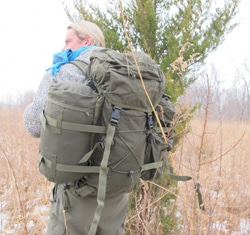
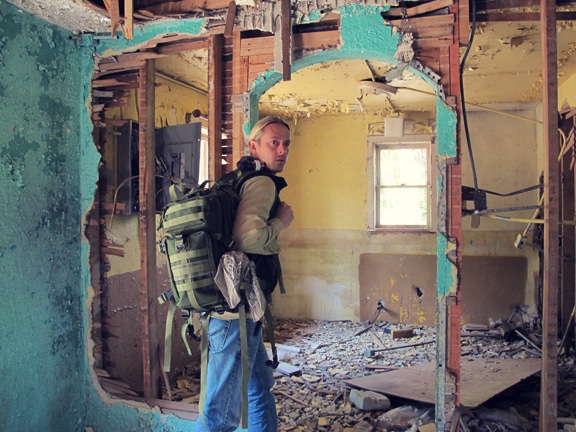
There are 10 supply categories that need to be considered when assembling your Bug Out Bag.  Before we dig into each of these categories it is important that I discuss the bag (or pack rather) itself.  Your Bug Out Bag needs to be a backpack.  It needs to be large enough and sturdy enough to contain the gear necessary to get you through 72 hours of independent survival.  You need to be comfortable carrying it for extended periods of time.  And, in my opinion, you don’t want to APPEAR TO BE PREPARED and STOCKED with gear.  A ‘tricked-out-pack’ can make you a target of people who want the supplies that you have.  Try not to let your pack send the message that you are stocked to the brim with all kinds of survival necessities.  Keep it basic.  I personally use a SnugPak Rocket Pack as my Bug Out Bag.

Once you have chosen your pack, below are the 10 supply categories that need to be considered when assembling the contents of your Bug Out Bag:

Category #1: WATER

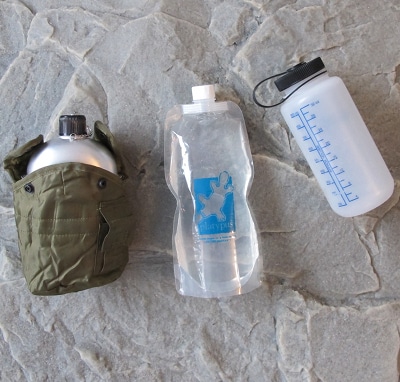
You will need at least 1 liter of water per day for proper hydration–preferably more, especially considering hygiene concerns and certain weather conditions.  Since this is a 72 Hour Survival Kit, that means it needs to contain 3 liters of fresh drinking water–minimum.  This water should be stored in 2-3 durable containers with at least one of them being collapsible to reduce bulk as the water is used.  A metal army canteen is another good choice because it can be used to boil drinking water that is collected ‘in the field’ if your immediate supply runs dry.  I carry a collapsible Platypus water bottle, a 32 oz. Nalgene water bottle, and a metal US Army issue canteen.
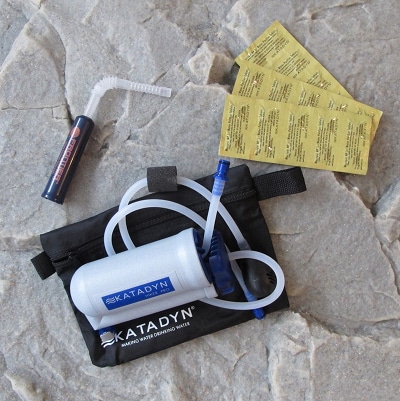
Because water is so critical to survival, I highly recommended also packing at least 2 water purification options.  Boiling water for 10 minutes is an option but is not always the most convenient.  I suggest packing 1 water filtration system and also some water purification tablets.  I personally pack a Katadyn Hiker Pro Filtration System, an Aquamira Survival Straw (as a backup) and sodium chlorite water purification tablets.  The 3 options of boiling, filtering, and chemical treatment will give you more flexibility in securing one of your most basic survival needs: clean water.

Category #2: FOOD

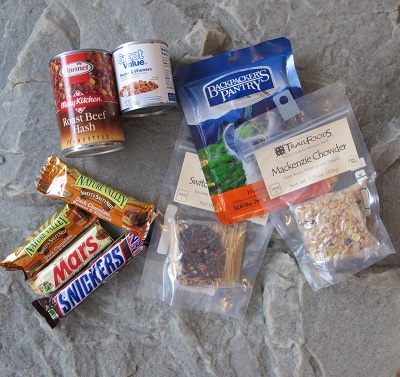
Don’t worry about planning for three well balanced meals per day–this is survival, not vacation.  I’ve gone on many survival trips where I haven’t eaten for a few days, so you can live without any food at all for 72 hours.  However, it isn’t pleasant.  You should pack simple & easy to prepare meals.  Canned meats and beans are great options.  Canned beef or chicken stews are equally as effective.  If the weight of your Bug Out Bag is an issue, dehydrated camping meals are excellent choices.  Remember, though, they require hot water to prepare–so that means a stove or fire and valuable time (if you are traveling).  Military MREs are also good options.  They have a long shelf-life, contain their own heating systems, and are very packable.  They can be expensive, though.  I would also suggest tossing in a few energy bars and candy bars.  These are packed with calories and carbs–both of which are extremely important.

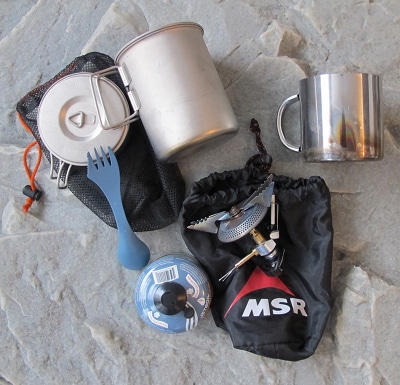
When we discuss food, we also need to discuss preparing it.  A very simple cooking kit is all you should need.  It should contain at least 1 small metal pot, a spork, a metal cup and maybe a metal pan or plate.  Anything more than this is overkill.  In many instances, preparing food requires heat.  A fire will always work but may not be practical in every situation.  I would suggest packing a lightweight backpack stove with 1-3 fuel canisters.  I’d rather have it and not need it than need it and not have it.  I personally carry a self-igniting MSR Ultra light stove in my BOB with 1 fuel can.

CATEGORY #3: SHELTER

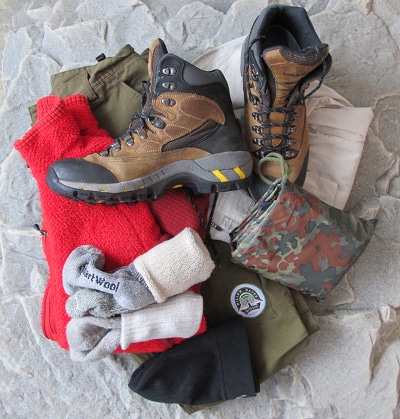
I include clothing in this category.  Regardless of climate, I recommend packing the following (some of these items can be on your body when you leave): 2 pair of wool hiking socks, 2 changes of underwear, 1 extra pair of pants (NOT BLUE JEANS AND PREFERABLY NOT 100% COTTON), 1 base layer thermal underwear, 1 warm fleece hat, 2 extra shirts (1 long sleeve, 1 short sleeve), 1 mid-weight fleece, 1 warm rain jacket, 1 heavy duty military poncho (can be found at any Army/Navy Surplus), 1 pair of comfortable waterproof hiking boots.

What to pack for an actual shelter is a heavily debated topic within the survival community.  I like having options and I like redundancy–especially when it comes to shelter.  Protecting yourself from the elements, whether rain, cold, or heat, is incredibly important.

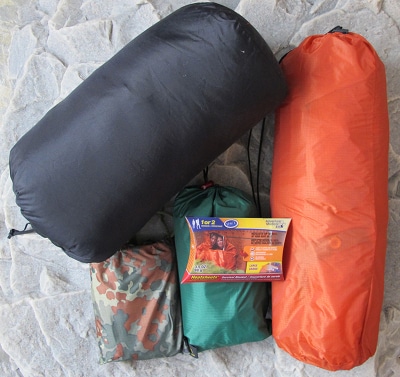
Your first emergency shelter option is the military poncho listed above.  These are designed with grommets in the corners to be used as a make-shift emergency tarp-tent and are actually quite effective.  I’ve spent many nights in the woods during all kinds of weather conditions with nothing more than a wool blanket and a military poncho…and have been fairly comfortable.  Practicing the set-up is the key.  Know HOW to use it before you need to.

A second emergency shelter option is a simple reflective emergency survival blanket.  There are many different kinds and brands of these on the market.  I prefer one from Adventure Medical Products called the Heatsheet.  Not only can it be used as an emergency survival sleeping bag, but it can also be used as a ground tarp or as a tarp-tent shelter.  These are lightweight and cheap.

Besides the poncho and the heatsheet, I also carry a 6′x10′ waterproof rip-stop nylon tarp.  I use this style of tarp as a year-round camping shelter, so I know it works.  It’s lightweight and really effective if you practice setting it up.  You can also bring a lightweight camping tent.  These can be pricey, but they are really nice.

Lastly, you will want to include a very packable sleeping bag.  If I had to give a general degree rating I would say a safe bet is a 30-40 degree bag.  This pretty much covers all of your bases.  Sure, you’d be cold at 20 degrees, but you would live.  If you have the room, a nice wool blanket is a great addition.  Wool maintains 80% of its warming properties even when soaking wet and is a very durable survival fabric with incredible insulating properties.

CATEGORY #4: FIRE

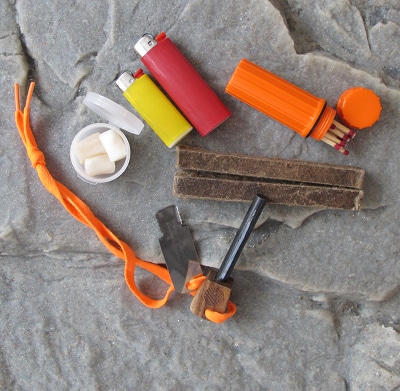
Making fire is one of the most important survival skills of all time.  You need a minimum of 3 ways to make fire.  Because you are preparing this Bug Out Bag in advance, you can toss in a few of the easy options like lighters and waterproof matches.  You will also want to include a fire steel which can generate sparks in any weather condition.  Besides these items, you will need to pack some tinder for fueling your initial flame.  You can buy tinder from any outdoor store, but cotton balls soaked in petroleum jelly is the best I’ve ever seen.

CATEGORY #5: FIRST AID

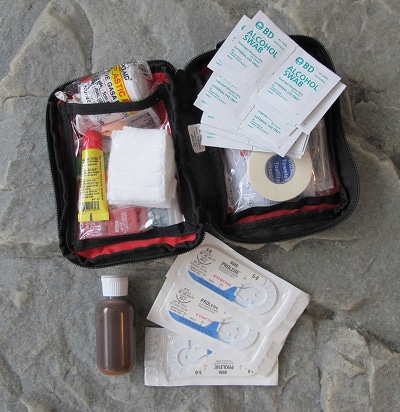
Whether you build your own kit from scratch or buy a premade kit, make sure it includes the following items at a minimum: 1″ x 3″ adhesive bandages (12), 2″ x 4.5″ adhesive bandages (2), adhesive knuckle bandages (3), butterfly closure bandages (2), gauze dressing.

My personal gear for this category includes: Adventure Medical Kit’s First Aid Kit 1.0 and, I’ve added 3 suture kits, more alcohol pads, 2 rolls of 2″ gauze, CARMEX Lip Balm, and some larger butterfly bandages.

CATEGORY #6: TOOLS

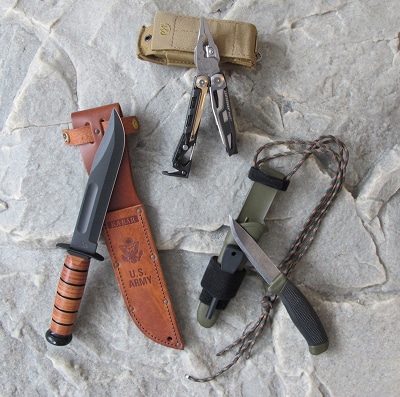
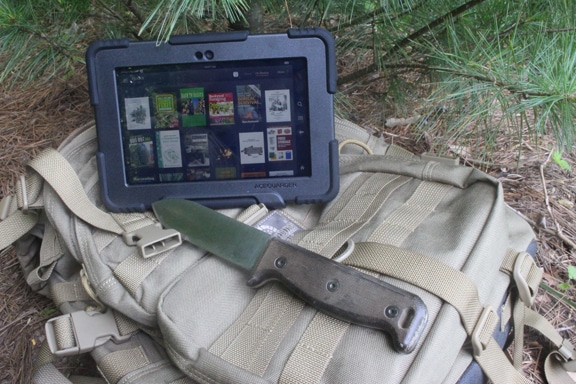
The first and most important tool in your Bug Out Bag is a knife.  Choosing your survival knife is a very personal decision, and besides your knowledge, it will undoubtedly be your most useful survival tool.  I suggest carrying a full tang fixed blade all-purpose survival knife.  It should be large enough to use for chopping, splitting, and self-defense but also small enough to use for more delicate camp chore tasks such as carving feather sticks and preparing food.  The right balance is a personal decision.  In my opinion the overall length needs to around 10″ –not too much over.  Any larger than this and the knife becomes more difficult to use as an effective tool and starts to get bulky.  I have made the decision to carry 2 knives in my Bug Out Bag.  I carry a Ka-Bar US Army Military Fighting Knife and also a Mora 840 MG Clipper Knife which I use as a smaller all-around camp knife.  Mora knives are very reliable all-around camp knives, and a good Mora can be purchased for under $15.

Besides a knife, one other item you will want to consider is a good multi-tool.  A multi-tool comes in handy for all types of projects–from cutting wire to complex mechanical chores.  Your multi-tool should have a screwdriver (both phillips and flat-head), pliers, a knife blade, and wire cutters at a minimum.  Leatherman makes all kinds of great multi-tools which can be purchased at almost any sporting goods store.  I personally carry a Leatherman MUT Military Multi-tool.

CATEGORY #7: LIGHTING

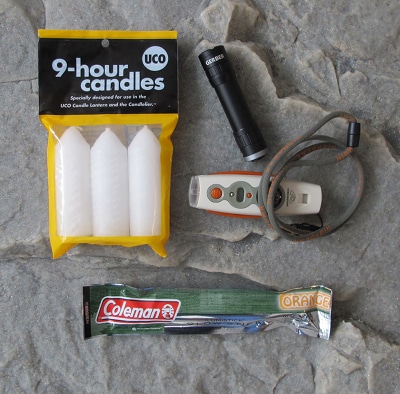
You need to pack at least 2 light sources.  I would suggest having 1 flashlight that with throw light some distance like a mini mag light or a mini LED flashlight.  The 2nd can be a smaller one to use around camp or while fixing meals, etc. Mini keychain LED lights are lightweight, cheap, and last a long time.  Other ideas are glow-sticks, candles, and LED head-lamps.  I personally carry the following light sources: Gerber Firecracker Flashlight, a lanyard multi-function tool with small LED light, 1 glow-stick & 1 package of 9 hour candles.  Again, I like options.

CATEGORY #8: COMMUNICATIONS

A fully charged cell phone is at the top of this list.  In an emergency, cell phone service will probably be jammed up.  However, text messages typically still go through, so having a cell phone is a necessity.  You should also have either a fully charger EXTRA cell phone battery or a means of charging your cell phone.  There are several options for charging your phone in the field without electricity.  Some include solar charging units, hand crank chargers, and aftermarket battery boosters.  You need to research and determine which solution is best for your current phone make/model.

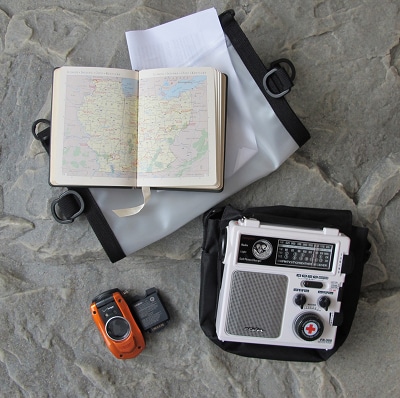
In addition to a cell phone, you should also pack a small battery powered or crank powered AM/FM radio.  This could be an important source of information and for the price and weight, you can’t go wrong.  I personally carry a hand-crank FR-300 Emergency Radio.  The hand-crank also has a cell phone charging feature.

Under this category I will also include IMPORTANT DOCUMENTS.  In the case of emergency evacuation, you should carry with you certain important documents.  Among these should be your driver’s license, passport, social security card, medical information, important phone numbers and account numbers (bank, insurance, credit cards, etc.), and your gun carry permit.

The last item in this category is to pack a detailed map of your surrounding area, your state, and any area in-between your location and your Bug Out Location (your predetermined destination in case you have to Bug Out).  You would be foolish to depend on a GPS in an evacuation emergency.  PACK MAPS!

I personally carry all of these documents in a sealable waterproof map case.

CATEGORY #9: PROTECTION & SELF-DEFENSE

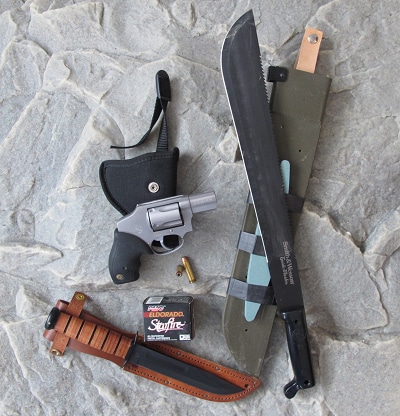
You can almost certainly guarantee that in an evacuation emergency there will be chaos and disorder.  Events of this magnitude inevitably overwhelm normal police and public safety measures–at least for a short time.  History tells us that rioting, looting, rape, and violent crimes will occur.  You need to be prepared to protect and defend yourself and your resources–especially if you have a family.  You would be naive not to take this category seriously.  The best measure of self defense is a gun–period.  Besides the intimidation factor, a gun has reach and stopping power.  A gun can also be used for hunting if necessary.  What kind of gun to pack is a lengthy topic all by itself.  Some like shotguns, some prefer rifles, and others choose handguns.  I have chosen to pack a 357 Ruger Revolver.  I chose a handgun because it is easy to conceal and is fairly lightweight.  I chose a 357 because of the stopping power, and I chose a revolver because I know beyond the shadow of a doubt that every time I pull the trigger a bullet will fire.  I’ve had automatic pistols jam on me enough times to know I don’t want my life to depend on one.

Other formidable weapons of self-defense can be your survival knife, a machete, or even a walking stick.  I, though, would hate for anything except a gun to be the only thing between me and a gang of thugs.

CATEGORY #10: MISC. GEAR

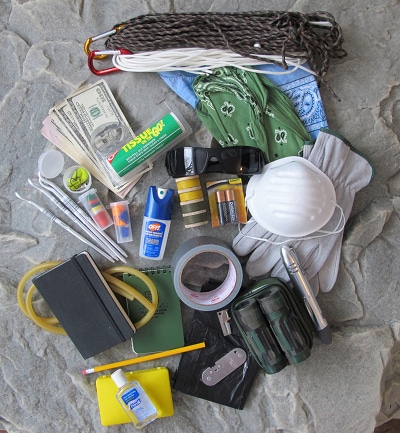
Just in case you have to Bug Out on foot, the weight of your pack should always be a consideration.  You should be comfortable carrying your pack for up to 3 days.  Because of this, everyone’s pack load will vary depending on their comfort level.  Below are some additional items that I have packed in my Bug Out Bag that you will also want to consider when building your own:

  • CASH – $1000 minimum (because cash talks)
  • Toilet paper
  • 200 feet of paracord (building shelter)
  • Duct tape (100s of uses)
  • 100 feet of Army issue trip wire (misc. projects, snares)
  • Pad of paper & pencil (leave notes or record information)
  • Small Bible
  • 2 Bandanas (because they are so dang multi-useful)
  • Leather work gloves
  • Small knife sharpener
  • Machete (clearing brush, chopping wood, self-defense)
  • 4 spare AA batteries for my Gerber Firecracker
  • 2 dust masks (can double as crude filters)
  • Bar of soap & small bottle of hand sanitizer (hygiene)
  • Travel toothbrush w/ tooth paste
  • 36″ length of rubber tubing (siphon, tourniquet)
  • Small sewing kit
  • 2 heavy duty 30 gallon garbage gags (water storage, shelter, poncho)
  • P38 can opener
  • Binoculars
  • Small fishing kit
  • Stakes
  • Sunglasses (can double as safety glasses)
  • Whistle
  • Insect repellent
  • Earplugs
  • Compass

At the end of the day, there is no perfect Bug Out Bag.  Even my own BOB changes and evolves with my needs, thoughts, wants, and tastes.  An incomplete and imperfect Bug Out Bag is better than nothing at all in an emergency.  For me, the peace of mind in knowing it’s there on the shelf to grab if I need it is reason enough to have taken the time, effort, and money to build it.  I hope that my thoughts about the Bug Out Bag have been informative and helpful (and maybe inspirational) as you consider building your own.

____________________________________________________________________________

Creek Stewart is a Senior Instructor at the Willow Haven Outdoor School for Survival, Preparedness & Bushcraft.  Creek’s passion is teaching, sharing, and preserving outdoor living and survival skills. Creek is also the author of the book Build the Perfect Bug Out Bag: Your 72-Hour Disaster Survival Kit. For more information, visit Willowhaven Outdoor.


{ 230 comments… read them below or add one }

201 Mark Petersen March 25, 2011 at 3:43 am

There is something that I don’t think anyone has mentioned and I think is an undervalued concept.

Redundancy = bartering items.

You may have to beg borrow and deal in some situations. If you have valuable resources that you have extra of they can be worth their weight in gold (and at 1431.80USD/oz that’s a lot.) Things that will be in short supply that everyone will need you may want to load up on so you can trade them for extra food or blankets. Matches, ammo, water purification chemicals, and even asprin will be valued commodities in disaster situations. Don’t be afraid to part with some of your surplus to get things you really need.

202 George Matheis March 25, 2011 at 6:23 pm

Very well written article with solid information. Just please get a proper holster for that handgun, it deserves it- George

203 N March 26, 2011 at 2:52 pm

Keep in mind that it may be illegal to carry a gun if a state of emergency has been declared. In PA, it is relatively easy to acquire a license to carry a firearm, but that license is not valid if the folks in Harrisburg declare a state-wide emergency.

Kinda dumb, since a gun is a tool that is *only* useful in an emergency situation, but there it is.

I wouldn’t advocate this, but I guess in some extreme situations (such as an extra-terrestrial invasion?) it might be justifiable to break that law. If you think you might need to make that decision, at least look up your local laws ahead of time and know what you might be getting yourself into. Any gun owner ought to do this, really.

Great article- I’d be interested in a similar one on stocking your home for an emergency situation.

204 Robert March 28, 2011 at 12:10 am

It’s a good article, but I doubt anyone without military experience will ever carry that much for three days or more. Or at least not without getting very far. I myself was in a Scout troop when I was younger and had lots of experience with backpacking and survival. We were taught survival skills by a former army ranger trainer. Backpacking (In essence, this is backpacking) requires not only strength, but a lot of endurance. I’m not talking 6 miles a day backpacking. I’m talking about 12 to 18 miles a day backpacking over rough, partially unknown, and mostly unmarked terrain. Not to mention poor spirits and a sense that you might never go back. (Katrina anyone?) My point is, for 98% of people, this is too much stuff. Redundancy is good; overkill isn’t. You are better off with one simple thing with multiple functions than twelve that all do the same. The stuff like the rubber tubing, binoculars, machete, etc. is too redundant. More than one large knife could never be needed. (If you have a gun the uses for a knife grow fewer) You have hose from the water filters, and a bandana can be both a dust mask and a tourniquet. Another note; canned food is extremely heavy. Save weight and space with other kinds of packaging.
This kit, while giving you all the comforts of home, will slow you down. You are out to survive and move, not camp. Speed is important. Don’t sacrifice it for your 4C battery Mag-lite flashlight.

205 John March 31, 2011 at 6:14 am

As a former government scientist I worked with the logistical models that the US military uses to determine what is sufficient equipment for troops in the field. That leads me to believe the author missed a critical item in his list: friends. From a logistics standpoint it make things more complicated. However in military planning the rule of thumb is that a soldier in a combat situation has a 33% hit rate (poor visibility, getting shot at, adrenaline, movement of target, your movement, etc.) and that on a 5-15 second window a bullet wound does not stop a soldier from doing his or her task (after about 1-2 minutes there is a precipitous drop off in functioning for most tasks however). True, a head shot is a fast kill but it is still occurs on a 1 to 2 second time frame if the lower portion of the brain is destroyed. Human reaction time is an order of magnitude faster so making a head shot cannot prevent a person from firing a weapon if they have drawn already. This is a long way of saying that a firearm is a dubious defensive weapon. This is also part of the reason why soldiers are trained to operate in squads and not as individuals in combat situations. My advice (for what it is worth) would be to find 3 or 4 like minded individuals that you like to go camping and hiking with and one night while around the fire talk about where to go, what to pack, and plan a couple of dry runs when the flood waters aren’t at your door. In other words Planning and Practice Prevents Poor Performance.

206 Oz chippy March 31, 2011 at 6:52 am

I keep very small rucksak with $$$$ in euro, au$, us$ & some gold, multi tool, large & filleting blade for dressing a carcass, flint & 5L clean water (make sure it doesn’t go stagnant). In the gun safe I have a lever action 12 gauge & .38 snub nose. With the firearms I can liberate anything I need. Remember it is survival of the fit & ruthless not the most prepared. I personally would rather die fighting. Oh yeah why a lever action I hear you yanks ask, I live in oz & we are no longer alllowed any semi-auto weapons, cursed gun control laws.

207 Oz chippy March 31, 2011 at 6:55 am

One other thing worth noting no matter how prepared you are all it takes is to walk into one ambush & you and the bug out bag are parted. Leaving you shivering and shoeless like the rest of the hungry populace.

208 Daniel April 3, 2011 at 11:19 pm

Wow, this article really started me down the rabbit hole for research. After looking around for durable, transportable food that’s high in energy, it seems that nothing can beat pemmican. I will be picking up ingredients this week.

P.S.
Oz,
You are likely better off weighing your bag down with brass and lead (ammo) than gold. I don’t see gold being used as a currency in an emergency. No one was trading gold after Katrina. A bottle of water, on the other hand, was of tremendous value.

209 Burwell General Store April 4, 2011 at 1:10 pm

I StumbledUpon this article- The comments are all quite thoughtful, and the content itself is very helpful and thorough Thanks for sharing – not only for men!

I second that bottles of water are worth their weight in gold, having been through one disaster and a blackout in NYC, each when millions of us had to walk home and recover- shopkeepers were price gouging for bottles of water, and socks.

210 Chad Blood April 4, 2011 at 5:53 pm

Great Post!

If you guys found this topic interesting and would like more in depth information & discussion on Bug Out Bags and other aspects of “being prepared” I would urge you to check out http://www.thesurvivalpodcast.com Just like The Art of Manliness, The Survival Podcast is a “Top Notch” show and community. Jack Spirko does a great job bringing quality content day after day. Brett, I would urge you to check it out, and consider Jack Spirko as a guest contributor to AoM.

211 BrazosSticks April 4, 2011 at 6:30 pm

Right on for the need for a multipurpose Walking Stick, ready at hand as an immediate tent pole for fast approaching weather and fast protection for all comers, besides balance and thrust for walking with a pack like is pictured here.

212 Daniel April 5, 2011 at 8:57 pm

Oh yes,
Bicycling jackets are extremely lightweight and packable and hold a lot of body heat.
And the Art of Manliness book might be a handy thing to have in the bag for reference!

213 PointSpecial April 6, 2011 at 12:33 am

Not to be a huge downer, but I’ve got a wife and two year old twin boys.

This isn’t nearly enough stuff and would end up being a logistical nightmare if we had to go anywhere on foot…

I think we’d likely be better off hunkering down and waiting for a window of opportunity. That, of course, means having plenty of the right stuff at home (and wouldn’t work in a Katrina-type flood situation, but that’s not likely in the Midwest, especially in a town called Highwood).

My contingency plan involves hopping in the mini van and driving to the middle of nowhere. I’ve got survival gear to last a good 24 hours… I likely need to beef that up a bit.

I’m ultimately not concerned about being stuck and having to defend my family… but that comes from being 6’9″ and 320 pounds. Especially if I’m in my own house, it would take a lot to dislodge me, and having a bug out bag wouldn’t prevent that, regardless.

And I’m not about to abandon my family. That’s about the least manly thing you could do.

214 Charlene April 6, 2011 at 9:26 am

I like how right after you say “Try not to let your pack send the message that you are stocked to the brim with all kinds of survival necessities. Keep it basic”, there’s a picture of you with a HUGE bag :)

If there was a natural disaster or chaotic something, and I saw someone with a bag like that. I would immediately assume that they were stocked to the brim with all kinds of goodies. And I would want you to share!

215 Megan April 6, 2011 at 2:41 pm

Charlene is right first thing i thought when i saw that Pic. I’m a woman trying to be prepared. Everyone things I’m crazy. So, If something does happen i might not be as prepared as i would be with help from family but they will be glad i did anyway thanks for this article and others like it.

216 Rob October 7, 2012 at 10:24 pm

Many different style multitools out there. I made sure the one I pack has the capabilities of a wrench, screwdriver, saw, knife, file, can opener and adequate space for a paracord lanyard.

217 C November 2, 2012 at 7:20 am

With regards to self defense, I’d rather be tried by twelve than carried by six. That said a breakdown .22 and a sidearm are really essential. A .22 rifle is great because the ammo is light and you can carry 500 rounds easily. A .22 pistol can be a good choice if you’re a good shot. If not a 12 gauge shotgun might be a better choice. Remember, desperate people do stupid things, so be prepared.
Look at Hurricane Sandy if you want to see how much help the government will be. They are practically useless., tits on a boar hog, so to speak. Oh, and have your gear together BEFORE you need it.

218 sugapablo November 3, 2012 at 2:32 pm

And while informative, one thing that bugs me about this list is the cost. Obviously, if you’re poor you can’t afford a bag like this. What should someone who’s never seen $1000 cash before do to prepare? So many people can barely put food on the table each day, let alone afford a pack even half as good as this.

Here’s an honest question? Add up all the items in the above pack. What’s the dollar value? How much would this pack cost?

219 WhoWuddaThunkIt November 6, 2012 at 2:54 pm

Good Article: I would like to add that it has been said that a Bug-Out-Bag (BOB) should not weigh more than 1/3 of the person’s weight who’s carrying it. After you put all the items you require in the bag, walk around with it on. Remove items or replace heavy items with lighter weight items. The better more designed pack you have, the more weight you can carry, and the better it is with the majority of the weight resting on the belt strap around the hips, and not the shoulder straps. There is also a technique as to how to pack the sack, as the greater weight at the top. Do some research and keep refining your pack. You-Tube has hundreds of videos, explaining what to do, or not to do. Do what works for you. I also suggest 2 collapsible walking polls to help steady you when climbing up or on uneven trails or help in stabilizing you when crossing streams and bodies of water. I would also suggest a good hand Axe for building shelters and wood supply for fires, heat and cooking. Besides paper maps for logistics, get a good GPS with trail maps on it and for locating water sources. Your best tool is personal knowledge, and keep reading daily.. You will be the hero, when SHTF!! Cheers!!

220 ParsedOut November 14, 2012 at 12:21 am

@sugapablo
I’ve priced out all the components necessary for a bare essentials BOB for my family members who do not see the value in preparing. A decent bag can be put together for about $300. It’s nothing fancy, but covers all the major bases. Then you can slowly add to it piece by piece as funds allow.

221 Simon J Stuart November 29, 2012 at 12:34 pm

Just to speak to the whole “legality” arguements regarding the use of guns and knives in the event of emergency: no matter where you live (anywhere in the world, in fact), there is something which overrides all laws and entitles you to use ANY MEANS NECESSARY to defend yourself… it’s called your INATE HUMAN RIGHT TO SURIVE. No state, government, autocrat or dictator can take that away from you (they can try, but ultimately if you stand your ground on the basis of necessity and your right to surive, they can’t win).

Personally, I live in the UK where all sorts of crazy things are either in law considered illegal, or by know-nothing cops treated as illegal.
I have, for example, been illegally searched here in the UK, and – upon finding one of numerous tool knives I carry with me at all times, both for emergencies as well as the nature of my work – read my rights.
Fortunately I am versed in UK weapons laws, and dutifully informed the officer that no knife designed and declared for the purpose of utility can be deemed a weapon in the eyes of the law, unless used for the purpose of being a weapon at the time of allegation or arrest.
Indeed, this holds true for anything! A pencil is a lethal weapon if used as such. So is a bottle, a drinking container (even plastic), a CD case, a pointy stick. Basically, nothing can be deemed as a “weapon” unless its registered purpose (meaning man-made product only) is to kill people (and only people).

A gun’s purpose is to kill, period. Carrying a firearm without the permit to do so under every-day conditions is (understandably) a crime in most territories, and you shouldn’t do it!
In a state of emergency in which civil order is (by YOUR reasonable judgement) indefensible, however; your right to surive (and take all necessary action toward that end) supercedes any and all laws.

Does that mean you can charge around shooting anyone who stands in your way? No! It means that, if faced with no other option – where the only alternative is that yourself or your family will be seriously injured or killed – you have the inate human right to take whatever means you deem necessary to defend yourself, your property and your family.

You will, however, need to be prepared to justify your actions once order is restored.

Shooting a man isn’t as easy as you think. It’s easy to sit in front of your TV watching a movie where the victim stands holding the agressors’ gun (hard-won after a lengthy and thrilling hand-to-hand struggle), aiming it at the agressor, with you screaming “shoot him ffs” at the screen. The reality is, however, that once you’ve taken a life, you can’t give it back. Most people (and this has been proven time and again) simply lack the mental ability to take the life of another, even if their life stands to be lost if they don’t.

It’s useless packing your GHB/BOB/EBOB/INCH bag with defensive weaponry if you lack the physical and/or mental ability to use them. Ultimately you’d just be arming the thugs when they inevitably take them from you.
The best way to succeed at battle is to never give the enemy a chance to fight. Your best bet at achieving that is for them to never know you were there!
Go looking for trouble and you will most asuredly find it!

What separates a survivor from a victim is the clarity of distinction between when it’s defense, and when it’s murder.
What separates a survivor from a psychopath is that the survivor cares about this distinction.

Anyway, that’s my input as regards legality and defense.

As regards the necessity of GHB/BOB/EBOB/INCH packs… every man woman and child should have one. You’re either always prepared or you never are, it’s as simple as that!
Taking myself and my family as an example: we live a couple of miles from a large nuclear power station (currently has 3 active reactors, a 4th due to go online in the not-too-distant future). History has shown that nuclear reactors can and do have the potential for massive disaster (Chernobyl, three-mile-island, and more recently Fukushima-daichi). With that in mind, it is not just wise for me to prepare these packs, but to not do so would be – in mind at least – criminally negligent as regards the well-being of my family.

What constitutes (again, from my experience) a good survival pack is MODULARITY: the ability to rapidly change the “loadout” to meet the given situation.
As an example: I keep a pack (actually one per person in my family – 4 total) containing rudimentary biohazard supplies (a WHO-approved boiler-suit or “smock”, a pair of thick rubber boots, a genuine biohazard head mask [rated for the likes of nerve gas] and large supply of Iodine tablets – not for treating water, but for protecting the Thyroid glands from absorbing radioactive particulate – specifically radioactive Iodine)
This pack can be attached in seconds (and securely) to my modular base pack.

I have the same sort of thing to turn the base pack into a 24-hour BOB, a 72-hour BOB, and even an INCH (which is basically all the modular packs attached together).

the base pack can be any mil-spec pack with a vast supply of MOLLE-webbing such as the Karimor 45 and 50 litre patrol packs, or (in my case) military Bergen packs.

222 Jack Crevalle December 15, 2012 at 7:43 pm

Wind the duct tape off of the roll onto a pencil. Same with toilet paper (only with TP you can leave out the pencil). It will take less room.

223 harold December 19, 2012 at 4:41 pm

two nits to pick.
Don’t rely on Bic lighters, the flints can deteriorate over time. I took out the ones I had stored for three years and at the first flick the flint turned to powder.
Vaseline on cotton balls is certainly flammable, but you’l have a heck of a time lighting it with sparks.
As a side note, a tube tent is an excellent shelter even if you don’t hang it up.

224 Doug December 19, 2012 at 9:57 pm

What is the blue thing taped to your Machete?

225 Rohan January 3, 2013 at 9:38 am

I would recommend that each person not only try a camping trip with your bug out bag but also do a nice overnight backpacking trip. I tried this and just taking from the car to a campground a few hundred feet away is a lot different than trying to traverse a few miles over the mountains or even just walking on the road.
When I was done I with my experiment I shed a lot of extras and slimmed down to a “minimalist” BOB. Unless you know you can carry your pack for multiple miles over paved and unpaved terrain you will be shedding a lot of stuff quickly. Speak to people who through Hike the Appalachian trail. Many people end of leaving a-lot of what they thought they needed within a day or two because it weighs to much. I have friend who worked on a documentary and many hikers left stuff behind on day one. There is even a store along the way that has made a lot of business stripping down peoples packs and mailing the useless stuff back home. You don’t want to spend all that money to have to leave it behind. I agree with all the Main points in the article and am not disagreeing but ounces = pounds and at the end of the day many people will have a hard time carrying this much weight unless they do it often.

226 Eric January 31, 2013 at 10:23 am

just get a knife, a lighter, and a water container(a steel one) and you are good to go, if you have the right skills and not live in a tough area like the desert ;)

227 Mr. Nutter March 7, 2013 at 3:30 pm

That is enough stuff to survive an entire lifetime in the woods, not a few days. A three day kit can fit into your cargo pant pockets and a holster on your belt.

228 Anthony March 7, 2013 at 7:55 pm

@N- you are actually incorrect. In Pennsylvania, under normal circumstances you may openly carry both long guns and handguns legally. During a state of emergency, it becomes illegal to carry a gun anywhere unless you have a concealed carry permit- in which case you are perfectly allowed to sit on your porch with an ar-15 or run around with a glock.

229 Casey May 9, 2013 at 12:11 pm

Most people read this and go out and buy a bunch of crap to “bug-out”. The LAST thing you want to do is run outside before, during, or after an emergency so step 1 for survival is to BUG IN. I built an emergency kit online through places like amazon.com, http://www.theicecubekit.com, and rei.com. A hard shell kit for your house or car is perfect because the number 2 rule to survival is shelter. (Number 1 is attitude)

230 Jacob Phillips May 21, 2013 at 9:01 pm

Great article. Clearly this a broad overview of everything that COULD go in a bug out bag but is a bit of overkill for 72 hours.

That being said the amount of detail here is great and it’s nice to see what the Pro’s are using. For anyone doubting this guys credentials this isn’t just some internet guy throwing together a list – he lives, works and teaches in the bush 24/7. This might be part of the problem however as he’s probably more used to trucking around heavy packs than the average joe.

Either way awesome article

Leave a Comment

Previous post:

Next post:

Site Meter