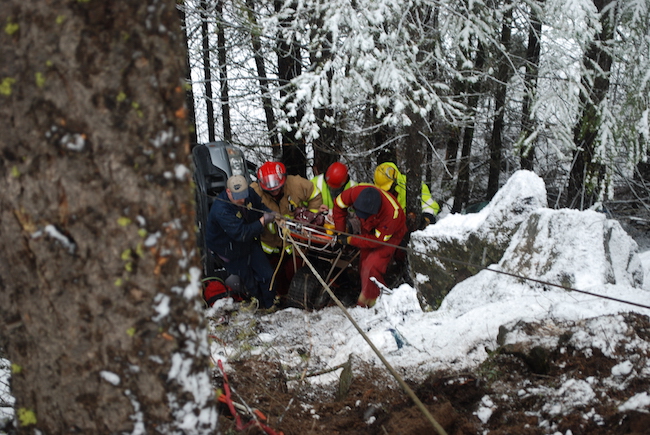
Search and rescue (SAR) teams in U.S. national parks respond to lost hikers, injured climbers, stranded boaters, missing children, and backcountry medical emergencies. Their work ranges from relatively simple trail searches to high-angle rope rescues, swiftwater recoveries, helicopter evacuations, and multi-day backcountry operations.
The National Park Service (NPS) has its own search and rescue capability. Many parks employ commissioned law enforcement rangers and specialized rescue rangers who are trained in technical rescue, emergency medicine, and incident command. Some large or high-risk parks maintain dedicated SAR teams made up of full-time staff.
At the same time, the NPS frequently works with volunteer and partner organizations. Depending on the park and the incident, they may coordinate with local sheriff’s offices, county SAR teams (often volunteer-based), mountain rescue groups, state agencies, the Coast Guard, or even military aviation units. In some parks, volunteers are formally integrated into SAR operations under NPS supervision.
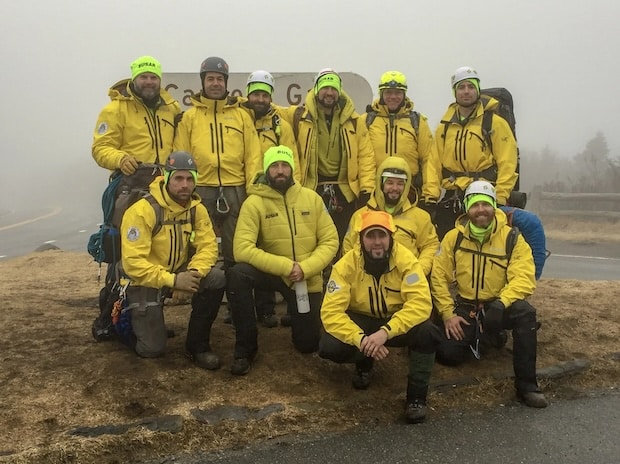
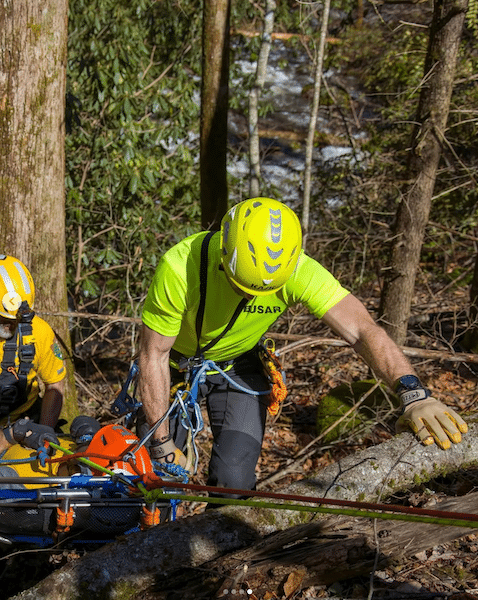
Among the parks that partner with outside organizations is the Great Smoky Mountains, America’s busiest national park. That’s where the Backcountry Unit Search and Rescue (BUSAR) team, which is headed by Andrew Herrington, operates.
When the members of BUSAR train, they do so through their own nonprofit organization. When a rescue mission kicks off and they respond, members are temporarily hired as emergency employees of the National Park Service. Some members don’t take the pay that’s given and just volunteer their time and talent. Nobody’s getting rich from this; that’s not why these guys do it. They find the work incredibly challenging and fulfilling.
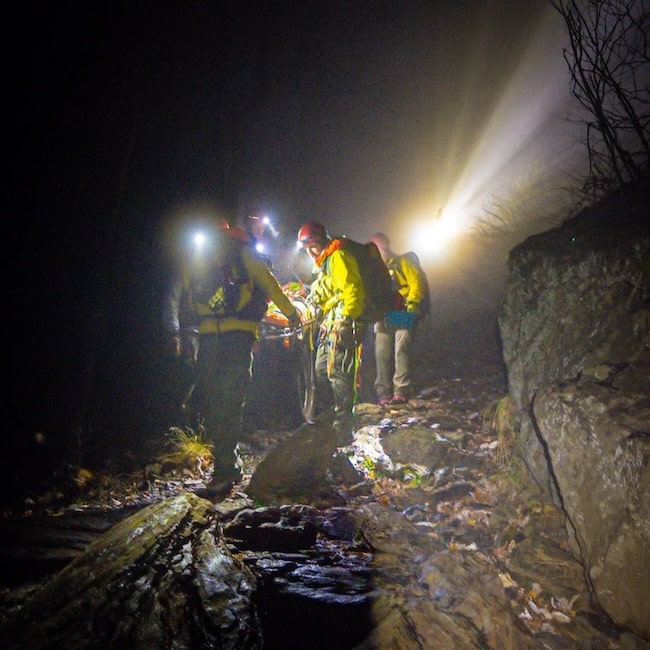
If you break your leg while hiking in the Smokies, chances are Andrew and his crew are the ones hauling you out. They’ll do it whether it’s raining, snowing, dark, steep, or completely off-trail. And carrying an injured person on a litter through rough terrain while wearing packs loaded with medical and survival gear is brutally strenuous work.
To pull that off, these guys have to be fit. Not Instagram-influencer fit. Useful fit.
To create a team of usefully fit guys, BUSAR has developed a fitness test that screens for members who will be able to do the hard, back-breaking work of rescuing people.
I recently talked to Andrew about why he formed BUSAR and the fitness test he uses to assess whether potential team members will be ready for action — and for anything.
Meet Andrew and BUSAR
Andrew is a professional hunter and trapper who has worked for the National Park Service in the Smokies for over two decades. He grew up outdoors, taught his first survival class as a kid (he still teaches them), and eventually landed in the law enforcement division of the Great Smoky Mountains National Park. That’s where he got his first taste of search-and-rescue work. Whenever there was a rescue mission, park rangers would call in personnel from various park divisions. Andrew’s experience as a hog hunter in the park gave him deep knowledge of its vast, complex trail system.
Though, in fact, his first real experience with search and rescue was getting rescued himself after a rock climbing accident as a teenager. That accident left him with a skull fracture, partial temporary paralysis, and a metal plate in his head.
While working on search-and-rescue teams in the Smokies, Andrew noticed that not everyone tasked with the job was physically prepared for it. He’d sat in meetings where leaders admitted they couldn’t send certain rangers on rescues because they weren’t fit enough. Or didn’t even know how to set up a tent.
So about ten years ago, Andrew decided to start an elite, dedicated backcountry search-and-rescue team. He wanted the most knowledgeable and physically capable people available and set out to recruit guys who had extensive outdoor, military, tracking, survival, firefighting, law enforcement, and medical experience and possessed superior levels of fitness.
The BUSAR Fitness Test
View this post on Instagram
To assess the readiness of potential members of this crackerjack search-and-rescue team, Andrew developed a rigorous fitness test they would have to pass to join up. The test is designed to answer one question: Can this person do the work?
The Park Service requires that rangers assigned to “arduous” duty pass the USFS Work Capacity Test, but it’s not particularly strenuous or revealing: rangers have to walk three miles on level terrain while carrying a 45-pound pack, in under 45 minutes. The test is easy to pass and doesn’t tell you much about how someone will perform off-trail, under fatigue, while handling awkward loads.
Andrew’s test is different. It’s stripped-down, demanding, and designed to replicate the effort someone needs on an actual rescue mission.
Here’s the BUSAR Fitness Test:
Thirty-Minute Loaded Carry Test
Candidates must first do the USFS pack test described above. They then exchange their 45-pound pack for a 20-pound search-and-rescue pack. While wearing that pack and holding a 45-pound kettlebell, the candidate must step up and over a picnic table in a continuous circuit for 30 minutes.
The movement is awkward by design. It mimics lifting, lowering, and repositioning weight in uneven terrain. Grip fatigue shows up fast.
Trap Bar Deadlift
A candidate must lift a trap bar loaded with two hundred and twenty-five pounds for as many reps as possible in one minute. The minimum to pass is fifteen reps.
Back injuries are the most common injuries among rescue personnel. Carrying litters and repeatedly handling victims stress the posterior chain. If your back can’t tolerate that kind of work under fatigue, you’re a liability.
Burpee Pull-Ups With a Pack
This is the hardest part of the test.
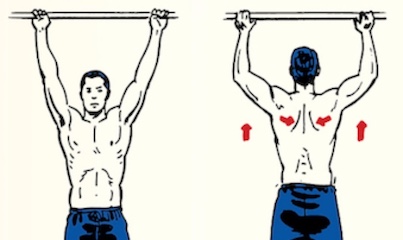
Wearing the 20-pound SAR pack, candidates perform a burpee, jump up to grab a pull-up bar, and pull themselves up. They have 10 minutes to complete a minimum of 50 reps.
This isn’t about strict pull-up strength. It’s about mobility, coordination, and the ability to get up and down off the ground repeatedly. Crawling, climbing, scrambling, and recovering from awkward positions are constant features of real rescues.
It’s also a test of how candidates manage energy and fatigue. A lot of guys make the mistake of trying to go too hard too fast, and they gas out. Knowing how to pace yourself is a skill you need while carrying someone out on a litter.
Andrew has had people recommend that he change the test to make it “more scientific.” But he figures if it ain’t broke, don’t fix it. In the ten years he’s been giving the test, he hasn’t seen anyone who passed it fail to perform on an actual mission.
Training Together
All BUSAR members are expected to maintain fitness so they’re ready when the call goes out. A lot of them do CrossFit and rucking.
For a while, Andrew’s team met weekly for group training. They’d show up at a park with their packs, and someone would bring kettlebells and sandbags. They’d create a workout on the spot: sandbag tosses, buddy carries, burpees, crawling, kettlebell swings. The workouts weren’t fancy or optimized. They were practical.
But more importantly, according to Andrew, they built cohesion. Shared physical suffering creates trust. When you’ve watched someone grind through fatigue without complaining, you have a better sense of how they’ll behave when things go sideways in the wilderness.
Life eventually intervened, and the weekly workouts faded for a time. Andrew is now looking at bringing them back, especially for newer team members.
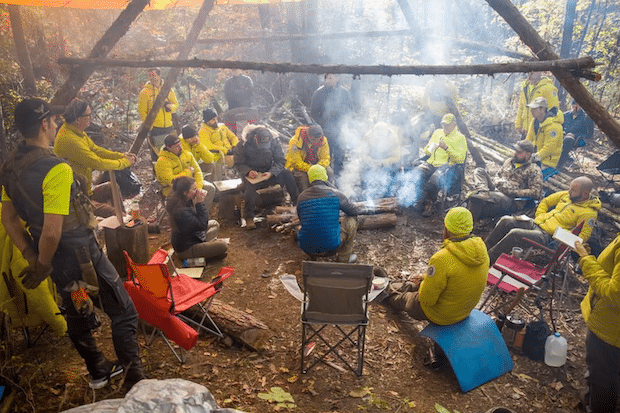
In addition to maintaining physical fitness, the team meets quarterly to keep their technical skills sharp: land navigation, tracking, first aid, shelter systems, and moving litters over terrain.
During high-visitation periods, the team sometimes stages in the park for pre-deployment. They train, stay ready, and can respond quickly if a call comes in. During busy seasons, they may get called out multiple times a week.
Be Strong to Be Useful
Most of us aren’t going to be hauling injured hikers out of the Smokies. But I reckon the average guy can learn from how BUSAR approaches fitness.
These guys are, as 19th-century physical culturist Georges Hébert put it, strong to be useful.
You don’t know when you’ll need to move furniture all afternoon, shovel snow for an hour, carry a kid who fell asleep, help a friend move, or deal with some minor emergency that turns physical. Training for general strength, basic conditioning, and handling awkward loads helps you be ready for those moments.
So yes, keep doing your hypertrophy work and chasing PRs on your deadlift. But make sure to incorporate some BUSAR-type training so you’ll be ready when you’re called to action.
And if you’re feeling intrigued about doing volunteer search and rescue work, here are some reasons you might join up.