Back in January, a day before a big winter freeze was about to hit Tulsa and dump a foot of snow on us, our home’s furnace stopped working. I didn’t want to spend a week without heat, so I called an HVAC (Heating, Ventilation, and Air Conditioning) company.
The technician who came out told me that the furnace’s motor was cooked. Because our unit is old (about 25 years), they didn’t have any replacement motors in stock and would have to order one. Given the weather, it would have probably taken a week to get here.
I didn’t want to spend a week in a house with single-digit temps outside, so I made the call to replace the whole unit. As I said, it was a quarter-century old, and wasn’t likely to last much longer anyway, having already surpassed the typical lifespan for a furnace (15–20 years). In addition to the expired motor, it also had some leaking issues, and the refrigerant the HVAC system’s AC side used had been discontinued, so if that needed replacing, I’d be out of luck.
While it seemed like the right idea to replace the thing, boy, I was not prepared for the bill. Dang! These things are incredibly expensive. The technician said the cost of HVAC units has jumped astronomically just within the last decade, as companies try to add more wizbang features to justify an ever steeper price tag. This is why you always have to be squirreling away money for such things — beware of phantom homeowner expenses!
We got the unit replaced that day, and the house was warming up again just as it started to snow.
The experience made me realize that I didn’t understand very much about how my HVAC system worked. So I decided to learn. And, as I’m wont to do, share what I learned with you.
What follows is an average joe’s guide to understanding his home’s HVAC system. You’re not going to finish this article and be able to diagnose a refrigerant leak. But if you want a working mental model of how your house stays warm in January and cool in August, this should get you there.
Note: I’m focusing specifically on central gas-fired heating paired with central AC, which is what most American homes use for heating and cooling. Oil furnaces work on a similar principle but are different enough in the details that they’re a separate conversation.
Your HVAC System Is a Loop
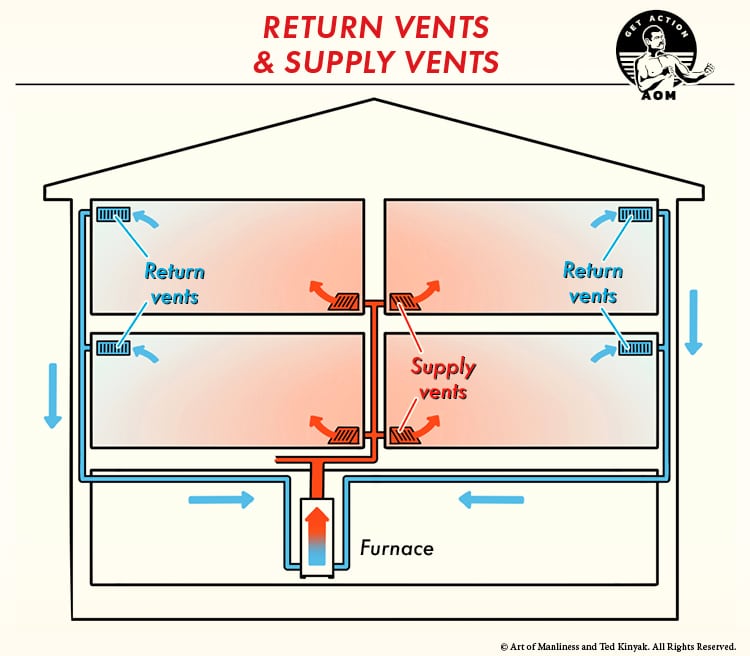
Your HVAC system is a loop. It pulls in air from your house, heats or cools it, and pushes it back out. This loop, running over and over, is how your house stays 70 degrees whether it’s 9 or 109 outside.
The system pulls in air to be heated or cooled through return vents. These are large grills that are located in central areas of the house. After the HVAC system heats or cools that air, it pushes it out through supply vents. These are the small vents you might see in your floors, walls, or ceilings. When you put your hand over them, you can feel air coming out.
How Your Furnace Heats the House
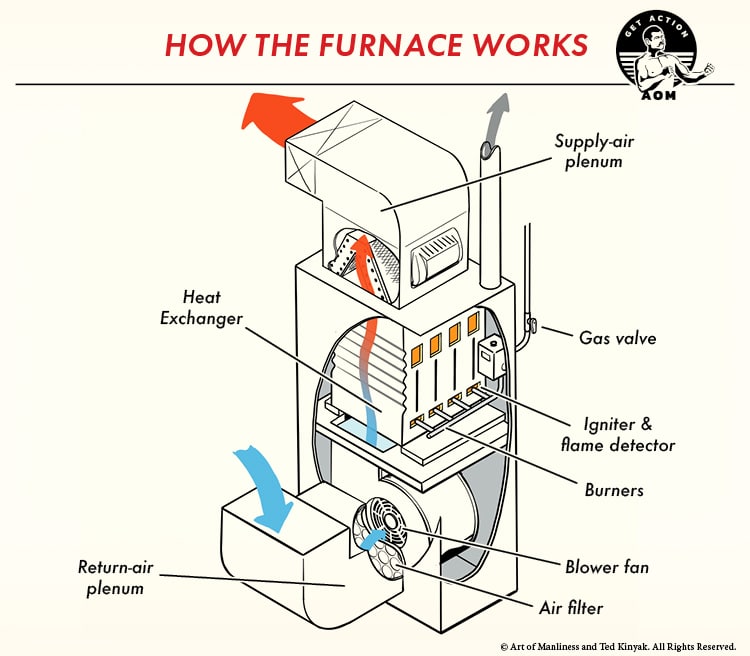
When your thermostat calls for heat, it signals the furnace to fire. Gas flows to the burner assembly and ignites. If your furnace is in a closet in your home (like ours is), you can hear this happen. It sounds like a gas log fireplace turning on.
The flame heats up a component called the heat exchanger — a set of metal tubes or chambers. The heat exchanger does two things.
First, the combustion gases created by the burner, including carbon monoxide, travel inside those tubes and get expelled outside your house through an exhaust vent. This is what prevents you and your family from dying of carbon monoxide poisoning.
Second, the outside walls of those tubes get extremely hot. Air will run across these red-hot tubes, and heat will be exchanged from the tubes to the air. Hence, the name heat exchanger.
When the heat exchanger is sufficiently warmed up, the blower motor in your furnace kicks on. This is a large fan inside the furnace that pulls return air in from your home and pushes it across the outside of those hot metal tubes. The air picks up heat as it moves across the exterior of the heat exchanger, gets pushed into what’s called the supply plenum (a large metal box sitting on top of the furnace), and from there travels out through your ductwork to every room. An important note: your house air never touches the exhaust gases, because, as mentioned above, those are sealed inside. This ensures the breathability of the warm air coming out of your vents.
Two safety components on your furnace are worth knowing about. The first is the flame sensor. It’s a metal rod that confirms the burner is actually lit. If it’s dirty (coated in carbon from years of use), the furnace will ignite for about 3 seconds and then shut itself off as a precaution. It’s one of the more common reasons a furnace starts and stops repeatedly. The second is the limit switch, which monitors the temperature inside the furnace. If it gets too hot, usually because something is blocking airflow, the limit switch shuts everything down before any damage is done.
Something else to know about modern furnaces is how they’re engineered for efficiency. When I replaced my unit, the tech started talking about variable-speed motors and multi-stage burners, and I had basically no idea what any of that meant.
Here’s the short version:
Older furnaces run like a light switch. They either go full blast or are completely off. A variable-speed blower motor runs more like a dimmer switch, ramping up slowly and adjusting its speed based on what’s needed. It uses significantly less electricity and runs quieter. Similarly, a two-stage or modulating burner can run at partial capacity on milder days instead of always firing at 100%. The result is fewer dramatic temperature swings and a lower gas bill.
Furnace efficiency is rated by something called AFUE — Annual Fuel Utilization Efficiency. An 80% AFUE furnace sends 20% of the energy it burns up the flue as waste heat. A 96% AFUE furnace loses very little of it.
The tech explained that the technology that allows for these increased efficiencies is a big reason why furnaces have gotten more expensive over the years. The idea is that you spend more upfront on the unit and save money on utility bills over the life of it.
How Your AC Cools the House
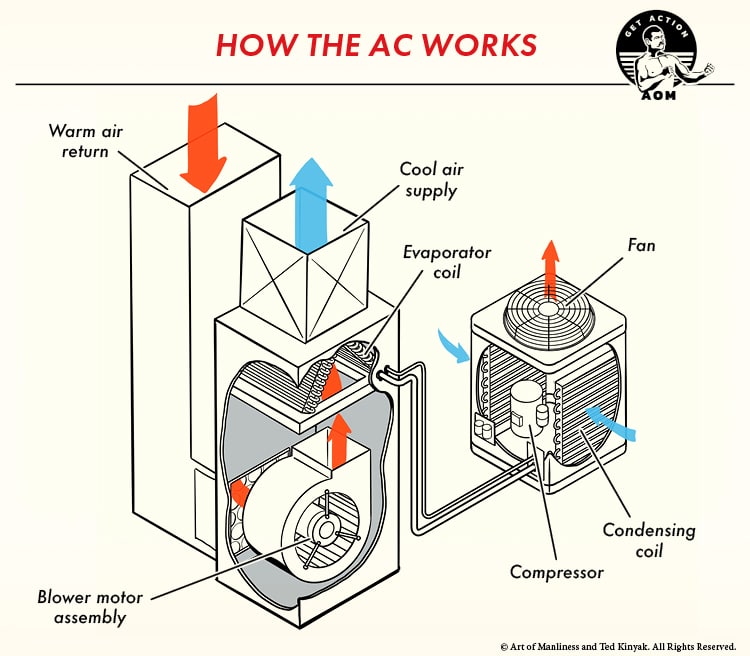
The first thing to understand is this: Central air conditioning doesn’t make cold air. Instead, it removes heat from your house and dumps it outside. This might seem like a trivial distinction, but it matters for understanding how the whole thing works.
The AC part of your HVAC unit has two parts. One part is connected to your furnace, and the other part is outside.
First, the outdoor unit. It’s that big metal box that sits next to your house. It contains the compressor and the condenser coil. The compressor squeezes refrigerant into a hot, high-pressure gas. That hot gas flows through the condenser coil while a fan blows outside air across it, transferring the heat out into your yard. The refrigerant, now cooled and condensed into a high-pressure liquid, flows back inside.
That cold refrigerant liquid travels to a thing called an evaporator coil that sits directly above your furnace. It’s shaped like an upside-down V. The liquid refrigerant flows through the evaporator coil, where it absorbs heat and evaporates into a cold gas.
Now here’s where the AC connects back to your furnace. That same blower motor that moves air in winter is doing the same job in summer. It pulls return air from your home and pushes it across this now-cold evaporator coil. Thanks to the second law of thermodynamics (which basically says that heat always moves from a hot place to a cold place), the heat in that air transfers into the refrigerant. The cooled air gets pushed through your supply ducts into the house. The refrigerant, loaded with your home’s heat, cycles back to the outdoor unit to dump it, and the whole thing starts again.
Besides keeping your house cool, your AC also dehumidifies the air that gets blown into your home. It does this because when warm, humid air passes across it, moisture condenses out. That water drips into a drain pan and exits through a PVC condensate line, which means the AC is also pulling humidity out of your house while it cools it.
A clogged condensate line is a common reason your AC won’t turn on. If that line gets clogged with algae or gunk, a small safety device called a float switch trips and cuts power to your thermostat. So if you notice your AC isn’t kicking on, check the condensate line before you assume the worst. An HVAC guy can do this, but you can also DIY it. I’ll do an article about it in the future.
Maintaining Your HVAC
Leave supply vents (mostly) open. You should avoid closing more than about 20% of your supply vents. It seems like it makes sense to shut them in the rooms you’re not using; why waste all that warm or cold air blowing into them? But closing the vents increases static pressure in the ductwork, which stresses the blower motor. Leave the vents open.
Keep the return vents clear. These are the larger vents that pull air back to the furnace. A sofa pushed up against one, or curtains hanging over it, chokes the system just as much as a clogged filter. Make sure they’re clear.
Change the filter at least every spring and fall. HVAC units need a filter. You’ll usually find them in a spot above your blower fan or in your return vent. What does the filter do? The filter’s primary job isn’t cleaning the air you breathe. It does that, but its main job is to protect your HVAC. Dust on the evaporator coil or heat exchanger kills efficiency and, if it builds up too much, can kill those components completely, forcing you to fork over dough for expensive replacements or repairs.
Clean the outdoor condenser unit twice a year. Every spring before cooling season, gently hose off the outdoor condenser unit to clear it of cottonwood fuzz and debris. This will increase the efficiency of your AC. Takes just 10 minutes and a hose.
Keep the condensate line clear. To prevent clogs from forming in your AC’s condensate line, pour a cup of white vinegar down the line once a season.
Get your unit serviced every spring and fall. Twice a year, have an HVAC guy come check out your unit for routine maintenance and service. They’ll catch small issues before they become big, expensive ones.
Conclusion
While you’re not ready to go to work as an HVAC tech, you now have a basic idea of how your heating and cooling system works and will hopefully be in a better position to understand what’s going on when an HVAC guy is explaining your options on how to remedy your dead furnace when it’s freezing outside.