Not long ago, the primary concern people had about boys was that they were wild, impulsive, and out of control — getting into fights, pushing limits, and stirring up trouble. Today, the problem has flipped. The more common challenge isn’t reckless behavior, but inert passivity. More and more young men are anxious, apathetic, socially isolated, and seemingly uninterested in doing much of anything at all.
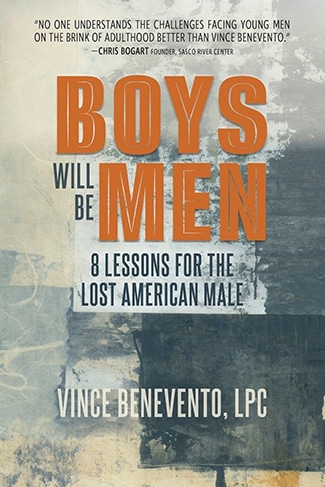
Vince Benevento, the founder of Causeway Collaborative — a male-specific counseling center — and the author of Boys Will Be Men: 8 Lessons for the Lost American Male, has spent nearly two decades working on the front lines of this shift. As a therapist, coach, and mentor who specializes in helping young men between the ages of 14 and 30, Vince has worked with both the combustible and the checked-out and developed a clear, experience-honed framework for what actually helps guys get unstuck, take ownership of their lives, and move forward with purpose.
In today’s conversation, we unpack what Vince has learned through years of work with boys and men, and how his approach — which is rooted more in action than in talk — can be applied not just in the therapist’s office, but by parents and mentors. We dig into why traditional therapy often fails young men, and how to give them the drive, accountability, and sense of connection they crave. We discuss the importance of teaching young men to build life “brick by brick” and helping them find their wild, their thing, and a good group of friends.
Resources Related to the Podcast
- AoM Podcast #810: How to Turn a Boy Into a Man
- AoM Podcast #926: The 5 Shifts of Manhood
- AoM Podcast #1,028: The 5 Marks of a Man
- AoM Podcast #886: What the World of Psychology Gets Wrong About Men
- AoM Article: Get Your Son Out of His Bedroom
- AoM Article: How Labeling Your Emotions Can Help You Take Control
Version 1.0.0
Listen to the Podcast! (And don’t forget to leave us a review!)





Listen to the episode on a separate page
Subscribe to the podcast in the media player of your choice
Transcript
Brett McKay:
Brett McKay here and welcome to another edition of the AoM podcast. Not long ago, the primary concern people had about boys was that they were wild, impulsive, and out of control, getting into fights, pushing limits, and stirring up trouble. Today, the problem has flipped. The more common challenge isn’t reckless behavior, but inert passivity. More and more young men are anxious, apathetic, socially isolated, and seemingly uninterested in doing much of anything at all.
Vince Benevento, the founder of Causeway Collaborative, a male specific counseling center and the author of Boys Will Be Men: Eight Lessons for the Lost American Male, has spent nearly two decades working on the front lines of this shift as a therapist, coach, and mentor who specializes in helping young men between the ages of 14 and 30. Vince has worked with both the combustible and the checked out and developed a clear experience and home framework for what actually helps guys get unstuck, take ownership of their lives, and move forward with purpose. In today’s conversation, we unpack what Vince has learned through years of work with boys and men and how his approach, which is rooted more in action than in talk, can be applied not just in the therapist’s office, but by parents and mentors. We dig into why traditional therapy often fails young men and how to give them the drive accountability and sense of connection they crave. We discuss the importance of teaching young men to build life brick by brick and helping them find their wild, their thing, and a good group of friends. After the show’s over, check out our show notes at aom.is/boysandmen.
Alright, Vincent Benevento, welcome to the show.
Vincent Benevento:
Great to be here man. Thank you and happy to be on for sure.
Brett McKay:
So you are a therapist that specializes in working with men between the ages of 16 and 30. How’d you end up working with this demographic?
Vincent Benevento:
So if my wife was on the show next to me, she would say that it all worked out. This is the only thing I’m good at. You know what I mean? So I found my way to something that people would say that I’ve done relatively well. But I mean, the truth was like many people in this field, I have my own story. So I was a lost and wayward young man. I was a guy who struggled with addiction. I was a guy who struggled with pretty profound mental health challenges, came from a broken home, dealt with divorce. My dad came out when I was young, so I had some stuff and my stuff is different than everybody’s stuff, but I had some stuff that required that I had to do some personal work at a pretty young age, and so I needed support. I was very resistant to receiving it personally, mostly because I wasn’t ready to do the work, but I really couldn’t find anything that spoke to me in terms of what I felt engaged to do. And so I started puzzling and being curious around what kinds of things young men would be open to and willing to do. And years later came up with some stuff that has been useful when supporting young men trying to get their lives on track.
Brett McKay:
One of the things you argue at the very beginning of the book is that talk therapy is largely useless for men between the ages of 16 and 30. Why is that?
Vincent Benevento:
Yeah, and a pretty bold statement from a therapist of 12 plus years or 15 plus years, whatever it’s been, 15 total, 12 as a licensed practitioner. And so yeah, it’s bold claim, but I stand by it. I mean, I think young men especially don’t have a lot of rich life experience to process through and to pick apart in ways that more mature individuals do. And so I think part of what we practice and preach is the notion that therapy or the therapeutic support process for young men should be much more about doing and not talking. For men and young men in general, this is a generalization but usually true, learn better from doing. And so men, because they learn through experience, gravitate towards frameworks like mentorship and coaching as opposed to traditional talk therapy, which tends to be a little more nebulous.
So we try to impress upon the guys we work with, the setting of small goals, the step work in achieving those goals, the literal experience of going out into the community and doing a thing can be a little more impactful than sitting and talking about something that someone may or may not do in the week in between sessions and just in addition and sort of separately, I think back to when I was 16 and pissed off and I didn’t have the emotional fluency to talk about my issues in the way that I do now. And I would contend that men, as we know, and young men are typically slower to mature than their female counterparts and particularly within the emotional realm. And so I think I didn’t have the language to describe what I was feeling till years and years later and hours of work in therapy. And so I think if somebody’s not engaged in that kind of process of self-discovery, it may be more productive and beneficial to do a thing rather than talking about a thing that you might not do.
Brett McKay:
Alright. So your approach is a little less conversation, a little more action with these young guys.
Vincent Benevento:
Yeah. For sure.
Brett McKay:
Something you describe in the book is in your career you’ve encountered two types of young men. The first type of guy is acting out, doing dangerous stuff, maybe has an addiction, is drinking, getting into fights. The second type of guy is pretty much the way he described him is anesthetized. He just doesn’t want to do anything. He just wants to sit at home. And you argue that the second type of guy is harder to work with. Why is that?
Vincent Benevento:
Yeah, yeah. So on first blush, it seems almost unreasonable to make that assertion. I mean, the second guy is just kind of not doing a lot. He’s not doing anything dangerous, he’s not doing anything risky. He’s not a danger to himself, not a danger to others. So how could that guy possibly be more difficult? I think back to when I was the first kind of guy. I was the fighting, drinking, driving, acting out, getting into trouble, but just oppositional externalizing kind of guy. When I go back 25 years to when I was that kind of guy, I was a mess, but there was energy and momentum associated with that mess. I had a girlfriend, I had a job, I had a car that I paid for money that I saved through my job. I was going to college. So there is progression personally and there’s goals that are being set and achieved and that guy’s doing stuff. He may be doing the wrong stuff, but he’s doing stuff nonetheless.
The second guy isn’t really doing anything. And this is the curious phenomenon that I talk about a lot in the book. It’s like this sort of, I call him the second wave. I saw the first kind of guy 15 years ago when I started my business and now we see the second profile of just anxious, isolative, apathetic, highly dependent young men who are not seeking to individuate in any way, shape or form. They’re not excited to go get a job. We have guys who don’t want to get their license. They’d literally rather have their mother drive them around in the car because they’re so anxious about driving a car that they can’t even consider the notion of having their own vehicle and taking themselves to and fro. And so the first kind of guy at least was doing a lot of stuff and was busy in the world and had energy and it was misdirected, but you could direct it. It’s very difficult with this sort of second wave to cultivate an active process with a guy who’s so inert. And this is where we have to move in the direction of really connecting with an interest and connecting with the soul of that person to get them engaged in something that they care about so that we can start moving them in any direction whatsoever.
Brett McKay:
Yeah, I’ve noticed this as well in my work with young men. So I’ve coached flag football, I’m a leader at my church’s young men’s group. I remember in flag football you’d see those two types of guys. One guy was super aggressive, had just that kind of killer instinct, but he kind of messed stuff up, but I could work with that. It’s like, oh, he’s got this energy, I can direct that. We can refine his skill and he’ll get better. Then you have the kid who just inert had no drive at all and it’s just like, I can’t work with this. And then in church you see the same sort of thing kids where it doesn’t matter what it is, they’ll be engaged, they’re excited, even if they think the activity we’re doing is kind of boring, they’ll try to make something out of it. And then you have the boys where it’s just like it’s pulling teeth. You do everything you can to get them engaged and they’re just like me. It’s so hard. So they lack that. The Romans called it thumos for that fire in the belly, that drive. And I’m seeing it more and more in young men as you are. What do you think is going on with this younger generation? You talk about how you see this a lot in Gen Z guys. What do you think is going on where you’re seeing this lack of thumos in drive in young men?
Vincent Benevento:
Yeah, I don’t think it’s any one thing. I think it’s a crockpot filled with a bunch of different things that make it hard to do this work with young men and make it hard to connect with people in general. I think there’s a tech piece for sure. There’s a tech piece and a subsequent isolative piece in association with that. We see a lot of skill erosion. So as everything has become both automated and immediately accessible, we can have things done for us rather than do things ourselves. And so the old example that I used to give was not so long ago in the early two thousands, I used to know how to get places and now I just don’t because I just throw it in the Waze just like everybody else and I’m not paying attention to where I’m going anymore. And so that’s one very small detail of the day in which we live where we’re not exercising our brain, we’re not exploring, we’re not engaging with our surroundings, we’re just passively moving through our day.
And that happens more readily than we would care to admit. There’s an instant gratification piece where I’m hungry and so I just ordered dominoes and they send me 44 ounce coke and a pepperoni pizza for with the fee is $31 and I just swipe that or my parents swipe that. And there’s no reward-based system where you do a task and you get a reward and then you can subsequently use it for whatever purposes you see fit. So there’s not a lot of delayed gratification and sequencing and work that goes into achieving goals. And I just think more broadly, because we’re so flooded with information and information that scares us, this pervasive culture of fear that we live in has raised the stakes in terms of the cumulative anxiety that we all experience as people, but specifically young men. And so young men are not excited to go get their first car and drive fast.
They used to. Now I’m not saying that that’s behavior that we should relish upon our boys, but boys used to be excited about getting their car and shining it up and driving around fast. They’re not excited about that anymore. They’re scared and they’re scared of things like that. And they’re scared of talking to a girl and they’re scared of getting a phone number and they’re scared of going on a date, which is why they watch porn and lock themselves in their room incessantly. And so this fear that is pervasive in our young men has caused us to opt out of taking healthy risks. I’m not talking about inappropriate risks, like the risks that I took when I was a younger man. I’m talking about healthy risks, age appropriate developmental risks, and that I think has robbed us of some of the heart work and the soul work that is really important to being a young man.
Brett McKay:
You also talk about how parents might’ve unintentionally contributed to creating this second type of young man. What’s going on there you think?
Vincent Benevento:
Yeah, I think it comes from a good place, and I’ve seen over the course of 15 to 20 years of doing this work, 15 years of running my own business, 20 years in mental health in general, I have seen parents’ awareness of mental health skyrocket. Parents are knowledgeable, they understand the resources, they speak the language. They even understand basic symptomology, even parents who haven’t been through or around therapy with a kid or have had a kid with mental health challenges. Your baseline parent understands and speaks the language of mental health. That was not the case when I first started. And so that has bore a lot of fruit in terms of the way we engage with our kids emotionally, but also just in terms of how you triage an issue in a situation. So it certainly comes from a good place. I think the unintended consequence is we pathologize, right?
We pathologize a lot of behavior, parents pathologize. And so if your kid is acting out, he’s depressed, he’s anxious, he’s got a mood disorder, and those things may very well in fact be the case. And so far be it for me to say in all situations that’s not true. But sometimes he’s just not accountable to his behaviors or sometimes he’s acting out and being manipulative or sometimes he just doesn’t feel like doing it and he goes in his room and he games for seven hours instead because he has the autonomy to do so and there aren’t the checks and balances in the system that will make it so that he can’t do those things. And so I don’t think that mental health is always the reason why someone is struggling. And I think parents jump to conclusions sometimes around pointing a finger at their son’s pathology as being the rationale for what’s happening when in fact a behavioral approach can yield better fruit.
Brett McKay:
And going back to the idea of anxiety, I think a lot of parents are anxious these days for their kids because I mean life in the 21st century, it is pretty complicated and complex. And for sure there this anxiety that, oh, my kid is not going to be able to make it. There’s a lot more you have to do to establish yourself in the world economically. So a lot of parents are like, I’m just going to do this for my kid. I remember when I went to college, and here’s a great example, when I went to college, my parents were like, oh, you want to go to college? Great. And that was it. I had to fill out all the forms and I was like, dad, I need this IRS stuff for the FAFSA thing. And they’re like, okay, here you go. But I had to do it on my own. It wasn’t like they were holding my hand. And then I see parents, my peers today who’ve got kids going to college, they’re doing all this stuff to get their kid into college, signing up for these prep classes, doing these elaborate college tours, helping them refine their essays. And I’m thinking that did not happen 20, 30 years ago.
Vincent Benevento:
Not even close. No, not even close. And talk about, it’s a really good call by you, Brett, but talk about contributing factors to the collective anxiety. I remember filling out those applications literally in pencil at my dining room table in the year 1998, so it’s not that long ago. And I did ’em all by myself. And there was no private SAT tutor and there was no educational consultant to pick my colleges for me. And no one filled out my FAFSA stuff. I did it first kid sink or swim, figure it out, go to college. So the world is just not that way. And I mean, listen, I know a lot of people in this space, they do extraordinary work in this space, the college space, the private university space, and the game that is getting your kid into the best school humanly possible to set ’em up on a trajectory for life.
And what I can tell you is the emotional pressure that kids experience as a result of this conveyor belt that has been socially constructed for them, whether they fall alongside it or not. And by the way, I got kids who mostly don’t fall on that conveyor belt and are trying to be shoehorned into it has a lot of challenging consequences for kids and for families. And I see a lot of kids who parents elect to send them to college because there’s no other option. You have to drive around with a sticker on the back of your car that says where junior’s going to college, whether they should be going to college or not. And so I get a lot of parents who call me in November the following semester and say, Hey, he didn’t make it. What do we do now? And I don’t think that the college is for everybody, and you have to go to a top 50 school framework is not one that every single person should subscribe to. Not every parent, not every kid. And I think the people who are having awareness of that in advance are far better suited than the people who are learning that lesson on the backside.
Brett McKay:
And then when parents do, because it comes from a good place again, they want to help their kids succeed.
Vincent Benevento:
For sure.
Brett McKay:
But when they do that stuff for their kids, sort of the unspoken messages, you can’t do this. I got to take care of it. And then that just carries over to other areas they like, well, yeah, you can’t get a job on your own. I got to pull some levers to do that for you. So it just disempowers these young men who are already disempowered.
Vincent Benevento:
Absolutely. Yeah, 100%. Yeah. And the job example is a perfect example because most of the people, I mean, I’m in Westport, I’m in Westchester, I’m in West Hartford, Connecticut, like pretty affluent pockets with a lot of high profile, high influence people. And so when their kid is struggling, usually dad will come into the center and say, Hey, I’m going to get my kid a job and such and such, what do you think? And I say, don’t you dare get your kid a job. Instead, let’s support him in the process of him finding it for himself and navigating and figuring out where his strengths are and where his weaknesses lie. And that’ll position us much better to help him down the line than it will if we just scoop something up and put it in his bread basket.
Brett McKay:
So in your book, you’ve laid out several principles that guide your approach to helping young men that come to your clinics, these sort of disengaged young guys. I want to walk through some of these. The first one is brick by brick. And this is about helping young men build a life for themselves. Why is this the first principle in your philosophy?
Vincent Benevento:
Because I think that to do anything of substance in your life, men have to commit themselves to a long focused approach. And I think the world sends quick fix messages. The world sends messages around both instant gratification and overnight celebrity. I’m advocating a different message. I’m advocating that anything I’ve ever built, whether it’s been my marriage or my relationships with my kids or my business or meaningful relationships, any of those things that matter to me deeply were patient in their growth process, were things that were step by step one after the next, next, next. Were filled with trial and iteration and reset and debriefing and learning. We’re messy at times and we’re not a straight line, none of them. And I think that’s the case. When you build something of substance across life, you don’t usually finish exactly the way that you start. And when you make a blueprint for something, typically there’s unforeseen challenges that come up along the way. And as long as you keep working step-by-step, day by day, brick by brick, it’s a good mantra to set you up for success in whatever you’re doing.
Brett McKay:
So how do you help a young man start becoming a builder? So a young man who can look for a job, find a job, apply to college by themselves, build a relationship. How do you help a young man who just hasn’t done that before? He’s one of those passive anesthetized type young men.
Vincent Benevento:
Yeah, yeah. I mean, I think you begin with the acknowledgement that at some point every person hadn’t done it. So me, you everybody, we all had to get started somewhere. And so for me, I get really excited about vision work. And what I mean by that is helping a young man get excited about crafting a vision for where he wants to go, young man or man, because we see people as young as 14 and we see guys into their early thirties crafting, co crafting, leading, sharing a vision for what ignites you, what feels right, what have you felt purpose in doing, what have you done that’s been exciting for you, and just dream boarding it and vision crafting and helping them get excited. One, because if this is their first blush with mental health supports, it debunks their preconceived notions about what it is. I want a guy coming into my office and feeling good enough that he wants to come back the next time of his own accord.
And typically this kind of vision work will draw them in that way. And so we start with vision crafting and developing a sense for where you want to go and what you want to do and what you want to be. And from there we get tangible, we do research, we answer questions, we go out and we learn through experience and service and shadowing and job acquisition and all these different processes, and we teach and instruct and we fill in the gaps as needed. So it starts very broad and very opaque to just cultivate enthusiasm, and then we get down to it sort of step-by-step brick by brick.
Brett McKay:
So that’s that action part. You’re not just having a weekly session where you’re talking about things.
Vincent Benevento:
No.
Brett McKay:
Maybe you have that session to lay out the vision, but then you’re going to assign this guy homework and then there’s going to be follow ups. Like did you get that application? Yes. Okay. Did you fill it out and turn in the application? I mean, that’s what it is. It’s a lot of coaching and mentoring
Vincent Benevento:
For sure, and it’s positioning a guy to be better off than when he started. And I don’t just mean broadly around the process, I mean in that hour, part of what I’m trying to do is I’m trying to get you farther in the hour. You come see me that week than you were when you came in. So you come when you go see Vince and you think to yourself, wow, we’re going to get a lot of stuff done today. So one of my favorite processes to do with a guy, and it seems so simple, is to come in and work with a guy who’s never had a resume before, a young kid, 15, 16, 17, now sometimes 18 years old. But listen, let’s bang out your resume and literally hand the kit of paper that reflects to him everything he’s done in his life to walk out of that session.
And it doesn’t have to be sexy and it doesn’t have to light the world on fire. And I’d started doing this 15 years ago, and I know you could throw it in your chat, GBT, you could do it in two seconds, but the co-constructing of that process to build what you’ve done and to reflect to you what you’ve done so you can hand it to your parents and be proud of it, or you could put it in somebody’s hands and go look for a job. Now that’s actually reflecting to you self-worth about your own achievements and positioning you to get excited about the next thing we’re going to do next week. So that’s just one example, but it’s a pretty good one. It’s a very simple exercise that denotes how we get kids moving forward in that very tangible way.
Brett McKay:
I think if you’re a mentor or a parent, you can start doing this with your kids now. Take those basic life skills that you just take for granted and then actively, we’re going to do this. We’re going to make a resume. We’re going to, I did this with my kids. They wanted a bank account. I was like, okay, let’s go to the bank. And I made them talk to the bank teller.
Vincent Benevento:
I love that.
Brett McKay:
You’re going to have to figure this out. And I say, here’s all the stuff you need to get your social security number. You have all this information. And I mean, the thing is, this stuff can be tedious and it’s boring, but it’s important work
Vincent Benevento:
A hundred percent. And I mean, I even think about when my kids were young, we’d go out to dinner and I remember watching people, their kids were like 10 and they would order for their kids in the restaurant. And when my kids were five, four, and two, they were ordering food for themselves just because building that requisite skill is essential for everything. You need to have a conversation with somebody, look ’em in the eye, and to whatever extent is age appropriate, engage with another human being. Right now, the hardest part is the consistent and persistent commitment on behalf of the parents because you’re going to get resistance very often. It’s so much easier to just opt out on one or two or three occasions, and then a habit that you’re trying to cultivate gets extinguished because you don’t consistently curate it. So the bank example that you gave, it’s fantastic. We should be trying to impart these life lessons and skills to our kids beginning as young as is appropriate. It just takes a lot of energy to do that over time.
Brett McKay:
Here’s another example. This is with my daughter. She’s 12 and she got this bad grade on an assignment and she thought, I did the work. I don’t agree with the teacher. And she was really upset and she asked Dad, can you email? I’m like, no, I’m not doing that. And she says, well, I’m just going to write him an email. I was like, no, you’re not going to write an email. I want you tomorrow to have a conversation with him. That night we roleplayed it. I was like, I’m going to be your teacher and you’re going to be, you talk about how you’re going to approach this without getting emotional and accusatory, and we workshoped it, and then she did it. She had this tough conversation with an authority figure challenging him on a grade, and it worked out great. He saw, okay, I messed up there. It was really productive and I was really proud of her, and I could see that she was proud of herself that she did that. Right?
Vincent Benevento:
No, yeah. And that’s how you build esteem. Esteem and purpose and self-belief is cultivated by kids doing for themselves independently with support and with guidance. But had you written the email to the teacher, you’re robbing your daughter of that rep. And part of what we’re always trying to do with parents is helping them support but not do for and enable.
Brett McKay:
Okay, so that’s brick by brick. So just start helping these young people, young men in particular start doing things on their own and it’s going to take a lot of support, but that’s important. The second principle is name it to tame it. What do you mean by that?
Vincent Benevento:
Being radically honest with yourself about your strengths, but also your challenges. And I’m speaking mostly in terms of the realm of mental health diagnosis and stigma. I’m pretty transparent in the book around my own struggles with substance use and my mood, and I’ve had a diagnosed mood disorder since I was 19 years old. I was hospitalized for it when I was 19 years old, and I was an alcoholic for years prior and years post until I was able to kind of clean my life up and get my act together. But it was really my ability to acknowledge and come to grips with those two diagnoses that were the prescription for me getting well and the acknowledgement of the limitations I now faced as a 19-year-old kid in college who was a substance user, who needed to figure out how to manage my life. It was those limitations that actually provided me with freedom and helped me relearn how to exist as a human being in the world. And so that was a very difficult process, that was shameful and humbling for me. But to come to terms in an honest way, which occurred over a series of years, gave me information, helped me take the right steps, helped me understand my boundaries, things that I can do shouldn’t do, and positioned me to be successful really for the rest of my life, truth be told.
Brett McKay:
Yeah. So you’re primarily focusing on working with young men who have a diagnosed mental health issue. But I think this is applicable, even if a young man doesn’t have a mental health problem, like you said earlier, a lot of young men, you can call them emotionally illiterate, they have these emotions, but they don’t know what they are. And because they don’t know what they are, they don’t know how to manage them. And so helping young men learn how to recognize, okay, I’m feeling frustrated. I might think it’s anger, it’s not anger, it’s just more of a frustration when you frame it like that, it’s like, okay, I can do something about that now. Or I do this a lot with young kids who are feeling scared, nervous about something. A lot of ’em will say, I’m just really anxious. And I’m like, no, hey, look. Yeah, you’re nervous, but that’s good. It’s not like something bad’s happening to you, it’s just getting you ready to take on this challenge of like, oh, okay. Yeah, that reframe helps them be more proactive with life.
Vincent Benevento:
And those clarifying questions, Brett, I think are super important. So okay, you’re angry. What does that look like for you? How does your anger show up in different situations? Are you blowing holes through the wall? Are you yelling at mom? Are you swearing? Are you not doing your homework? What do you do when you’re angry? And from there, we can develop ways to address that in different fashions depending upon how it shows up. But I think like you said, also, it’s the emotional fluency piece. Guys don’t understand basic emotions besides sadness, which they typically can’t articulate and anger. So I mean, I remember being a guy at 19 years old who was so confounded with my emotional world and so limited in my ability to articulate it, that I just showed up as angry literally all the time. And I think it was essential for me to become better equipped at communicating where I was emotionally, right? I’m ashamed because I’m fearful, because I’m sad, because I’m lonely, because these are all nuanced offshoots of anger that boys and young men and men experience, but naming them well and naming them precisely again gives the prescription about how to approach the solution going forward.
Brett McKay:
Yeah, it’s like a Rumpelstiltskin, remember that story? Once you know his name, you have power over him. It’s the same thing with your emotions.
Vincent Benevento:
That’s exactly right.
Brett McKay:
Once you name, it’s like you have power over it.
Vincent Benevento:
Yeah.
Brett McKay:
Alright. So it is just all about helping these young men become more emotionally literate and not confuse maybe frustration or shame or anxiety for anger, because I think that’s what a lot of young guys do. Whenever they feel those things, they express it through anger. It’s probably not anger, it’s something else, but help them understand that and those messier
Vincent Benevento:
Ones, the fear and the shame and the hurt and the regret. Those emotions that are dirty words to boys and young men, giving yourself permission to hold the ability to articulate that and to communicate it. And I think this is where parents can move mountains in their ability to model that in a healthy way for their kids in a setting of difficulty or challenge or conflict in the home. When you are fighting in front of your son, how do you speak to your spouse? How do you speak to your son? How do you speak to your daughter? And what do you do to communicate your own emotional response in the moment? These are the ways that parents can do incredible things to support their kid moving more towards emotional fluency.
Brett McKay:
Another principle that you have in your philosophy towards helping young men is you got to help them find their wild. Why is tapping into your, well, first off, what do you mean by your wild? What is that?
Vincent Benevento:
Yeah. Wild for me is a rejuvenation of the soul. And I think about it as losing it, right? So it’s becoming reacquainted with the things that make us feel alive. I think there’s a very primal natural peace that is deconditioned out of us as men, as we move through life and as we move from young men, competitive, moving through physical prowess, activities that cause us to evaluate ourselves against other people and compete in large groups or packs. When you’re driving around a minivan, doing a Girl Scout cookie drive and reporting to the same cubicle for 10 hours a day, five days a week, those things are the opposite of wild. So I think that as the lifespan continues, and I talk to guys in their thirties, forties, and fifties all the time, they just don’t feel alive and they feel bored and they feel underappreciated and they feel like their value is waning and they’re not alive. And I think the process of finding your wild is re-engaging with your soul and finding the things that used to make you feel alive again.
Brett McKay:
How do you do that? So this is for older guys, we’ll talk about helping young guys find their wild. But let’s say you’re a middle aged guy and you’re feeling just kind of that middle aged burnout, malaise. How do you capture that wild?
Vincent Benevento:
Again, I think it takes effort. I think it takes effort. So you have to seek it. You have to plan a trip with your kid and go ice fishing somewhere. You have to finally stop complaining about the job that you hate and develop a strategy and walk out and start again. You have to take your wife on a getaway to an island that you plan because she plans literally everything. You have to make plans with a guy and go away. You have to try a new hobby and do a new thing. You have to put yourself out there. And so I think a lot of the men that I talk to are highly isolated and they go through their routine and they sit in their house and they, particularly in the winter, they are not actively doing new things that cause them to reevaluate the world around them and test themselves to be better. Part of being wild is competing against yourself and testing yourself to see what you have the capacity to do. And that requires planning and time and resources, but I think the yield is worthwhile.
Brett McKay:
What about a young guy, one of these anesthetized young men we’ve been talking about that just have no wild in them, maybe they’ve never found their wild. How do you help them find their wild?
Vincent Benevento:
Yeah, I think when we think about what has been lost in the society that we live in now, it’s this male mentorship, male specific mentorship. So 200 years ago when you decided that you wanted to become a blacksmith, your dad was a blacksmith and your grandfather was a blacksmith, and your great grandfather and his father were also blacksmiths. So you grew up learning everything from them and mentoring under them, which not only showed their favor and their investment in you, but it taught you all the requisite skills that you need to learn. Now, we’ve deconditioned men. They don’t do physical things. Young men, especially young men, are not often doing physical things or many of them can kind of extricate themselves from doing physical things by just doing work behind a screen behind a door. So I think we mentor young men and show them and teach them and reflect our favor and investment in them. We take them literally out into the world, into nature like our predecessors, and sit around and tell stories and blaze a trail and hike and climb and grab a pole and fish and engage in nature to be reacquainted with their physical wild. And we communicate with them in ways where we demonstrate what they have the capacity to do. We teach them a skill, we let them learn a skill, we show them that they are capable of a thing, and they begin to believe in themselves over time by trying new things and succeeding.
Brett McKay:
I think as a mentor, as a father, one thing you do for boys, teenage boys is to expose them to as many different things as possible so that they can find, you talk about this in the books, they can find their thing because a lot of young men, they might not be excited about anything. They haven’t found the thing that excites them, and they might not know they’d be excited about something until they actually try it. So I do think as a parent you might have to sort of nudge kind of like, Hey, you’re going to do this thing even if you don’t think you want to do it because there’s a chance you might like the thing that I’m having you do.
Vincent Benevento:
Yeah, for sure.
Brett McKay:
Yeah, I saw this. We did this. We took some boys rock climbing at church one night, and this one kid, he was kind of a little passive, not confident, and he didn’t think he was going to like it, but then he ended up liking it. He actually signed up for a membership later on. It became like a rock climber. That was great. That’s a perfect example of finding your wild. You have to expose ’em to stuff. You talk about relationships in your book and this idea of mentorship, but also relationships between just having friends, men having friends, and you talk about a lot of the young men you work with, they don’t have any friends. Why are young men so lonely these days? What’s going on there?
Vincent Benevento:
Yeah. Yeah, it’s really sad, but the number one reason for referral documented by the client coming into Causeway is to make friends. And we have countless kids who come through the center who set the goal of having one friend. I’m not talking about girlfriend, I’m not talking about boyfriend, I’m talking one friend. And so to me that just speaks to where we stand, where it is difficult for young people to connect authentically with one another. It is easy for people to remain isolated. And so I think we have to work to practice relationship. And I think we see a lot of guys who are marginalized socially and who struggle socially. Guys on the spectrum, guys who have social challenges, guys who’ve been bullied, guys who are depressed and anxious, guys who haven’t had a lot of success in making friends. But our message to them is to find their tribe and find their people and cultivate the relationships from there.
So if it’s an online community of people and those relationships are fostered predominantly online, we can start there and then potentially scale up to person to person engagement from there. If they’re kids who have a specific interest, be it in Legos or in music or in building something out of wood or in fishing or in whatever, there are communities of people who can develop relationships with them, with shared experience, with shared interests, which makes it a lot easier. And so part of where I think mentorship as we do it is effective is we can model those skills that have eroded over time. We can take Junior to grab a cup of coffee down the street and just kick it with him and get him feeling comfortable talking to someone in a public space. We can have him go down to the town green and throw the Frisbee disc around and have him do an activity that he can then do with someone else.
We can have him just walk around the grocery store and chat with somebody and get a sense of what the body language is as we’re watching him so that we can help him read a conversation more effectively. So when we’re doing mentorship with guys who struggle socially, there’s a didactic component where we’re teaching and we’re gap filling, and we’re helping them understand the things that they can do differently through feedback exchange, but there’s a heavy, heavy relational component because we’re leveraging the relationship and the trust that we’ve built with somebody to get them to do a thing that they wouldn’t otherwise try. And I think that’s the difference. Parents struggle with their kids because they can’t just get them off the dock, they can’t get ’em to try the thing. We’re typically successful because we have the quality of the relationship where we can get a kid to buy in and at least try something. And hopefully he’ll like it more than he thought he would.
Brett McKay:
I’ve got a friend, he doesn’t have any sons, but he has a son-in-law, and he noticed the son-in-law didn’t have a lot of male friends, and he’s like, this is a problem. You need to have friends. You’re a young guy, you should have friends. And he’s like, well, I don’t know how to do it. I’m just so busy with work and I just don’t know where to connect with guys. And he says, here’s what we’re going to do. I’m going to host, we’ll call the mastermind group at my place once a week and just invite some guys, you know, don’t have to be best friends with them, invite them over and we’ll just talk shop, we’ll talk about work, we’ll talk about life. And he has to model. He is this 50-year-old guy, basically. He says, I’m doing remedial work here with these young men. I had to model what it looks like, and it’s a lot of work, but he’s like, it’s paying off. These guys are starting to connect. They’re starting to form some friendships and it’s enriching their lives.
Vincent Benevento:
For sure, for sure. And I got to be honest, Brett, I actually did it in my life. So when I started to reevaluate the way in which I was spending my time and I really dialed back my commitment to work, I found out that I was almost spending too much time at the house and started working from home more, and me and my wife were around each other too much. I was around the kids maybe a little too much, and I felt that there was this sort of missing piece for me, and it was in the name of relationship with other guys. And so I just started asking guys to go grab coffee, and it was something that I didn’t do for a decade professionally, and I just started. If I met a guy and I hit it off with him at the ball field or in town, or our wives were friendly, but we never really hung out before, I would just grab coffee with somebody and it got to the point where four or five, six hours a week, I’m just having a coffee with a friend, which is good.
It’s good balance for me as a man. It helps me getting out into the community and meeting and talking to people. It makes me visible. It gives me things to talk about in instances, some of them. It allows me to help somebody and see a need and meet a need. So I think male relationship as guys is something that we must continuously practice, even if we’re decent at it or pretty good at it because the force that the accountability provides is also very important. We need to have other guys reflecting how our decisions feel to them, and it makes us better versions of ourselves.
Brett McKay:
Yeah it’s the whole iron sharpens iron.
Vincent Benevento:
That’s right. Yeah.
Brett McKay:
Well, Vincent, this has been a great conversation. Where can people go to learn more about the book and your work?
Vincent Benevento:
Yeah, appreciate it very much and it has been awesome. Thank you. So you can check us out at our website, causewaycollaborative.com. That’s the organization. I have a personal website, which is sharperformen.com. My Insta is @VinceBeneventolpc, and obviously the book is available on Amazon, and we hope you guys check it out and enjoy it.
Brett McKay:
All right. Well, Vince Benevento, thanks for your time. It’s been a pleasure.
Vincent Benevento:
Thank you, Brett. Really appreciate the time, man. Thanks.
Brett McKay:
My guest today was Vince Benevento, the author of the book, Boys Will Be Men. It’s available on amazon.com. You can learn more information about his work at his website, sharperformen.com. Also, check out our show notes where you’ll find links to resources where you can delve deeper into this topic.
Well, that wraps up another edition of the AoM podcast. As always, thank you for the continued support. Until next time, this is Brett McKay, reminding you to not only listen to the podcast but put what you’ve heard into action.