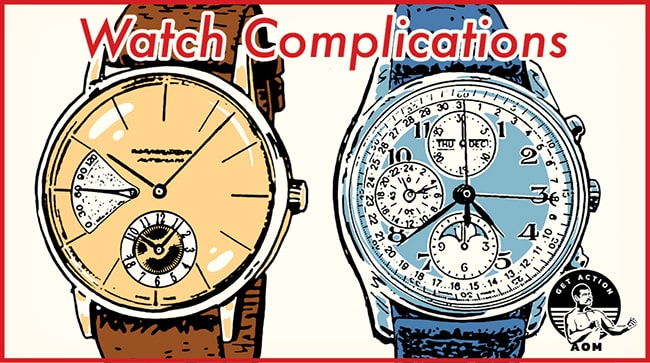
In the world of watches, the word complication doesn’t mean something has gone wrong. It simply refers to any function beyond those of a three-hander, which tells the hours, minutes, and seconds.
There are dozens of possible complications and some of them are wildly elaborate: perpetual calendars that account for leap years, “tourbillons” that counteract gravity, minute repeaters that chime the time on demand. At the highest end, watchmakers compete to stack as many of these feats of engineering into a single case as humanly possible.
But for most men, those aren’t the complications that matter.
The vast majority of watches you’ll encounter and realistically consider wearing feature a couple of common, practical complications. They add useful functionality, distinctive character, and a certain mechanical charm that stands out in a sea of smartwatches.
Here are the five most common watch complications — and why you might choose a watch that includes one or more of them.
The Date
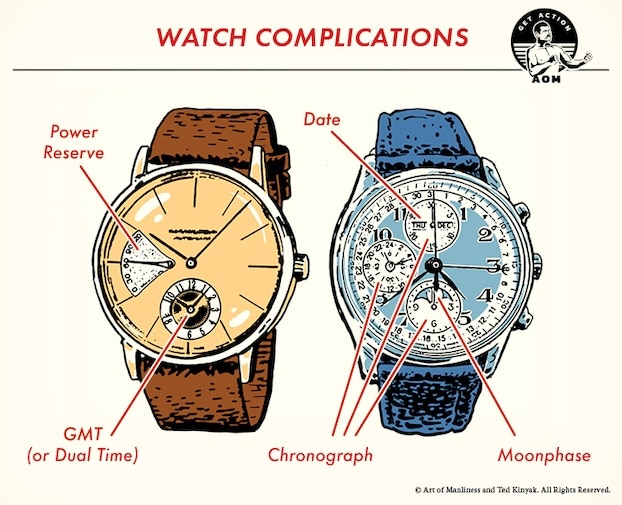
The date window is the most ubiquitous complication in modern watches. It’s simple, useful, and unobtrusive. If you routinely sign documents, schedule meetings, or just like having the date visible without pulling out your phone, it’s handy to have.
It’s also a complication that allows for a bit of variety and personal style. A small date window at 3 o’clock adds a touch of modern utility; a larger display near the bottom makes a bolder statement.
The Chronograph
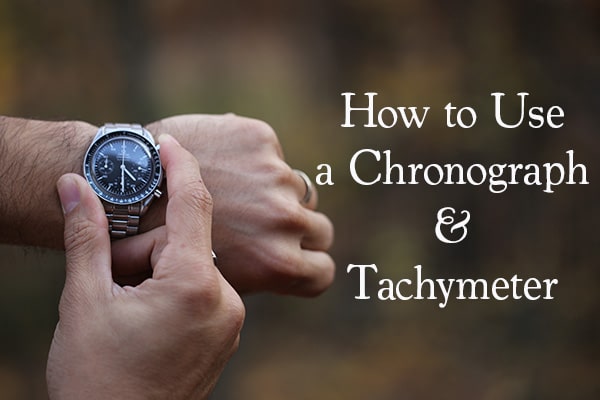
A chronograph is essentially a stopwatch built into your watch. It allows you to measure elapsed time — useful for exercising, grilling a steak, or calculating speed when paired with a tachymeter bezel.
Chronographs undoubtedly add visual interest, but can also veer into busyness. You may run into multiple subdials, pushers on the case, and extra markings, which can give the watch an overbuilt, tool-oriented feel. Whether you like that or not comes down to personal preference; if you appreciate mechanical ingenuity or want a watch with a bit more presence on the wrist, a chronograph certainly delivers.
The GMT or Dual Time
Originally developed for pilots, GMT watches allow you to track a second time zone simultaneously. It could be a fourth hand that circles the dial once every 24 hours or a small separate dial.
If you travel frequently, work across time zones, or have family overseas, this complication is genuinely practical. It also carries a subtle air of adventure and the romance of global exploration.
If your life is firmly rooted in one time zone, it may simply be a perfectly acceptable aesthetic choice.
The Moonphase
Few complications are as poetic as the moonphase. It tracks the lunar cycle, displaying the waxing and waning moon through a small aperture on the dial.
It’s certainly not necessary, but often beautiful and just plain fun.
This is a complication that’s less about utility and more about tradition and craftsmanship. Long before modern calendars and digital displays, watchmakers devised moonphase complications to track the lunar cycle for navigation, agriculture, and religious observance, making it one of the oldest features of horology — the science, study, and art of measuring time. Because early watchmakers had to mechanically replicate the moon’s 29.5-day cycle using gears alone, the moonphase became a showcase of both technical skill and decorative artistry.
The moonphase complication thus connects modern wearers to centuries of horological heritage. If you’re drawn to watches for their romance and history, this complication may speak to you.
The Power Reserve
On mechanical watches, a power reserve indicator shows how much stored energy remains before the watch needs winding. It’s especially practical if you rotate watches; while a daily-worn watch is either continuously wound (automatic) or regularly wound by habit (manual), one worn only occasionally can unexpectedly run down.
A power reserve also adds a subtle technical character to a watch — a reminder that what you’re wearing is a human-engineered machine.
Choosing What Fits You
It’s easy to fall into the trap of thinking you should choose a watch based on its complications. But the truth is simpler: pick those that align with how you live and what you think looks nice.
If you value clean design, a simple three-hand watch may be your best companion. But depending on your tastes, one or more complications may be exactly the fit for your life and your personal style.
A watch is one of the few pieces of gear you’ll wear every day. Function matters, but so does the way it looks and feels. A watch’s complications should serve your daily life while also bringing some subtle satisfaction each time you glance at your wrist.