







What I Eat in a Day
Strength training is a fundamental part of my life. One of my biggest sources of happiness and satisfaction comes from lifting weights and seeing how I can improve my fitness and shape my body.
Powering those efforts is the real engine behind any exercise program: nutrition. I track my macros each day to ensure that my work in the gym doesn’t go to waste.
A question I get a lot is what exactly I eat to hit those macros.
So today I’ll walk you through my diet: exactly what I eat each day, what its nutritional profile looks like, and what it costs me.
This setup has worked for me. The proof is in the pudding. I’ve stuck with it for years. I’ve lost 30 pounds on the low-calorie version of it and have packed on 10 pounds of muscle doing the bulking version of it.
But it’s probably not for everyone. I measure out my food and eat basically the same plain and basic things every single day. Kate laughs at how much of a robot I am when it comes to food. For me, it’s just fuel. I’m not a gourmand. I like that my diet doesn’t require too much bandwidth or work. I’m busy, and I need a system that’s fairly automatic and requires little thought.
I know that’s not how everyone is wired. If you need variety at every meal, this wouldn’t work for you. That’s fine. Different guys need different setups, but maybe my menu will give you some ideas that you can use in yours. Or maybe you’re just curious about what I eat. I know I’m always curious about what my fellow humans are consuming each day.
So let’s take a look.
Breakfast
Prep time: 5 minutes
Cost: $3.75–$4.10
Macros:
- Protein: 51 g
- Carbs: 38 g
- Fat: 5–17 g (depending on the cheese)
- Calories: 430–500 calories (ditto)
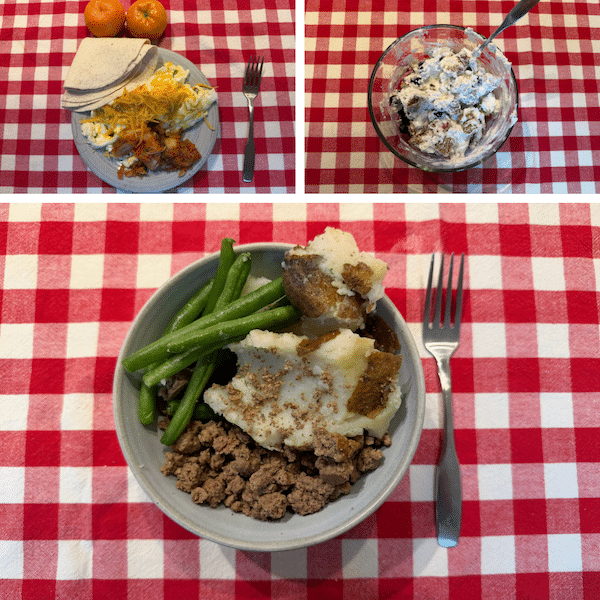
Breakfast is a couple of egg wraps. I scramble one whole egg with 8 oz of liquid egg whites and a handful of spinach, scoop it into two Xtreme Wellness wraps, add an ounce of shredded cheese (Great Value Fiesta Blend, or Kraft Fat Free if I’m cutting), and eat it with a couple of Cutie oranges on the side.
Advertisement
I’ll usually have a side of kimchi too. I love kimchi, and you gotta take care of that gut.
Also taking care of my gut: the heaping helping of fiber I get with my breakfast. The Xtreme Wellness wraps pack about 11–13 grams of fiber each, and with the oranges and spinach, I get close to 25 g of fiber out of just this one meal. That’s most of my daily fiber requirement before 7 a.m. Doing all I can to poop like a champ.
Mid-Morning Meal
Prep time: 1 minute
Cost: $3.80–$4.40
Macros:
- Protein: 57 g
- Carbs: 66 g
- Fat: 4 g
- Calories: 500
A couple of hours after breakfast, I have 340 g of Fage Total 0% Greek yogurt mixed with 140 g of blueberries and 60 grams of either some Kashi cereal or oatmeal. When I’m bulking, I bump things up to 120 g of oats, which jumps the totals above to about 66 g protein, 100 g carbs, and 750 calories.
When I’m deep in a cut, the cereal or oats are the first thing to go, and I just eat the yogurt and berries.
Lunch
Prep time: 4 minutes (20 minutes to make a batch, divided by 5 meals)
Cost: $1.25–$3.70 (depending on the meat/starch/vegetable)
Macros:
- Protein: 33–50 g
- Carbs: 36–50 g
- Fat: 8–11 g
- Calories: 335–400
I don’t meal prep my food except for my lunches, which I prepare on Sundays. And even this meal prep I keep pretty minimal.
Lunch has two main components: a protein and a starch. And then I do a vegetable on the side.
For the protein, I rotate between chicken breast, pork loin, and 93/7 ground beef. How I cook it depends on how ambitious I am that particular Sunday.
If I’m doing chicken and I’m feeling motivated, I’ll grill a bunch of breasts on my smoker (here’s why you definitely want your own). If I’m feeling lazy (which is most Sundays), I’ll dump the chicken breasts into the crockpot with a jar of marinara or BBQ sauce before church. It’s done by 2 p.m.
Advertisement
If I’m doing pork loin, I season it and put it on the smoker for a few hours. Almost no active work.
If I’m doing ground beef, I season it and brown it in a skillet. Takes about ten minutes.
Whatever protein I cook goes in a Pyrex container in the fridge. During the week, I dole out a 150-gram serving for lunch.
For the starch, I rotate between russet potatoes, sweet potatoes, white rice, and pinto beans. If it’s potatoes, I’ll boil a few until they’re soft, mash them up in another Pyrex, and that’s it. No butter or cream, just mashed potato. I know that sounds joyless, but I’m not trying to win any Michelin stars here. If it’s rice or beans, I cook a big pot of beans or use the canned variety or cook a big pot of rice. I dole out a serving along with my protein. Portion goes up or down depending on if I’m trying to lose, maintain, or gain weight.
I always add a vegetable. It’s usually frozen green beans or a California medley. Frozen vegetables are cheap, easy, and just as nutritious as fresh. And they take just a few minutes to cook in the microwave.
Post-Workout PB Sandwich
Prep time: 1 minute
Cost: 75 cents
Macros:
- Protein: 15 g
- Carbs: 52 g
- Fat: 19 g
- Calories: 410
I do my workout early in the afternoon. After I’m done lifting, I’ll have a PB sandwich. Two slices of Nature’s Own Perfectly Crafted White Bread, two tablespoons of Jif Creamy. That’s it.
When I’m in a hard cut, this is the first meal I drop.
Dinner: Whatever We’re Having as a Family
By the time we get to dinner, I’ve already eaten three to four meals, and I’ve still got plenty of macros left over. Which means I can eat whatever we’re having for dinner as a family. I don’t want to be the weirdo dad eating plain chicken and broccoli while the kids are having the tacos Mom made. That’s not how I want to do family dinner. So I eat the tacos, spaghetti, quesadillas, burgers, or pizza that the family is eating. I just eyeball the portions. After this many years of tracking, I’ve got a pretty good sense of what a serving of pasta or rice looks like without weighing it. I always try to stop eating before I get completely full.
If I know we’re going out to eat that night, I’ll pull up the restaurant menu in the afternoon, log what I plan to order, and then adjust earlier in the day to make the macros work. I talk about how to do this in the tracking macros article, so I won’t get into the weeds here.
Advertisement
What It Costs to Fuel Me
If I’m eating pork or chicken with my meals, the entire day comes in $9.50–$9.75 + dinner.
If beef is on the menu, the daily cost is $12 to $13 (plus dinner) because beef is dang expensive these days.
Monthly, that works out to somewhere between $300 and $390. For three to four meals a day, every day, hitting all my macros and most of my micros, that’s not bad. I’ve bought premade frozen “paleo” meals before, where just one entree was $13.
Final Thoughts
One of the interesting things about the menu I’ve landed on is that I usually no longer have to drink whey protein shakes, which used to be a mainstay in my diet. I get all my protein from food. If I’m deep in a cut, I may bring in a whey shake to get the protein while keeping carbs and fat low, but most of the time I’m hitting my protein goals with whole foods.
The setup also leaves room for treats. I like to have a few small cookies after lunch. If I’m on a bulk, I’ll have some Rice Krispies treats before training or enjoy a peanut butter cup. I’ll have the occasional dessert with the family after dinner, too. Even when I’m cutting, I don’t ever feel like I’m depriving myself.
There you go. What I eat in a day. The thing that’s made this work is that it gives me a structure that I can easily modify as needed. Depending on whether I’m cutting or bulking, I can swap things out and raise or lower portions without thinking too much about it. Also, my meals are stupid easy to prepare. Robotic, sure, but stupid easy. Beep boop, beep boop, Brett out.