A few years ago, red light therapy started showing up everywhere I looked, and it’s still getting a lot of attention. Fitness influencers evangelize it for muscle recovery, fat loss, and metabolic health. Beauty influencers say it will give you glowing skin and thicker hair. Biohacking bros claim it can help your mood and sleep, and that if you expose your balls to red light, it’ll boost your testosterone.
Thanks to the social media hype, gyms have started installing red-light booths next to their tanning beds. Just a few months ago, a dedicated red-light studio opened near my neighborhood here in Tulsa. $50 gets you 25 minutes in a red-light booth plus 10 minutes on something called a “power plate.” You can now buy red light therapy panels and blankets for your home, but they’re not cheap; serious at-home red light therapy can set you back $1,000 to $2,000.
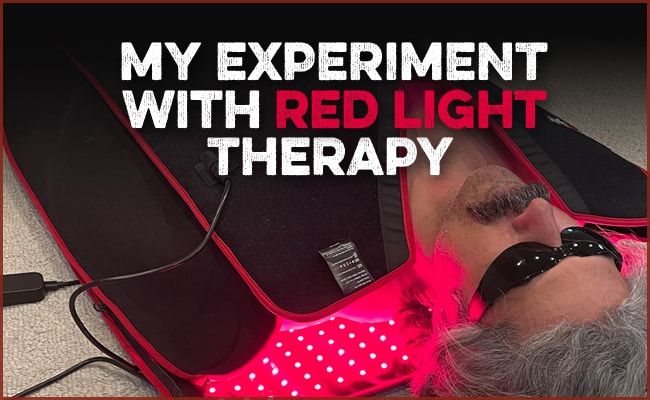
As a creaky, stiff 43-year-old veteran garage powerlifter with nagging tendons, I was intrigued by the promises of pain relief and faster recovery. The potential mood lift was also a plus. Rather than schlep to a tanning studio and fork over $30 a pop for red-light sessions, I decided to buy a red-light blanket — essentially a sleeping bag lined with therapeutic LEDs — run an experiment on myself, and then share the results.
Five times a week for three months starting in January, I stripped down to my birthday suit, crawled into my high-priced red-light burrito wrap, and lay there on our gameroom floor for 15 minutes. About halfway into my session, I’d scrunch my body down so the bag covered my head too, burrowing in like I was in my mummy sleeping bag on a cold night of camping. One morning, my son wandered in to find just my gray head protruding from my glowing red cocoon. Gus finding his dad doing weird things for his man blog isn’t anything new. “You look like a weirdo,” he flatly said and walked out. He wasn’t wrong.
I’ll let you know below whether my experiment paid off. But first, let’s take a look at how red light therapy works and whether its popularly touted benefits are supported by research-backed evidence.
What Is Red Light Therapy?
Red light therapy, or photobiomodulation (PBM), involves exposing tissue to specific wavelengths of red and near-infrared light to stimulate cellular function, specifically your mitochondria. When cells are stressed, a molecule called nitric oxide plugs a key enzyme in the mitochondrial chain, suppressing ATP production. ATP is the energy currency our cells use for repair and regeneration. Red and near-infrared light can dislodge that nitric oxide and get cellular energy production running again, allowing your body to repair and regenerate. That’s the theory, at least.
When you’re doing red light therapy, there are two kinds of wavelengths that provide different benefits.
Visible red light in the 630-660 nm range is primarily absorbed by your skin’s dermis and epidermis.
Near-infrared light in the 810-850 nm range, on the other hand, passes through skin and can penetrate several centimeters into muscle and joint tissue.
If you’re treating a skin concern, you want visible red light. If you’re treating a joint or trying to reach deeper tissue, you want near-infrared. Most quality panels deliver both, largely because it makes them more versatile — you can use the same device for skin, joints, and deeper tissue work — which is why they’ve become the standard for broader therapeutic use.
Red Light Therapy’s Purported Benefits
When I dug into the research about red light therapy, I discovered that, like a lot of health fads, the marketing and social media hype around red light therapy has significantly outrun what the science actually supports.
There are some benefits to red light therapy, but they’re a lot narrower than the guys on Reels wearing blue-light-blocking glasses claim.
Red Light Therapy May Improve Your Skin
Wavelengths in the 630-660 nm range penetrate the upper layers of skin and stimulate fibroblasts, the cells responsible for producing collagen and elastin. Meta-analyses have found solid evidence for PBM reducing radiation dermatitis — skin irritation and damage caused by exposure to radiation therapy — in cancer patients. There’s also evidence that it accelerates the closure of chronic wounds like diabetic ulcers.
For general anti-aging applications, red light exposure can reduce wrinkles and improve skin texture over time.
But to get the benefits, you have to do red light therapy consistently for a long time. We’re talking three to five sessions a week for three to six months before you see any changes. It’s not a quick fix.
Red Light Therapy May Help With Hair Loss
If you’re dealing with androgenic alopecia (aka standard male pattern hair loss), the evidence for red light therapy is reasonably solid. Low-level light stimulates the mitochondria in hair follicles and increases blood flow to them. Studies have shown improvements in hair density and thickness in both men and women after three to six months of consistent treatment.
The catch: you have to keep doing red light therapy indefinitely to maintain the hair growth. Stop the sessions, and the follicles drift back to their previous state. So you have to decide whether a modest improvement in your hairline is worth putting on an $800 red-light helmet that looks like something from the Minority Report every day, indefinitely.
Red Light Therapy May Ease Localized Pain and Inflammation
For specific, targeted musculoskeletal problems — knee osteoarthritis, plantar fasciitis, localized joint inflammation — there’s decent evidence supporting red light as an adjunct therapy. Near-infrared wavelengths around 810-850 nm can penetrate several centimeters into muscle and joint tissue and have been shown to suppress pro-inflammatory cytokines and reduce pain. Again, you have to use red light therapy consistently for months before you see any benefit. It’s not a one-and-done thing. Also, it’s an “adjunct” therapy, meaning you need to do it alongside physical therapy to get the benefits.
There are devices you can buy that you can strap to areas that you’re trying to treat. They’re more cost-effective than whole body panels or blankets. Still not cheap though! Look to spend $400-$800 for these.
Red Light Therapy May Speed Up Muscle Recovery (But Probably Doesn’t Do Much for Muscle Growth)
Multiple meta-analyses — including reviews published in 2024 and 2025 — show that red light therapy consistently lowers creatine kinase levels in the blood after intense exercise. Creatine kinase is one of the primary markers for muscle damage, so bringing those levels down faster means your muscles are repairing more quickly. The same research shows consistent reductions in delayed-onset muscle soreness, or DOMS.
The muscle growth question is murkier. Recent meta-analyses suggest PBM doesn’t consistently increase peak strength beyond what training alone produces, and nothing shows that it will do much for hypertrophy.
Red Light Therapy Probably Won’t Help You Lose Fat
This is fitness influencers’ favorite claim, and the evidence behind it is the weakest. The theory is that PBM causes temporary pores to form in fat cells, releasing triglycerides to be metabolized. Small studies have documented modest circumference reductions, but these haven’t translated into meaningful changes in total body weight, and without a caloric deficit, the released fat is likely just reabsorbed. No large-scale, long-term human trials support the idea that red light meaningfully accelerates fat loss beyond diet and exercise.
Red Light Therapy Probably Won’t Fix Your Mood or Sleep
Research into transcranial PBM for conditions like depression and Alzheimer’s looks promising, but it’s still in the early stages. It’s worth watching over the next decade.
But systematic reviews have concluded that sleep quality and cognitive enhancement in healthy individuals using red light aren’t yet statistically significant.
If you notice any mood lift from red light therapy, it’s probably the placebo effect, which does have a real impact. If you feel better, you feel better, but red light therapy is a pretty expensive and time-consuming way to get the placebo effect. You can get a mood boost just by walking outside and catching some sun.
On That Testosterone Claim
The evidence that testicular irradiation boosts testosterone in men comes almost entirely from rat studies. Human data is essentially anecdotal. I’d file this under things that work in rats and for TikTok bros wanting you to smash that like button.
Did Red Light Therapy Do Anything for Me?
After three months of spending 15 minutes 5X a week under my red-light blanket, here’s what I found:
My mood didn’t noticeably improve.
My nagging tendons still nagged me.
My skin looked exactly as it did before, that is, like the face of a 43-year-old man. A scar I picked up at Thanksgiving remained stubbornly present.
I didn’t lose body fat.
My recovery from workouts didn’t improve.
My hair, which was already thick, remained thick.
I can’t say for sure that the red light therapy didn’t do anything for me, but the effect was not significant or noticeable enough for me to continue to spend over an hour each week lying on the gameroom floor in a glowing body bag.
So Should You Do Red Light Therapy?
Red light therapy didn’t seem to do anything for me, but this was of course an n=1 experiment. Your results may vary.
If you have a specific problem that the research supports — hair loss, age-related skin changes, a nagging joint issue — a high-irradiance red-light device used consistently over several months may be worth investigating alongside whatever else you’re doing for it. There’s research that backs it up. But keep in mind, even when it works, the benefit is typically modest, and if you have to do the light therapy consistently for months — and in the case of hair loss, forever.
For general wellness, whole-body recovery, fat loss, and mood, the evidence isn’t there. Yet, at least.
My takeaway: if your gym has complimentary red light therapy, it won’t hurt to sit in it for a few minutes after a workout; just don’t expect much from it.
I wouldn’t plunk down the money to go to a specialized red light salon or for an at-home red light therapy device unless you’ve got money burning a hole in your pocket, and you don’t mind losing aura in the eyes of your teenage son.