When our family moved from Colorado (downhill ski country) to northern Minnesota last summer, we knew we’d have to spend our first winter learning how to cross-country ski; this region is home to some of the finest cross-country terrain and skiers around. Little did we know that not only is Nordic skiing (as it’s often called up here) vastly different from downhill skiing, but that there’s even variety within this branch of the sport.
While it was helpful to have some experience with skis, our first few lessons quickly revealed how much we had to learn in order to fully enjoy this delightful winter activity (and workout!). Because you’re moving on flat ground rather than blasting down a mountain, it’s easy to assume you can just grab a pair of skis and head out with no training or experience. This is true to a degree, but we’ve run into a lot of folks who did just that and then wished they had some type of short lesson or even just basic Nordic knowledge before heading out. I can easily say that our handful of lessons have greatly increased our confidence on the trails.
Whether you decide to pursue formal training or simply learn by doing, knowledge of the five essentials below will make your first few outings smoother, safer, and far more enjoyable.
1. Know the Difference Between Classic and Skate Skiing
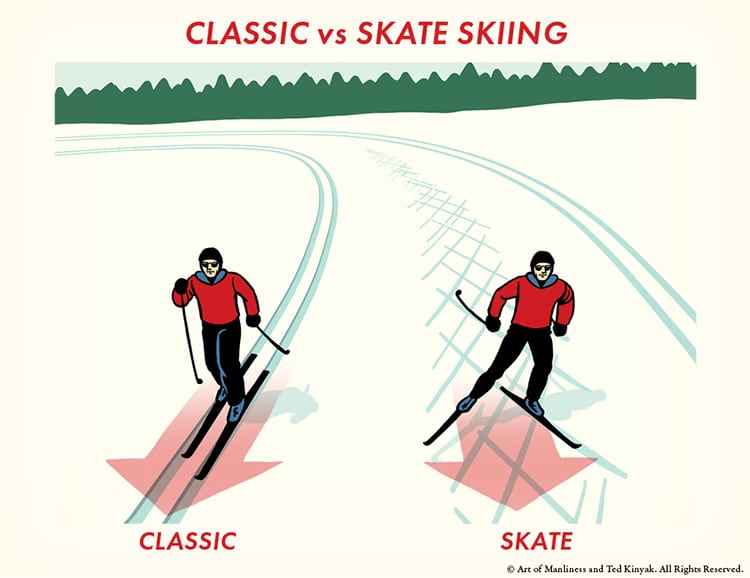
It’s not always common knowledge that there are two types of cross-country skiing: classic and skate (also sometimes called freestyle). Classic skiing utilizes parallel tracks in the snow, just a couple inches deep, that you stay in for the majority of your outing. This type is most likely what you associate with cross-country skiing; your legs stay parallel and basically do a shallow lunge back and forth in the tracks.
Skate skiing was popularized in the 90s and utilizes a wide, flat trail. The motion in skate skiing is similar to — you guessed it — ice skating. You alternate pushing off of each leg and gliding forward, with the skis making more of a V shape versus staying parallel. It requires more specialized technique and a higher baseline level of fitness.
It’s important to know the difference because the two types of skiing are vastly different in terms of equipment and skillset — it’s basically two different sports. If you’re new to cross-country skiing, you want to stick with classic. It’s much more forgiving when it comes to fitness levels and learning curve. If you’re renting skis or going out with a friend, get yourself classic equipment and stay in those parallel tracks. Some cross-country trails only offer classic tracks and some offer both; very few offer freestyle without classic tracks.
The rest of this article assumes that you’re partaking in classic cross-country skiing.
2. Know How to Handle Hills
The two hardest parts of cross-country skiing are navigating hills and making turns. Nordic skis are different than downhill skis in that they don’t have a metal edge; this means you simply don’t have the same control while going downhill or turning, requiring a little more thought and technique.
What also makes cross-country skiing a little tricky is the fact that your skis run along set tracks, which limits your range of motion and can cause some anxiety when you get up a little speed and aren’t sure how to stop or maneuver. So at the outset, you should know that if you’re ever feeling uncomfortable, you should step out of the tracks. Your skis are not glued to them, and if you stay in them when things don’t feel right, you’re more liable to not only mess up the tracks but also injure yourself.
With that knowledge in your pocket, let’s first talk about navigating going uphill and down:
Going Uphill
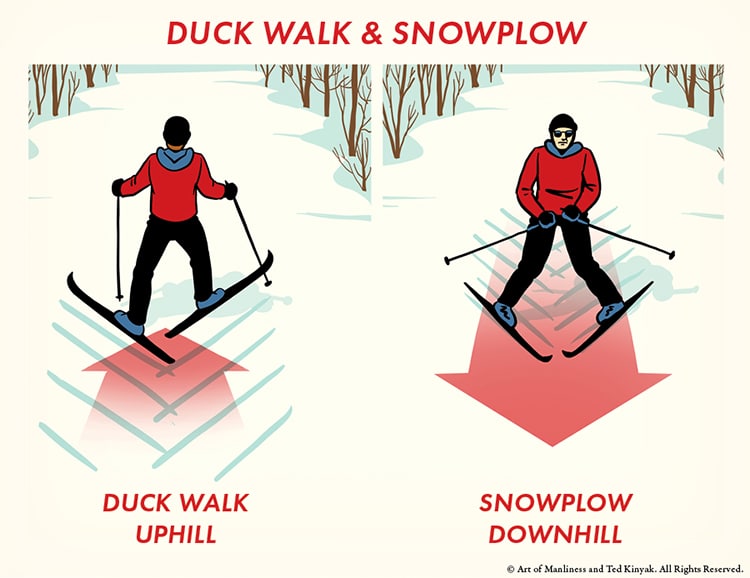
For small inclines, you can often simply increase the pace of your walk/lunge to more of a jogging pace and make it up the hill. (Proper pole technique will help too; more on that below.) For more intense inclines or when you start slipping backwards on the hill, step out of the tracks and utilize the duck walk. Make a V with your skis (with the point behind you) so that the inside edge can grab onto the snow and get you uphill. It’s fairly straightforward compared to going downhill.
Going Downhill
Going downhill on cross-country skis is where things can turn iffy very quickly, especially if you’re at all used to downhill skiing. On mountain slopes, you have skis that pop off when they’re torqued; that’s not the case with Nordic skis, which means your legs can get twisted up in a rather ugly way.
A lot of people start going down a hill only to get scared halfway down, and then you’re stuck in the tracks hoping to either make it through or do some kind of controlled fall. An easier way to approach it is to simply decide before you start down the hill whether you’re comfortable staying in the tracks. If the slope looks intimidating, step out at the top while you’re still in control. It’s much easier to reposition when you’re stationary or moving slowly than once you’ve picked up speed. The more you get out skiing, the more your tolerance for and confidence on hills will increase.
Once you’re out of the tracks, turn your skis into a “snowplow,” making a V with the point in front of you and squeeze your knees together like you’re trying to hold a ball between them. This will slow you down (though not all the way) as you go downhill, and you can then turn as needed by putting more pressure on one leg or the other. If you need to fall, let yourself fall straight to the side with your arms out to brace the impact.
You can try to snowplow in the tracks if needed, but it’s going to quickly ruin the tracks for any skiers coming after you (and it may not even work if the tracks are firm or icy).
3. Know How to Turn With Control
Besides going downhill, turning is the other part of cross-country skiing that folks struggle with — especially when you have to turn while going up or down a hill. Indeed, trying to turn while your skis are in parallel tracks is tricky. With just a few quick pointers, though, you’ll be able to at least get through turns with confidence rather than fear.
First, just take it slow and use more of a walking pace rather than trying to glide through it. You can even step out of the tracks and just walk the turn if needed. Another related option is to step out with one ski (generally the inside ski), giving you a bit more control while the other ski stays in the tracks.
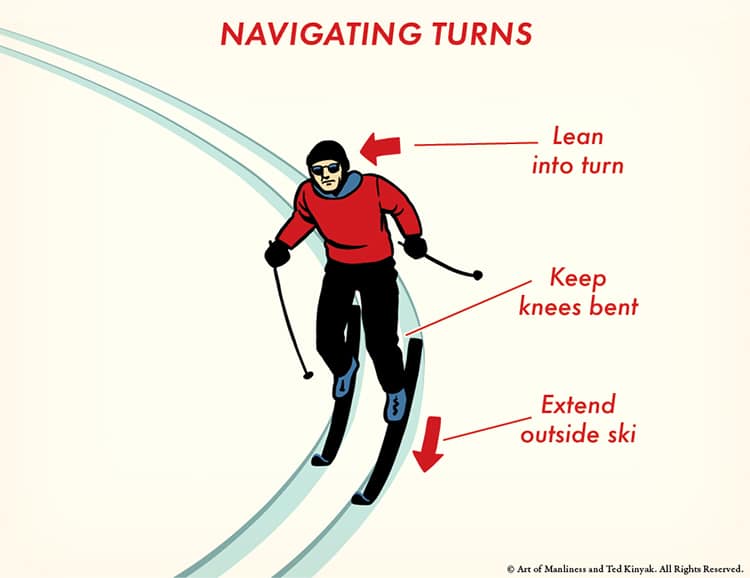
Second, if you’d like to glide through a turn (like if it’s at all on a decline), extend your outside ski a bit further forward. This creates a more natural position for your body to turn with the skis, just like how a car turns.
Third, as unnatural as it may feel in the moment, you need to lean your bodyweight into the turn, just a bit, so that your momentum goes in the correct direction rather than going straight or away from the turn. This will help considerably.
Finally, just know that slower turns are very common on Nordic trails, especially for beginner and intermediate folks. It’s really only experts who are blazing through at any kind of full speed. Just do what you’re comfortable with.
4. Know How to Use Your Poles Effectively
In downhill skiing, poles generally don’t do a whole lot other than provide some counterbalance and slight maneuverability. In cross-country skiing, the poles get heavy use as tools for balancing and pushing yourself forward.
You always want to coordinate your poles with your opposite leg — your right pole plants when your left ski is forward, and vice versa. When your arms and legs work together like this, the glide will feel natural and powerful.
You also want to be sure to plant your poles with purpose. Drive them into the snow — just behind your leading foot — and push backward, driving power and boosting your forward momentum along with your legs. This is what makes cross-country skiing a full-body exercise; if you aren’t using poles correctly, it’s going to quickly become an unintended quads-only workout.
You might white-knuckle the poles at first, but try to relax your hands and let the straps do some of the work.
5. Know How to Ski Safely
One final note: As with downhill skiing, be sure to take your physical safety seriously. Just because the terrain is flat(ter) doesn’t mean you can pay less attention to what’s going on in front of and around you, or that you can pay less attention to your body’s fatigue. As mentioned above, a tumble in your skis on relatively flat ground can mean seriously banged up limbs and joints — just days after writing the first draft of this piece, my wife tore her ACL and MCL towards the end of an intermediate level 5K ski.
Now, not all injuries or freak accidents are preventable, but pay especially close attention when going downhill, which is when the majority of falls and injuries occur. If at any point you feel like you’re going too fast or are too tired to safely navigate, slow down, catch your breath, and feel free to take it nice and easy. The goal of cross-country skiing is not the adrenaline rush that you get from the downhill variety; it’s to enjoy winter, move your body, and come home ready to go again next time.
Illustrations by Ted Slampyak