The awkward silence at work when everyone knows a project is going off the rails.
The simmering resentment in a marriage over an issue neither spouse will confront.
The dysfunction in a church where certain topics are understood to be off-limits.
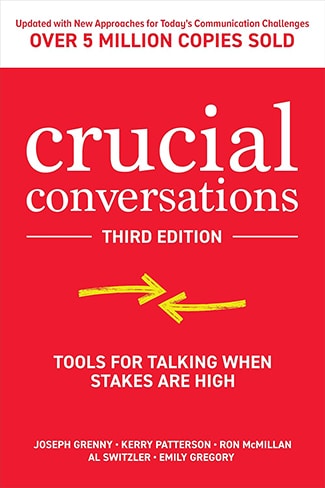
My guest, Joseph Grenny, says that some of the biggest problems in every organization, from businesses to families, aren’t the issues themselves, but people’s inability to talk about them. Joseph is a business social scientist and consultant, and the co-author of the bestselling book Crucial Conversations. For decades, he’s studied why people shut down or blow up when the stakes are high, emotions are strong, and opinions differ.
Today on the show, we talk about what makes a conversation “crucial,” why our brains betray us in conflict, and how to escape the false choice between maintaining a relationship and speaking honestly. From figuring out what kind of conversation you need to have, to creating the right conditions for connection, to dealing with criticism, we unpack how to have the conversations you’ve been avoiding — at work, at home, and everywhere else.
Connect With Joseph Grenny
Listen to the Podcast! (And don’t forget to leave us a review!)





Listen to the episode on a separate page
Subscribe to the podcast in the media player of your choice
Transcript
Brett McKay:
Brett McKay here and welcome to another edition of the AoM podcast. The awkward silence at work when everyone knows a project is going off the rails, the simmering resentment in a marriage over an issue neither spouse will confront, the dysfunction in a church where certain topics are understood to be off limits. My guest, Joseph Grenny, says that some of the biggest problems in every organization from businesses to families aren’t the issues themselves, but people’s inability to talk about them. Joseph is a business social scientist and consultant and the co-author of the bestselling book, Crucial Conversations. For decades he studied why people shut down or blow up when stakes are high, emotions are strong and opinions differ from figuring out what kind of conversation you need to have to creating the right conditions for connection to dealing with criticism. We unpack how to have the conversations you’ve been avoiding at work, at home, and everywhere else. After the show’s over, check out our show notes at aom.is/CrucialConversations.
All right, Joseph Grenny, welcome to the show.
Joseph Grenny:
Happy to be here with you, Brett.
Brett McKay:
So you are a business social scientist and researcher. You’re a speaker and a corporate consultant who specializes in organizational performance and human behavior. And something you observed decades ago in companies really shaped your career, and that was that some of the biggest problems in companies are the result of people not feeling able to speak up about problems. And you wrote a book over 20 years ago, it’s called Crucial Conversations about how to fix that. So you train corporations and companies in this skill of crucial conversations, but this problem of not being able to talk about hard things, this happens in personal relationships too, like in families. It’s not just business.
Joseph Grenny:
Yeah, in fact, the general way we’ve come to describe our findings is that you can pretty much tell the health of any relationship, any team or any organization by looking at one simple thing. And that is the lag time between when people see it and when they say it, between when they feel it and when they discuss it, between when it’s a concern and when it’s a conversation. And so you look at a marriage and if there are undiscussable things that both of us are bothered about, but neither is talking about, it comes out in passive aggressive ways. If you don’t talk it out, you act it out and it shows up in your behavior. And that always makes matters worse and tends to make the problems persevere and even worsen. And so the general finding that any social system, it could be a church congregation, it could be a community organization, a nonprofit or what have you, even entire nations suffer from this. Our inability to have emotionally and politically risky conversations is at the heart of most all of our persistent problems.
Brett McKay:
So what makes a conversation a crucial conversation?
Joseph Grenny:
So there are three characteristics of a crucial conversation. One is that it is high stakes. There’s something on the table that matters a lot to me. Now, it doesn’t necessarily have to be that the entire economy is going to crash. It could just be that my ego feels threatened, there’s something important to me. High stakes. Second, I come into these moments expecting the other person to disagree with me. I expect you to have an opposing opinion. And the third is there’s an emotional piece to this or it’s emotionally salient to us. And so the combination of high stakes, opposing opinions and strong emotions causes us to show up differently in these moments than we would most any other time. There are a lot of us that are quite princely or regal and effective diplomatic and so forth, and how we show up in a lot of communication, great at small talk, but in these moments, these moments of emotional stress and threat, we behave differently and that has enormous consequences for our outcomes.
Brett McKay:
Why do we behave differently? Because you take a step back and say, well, it’s just a conversation. It’s not like someone’s got a gun drawn on you.
Joseph Grenny:
Well, it is kind of like someone’s got a gun drawn on you, unfortunately. So I’ll give you a brief anecdote. One of my business partners, Kerry Patterson, and I had a long, long history of writing together. We did a lot of the writing on these books together and worked in very close collaboration. And as you’d expect, there were crucial conversations along the way. What happened on a particular Saturday where our pattern was one or the other of us would write the first draft of a chapter, send it to the other, the other would do critiques, and then we’d get together on the phone to talk about it. So I sent it over on Thursday. Kerry got the chapter and then he rewrote it. I sent it back and with some rewrites. So here we are, Saturday, seven o’clock. And I said, so Kerry, did you get it? And he said, yes, yes I did. I said, what’d you think? He said, you ruined it. I said, I didn’t ruin it, I fixed it. He said, you didn’t fix it. It’s all disjointed now. I said, it’s not disjointed. It has a soul. I mean, here we are. And this was a chapter of Crucial Conversations.
As I tell that story, and I recall that moment, I think I knew better than this. I knew how to respond in this moment, but it wasn’t coming out of my mouth. It wasn’t even accessible to me. Our problem in these crucial conversations is first and foremost, physiological, literal changes. Physiological changes happen in our bodies when we’re under stress or threat. Cortisol starts to increase and adrenaline starts to occur in our veins in higher concentration. Literally parts of our brain shut down and we behave like idiots. We behave like raw animals that only know how to fight, flight or freeze. And so there’s a physiology you’ve got to overcome. And much of what we learned about how to deal with crucial conversations are skills for addressing that physiological problem. We’ve got the fact that I feel stressed and tight and angry or aroused, that’s the first thing we have to contend with.
Brett McKay:
So whenever we find ourselves in these high stakes moments, so crucial conversations, the stakes are high, there’s differing opinions, and there’s a lot of emotional salience going on. A typical response is that people just don’t say anything. And it’s because I think oftentimes people feel like we have these two choices. It’s like, okay, I can speak up, be honest and ruin the relationship, or I can stay silent and just keep the peace and don’t rock the boat. And you call this the fool’s choice. Why are we so conditioned to believe those are only two options in a tough conversation?
Joseph Grenny:
Well, yeah. You think about it and what I just described, when the prefrontal cortex of our brain starts to shut down because in moments of stress and threat, our body doesn’t think we need complex problem solving. What we need is to be able to run very fast or hit really hard or hide or something like that. Very simple tasks. And so portions of our body get starved for blood and the oxygen associated with it. So we don’t think particularly clearly. And so this fool’s choice is evidence of this simplistic view of the world that I’ve got. I either have to kill my enemy here or I have to run from my enemy. That’s what I’ve got to do. So it’s expressed in that same way, silence or violence. And so the real challenge is juicing your brain back up and starting to recognize those aren’t your only options.
One of the consequences of how we feel during crucial conversations is we start to adopt this false belief and we don’t even realize we have it, but I’d urge all of your listeners to write this down and to commit it to memory so you recognize the next time you’re framing your reality in this way. We often believe we have to choose between telling the truth and keeping a friend. And when you’re thinking those are your only two options, that thought is the problem because the real challenge is to figure out how to do both. And most of us in rational moments realize you really can’t keep a friend without telling the truth. The only way forward in a relationship to high trust and real collaboration or connection is for us to be able to work through the problems. In fact, crucial conversations are intimacy accelerants.
We’ve all had the experience with somebody of dreading a crucial conversation, but getting to the other side of it. And there’s almost this euphoric sense of connection of intimacy if it was a loved one at home, a feeling of trust and relating again. And that doesn’t come without going through this difficult process together. So reminding ourselves, there usually are ways to both tell the truth and keep a friend. In fact, doing one is the way to do both. And so the fool’s choice has to be transcended before we’ll even entertain the possibility that there’s something better on the other side.
Brett McKay:
And I imagine there’s a lot of social conditioning going on there too because I mean, you grow up, you watch Bambi, you hear Thumper say, “If you can’t say anything nice, don’t say anything at all.” And if you go to church, there’s emphasis on being nice. Don’t rock the boat. You got to keep the connection. And I’ve seen that in family life, friends and church congregations and trying to be nice often isn’t the nice thing. It just makes the problem worse.
Joseph Grenny:
Yeah, yeah. We had a reprise Thumper to say, “If you can’t say something nice, grow a tumor,” because that’s the outcome. We’ll just suppress all of these concerns that we’ve got and it doesn’t show up in great ways. And interestingly, you mentioned the church or the religious context too. So many will misunderstand their own religious texts and assume that what their religion is calling them to do is just put up with stuff. And there is not a more robust example of a community that dealt with hard conversations than some of the Christian texts. And you could say the same about Muslim and Hindu and others and their great examples there, but if many of your listeners are familiar with that, Jesus wasn’t somebody that pushed it under the rug and it was a pretty fractious thing at times. The people that he gathered around him, they dealt with stuff, but for some reason we misunderstand, we misread that and we start thinking, turning the other cheek means not dealing with stuff that is not anywhere in Christian text.
Brett McKay:
If you read the gospels closely, a lot of it’s just Jesus being annoyed at people. There’s the Pharisees or the scribes or his own apostles, and he would confront them very directly. So what is the goal of a crucial conversation? Is it agreement? Is it compromise? I think when people think about having a hard conversation, they think the purpose is to come to some kind of agreement.
Joseph Grenny:
It’s unwise to make agreement the goal because then you tend to force competition. What we tend to do in a crucial conversation in unhealthy moments is I’ll share my point of view and then you’ll try to pick holes in it and then I hear your point of view and I debate back, but we think of agreement as the natural outcome of a healthy conversation, not the objective. So the objective of a crucial conversation is just to fill a pool of common meaning where we get both of our perspectives and experiences and preferences and everything out there accessible between both and make ’em swim together, stir it all together and see if there’s better combinations or better points of view that come out of having both of those most synergy and most problem solving happens more naturally if we just create a climate where we’re just understanding and appreciating each other’s points of view and not trying to drive for agreement. The agreement tends to follow naturally as we develop more of a sympathy for others’ perspectives, more of an appreciation for where they’re coming from. And so filling the pool of meaning creates a common pool of meaning is our objective.
Brett McKay:
I thought that was really useful. I typically go into these kind of conversations with the idea like, okay, we got to figure this thing out, but you really don’t know what you’re trying to figure out and you can’t even conceptualize the potential outcome because you really don’t know the other person’s side of things and what they’re thinking until you create that shared pool of meaning. And once you do, that’s going to change what comes out of that conversation.
Joseph Grenny:
Yeah. Some people will hear that and say, well, that sounds like a pretty wimpy approach to conversation. You got to come in with a point of view, argue for it, prosecute it, and that’s how you come to be persuasive. Well, that might be good on a TV game show or a reality show where there’s no ongoing relationship or need for mutual commitment and executing on things, but the real point here is it doesn’t make you weak, it makes you effective. I once watched a conversation between a senior executive who believed that another executive was embezzling from the company, so really difficult thing to deal with. And the two of them get together to talk this through, and one obviously expected denial and obfuscation and redirection and all that kind of stuff, but he approached it as filling the pool of meaning and how do you do that?
He started very honestly with laying out what he believes was going on and then all the evidence to support that. And then says, you know what? I might be wrong. Maybe you’re not embezzling from the company, but here’s all the evidence I’ve got. Here’s where I’m coming from. And I watched the other guy kind of staring at this for a moment. He had expected hostility. He expected to be able to try to redirect by saying he was being abused and accused that this was any other sort of thing, but instead as it was just laid out factually and calmly and appropriately and confidently not apologetically, the other guy basically looked at it and said, I think I need to resign and basically confessed. And it was remarkable to watch. When you suck defensiveness out of a conversation, the likelihood of people coming to a common view increases dramatically. And the way to suck out the defensiveness is to make the objective to ensure that both sides are completely heard and to just inquire and explore and be curious about the other point of view to all the meanings in the pool, and then confidently and appropriately place your meaning in the pool as well. And better things tend to happen when we do.
Brett McKay:
So something you talk about is before you have a crucial conversation, you need to kind of prepare your mind for it. And a big reason a lot of crucial conversations fail is because the person is having the wrong conversation. They think they’re talking about the right topic or having the right conversation, but they’re not. You say there are three different kinds of conversations and you got to pick the right one for the issue.
Joseph Grenny:
We have this little acronym we call CPR that many people find incredibly useful because it helps you to tease out the different kinds of conversations we could be trying to have or should have. The C stands for content. So let’s say you and I rideshare together and we take turns driving, and whenever it’s your turn to drive, you tend to show up 15, 20, 30 minutes late and it really compromises my schedule. And we’ve been driving together for about a year, and this happens about 50% of the time. So now it’s Thursday, you show up and you’re about 30 minutes late. I get in the car and I say, “Doggone it, Brett, you’re late.” So there’s the first mistake. The first mistake just let’s take out of this that then I’m being too energetic or aggressive about this. The real problem here is the topic is wrong because I’m talking to you at the content level, the C level, the content level is the immediate problem, the immediate instance of whatever the concern is.
The reason I’m so angry and upset is because I haven’t been dealing with what is a longer pattern. That’s the P. I’ve never addressed it as a pattern. So I wait for one more instance and then I blow all of that upset and energy out through this particular instance. That’s a big mistake. Don’t talk about content when your issue is pattern. And I’ve set it up as a content issue as well, which also makes it less likely I’ll get satisfaction because you might very well say, gosh, I’m really sorry Joseph, I apologize. I got up this morning and there was only five pounds of pressure in my tire and my pump at home didn’t work. And so I had to find a gas station and I put coins in one and it didn’t work. And so I had to find two other gas stations. I’m really sorry.
It won’t happen again. I’ll leave a little bit earlier so I make sure I’m on time. Now, in that moment, what many people will do is feel like, oh, all right, well, he kind of apologized, kind of owned it. Let’s move on. No, he didn’t because your problem was a pattern and all you did was just solve the content problem. If you wait for a new content issue, a new instance of the problem to occur before you try to talk about pattern, you lose because it’s going to get mired down in all of the idiosyncratic things that are part of this particular instance when that isn’t your concern. It’s that 50% of the time over the last year we’ve had this issue. So one of the first pieces of advice on this is when you have a pattern conversation, don’t wait for a new instance of concern to raise it because then you’re going to lose the point, create a special opportunity just to talk about the pattern.
“Brett, we’ve been driving together for a year over the last year. Shame on me, haven’t brought it up, but I want to do it now so we can figure this out. You tend to show up late 15 to 30 minutes late about half the time.” Now we’re on the right topic, the final kind of conversation, the R in CPR, so content pattern, and then the R is a relationship conversation. This is a conversation where it isn’t that there’s a pattern of concern anymore, it’s that I don’t trust you anymore or I don’t respect you, or I don’t think you respect me. So trust, competence, and respect are the three things that tend to describe relationship concerns. So for example, if I keep giving you faulty work, you delegate assignments to me and I’m getting back to it poorly. And the real issue is that it looks like I’ve got bad grammar in some of my written communication, and you want to talk with me about this concern you not just say, “Hey, Joseph, the last two things you wrote had some mistakes.”
That would be content stuff or this tends to happen consistently. That would be a pattern conversation. If your real conclusion is “Joseph, you’re not good at written communication,” that’s a competence problem. And that isn’t solved by you just pointing out a couple of mistakes and me trying to be more attentive. You think I have bad grammar, you don’t think I know how to construct a paragraph, and that requires a much bigger solution. So before you open your mouth, identify, is this a content pattern or relationship conversation, tease that out and then hold yourself accountable to address the right thing.
Brett McKay:
I can see that happening, that confusion happening in marital disputes, like the husband doesn’t turn on the dishwasher at night or something, and for the wife, it’s like a relationship thing. It’s not the fact that he’s not turning on the dishwasher. It’s like what it represents about the relationship. Like, well, you don’t respect me, you’re not considerate. And the husband might say, okay, sorry, I’ll turn on the dishwasher. But for the wife, she’s not feeling like he’s competent. She feels like she can’t trust him to take care of things. So it’s like it’s not really about the dishwasher, it’s a relationship issue.
Joseph Grenny:
Yeah, I’ll give you an example of that. So I’ve traveled a lot in my career and I think I’ve been married for about 13 years or something at the time. And so our kids were getting a little older and were aware of different dynamics between us. And at one point the kids said, dad, we want to have a conversation with you. And I got that little tummy tickle and nervousness and sat down and they were pretty prepared for this. And basically they started out with saying, dad, we don’t like it when you come home. That was a big bomb to drop. Now, there could have been better ways for them to open this topic, but they had a relationship conversation to hold. And their grievance with me was that mom has a certain way of doing things and all of a sudden when dad comes home, the rules all change and it’s miserable to try to have to deal with two different regimes and we don’t like that. And so I’d come home and I realized as they said this, I did feel like I had to reset things to the truthful and proper way for things to operate because she wasn’t managing it. And so she had issues with me that she wanted to address. They were relationship things about respect and about care and compassion for other people. They were not just about patterns of behavior and much of the improvement that later came in our family came because we had that relationship conversation with each other.
Brett McKay:
So a conversation can happen on three levels. There’s content, which is an immediate instance of whatever the problem or the concern is. There’s pattern. That’s when a problem is occurring regularly. And then there’s relationship. That’s where the problem is causing an issue that’s making it hard for someone to trust or respect the other person or feel they’re competent. And you got to know which kind of conversation you’re having.
So another thing you talk about is that each person is coming into the conversation with a story that they’re telling themselves about what’s going on and their feelings are flowing out of that story. So it’s important to get a handle on that story and make sure it’s true.
Joseph Grenny:
Oh boy. I mean this is, of all of the personal work I’ve done on crucial conversations over the last 35 years, this has been my central focus. It’s learning to master my story. If you can develop control over your emotions in your life, a mastery and an understanding of your own emotions, you can master your life. This is the key to intimacy, to connection, to being able to work well and build trust with other people. It’s recognizing that when emotions flare up, they can corrupt your capacity to have a crucial conversation. They are not a function of what happened. They’re not a function of what somebody just did. They’re a function of them doing something and then you telling yourself a story about it. So I share this example of, again, early in our marriage when I was traveling a lot, we would have kind of an adjustment.
When I came back home, I remember at one point I came home late at night, kids were in bed, and it had been a long week. It’s a Friday, and I walk in, and this was when we had wall phones, if any of your listeners were alive during that time. And I remember walking by this wall phone and I looked across the room and my wife is sitting there, she’s relaxed. It’s the end of her day. She’s got a book open. And I looked at her with this adoring kind of gaze, and all of a sudden the phone rang. And that was a moment of decision for me. It was a moment of decision of whether I’m going to pick it up or not, right? I’m looking at the love of my life. The two of us have an opportunity to have a little quiet moment and reconnect, but the phone is ringing, and I picked it up.
Now, a lot of people won’t believe what I’m about to say, but as I turned towards the wall and put the phone up to my ear and heard the voice of my administrative assistant saying, “Hey, I knew you were getting home right now. There were just three things I needed to address before tomorrow morning.” And then she launches in on this. I felt this burning sensation in my back. I mean, it was a physical, tangible kind of thing. And I looked around to find the source of it, and there was Sila across the room staring at me with just this absolutely deadly stare. And that was a moment too. I had an opportunity there. I experienced some emotion when I saw that look on her face. Now, it would’ve been easy for me in that moment to tell myself the reason I’m feeling how I’m feeling right now resentful and hurt and defensive is because she’s being insensitive, because she’s being uncaring, because she’s judging me, because she, so we tend to tell ourselves that our emotions are a function of what’s happening to us, of what others do.
And the beginning of all capacity to manage my emotional life begins with me accepting the fact that it does not, that it comes from the story I’m telling myself about what that other person is doing. I was telling myself a story that she was being judgmental, that she was being rude, that she was being inappropriate. I had these stories. I was telling myself about how insensitive and how impatient and how selfish she is. And so I looked back at her and rolled my eyes, not my best shining moment, but completely dismissed the frustration and concern she was experiencing and continued my conversation. I heard her book slam shut. She stomped upstairs, and we didn’t talk the rest of the night. Now, this is a long time ago, and I think I’ve grown a little bit since then, but as you break all of that down, none of that had to do with me answering a phone or with her staring at me in a deadly looking way.
It had to do with the stories we were both telling ourselves about that. The three kinds of stories we tend to tell in these crucial moments are, number one, a victim story. When something is happening that we don’t like, we tend to make ourselves out to be innocent sufferers. And that’s what I did in that moment. I’ve been working all week. I’ve been on the road, I come home and this is the kind of treatment I get. I look at all my virtues and absolutely none of my vices. And then with the other person, we tell a villain story. If I want to be rude to the love of my life and feel good about it, if I want to be able to justify myself in doing bad things to good people who don’t deserve it, I need three kinds of stories. First, a victim story, second, a villain story.
I need to think about her and think of only her vices and none of her virtues. Think of all of the worst weaknesses I can paint on her, and then I feel justified and mistreating her. And finally, I need a helpless story. I need a story that makes me helpless to do anything other than the petty little thing, the hiding or the sneering or whatever it is that’s coming out for me right now that I’m doing so victim, villain, and helpless. That’s what we mean by master my stories. It’s learning to take responsibility for and be aware of our tendency to tell those three kinds of stories during these crucial moments, and then to set them right?
Brett McKay:
Yeah, I know I do the villain thing whenever someone does something that I don’t like, the tendency is to jump to the worst conclusion. Like, oh, this guy, he’s out to get me. And then when you actually talk to him, it’s like, oh, man, I’m really sorry. I’ve had a lot going on and I didn’t really address that. I think there’s that story I think Steven Covey talks about in his book where he’s on the subway and there’s these kids just going crazy and the dad’s not doing anything, and Steven’s like, look at this deadbeat dad. He’s not taking care of his kids. And he says, sir, can you do something about your kids? And the dad was like, oh, I’m really sorry. We’re just coming back from my wife’s funeral. And I imagine they’re feeling bad. It’s just like a gut punch, like, oh man, I made this guy a villain, and he’s going through a hard time.
Joseph Grenny:
And we get there so naturally, so quickly. Now, some people will listen to this conversation we’re having and say, but there are villains out there, and that’s true. There are times where somebody lied to you, they stole from you, they embezzled from your company as we talked about before. But oftentimes the story is more complicated than just that too. Does that mean we let ’em off the hook? No, but it would change our emotional response to them. We had a guy that worked for our company many years ago who we were in a building with another firm and we owned the building, so they were subletting from us. And we found out from this tenant of ours that somebody from our company had stolen from them, had broken into their office and stolen things. And I had to sit down with this particular employee and address that.
And I remember first of all being incensed and embarrassed and all of that. And of course he was let go. But it turned out that he was struggling with drug addiction and his marriage was falling apart. He had seven children at home and there was a lot more to the story. And I ended up after letting him go, taking him to lunch a few times and checking in, and just because I cared about whether he was going to get through this awful time in his life as well. So there is no necessary opposition between holding people accountable, dealing with things truthfully, and also making sure you get to the right story, that you get more meaning in the pool so that we have a proper appreciation for even villains aren’t just villains, and you’re not always a completely innocent victim, and you’re not helpless to show up in a more mature and appropriate way too. There are better ways through this. We can tell the truth and keep a friend.
Brett McKay:
Okay, so that’s what you do before the conversation. Prepare yourself for this crucial conversation. Figure out what is the topic of the conversation actually? Is it content, pattern, relationship, get my story straight, master my stories. Am I painting this person as a villain? Am I painting myself as just a victim who’s as pure as the newly driven snow? Or am I painting myself as helpless? And then I think the important thing, you talked about it earlier is once you decide you need to have the conversation, don’t delay, because I thought that was really key, that if you have too much lag between the event and the conversation, it’s just going to get worse than that idea. If you don’t talk about it, you act it out. I think that was because I’ve seen that in my own life. I think if you’re in a marriage or even in a business or a church, you see that where you don’t talk about the thing and then you just start acting resentful towards the person.
You kind of just give them a sideways look. You ignore them, you dismiss them, and nothing’s ever solved. So you got to rip off the bandaid basically. So you mentioned the typical response people often have to crucial conversations is silence or violence. So they either just clam up and just ignore it and try to not rock the boat or violence, which is just lashing out, arguing, being combative. And a big reason why people do that is because they don’t feel safety. They don’t feel psychological safety. And I think often people misinterpret this idea of safety as comfort or being nice, but you argue that safety actually allows you to be more candid and unapologetic with the truth, not less. Tell us about that.
Joseph Grenny:
And so here’s the thing, we’ve done a lot of consulting in healthcare, and it’s fascinating to me that I think I’ve got a friend right now who’s in the hospital that there are people on this planet that you’re willing to walk into a room with, lay down at a table and let them cut you open with a knife. You’re willing to do that. And the reason you’re willing to do that is because you feel safe with them. You believe that they care about your problem. You believe that they’re competent to help you solve it. We call them surgeons obviously, and we ought to limit it to just people with that classification. But we are willing to go through uncomfortable things with people if there’s a reason to do it, and if we feel safe with them. What we know about crucial conversations is that you and I tend to believe that the best predictor of the outcome of a conversation is how risky the topic is, and that isn’t true at all.
We think I couldn’t approach somebody and tell ’em I think they stole from the company or that they’re incompetent or that they’re racist or whatever it is. We couldn’t do that without them getting defensive. Well, that just isn’t true. We’ve seen over the years that there is no correlation between the outcome of a conversation and how risky the topic is. The only correlation is with how safe the people feel discussing the topic. I mentioned Kerry Patterson, my writing partner early on, and one of the first conversations I had with him about writing, I had written a white paper on some topic. I handed it over to him, he gave it back, and I said, what’d you think? And he said, it’s boring. He said, it’s turgid, it’s vapid. And it was interesting to me because normally I would’ve felt really tight and offended inside, but for some reason that information got through to me perfectly fine.
Why? Because I knew he invested a lot of time reading that paper, and he wanted me to be a good writer, and that was his sole motivation in sharing that. When you believe that, when you believe two things, you feel safe with people, and this is your first task in a crucial conversation in the first 30 seconds, you’ve got to generate evidence for them of two things. The first is that you care about their problems, interests, and concerns almost as much as they do. Just like the doctor, that doctor cares about the fact that I’ve got racking back pain and he wants to help me fix it. You care about their problems, interests, and concerns. As soon as they believe that they do this, they go. So I needed to have a crucial conversations with an employee many years ago who I had concluded was incompetent at some really fundamental parts of his job.
He was terrible at managing projects and terrible at managing people. He was a great designer, a great graphic designer, but we tried to grow a department underneath him, and he was terrible at projects and managing people. And so that was the message I needed to get across. It was a big relationship conversation, and I started that conversation not giving myself all the credit. A lot of it goes to him that he cared about these things, but I said, Hey, I’ll call him Paul. I said, Hey, Paul, I need to have a pretty heavy conversation with him. And he knew, of course there was stress and disappointment. He knew that things weren’t working well, but I said, I want you to know that my sole motivation in this conversation is to help you win here. I want you to have a wonderful work experience here. I want you to be here for a very long time.
You’ve made a great contribution in the past and things just aren’t working right now, and I want to talk about that and figure it out. And I watched him take a really deep breath, and you could almost watch his soul open. He just sat back and it was kind of like somebody saying to the doctor, go ahead and do surgery here. I know something needs to be done. I felt such permission from him, such vulnerability from him. Why? Because he trusted my motive. He trusted that I really did care about his problems, interests, and concerns. So that’s point 1. In the first 30 seconds of a crucial conversation, you need to make it clear that you have mutual purpose, that you care about those problems, interests and concerns. And second, you need to make sure the other person knows you care about and respect them. So mutual purpose and mutual respect are what we call the conditions for psychological safety.
They believe that not only do I care about your problems, but I also just care about you as a human being and I respect you. So Paul, this person that I’m talking to here, he got it that I love him and that I like working with him and that I respect him, and he’s then able to take a deep breath and open himself up and be vulnerable. And we had a great conversation where at the end, he agreed to take a salary reduction. Eventually we grandfathered him and kind of moved him gradually there to move out of a management position more into a technical position, and that this was best for him. It worked. It went there. Why? Because he felt safe. You and I tend to believe that when others get defensive and combative, it’s because they’re arrogant or mean or rude or manipulative or whatever. It’s generally about a lack of psychological safety, and that’s an empowering thing for us to learn.
Brett McKay:
So how do you do that? I imagine in longstanding relationships, what helps is you’ve already established a track record over time that shows that you care and can be trusted. But you’re also saying that you can establish that psychological safety in the first 30 seconds of a conversation. So how do you convey that? How do you convey, Hey, I respect you, I care about you, right In that moment.
Joseph Grenny:
I’m going to differentiate here between some gimmick or technique and just what really needs to happen. Your job is to generate evidence, and that can happen in a lot of different ways. If it’s with a loved one, sometimes it’s putting your hand on their knee. Sometimes it’s leaning forward and offering a warm smile. Sometimes it’s breaking tension with a joke because sometimes a joke shows that it’s a relaxed situation and that you feel safe, and therefore they can too. There are lots of nonverbal ways of doing it. One of the best ways to do it verbally is what we call a contrasting statement. It’s telling people what you do and don’t want. That’s what I did with Paul. I told him, look, I don’t want to come in here and just criticize and tear you down and point out everything that’s wrong. I want to get to a place where you are joyful and happy and feel successful in your work.
You describe what you don’t want and what you do want. The most important part of that message is the don’t want part because their brain, the threatened part of them is going to tell them that that is what you want, that you want to hurt them, that you want to insult them, that you’re just trying to downsize. You just want to get rid of an employee, or they’ve disagreed with you in the past, and this is revenge. They’re going to make all that stuff up, and that’s their story. So letting them know what it isn’t is a critical part of constructing that first sentence. But if that sentence doesn’t work, you’ve got to keep generating evidence. Sometimes it’s apologizing. Paul, I’ve let this go for a long time. I’ve let this build and accumulate. That’s my fault. I’m sorry. And I apologize that this conversation is now bigger than it should be, and I’m willing to take my responsibility for that in it. Any of those things that you do that demonstrate I care about you and respect you, and I care about your problems, interests, and concerns, can possibly help the other person get the signal that they’re safe and then be able to engage in the conversation. This does not mean the conversation will be pleasant. It might be really hard, might be really difficult, but you’ll feel safe. You’ll be able to hear.
Brett McKay:
Yeah, and then you can add to that shared pool of meaning. Exactly. One of the hardest conversations to have is whenever you disagree with someone on a value level. So maybe it’s a political disagreement with your loud uncle at Thanksgiving, or maybe a strategic disagreement at work or maybe a disagreement with your spouse about how to raise your kids. How do you find a shared goal when your immediate objectives are completely opposite?
Joseph Grenny:
Yeah. Now you’ve used a few different words there that I want to parse out because they’re very important. I think it’s very, very rare when we have value disagreements. It’s very, very common for us to have strategy disagreements. It’s all about the way something is being executed. So you think about the massive political divide we’ve got in the United States. Now, I defy you to find two people with polar opposite views that can’t sit in a room long enough to understand that a lot of their strong advocacy of polar opposite opinions is trying to achieve values that both of them value. And so sometimes digging down deeper and understanding, no. So let’s say we disagree on immigration. Most people at the end of the conversation will agree that we have a primary responsibility to the citizens of our country, and we also ought to care about citizens of other countries too.
But we have a primary responsibility there that we need to make sure our economy works and that it can sustain support for the people that it has primary responsibility for. When you start getting down to the values level, you’ll find there’s usually more ready agreement. I’ll give you an example of that. So I once had a late night flight to London, had a speech the next morning, the flight was delayed, got in at like one o’clock in the morning, got into my black taxi at the Heathrow Airport, and I just wanted to rest on the way to hotel to sleep as much as I could before the next day. And I noticed the taxi driver kept turning around and looking at me, and finally he said, in a really aggressive voice, he said, are you American? And I said, yes, I am. And he said, your president is a murderer.
And I thought, oh, great. Here we go. Here goes my rest. And at first I was going to try to just ignore it, but then I thought, you know what? I’m going to talk about crucial conversations tomorrow morning, and how lame is this that I can’t even engage in one right now? And so I thought, all right, I’m going to do this. And so I said to the guy, I said, look, we’ve got 40 minutes before we’re going to get to my hotel. I said, I’m willing to talk with you about this, but I want some ground rules. I said, first of all, you’ve got 10 minutes and I want you to say anything you want to say to me as an American, and I’m going to listen to absolutely everything and just try to understand it. And then afterwards, you’re going to have to listen to me for 10 minutes.
And I wasn’t saying I disagreed with him necessarily. I just wanted to make sure we had ground rules in place. It would keep us both safe. And he got this silly grin on his face. He said, you’re really strange, aren’t you? And I said, do you want to do this or don’t you? And he said, yeah, let’s do this. And we had a wonderful conversation. And I can’t say that I agreed with all of his beliefs or perspective on US foreign policy, but I was way more sympathetic to it when I got there. And I don’t know that he necessarily agreed with me on everything, but he was probably far more sympathetic to my point of view than he was when we first started. We started realizing we had some common values that both of us cared about decency and honesty and human life. And we didn’t think that economics should come above human life. And so we realized there were common values. So often our disagreements are at the strategy level, not at the values level, but the problem is we never discover it because we don’t spend enough time listening and asking and filling the pool of meaning so that we can appreciate where the other person’s coming from.
Brett McKay:
So to help people guide a crucial conversation, you’ve got an acronym state, S-T-A-T-E. What does that mean?
Joseph Grenny:
Yeah, we tend when we want to make our points, so let’s say for example, we were talking about immigration or something like that. What we tend to do is we start at the wrong end of the conversation. We just say, I think we need to build a wall and we shouldn’t have any illegal immigration in our country at all, and we got to kick out everybody. That’s illegal right now. That’s my point of view. So I tend to start there and people then react to that. I’m starting with my conclusion. I’m starting at the end of the story, not the beginning of the story. When I came to whatever conclusion I’ve got on immigration or any other topic, it started with me having some experiences, concrete experiences. It starts with my belief about what’s factual and true. And then I tend to tell myself stories about that and then I have feelings about it, and then that results in how I’m going to act.
So we call this the path to action starts with facts. Stories come next, emotions come next. And then the actions, the proposals, the opinions that I form, follow from the end of that. If you want people to be able to understand your point of view, you’ve got to take ’em by the hand and walk ’em down that whole path, start with the factual basis. What do you think is going on in our country today and how is immigration affecting that? What facts do you have to put on the table? What stories do you then tell yourself about it? What feelings does that create for you? And then what policy positions do you advocate as a result? Walk them through that. And even if they don’t agree, at least there’s more meaning in the pool. So they can see how a reasonable, rational, decent person might come to the point of view that I’ve got.
And then help them do the same. We call this state because the acronym S-T-A-T-E describes the five things you need to do in order to be heard non defensively. First, share your facts. S second, tell your story. That’s the T. A ask for others facts and ask for others’ point of view and then talk tentatively and encourage testing. Encourage testing means you encourage the other person to challenge, to question, to interrogate your point of view. Invite that when you do that defensiveness decline. So those are kind of the five ways of showing up when you start to share your opinion in a way that reduces defensiveness.
Brett McKay:
Let’s talk about that talk tentatively part because I think a lot of guys listening might think, well, that’s just being weak or in unconfident, what does talk tentatively actually look like?
Joseph Grenny:
Yeah, it just means to tell the truth. Most of us overstate our point of view. We think that banging the table and overstating the fact of the matter is, and as all thinking people know, and the only reasonable conclusion is when we overstate our point of view, when we act as though we’re absolutely certain that I’ll use immigration again, that this one immigration policy is the only right way for us to do this. When you do that, what tends to happen is number one, you lie because you probably don’t really believe that that’s the only point of view that has any reason or factual support for it. And secondly, you provoke defensiveness. So the other people who tend to feel like your goal is to try to convince compelling control, you’re trying to convince them of your point of view. They tend to start poking holes in it.
People naturally look at what’s wrong with your argument when the argument is overstated. If you want them to be able to listen, then state an opinion is an opinion. That’s what tentative means. So in my point of view, this is what I believe, or in my long experience, this is my point of view or after long consideration, I’m quite confident that all of those are perfectly appropriate things to say because they’re honest. They aren’t overstating your level of confidence or your level of omniscience about the topic. We find that people are more persuaded when you’re less aggressive, when you state your opinion as an opinion and allow room for testing.
Brett McKay:
So as part of a crucial conversation with a loved one or at work with a boss or colleague, you might receive feedback and criticism, and that’s always hard because it sets off for flight or fight response to feel criticized. But you say feedback can stop being threatening once you treat it as information rather than indictment. Even when it’s given emotionally or clumsily, you can still separate what’s being said from how it’s being said, and instead of reflexively defending your ego, you can start getting curious and ask, what does this person see that I might not even poorly delivered? Feedback often contains a fragment of truth worth examining, and one thing people can do to get value from criticism without being crushed by it, is to take your time with it. You can say, alright, thank you. I’m going to take that and sit on it for a bit, and then you go through it by yourself and think, okay, this doesn’t mean anything. That’s not true, but like, oh, that comment, he’s got a point here.
Joseph Grenny:
Yes, that’s a powerful, if you can recognize that in a crucial conversation, you can control the parameters of it. You’re not powerless. You’re not a victim of it. One of the best ways to take control is to control the pacing. So if somebody’s coming at you with some really hard feedback, it’s okay for you to set the table like I did with the guy in the taxi cab and to say, I want to hear you out. I’m going to ask a lot of questions, and if it gets a little overwhelming to me, I may ask for a break, but I want to get to the other side of this and understand it, and then I don’t know that I’ll respond right now. I’m going to need some time to reflect on this. So there it is. That’s how I’m okay with engaging in this conversation. So if you’re sitting down with your boss in a performance review and she gives you some feedback that’s surprising to you, don’t respond right? Then let her know that you want a chance to sort through it and absorb it, and then you want to respond in a way that’s respectful of the feedback that you’ve been given, and then go and deal with whatever emotions you need to work through to get to a good place, sort through it and come back and then deal with part two of it.
Brett McKay:
All right, so we’ve had the conversation. We have a shared pool of meaning. Everyone feels heard, but I’ve seen this happen a million times in groups where these hard conversations happen, but people get on the same page, the meeting ends, everyone feels good, but nothing actually happens.
Joseph Grenny:
You’ve been there too.
Brett McKay:
Yeah. So why do people mess up the transition from meaning to action?
Joseph Grenny:
Yeah, because I think we let ourselves sell out at the end, and we all know that we should always end a conversation by clarifying who does what by when, and how we’re going to follow up. We need to make sure that we confirm our agreement, and if it’s a politically sensitive one or there’s a low trust history, writing it down so that everybody can confirm, yeah, that’s what we agreed to, that’s what we understood, and then how are we going to follow up? What changes are we going to make as a result of this? That’s the work at the end of the conversation. And if you don’t do that work, you will have deja vu dialogues. You will have to have Groundhog Day, and it’s not fun to do it, so why go through all the trouble of having a good crucial conversation if you’re going to just waste it at the end? Always end with who’s going to do what by when, and how do we follow up?
Brett McKay:
Well Joseph, this has been a great conversation. Where can people go to learn more about the book and your work?
Joseph Grenny:
Cruciallearning.com is our website and lots of great resources there to get the training virtually or in person or online with public classes. The book is called Crucial Conversations: Tools for Talking When Stakes Are High, and I’m happy to have a chance to share it. Thank you, Brett.
Brett McKay:
Thanks, Joseph. It’s been a pleasure.
My guest here is Joseph Grenny. He’s the co-author of the book Crucial Conversations that’s available on amazon.com and bookstores everywhere. You can find more information about his work at his website, cruciallearning.com. Also, check out our show notes at aom.is/crucialconversations where you can find links to resources to delve deeper into this topic.
Well, that wraps up another edition of the AoM podcast. As always, thank you for the continued support. Until next time, this is Brett McKay reminding you to not only listen to the podcast, but to put what you’ve heard into action.