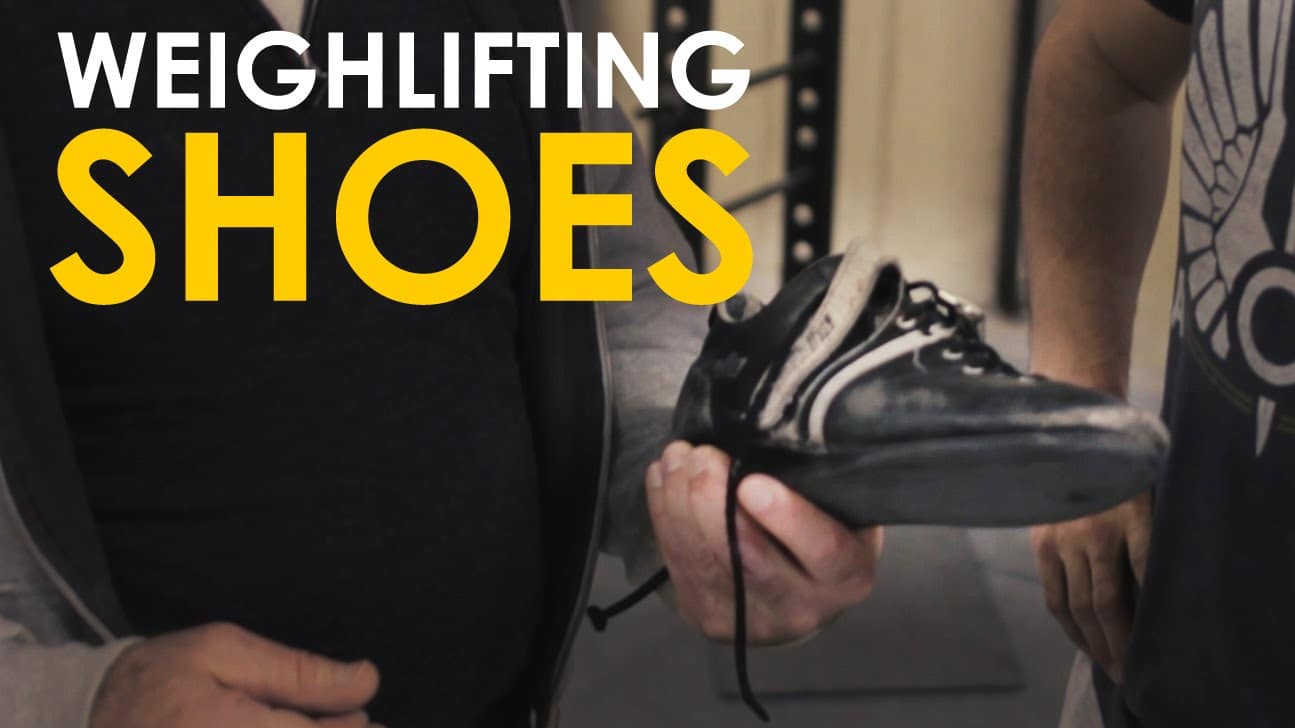
If you’ve moved beyond machines in your strength training journey and are getting under a heavy barbell to do squats, cleans, or presses, you may have wondered if you should get yourself a pair of weightlifting shoes.
If you’ve started to work with significant weight, you really should.
Here’s why weightlifting shoes matter and what they do.
Weightlifting Shoes Do Three Jobs
A weightlifting shoe does three things, and all three can significantly improve your lifting experience:
It supports your foot. “Lifters” surround your feet in a tight casing so that nothing wiggles around while you’re moving heavy loads. Everything feels nice and secure, which is a good feeling to have when you’re lowering into a squat with 400 lbs on your back.
The sole does not compress. At all. There’s zero squish. This is important! If any part of the sole compresses as you drive upward out of the bottom of a squat, part of your force gets absorbed into the squish. It’s like trying to squat on a mattress. All that effort you’re generating from your legs, your hips, and your back disappears into the foam under your feet. You don’t want that. No energy leaks! This is why you don’t want to lift in running shoes or cross-trainers. They’ve got too much give.
The elevated heel changes your mechanics. Most weightlifting shoes have a heel that’s raised somewhere between 0.5 and 1 inch. That heel elevation lets your knees travel further forward over your toes at the bottom of the squat, which does a couple of things. First, it allows you to sit deeper into the squat more easily, especially if you have limited ankle mobility. Without the heel, a lot of guys compensate for tight ankles by leaning their torso way forward, which turns a squat into more of a good morning. I like good mornings, but you don’t want to good morning when you’re squatting. The heel-assisted knees-over-toes position also shifts more of the workload to your quads by keeping your torso more upright (helping you with those quad goals).
What to Look for in a Weightlifting Shoe
A good weightlifting shoe will have 1) a hard, non-compressible sole (often made from stacked leather, wood, or hard plastic), 2) a snug fit that locks your foot in place with straps or laces (or both), and 3) a slightly elevated heel.
Several companies make solid lifting shoes. I’ve tried several of these lifters over the years:
Adidas Adipower. This was my first lifting shoe. It checks all the marks for a good lifter: plastic non-compressible sole, snug fit, and elevated heel. The thing I didn’t like about it is the shoe is too narrow. My wide Fred Flintstone feet would start hurting about halfway into my workout.
Do-Win Classic. Do-Win was the second pair of lifting shoes I tried. I mainly bought them for the looks. They’ve got a handsome, vintage design. Looks like something Vince Anello would wear back in the day. Instead of a plastic sole, it uses stacked leather. The shoe has a nice elevated heel and plenty of support. It’s a bit more roomy than the Adidas Adipower.
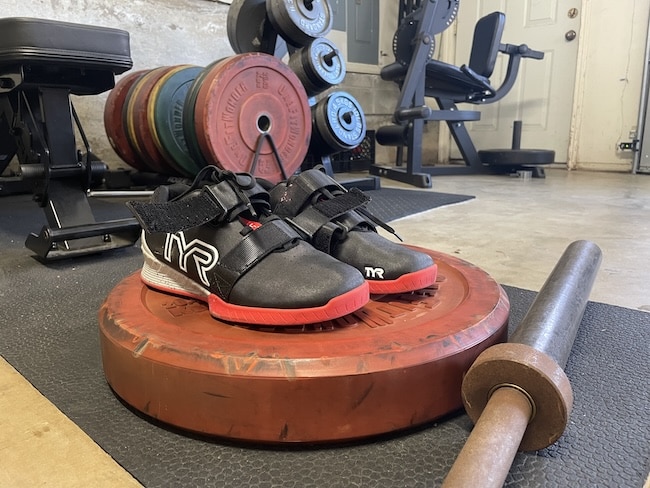
TYR L-1 Lifter. This is my current shoe. I’ve been using it for a few years, and I love it. Here’s what I love about the TYR L-1 Lifter: The anatomical toe box is a game-changer for those of us with wider feet — no more feeling like your toes are in a vice grip while trying to maintain stability in a heavy squat. The 21mm heel-to-toe drop puts it right in that sweet spot for Olympic lifts and squats. This is the lifter I recommend that guys get.
Besides the above brands, Nike has their Romaleo series. I haven’t used them, but have heard good things about them.
Whatever you choose, you want support, no squish, and a raised heel. Those are your three non-negotiables.
Why Plunk Down $200 for Gym Shoes?
Fair question. A good pair of weightlifting shoes will run you up to $200, which feels like a lot for something you’re only wearing a few hours a week.
But here’s the case for them:
For starters, they’re going to improve your barbell training. Unlike most gear purchases, you’ll actually feel the difference the first time you lift in a pair of weightlifting shoes. Take that first squat with a solid, incompressible base under your feet and your knees tracking forward over your toes the way they’re supposed to, and you’ll wonder why you spent all those years squishing around in running shoes.
Second, your lifters are going to last a long time because you’re only wearing them for your workouts. You’re not running in them or walking the dog. You’re standing on a rubber gym floor, squatting and pressing and pulling for an hour, then taking them off. With that kind of limited use, a quality pair of lifting shoes can easily last a decade or more. That pair of Adidas Adipowers that I stopped using? I disinfected them, cleaned them up nice, and gave them to a guy who was just getting started on his iron journey. He’s still using them. They’re 13 years old. Spread $200 over 15 years of training, and you’re looking at about $13 a year. That’s a pretty solid return on investment for a piece of gear you use every single session that’ll improve your lifts.
Get yourself a pair. Your squat will thank you.