







Whatever Happened to Those Manly-Shaped Avon Cologne Decanters?
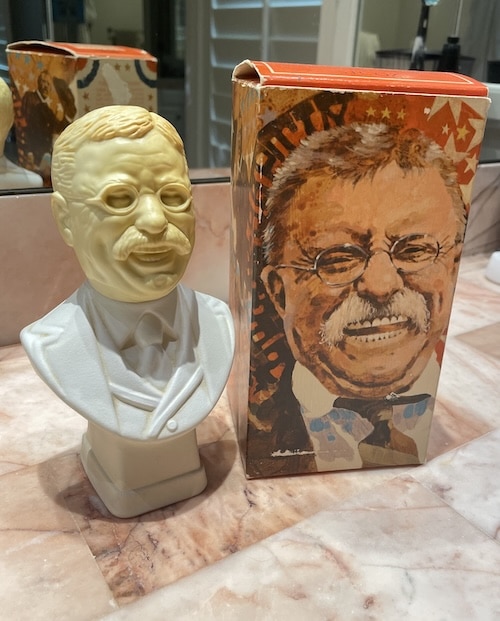
A few weeks ago, I met up with some Strenuous Life guys here in Tulsa for a book club meeting at a local brewery. One of the guys had a gift for me: a 1970s Avon aftershave in a bottle shaped like the bust of Teddy Roosevelt. Screw off Teddy’s head, and you get punched in the face with a pungent but masculine smell that burns the nostrils.
I started cracking up because my dad had similar Avon aftershave bottles in his bathroom when I was growing up in the 1980s.
He had ones in the shape of a pheasant and a duck. After you shaved, you screwed off the bird’s head, dabbed some aftershave on your hands, and slapped your face with it.
Your dad may have had some of these novelty cologne- and aftershave-filled Avon decanters in his bathroom during the 70s and 80s, too. For about twenty-five years, you couldn’t walk into an American home without running into them. They came in the form of cars, eagles, ducks, dueling pistols, spark plugs, and rearing stallions. In addition to the TR bust, they had one in the shape of a stately white bust of George Washington, whose head you unscrewed to get at the aftershave. How dignified for the father of our country.
So what happened to them? Why did this ubiquitous staple of American bathrooms disappear? Why doesn’t a man keep a glass Corvette full of cologne on his counter anymore? Today, we’ll chart the rise and fall of the manly-shaped Avon decanter.
The Rise of the Avon Decanter
To understand the rise of the Avon decanter, you need to understand the rise of Avon. Remember Avon? Maybe your mom was an Avon Lady in the 1980s while simultaneously hosting Tupperware parties so she could make extra cash to buy you back-to-school clothes at Montgomery Ward’s.
Well, Avon got its start in 1886, when a door-to-door book salesman named David McConnell noticed that the housewives on his route cared a lot more about the free rose perfume samples he handed out than the books he was actually trying to sell. So he dropped the books and got into the fragrance business. To increase sales, he built an army of women who sold perfume and soap to their neighbors out of a catalog, right there in their doily-covered parlors and living rooms. It was the birth of the Avon Lady. Hail, Avon Lady!
Advertisement
For the first part of the 20th century, the bottles that held the perfumes and colognes that Avon Ladies slung to friends and neighbors came in plain, standard shapes. Then, in the 1930s, Avon experimented with novelty-shaped decanters, releasing a Mickey Mouse bottle in collaboration with Disney. It was a hit, but a one-off. For the next 30 years, Avon kept using standard bottles for its fragrances.
By the 1960s, competition was getting fierce in the cosmetics industry, so Avon looked for ways to differentiate itself from the pack. I guess an executive remembered that the Mickey Mouse-shaped perfume bottle did well, so why not do that again? So in 1965, Avon released a decanter in the shape of a boot that contained a men’s “leather” cologne. It was a smash hit. They followed it up in 1968 with a decanter shaped like a Sterling Roadster. Also a hit.
Avon found a winning strategy to move their fragrances: put them in fun-shaped bottles.
What was great about this strategy was that Avon didn’t have to come up with new formulations for their fragrances. They would take the same fragrance, offer it as both cologne and aftershave, and simply vary the bottle it came in. Avon would put out the same product in a new crazy-shaped bottle every year, and people would buy it, even though they had a full bottle of the same cologne or aftershave unused at home. The TR aftershave my friend gifted me smelled exactly like the aftershave in my dad’s pheasant-shaped Avon decanter. Basically, Avon was no longer in the fragrance business, but rather in the novelty bottle biz.
Which is probably smart because the aftershave didn’t smell very good. This was Avon, after all, not Creed. Avon was pumping out a mass-market product, and so it smelled like a lot of mass-market fragrances in the 1970s. These fragrances, to quote anchorman and cologne aficionado Ron Burgundy, had “a formidable scent. It stings the nostrils. In a good way.”
Advertisement
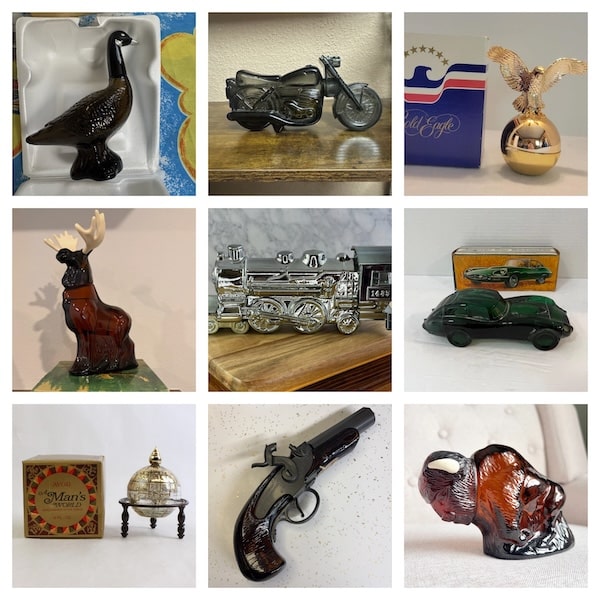
Over the next 20 years, Avon partnered with a New Jersey glassmaker, Wheaton Glass, to crank out figural bottles by the hundreds of thousands. The perfume bottles for women came in shapes like shoes, slippers, purses, and handbags. The men’s line got the rugged stuff like cars, trucks, fishing reels, shotgun shells, spark plugs, footballs, dueling pistols — and busts of George Washington and Teddy Roosevelt.
The 1970s were the peak of the Avon decanter. Avon’s catalog filled up with glass owls, deer, kangaroos, station wagons, and just about every car Detroit ever rolled off a line. They even made a 32-piece chess set out of the things.
It was during the 70s that the Avon novelty decanter became a collector’s item, sort of like Beanie Babies or Department 56 Christmas houses in the 1990s. Avon saw this as a money-making opportunity to exploit, so they leaned into this consumer-driven trend. They released bottles in limited runs and started a club for collectors. People started printing price guides telling folks what their bottles were worth. There was even a National Association of Avon Collectors with national conventions and a newsletter called The Avon Times.
Basically, you had people buying a glass Corvette full of aftershave, never opening it, and stashing it in a closet still in the box, certain it’d be worth a fortune someday and would pay for their kids’ college education. The TR bottle my friend gifted me was in a pristine, original box and still full of aftershave. Some guy in Oklahoma probably bought it in the 70s and never used it, thinking it would be worth thousands of dollars in 2026.
The Fall of the Avon Decanter
Eventually, the fun-shaped Avon decanter went away.
Why?
Well, two things killed it: 1) Avon nearly went bankrupt, and 2) consumer preferences changed.
Advertisement
By the late 1980s, Avon was buried under more than a billion dollars of debt and fending off hostile takeovers, having spent its flush years on a strange business shopping spree that included medical-equipment makers and nursing homes. It spent the ’90s digging out, and in 1999, it brought in Andrea Jung as its first female CEO with marching orders to drag the brand into the modern beauty business and compete with the department-store labels. The folksy “Ding Dong, Avon Calling” image had to go, and so did the glass pheasants full of aftershave.
Consumer tastes changed, too. By the 1990s, people wanted less junk in their houses, and a shelf full of glass animals was gauche. Dad’s Avon bottles got hauled off to Goodwill. Avon was hep to this change and started putting their fragrances back in a plain bottle with a plain label. Men today buy fragrances for the smell, not for the bottle it comes in (though a suave-looking bottle is a nice bonus). 21st century man is smellmaxing; not bottlemaxing.
The Avon Decanter Is Dead. Long Live the Avon Decanter!
If you’d like to have one of these manly-shaped Avon decanters sitting on your dresser, well, you’re in luck! Because the market was flooded with them during the 70s and 80s and because people babied them, thinking they’d pay for their retirement, you can usually find mint-condition Avon decanter bottles in antique stores or at estate sales still full of cologne or aftershave. My friend found the TR one in an antique store in Guthrie, OK. eBay has a bunch of them, too. Your dad probably still has a couple sitting on his dresser. Ask him if you can take them off his hands. My dad’s pheasant and duck aftershave bottles are still in his bathroom. Maybe it’s time for him to pass them on to his son. The making of a venerable tradition.
Buy the decanter bottles for the decoration and for a connection to an interesting part of kitschy American history. But don’t wear the cologne. It smells pretty bad. And burns. In a good way, I guess.