Books are everywhere. They’re so common, they’re easy to take for granted. But my guest argues that they’re worth fully appreciating — because the book isn’t just a container for content; it’s a revolutionary technology for shaping culture and thought.
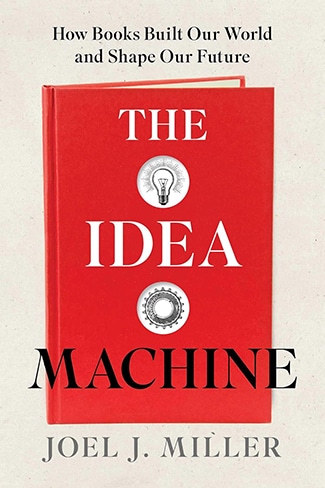
Joel Miller is a former publishing executive, an editor, a book reviewer, and the author of The Idea Machine: How Books Built Our World and Shape Our Future. Today on the show, Joel argues that to appreciate the power of the book, you have to look at its design: how it’s constructed, how we interact with it, and how its evolution transformed the way we think, learn, and communicate. He walks us through a fascinating history of the book as a physical object, from Augustine reading under a fig tree, to medieval monks introducing word spacing and punctuation, to the printing press’s world-altering explosion of information. We also explore how novels changed our emotional and social intelligence, how silent reading birthed individual interpretation, and why, even in an age of video and AI, books still matter.
Resources Related to the Podcast
- AoM book-related archives
- Dying Breed Article: Why I Hate Making (and Watching) Online Videos
- AoM Article: Why Men Should Read More Fiction
- AoM Article: Fiction for Men as Suggested by Art of Manliness Readers
- AoM Podcast #1,057: The Power of the Notebook — The History and Practice of Thinking on Paper
Connect With Joel Miller
Listen to the Podcast! (And don’t forget to leave us a review!)





Listen to the episode on a separate page.
Subscribe to the podcast in the media player of your choice.
Transcript
Brett McKay:
Brett McKay here and welcome to another edition of The Art of Manliness podcast. Books are everywhere. They’re so common, they’re easy to take for granted, but my guest argues that they’re worth fully appreciating because the book isn’t just a container for content. It’s a revolutionary technology for shaping culture and thought. Joel Miller’s a former publishing executive and editor, a book reviewer and the author of The Idea Machine: How Books Built Our World and Shape Our Future.
Today on the show, Joel argues that to appreciate the power of the book, you have to look at its design, how it’s constructed, how we interact with it, and how its evolution transformed the way we think, learn, and communicate. He walks us through a fascinating history of the book as a physical object from Augustine reading under a fig tree to medieval monks, introducing word spacing and punctuation to the printing press’s world, altering the explosion of information. We also explore how novels changed our emotional and social intelligence, how silent reading, birthed individual interpretation, and why even in an age of video and AI books still matter. After the show is over, check out our show notes at aom.is/books.
All right, Joel Miller, welcome to the show.
Joel Miller:
Yes, thank you so much for having me.
Brett McKay:
So you got a new book out called The Idea Machine, and this is a book about books, and you argue that books are idea machines, and that to truly appreciate them and think about how amazing they are, you have to understand books as hardware. What do you mean by that?
Joel Miller:
Well, I think we tend to think about books like the content in them. We think about the information in them. So we tend to think about books as software, but in reality, books are both software and hardware. And the reality is that the physical format of the book, the way that you interact with the book, has a very important impact on what we get out of it, what it enables us to do and how it’s used. And you can kind of trace that all the way back to the very earliest days of books all the way until the present.
Brett McKay:
And we’re going to do a history of the development of the book as the format, the hardware that we have now today, because it’s a really interesting history. But what are some of those benefits? What’s the benefit of having this thing that you hold in this rectangle that has pages? What’s the benefit of consuming content in that way?
Joel Miller:
Well, I start the book with the story of Augustine in the garden. There’s this classic story out of the confessions where Augustine is distraught and he walks off to a garden. He’s got a copy of St. Paul’s letters with him and his friend Olympia is also with him and he doesn’t want Olympia to see that he’s crying. He’s just kind of completely wrecked. And he wanders off to another corner of this garden. He sits down under a fig tree and he just begins to weep. And while he is in that state, he hears over the wall of an adjoining villa, the Latin phrase for take and read. And he remembers his copy of his book. So he runs back to the bench where he dropped it off and picks it up and he opens the page at random, opens the book at random, and he lands on a page, lands on a passage that completely upends his life.
It salves his troubled spirit. It solves the kind of quandary that he’s in. And there’s a very interesting detail in that passage of the confessions where he says, after that I put my finger or some other marker in the place to hold what he found. And that’s like a completely throw off line that you wouldn’t necessarily think about until you recognize that the book is also hardware as well as software. Because what that enabled him to do was then go back to that line, it enabled him to share it with Oly, his friend. And you can imagine just the benefit of being able to do that, not just with one book, which of course he did at that moment, but with an entire library to be able to mark the finding within a book enables you to do it across the book, multiple citations within a book.
It enables, in other words, a kind of critical engagement with that text that would otherwise be unavailable to you. It also enables you then to take all of these different marks that you have and compare them with other books, which enables an even deeper level of critical engagement and now a new level of synthesis where you’re able to take ideas from one place and ideas from another place and put them together. And if you couldn’t go back and find them, you’d never be able to do that. So that’s like a really simple example of how the format itself, the function of the book, enables you to do more with it than merely interact with content.
Brett McKay:
And you contrast that to say scrolls. Before we had the codis, we’ll talk about this, the book format that we had today. There was some organization in scrolls, but it was a lot harder. They were just cumbersome and you couldn’t do that sort of marking the way that Augustine did.
Joel Miller:
Correct. Augustine was able to open a book with essentially random access. So with a Codex, that’s the style of book that we have today, which is basically a bunch of pages bound within two covers. And with that format, you’re able to open a book at random. You can’t do that with a scroll if you’re a Gen Xer like me. The nearest comparison would be when you went to Blockbuster and some fool didn’t rewind the VHS and you were stuck having to rewind the thing to go back to the beginning. You just started wherever the thing was left. And that’s how a scroll worked. There wasn’t the ability to sort of navigate the text anywhere near as easily as with a codex.
Brett McKay:
Well, you mentioned video. That’s one reason why I’m not a big fan of even online video. You can’t jump to different parts. I mean, YouTube has done stuff where they kind of add these chapter things, but it’s still hard to get to this one specific thing and this one part of this video. Same thing with podcasts. I mean, I like podcasts more because at least I can do other things while I’m listening, but I feel like video just holds you hostage. But if you’re looking for something specifically, you can’t beat a book.
Joel Miller:
Yeah, a hundred percent. Like podcast apps and YouTube and others, they take these linear formats like that and they are introducing essentially index features or content finding features. Those are necessary. The truth is, you can’t sit through a two hour long video or even a 30 minute video and get what you want and then go back to it easily. And so the need to do that is inherent in the format. If you’re going to consume content, you have to be able to go back and identify parts of that to reassess and to use again. And so those kind of linear formats like video, audio, they limit that. And these developers are going to have to, because the typical consumer is going to want to have ways of overcoming that limitation. The book already has it built into it,
Brett McKay:
So they’re trying to make podcasts and video more like books essentially. So books are the OG best way to organize information. The other thing I like about books too is that, and this is about writing in general. We’ll talk about writing here in a bit, but Socrates has beef with writing. But something I’ve noticed with books and reading and writing is that I feel like it helps you think better when you read something. You’re able to really see someone’s completed thoughts about something in a linear argument and synthesize it, then you can go back to it and analyze it again. I mean, it’s something about the format of the book. Even a physical book. Totally improves my thinking.
Joel Miller:
Yeah. Well, one of the things that I emphasize in The Idea Machine, which is kind of my metaphor for what a book is, and then of course the adjacent things around it, like libraries are also part of the idea machine. But one of the things that an idea machine allows you to do is think new thoughts. And the way that you have the ability to do that is one of the ways is the book makes ideas like objects. You can see them and you can manipulate them, you can play with them, you can move them around, you can analyze them such that you can see the components of an argument when you are reading a book, for instance, and you can write in the margin point #1, point #2, point #3, it enables you to go back to that page and quickly reassess the argument or quickly go back and see how it holds together.
If something is made objective like that, it’s much easier to dissect it, to be critical with it. Whereas if you’re listening to an orator or a speech or whatever, you can’t really do that. It’s very difficult to go back and analyze “How was that? How did he make that argument? Was that a specious argument? Was that totally bogus?” The answer is probably yes. And you have no way of actually going back and doing anything other than using your memory to get the gist of what he said. Whereas with a book, you have quotable objective data that you can look back at.
Brett McKay:
At the beginning of the book, you developed this grid that shows how the format of the book can allow its content or the software to not only persist over time, but how its meaning can change over time as well. So how are books kind of like these weird time machines?
Joel Miller:
Yeah. Well, I talk about basically a three dimensional grid. Imagine you have an X axis, which is the expression of an idea. The Y axis going up is the specificity of that idea, the clarity of that idea. And then the Z axis is time itself. And time goes as far as it can run. And because the format of the book freezes content in a place in a time, you are actually able, we do it all the time without thinking what a wonder this is, we’re able to access the thoughts of people like Augustine or Paul or Socrates or whoever, as those ideas were formulated originally. And we’re able to go interact with those ideas. And sometimes those ideas are super clear to us. Other times they’re not. We are able to impose new interpretive criteria on those messages. We’re able to use those messages in ways the original people had no intent. They never would’ve imagined the way we’ve gone off and used them. But those are all capabilities of the book because of the particular form that it takes.
Brett McKay:
Yeah, this past year I’ve been rereading books that I read in high school, like the Great Books. So I reread Moby Dick, I reread Ralph Ellison’s, Invisible Man. I reread Catch 22. And it was interesting to see how the meaning of those books changed compared to when I initially read them when I was in high school, because the thing is that you have more experience, you learn more. I have more of an education for Ralph Ellison’s, Invisible Man. He was making all these references to Marxism and Hagel, some of the sociopolitical stuff that’s going on in the 1950s, 1940s in America. And when I was in 12th grade, when I read that, that went completely over my head. But then when I read it again as a 42-year-old man, I was like, oh, okay, I can see what he’s doing here. This is an interesting kind of critique of what was going on there.
Joel Miller:
Yeah, I think that’s one of the great things about revisiting books is the book says exactly the same thing as it did when it was first published. However, we’re not the same people from one reading to the next. And so we bring different things to it every time we open it.
Brett McKay:
So before we could have books, we needed to have writing. But you highlight the fact, and I’m sure a lot of people know this, the most famous philosopher in the west had a beef with writing. Why didn’t Socrates like writing or reading?
Joel Miller:
This is actually such a funny story. Yeah, Socrates kind of hated, well, lemme say it differently. Socrates is his most popular voice. The person that gave him his voice, Plato, who wrote the dialogues, he has Socrates make this very robust case against books. And Socrates thought that it degraded memory. It’s kind of a complicated case because the way he tells it is through a myth. But essentially this Greek God comes to this Egyptian Pharaoh, and he says, “Hey, I’ve invented this amazing thing called reading. It’s going to be great.” And the pharoah is like, wait a minute, unpack this for me because all I see are downsides. And he starts reciting all these downsides and they include things like reading will give people the appearance of knowing stuff when in reality they don’t really know anything. They can just pair it what they’ve read. And we know people like that. If you spend any time on Twitter or X or whatever you want to call it, we run into those people all day long, folks that claim to know things that know nothing.
And that was kind of like the beginning part of what he was saying. But what’s interesting is everybody has read him. Everybody has read Socrates ever since then as being critical of writing. And there are other aspects to it. For instance, he says like a book can only say what it says. Therefore, if you have an objection, the book can never deal with the objection. A book can be read by anybody. So a book that’s meant for one audience can be read by any other audience, and therefore it can fall into the wrong hands. So he levels all these objections to it. And I think as a result of this persuasive case that he makes, a lot of people have walked away with the assumption that Socrates was against writing and against books. And on its surface, I think that’s true. But Plato’s very dialogues and then Xenophon, another disciple of Socrates, his memorabilia clearly show him interacting with books in a way that violates his own objections. So I call him a hypocrite out of a little bit of fun and recommend that we don’t follow what he teaches, but instead follow what he did.
Brett McKay:
Yeah, I mean, I think I see what he’s getting at for Socrates or the way that Plato presents him to know something. It was all about knowing the forms, and that’s how you knew what the right thing to do was. I imagine Socrates would think, well, if you sort of outsource that knowledge to an external book, you really can’t say the forms, and therefore you can’t make wise good decisions. So you don’t want, I can get where he is going from, but it’s not very useful to try to memorize everything that you come across.
Joel Miller:
Well, there was this concept that everything that could be even taught in education, anything that an educated person would ever know, they already know that they have access to that through essentially the divine, and it needs to be awakened within them. And then they would simply know the things that they needed to know. There wasn’t a sense that education was informing people. Education was more about forming people who could then have access to these truths, to the verities. And I don’t think there’s any objective way of demonstrating that that’s remotely true, but books violate that model of the world and Socrates theoretically held to that model of the world.
Brett McKay:
Yeah, Socrates, he does read, I mean, there’s a dialogue where he says, I got to go back to this book to look up a reference. So he must’ve been reading. And then even Plato in the Republic, he makes this kind of a critique against poetry. I mean, how it can corrupt the mind. But Plato himself, he’s a fantastic writer. I mean, his writing is not only philosophically dense and thorough, but it’s beautiful. I mean, it’s really nice to read. So clearly he values the written word.
Joel Miller:
Well, there’s a great funny example. This again kind of goes to the hypocrisy point. There is a story told about Plato that after he died, his writing tablet, which would’ve been a wooden board that had a recess on the top and wax would’ve been poured into that, so you could incise letters with a stylus. This was before paper. So this is kind of what people used to use in the old days to jot down ideas or rework ideas. So this is kind of like where your first draft would’ve been kept. And when he died, people went back and looked at his tablet and it showed the first line of the republic written out in multiple ways. He was sitting there editing the text in order to get the right phrase, to get the right formulation of it, which shows how dependent he was on the technology of writing and the technique of writing the technology of the writing tablet in order to convey his own ideas.
Brett McKay:
Alright, so writing, even though some ancient philosophers had a beef against it, they knew that writing had its benefits, reading had its benefits. You pick up this section about writing and you shift over to the Romans. The Romans relied on slaves to dictate the writing and copy books out and even read books out loud to them. And you really highlight the fact that the Romans really started to use reading and writing as a form of thinking.
Joel Miller:
I think you get this actually in that story of Plato also where you see him editing the text. One of the arguments I make in the book is that writing leads to editing and editing is evidence of thinking you cannot critique your own work without having engaged cognitively and critically with it. And you see that actually in that example of Plato, he is re-engaging his own text. But the same thing is true for now in a refined sense in the Roman context because you have examples of Virgil talking about, or rather pious, his biographer talking about how Virgil worked. And the way Virgil worked on his Geox or the Inid was to basically dictate all morning and then ju and edit all afternoon until he had what he wanted to keep from the morning’s work all solidified. So he dictates, and his scribe is busy keeping track of all these notes writing, and then in the afternoon he goes back and he cleans it up until he has a draft that he likes.
And then on top of that, whenever he has new ideas pop in like, oh, I need to remember this, or I need to remember that, or whatever, he basically works with an outline. He goes ahead and he jots down these ideas in rough shape. He calls them wooden pillars that are placed in a building while we’re awaiting the marble pillars to come the final product. This is like a prop for his own thinking, in other words. And so there’s this clear sense in the way Virgil worked that he is using writing as a prop to his own thinking as a support to his own thinking. And he structures even the work itself to facilitate that. And then in Quintillions instructions on oration, he talks about the same basic thing and including the idea that whatever we first write out in our first draft, we like it.
We love it. It’s our first go at it, we feel great about it. It’s probably bad. You got to go back and edit it. You got to go back and clean up the flow. You got to go back and tidy up these phrases. You got to go back and kill your darlings. He said almost the very same thing that Arthur Quiller Cooch said 2000 years later, Quintilian said it way back when because what he recognized is is that the writing process itself and then especially the editorial process, is part of formulating the ideas. And so the actual page, or in their case, the actual tablet on which they’re writing is a reflection of the thought process itself. In fact, it is part of the thought process itself. So when we write today on a word processor or a notebook or whatever, we’re doing the same thing. We’re literally thinking on the screen, thinking on the page, the device, whether it’s a notebook or a tablet or whatever, it’s an externalized part of our own brain at that point. It is a part of our own mind. We’re using it to scaffold our own creative processes.
Brett McKay:
Yeah, I’ve noticed that with my own writing. If I can’t write it clearly and succinctly and where it makes sense, I realized I don’t even know what I’m trying to say.
Joel Miller:
Yeah, exactly.
Brett McKay:
I mean, I had this problem, there was an article I was working on a couple weeks ago and I thought it sounded good. Technically it was good, but I wasn’t hitting the idea. And my wife, I was getting some feedback from her and she’s like, what are you trying to say? And I’d be like, I don’t know.
Joel Miller:
Totally.
Brett McKay:
I don’t know. So I had to just dump it and I had like, I got to think about this some more because I couldn’t articulate what I was trying to say. I didn’t know what I wanted to say. So you can think you have a good idea when it’s all amorphous in your head, but if you can’t write it out, you really don’t know what you think.
Joel Miller:
That goes back to that idea grid that we talked about earlier. The X axis represents that expression, and the Y axis represents specificity or clarity of thought, and what you have there is the ability to express a lot. So you’re high on that x axis, but you’re low on the Y, like the clarity isn’t there, and we experience that all the time, and it’s like writing enables us to move it up into that other quadrant, that far quadrant where it’s both fully expressed and also very clear.
Brett McKay:
Yeah. So when did the book appear, as we note today? So pages that are sandwiched together, bound together, when did that come onto the scene?
Joel Miller:
It’s kind of a first century Roman invention. You could find it going back like pre-advent of Christ kind of time, but it would’ve been very new at that point, and it wasn’t used the way we think of it, it was kind of like a notebook, basically tradespeople use them to just jot down notes. These would’ve been usually on parchment or possibly papyrus, and they basically would’ve just taken sheets of papyrus or sheets of parchment and folded ’em together and stitched them down the back, and that was what a codex was in those days. The use of that was primarily for work a day purposes, keeping notes on business or maybe rough drafting something or jotting down the draft of a contract or something like that, keeping tallies if you’re a merchant and so on. Those were the workaday purposes to which the codex was put.
It was not a literary format. The first rule reference to it as a literary format comes from the Roman poet Marshall who talked about this amazing innovation that you could basically, instead of having a big bulky scroll, because Codex could be, COEs, could be a slightly more compact, you could end up with, in his case, he was bragging about some of his own work, but he talked about other people’s work also that you could find in a codex and it would be smaller, you could carry it around. He talked about someone being able to carry him in one hand and being able to thumb through his work everywhere, but that didn’t really take off. I guess he mentioned that in some very public poems that were designed as kind of gift suggestions for Saturnalia. And it was like, if you think about it as an early marketing effort, like a lot of book marketing, it didn’t work.
Nobody took his advice but didn’t take off. The group that actually did embrace the codex weirdly enough, were Christians. And so first century Christians began using the codex the same way everyone else did, but they began using it for other things too, including recording their scripture. And that was a novelty. No one else did that. And that eventually took off. And as Christians became a larger and larger percentage of the population in the Roman Empire and then beyond, they kept that format and kept using it. They never went back and sort of adopted the older version, and as a result, the codex took off wherever Christians went.
Brett McKay:
Why do you think Christians glommed on to the Codex?
Joel Miller:
There is so much speculation on this and there’s no real solid answers, but here are a couple sketchy ones that I think are generally agreed upon. One was that a codex allowed you to gather together different texts and present them in a way that you could have all of it in one bundle. So ancient codices have, for instance, you may have a letter of Paul and a letter of James and a poem and a Psalm, and somebody may have all that stitched into one codex. That would be odd in a scroll. The way that would work in a scroll would be a little strange. And so that just didn’t happen that way, but it did happen with codices. The other thing that was interesting is that if you wanted to collect all of a thing like all of Paul in one document, that would’ve been a codex.
That would’ve been kind of like the preferred way to do that. If you took all of Paul’s letters and put them into one scroll, it would be a massive, massive, massive scroll. But you could do it all in a codex by basically taking many of these individual codices, these choirs they were called, stacking them up on top of each other and binding them together. So the end result is what we think of as a book with a book spine with a big thick spine. You can’t do that in a scroll, but you can do it with a codex. And so as Christians in their bookish ness begin to collect these letters of their early founding voices, that’s how they found the best and most efficient way to do it. That’s one particular kind of argument for it. Another argument for it is that the Christians were using kind of the technology of the codex to capture extracts out of the Jewish scriptures that kind of tended to confirm their claims about Christ.
These were called testimonial, and Paul actually might be speaking to one of these when he tells Timothy in one of his letters to bring his cloak and a few other things when he comes, I think, what is it to Troas, and he says, bring the books, especially the notebooks or the Latin. There is Menani, which is a parchment notebook, and so that could have been his collection of his own letters. When he sent a letter out, he probably kept the original and that was copied down in his notebook when he had his own insights and his own arguments and his own interaction with the Jewish scripture. He was probably writing that down in a notebook so he could refer to it later. That would’ve been the kind of thing he was asking Timothy to collect for him. And so Christians just tended to glom onto it and hold onto it. And the end result was a lot of Christian documents ended up in Codices almost to the complete exclusion of scrolls. It’s just not very many scrolls of Christians from that time. It’s almost all codices. And as Christians spread, that preference just took off. There are maybe other reasons, but those are the primary ones.
Brett McKay:
Maybe there’s another speculation of mine, but I wonder if it was also because the early Christians, they were outsiders in Roman culture, so maybe they were scrolls, oh, that’s for rich guys. That’s what the elites use. Were not that, so we’re going to use these kind of humble workaday notebooks to take care of our writing.
Joel Miller:
That’s an interesting speculation, and I think a good one because it actually parallels another one like that, which is why monks became copyists. So if slaves were the infrastructure of the book trade, as Rex Wesbury said, the reason for that is that copying manuscripts was laborious, difficult, mostly unappreciated work. And Christian monks adopted it in part because of its aesthetical value. It was a way of mortifying the flesh to copy manuscripts. And so they took that up with relative gusto. And as the sort of Roman model began to disintegrate, the Christian model began to emerge. Monks became the new infrastructure of the trade, but they did it because they were rejecting the assumptions around that work that the Romans had.
Brett McKay:
Yeah, I mean, if you were in first grade and he had to copy stuff out for punishment in school, the monks did that on purpose. They were like, that’s how they wore their hair shirt.
Joel Miller:
It was just like fasting long bouts of prayer, like keeping vigil. I mean, it’s just like that.
Brett McKay:
But you talk about how monks, these early Christian monks, how they changed reading and writing with the help of the book the Codex. How did Christian monks change reading and writing so that it looks more like what we do today?
Joel Miller:
Well, this is one of those examples that, again, unless you’re looking at how it worked in the ancient world, you would never even assume it was anything other than this. But monks did something as simple as put spaces between words. In the Greco-Roman method of producing literature, of producing text, they did not put spaces between words, and they didn’t really need to because students were trained to read by basically memorizing syllable combinations, and then they would pick out the words from this river of letters or this monolith of characters as a couple of scholars have called it. And so if you go back and you look at very ancient copies of Greek manuscripts, they don’t have punctuation, they don’t have spaces between words. They don’t have any of that stuff. Those were all innovations by Christian monks.
Brett McKay:
And they also introduced because they put in these spaces and commas and punctuation, they also introduced silent reading. Yeah, tell us about that.
Joel Miller:
So this is kind of contested, but in the ancient world, it was more common for people to read aloud, and that has to do with that script continua text. In other words, all those words just jammed together all the letters in a constant stream with no breaks. The way you did that was you picked out the syllables, and the way you did that was you at least mouth them, if not verbalize them. And so you can find various indications of this in books like Cyril of Alexandria, he has to direct, or it might’ve been Cyril of Jerusalem, Cyril of Jerusalem directs the women in his congregation in this catechetical setting to read while moving their lips, but without letting other people hear your voice. So here’s direct evidence that people were reading aloud. That’s just kind of how they did it. And in the confessions, Augustine talks about seeing Bishop Ambrose reading quietly to himself without doing that, and that was an oddity, which warranted being mentioned, like this guy didn’t even need to mouth these syllables in order to read. It was kind of like a freak of nature sort of thing. So people could read silently, but the tendency was to read aloud because the format itself encouraged you to read aloud.
Brett McKay:
And I think that change from reading aloud to silent or inner reading, that opened up some new possibilities with how you approach the text. I think.
Joel Miller:
Oh, absolutely. First off, it enabled private reading on a level that really wasn’t accessible before. And I think this is a highly underrated aspect of our understanding of how books transformed us as people, but we mostly read in private now, either we listen to audio books which are contained within earbuds in our own, just our own headspace or a book in front of our eyes. We rarely read aloud anymore unless it’s to children or something like that. And so our consumption of texts is almost entirely individualistic. In those days, it was not. The way that you heard a book when it was first published or thereafter, was mostly to go listen to the writer, read it aloud at a public presentation. You didn’t just go to the store and buy a copy. They didn’t have copies. You went to a store perhaps to have a copy made for you, but that was expensive. And so people went to what were called CIOs to have a book read that you would listen to. That was how it was published in those days. But as these technologies of presenting text enabled the text to be more easily discernible, spaces between words, standardized, punctuation, that kind of thing, it enabled people to read more easily on their own. And when that could happen, then you could have private reading. And private reading really frankly changes the landscape of the world.
Brett McKay:
How does private reading change the landscape of the world?
Joel Miller:
Suddenly you can have your own opinions about what you’re reading. You can challenge things. You can read things on the slide that you’re not supposed to be reading. You can have interpretations of those things that are not acceptable. You can wrestle with received expectations on how to interpret something by holding your own interpretation. And what that does fundamentally is it ultimately tends to erode community interpretations and help elevate individual interpretations where that matters on big scale stuff would be like religions, but it also matters in small scale stuff. Imagine you are reading, for instance, a book I talk about a dedicated chapter, not exactly to Uncle Toms Cabin, but it’s a primary example within this chapter, reading about the horrors of slavery. You’re reading that on your own. You could read that anywhere. You could read that in the north where abolitionist attitudes were already rife or you could read it in the south where they were not. And there were literal laws passed against reading that book as a result because they were worried that people would come to alternative interpretations of how society should be structured.
Brett McKay:
Well, going back to this idea of how individual reading can cause big changes, you mentioned religion. We see this in the Renaissance after the printing press, like the printing press skyrocketed, the number of books available during the Renaissance. Can you give us some numbers so we can really see how rapidly the book proliferated during this time?
Joel Miller:
Yeah, this is nuts, but if you look at, say the ninth Centuries between the sixth and the 15th centuries, European scribes produced about 11 million books, 11 million individual copies. This is based on the best analysis of the available data, but about 11 million copies in just the 148 years between 1452 with the invention of the printing press and 1600 printers produced about 212 million individual units. So that is basically an 1800% increase. It’s unbelievable. And that was just getting started. That’s just 148 years. Those numbers go into the beyond that they go into the billions eventually.
Brett McKay:
And as you said, people were reading these books on their own. So a lot of those books that were printed were Bibles, and so people were reading the Bible on their own and figuring out what does this mean to me? And then that gave rise to the Reformation and all these different Protestant break offs. And then, I mean, people argued the printing press is actually what caused all that war fair that happened during the, it was very violent, and then they attributed to the printing press.
Joel Miller:
Yeah, there’s the arguments that say that that was an instrumental part of it. There’s the arguments that say that’s way overstated and all of that stuff is all interesting, and it’s very difficult to suss out the ultimate story. Of course, history is mostly an argument we just talk about in retrospect. We don’t actually know a lot of stuff for certain, but I do think one thing is very clear, and that is the reformation could not have happened without the printing press. There would’ve been no way, for instance, for Martin Luther to do what he did, which was swamp all of Europe in text presenting his particular view. Other people held views that were similar before, and they had nowhere near the impact. They had zero impact. Luther blew up Christendom, and that was in part because of the printing press.
Brett McKay:
So the number of new books started posing a problem for people. It was organizing and finding information. They were having a problem with information to overload thousands way back, way back when. Today we think of, this is really interesting. I thought this is really interesting. Today we think of organizing books. The way you do is you put it on a shelf with the spine facing out, so you can read the title and then you can organize those based on subject or however else you want to organize them. But that’s not how people kept their books during the Renaissance. How did people store their books and how did that make finding information a big chore?
Joel Miller:
I think it’s Duncan Watts as a writer who has a book called Everything is Obvious Once You Know the Answer. But this is one of those examples. We all have bookcases, we all have books sitting on our bookcases. They all mostly sit upright with their spines facing out and a lot of words on the spine. So it is like, of course, that’s how you organize books, right? It seems so obvious. Well, that’s not how they did it in the old days. They didn’t have words on the spine, or if they did, they might not have even been things as simple as a title. They regularly kept them inside of chests. So imagine just a big box full of books. They might be kept in a wall niche in a window or something like that if you just had a dozen or so books and monastic libraries are a great example of this.
They tended to be small. Even big ones may have only several hundred books in them. The biggest might’ve had a thousand. There’s a few that had even more than that, but we’re not talking about massive tons of books. However, they were all kept in boxes or maybe with some sitting out on top of the box or some sitting on a table often chained to that table so that they wouldn’t wander off. Book theft was a real thing. And so the end result was finding books was a chore. You had to kind of know what was in that box, and the only way to do that was to lift up the lid and go digging through it to see what was in it.
Brett McKay:
When did they start figuring out like, oh, hey, we don’t have to stack books in boxes or keep them in trunks. We can put them on shells and organize them by subject. When did that start happening?
Joel Miller:
Well, that was really a product of the Renaissance, and that was the late Renaissance or the early modern era. Hernando Colon, who was Christopher Columbus’s bastard son, was one of the very first to do this. He realized that books could be much more efficiently stored on open air shelves standing upright. Even the idea that we think of the book as upright that way tells you how we’re now so wired to thinking, but standing upright. And then he basically created collections of indices, like a massive catalog and indices that enabled him to find anything in his library. And he was trying at his time to develop the biggest library in the world. Basically, that was his mission, was to create a library of everything ever printed, including things that nobody thought were valuable at the time, all this print ephemera, posters and things like that. He had all that too.
And he created essentially an internet browser out of a paper that had this massive printed catalog of everything in his library where you could go into that library catalog and you could find the entry that you were looking for and then go find it on the shelf. But more than that, he also then digested a lot of what were in those books in this catalog setup that he had, so that you could, without even having to go pull the book off the shelf, you could decide if you needed it or not. So he was basically coming up with a way of digesting texts so that it could be searchable in essentially like a proto Google, an analog Google. And it’s a pretty phenomenal feat that he accomplished, but it’s like he was one of the first to ever think to even do that.
Brett McKay:
And then I imagine other people thought, oh, that’s a good idea. I’ll try that too.
Joel Miller:
Yes, exactly. Every age, if you look at the production of books going all the way back to the ancient Near East when books were really first invented and they were written on clay tablets, every society that has ever had to deal with information has had to come up with ways of doing what I’m just describing. But in the age of print, when instead of having thousands of tablets, for instance, now you have tens of thousands of books that are all far more information dense than those clay tablets could be. The work has suddenly become infinitely harder. And so what colon invented and innovated on at that time, and then others around him and after him enabled a much more immediate access to those ideas.
Brett McKay:
So we’ve been talking about books as a hardware, right? Its format allows you to do things with ideas that you couldn’t do if it were in another format, but they also have a software that’s the form of the content of the book. And starting in the 18th century and really picking up speed in the 19th century, a new type of book software started showing up, and that’s the novel. Why did it take so long for the novel to develop after the Codex was invented?
Joel Miller:
That’s a great question. I mean, there are examples of proto novels that go back much further. You can find things that kind of qualify as novels in ancient Roman literature, there’s Christian Hagiographies where they’re writing about saints and the saint’s lives, and there’s full of imaginative, almost fantasy like elements within those. All of that though, kind of is pushing towards the modern novel. And Don Quixote is kind of the first example of that. Miguel Cervantes’s massive novel in which he warns about novels, which is hilarious. He gives us this massive novel to warn us about the dangers of novels. But that was kind of like the first, but as a cultural thing, I think it required mass literacy in order for that to take off. Because for a novel to really work, it can’t just be that the upper 20% of a society has access to it and they can read it.
It has to be where you’ve got a lot of people with some expendable time, like either in between jobs or waiting for this or waiting for that or whatever, where they’re able to take this portable thing, pull it out of their pocket and start reading it. And it wasn’t really until the 18th century, the 19th century where that was possible. And then on top of that, you really needed what happened in the 19th century, which was industrialized printing, because what that did was as incredible as the original printing press. And that original revolution was, it was really industrial printing that created the scale that we think of today as the ubiquity of books. Because before that, every book that was printed was printed one sheet at a time, and that one sheet might have eight pages on it, but still we’re talking about somebody manually feeding a sheet into a printing press and the machine having to come down and press it onto the paper and so on. By the 19th century, steam power had been invented and they figured out how to basically create rotary presses that could take paper off of a roll, so not sheets any longer, take it off a roll, feed it through a rotary press, and within an hour they could produce what had formally taken two weeks to produce. So that created a massive ubiquity of books, which then drove the price down, and that suddenly meant that middle class and even poor people could afford to pick up a novel and be entertained by it.
Brett McKay:
That’s interesting. So some, and I think often men think of fiction reading or novel reading as just entertaining fluff, but you make the case that the novel is a powerful tool for individual and societal change. So what does reading fiction do to us?
Joel Miller:
Man, reading fiction does so many things for us. Let me just, this is kind of a personal perspective, personal story here, but I grew up reading a little fiction. I’ve always read a little fiction over the course of my whole life, but as a young man, I mostly read nonfiction. I wanted serious stuff. I wanted to read economics and politics and history. And I mean, that’s literally all that in theology. That was all I ever read except for the occasional novel that would come across my path that interested me. For whatever reason, now that I’m almost 50, I almost only read novels. And I think what I’m getting ready to describe is available to anybody at any age, but we don’t quite appreciate it usually when we’re younger, at least I think at least I didn’t. So maybe the world’s blame on this one rests on my shoulders.
But the way to think about it is this. When you pick up a book and you’re reading about a character, whether that’s in a first person narrative or it’s a third person narrative, we impose our own cognitive faculties on this character. We loan our own emotions to the character we loan, our goal setting ability to the character we loan, our problem solving ability to the character in ways that other kinds of literature don’t allow us to do or don’t invite us to do. So when a character is stuck, we are busy problem solving with them. We’re like, well, you should really do X. You should really do Y. And then that happens, and then we feel either grief or joy at how it happened or whatever. That emotive connection is also powerful all by itself because it is formative. It is the kind of thing that actually shapes our own emotional intelligence. So as we’re reading fiction, we are learning about the world in a way, and other people, more importantly in a way that we couldn’t, outside of books that were so directly related to that kind of experience.
Brett McKay:
A while back ago, I wrote an article for the site Why Men Should Read More Fiction, because I was like, when I read, it was like I was going to read nonfiction history books, whatever. But yeah, I mean, studies show that reading fiction increases your theory of mind, which is this cognitive ability to understand the thoughts and feelings of other people. Basically, you need theory of mind to socialize, right?
Joel Miller:
Totally. You’ve got to guess what so-and-so thinks, and then you’re going to guess what they think based on what this other person might or might not think.
Brett McKay:
Right? And reading fiction allows you to do that. Seeing theory of mind and action. You’re seeing the thoughts of all these different characters, and you got to keep ’em in place. I mean, as you said, it makes you more empathetic. The character’s emotions become your emotions and your emotions become the character emotions.
Joel Miller:
Exactly.
Brett McKay:
And you were talking about that’s why Uncle Tom’s Cabin was so powerful, because it really affected people. And I mean, even Abraham Lincoln when he met Harriet Beecher Stowe is like, oh, so here’s the little lady that started this war that we’re fighting because everyone read Uncle Tom’s Cabin.
Joel Miller:
Yeah, absolutely.
Brett McKay:
Let’s say there’s some guys out there who are listening, they want to start reading more fiction. Are there three novels you’d recommend they start with?
Joel Miller:
Oh man, they’re so freaking many great novels for men that don’t regularly read, I would have them read something like Cormac McCarthy’s No Country For Old Men.
Brett McKay:
Oh, yeah, that’s a great one.
Joel Miller:
That would be such a great book to start with. Kurt Vonnegut is a blast. I can’t imagine a better starting place than Slaughterhouse-Five. That’s a funny, very satirical snide, but very wise, fascinating book. That’s a great one. And then personally, one that I’d love, it’s a little bit more speculative in the way that it’s written, but it’s a beautiful, wonderful book by the Russian novelist, Eugene Onegin. Don’t let Russian novelist be a phrase that scares you away. It’s very contemporary and it’s translated very ablely by the wonderful Lisa Hayden, but it’s called The Aviator, and it’s a book about a guy who is frozen during the Russian revolution and some cryogenic experiment and wakes up in the modern era and has to kind of understand what happened to him. And it’s really great.
Brett McKay:
I haven’t heard of The Aviator. That sounds awesome. So what do you think the state of reading is today? So we’ve talked about the book, how it’s this amazing thing, it’s this idea machine. We have the book to think for the spread of religion, the rise of the scientific method, the rise of different institutions, governments, democratic governments, constitutional governments. What’s reading look like right now? Are you optimistic or pessimistic about it?
Joel Miller:
I’m both. One of the reasons I wrote the book, I just wanted people to appreciate the book. I wanted people to appreciate this amazing technology, especially as we are so technologically fixated these days. I say at the very beginning of The Idea Machine that books basically suffer from their ubiquity. They’re everywhere, and most things don’t like ubiquity. And all of that doesn’t really breed contempt so much as neglect, familiarity. We just tend to ignore it. And yet this has been demonstrably instrumental in making our modern world. We wouldn’t live in the world we live in today without the book, without the invention of the book. And so I wanted people to be inspired by that history, which is part of the reason I wrote the book. But in terms of what I actually think on a day-to-day basis, I kind of ping pong between discouragement and encouragement.
On the discouraging side, fewer people today seem to be reading than they have in the past. Now on a historical scale, we’re still reading it much, much higher than they were in the Middle Ages say. So these things are all relative, but those numbers that you see on how much people engage in books these days, there’s studies published every couple years, every several months, you can find this or that study. And none of them have encouraging news hardly ever however I say that. And yet at the same time, I also go to a platform substack where I keep my newsletter, millersbookreview.com, and there are loads of people celebrating classical literature there. There’s loads of people talking about what they’re reading. It is phenomenal, and that’s very substantive in its depth and breadth in terms of the quality of the discussion there. At the same time, there’s places like TikTok where I don’t think the discussion is anywhere near as robust, but it’s very plentiful. Like BookTok is a thing where there’s scads of people talking about this or that romantic author that they’re reading or whatever. I don’t want to denigrate any of that. People reading should just be reading and enjoy what they’re reading. So whatever you want to read, rock on, do it. But I see those kind of anecdotal examples and I think, ah, maybe there’s a lot to actually still be enthusiastic about. So I kind of vacillate between the two.
Brett McKay:
I’ve heard people say that books, at least nonfiction books are going to become outmoded in the age of LLMs like chat GPT, because instead of having to read through a whole book to find the information answers you want, you can essentially generate a text entirely tailored to your interest in questions from the LLM. So what role do you think books will play in a world with large language models?
Joel Miller:
I end the book with Sam Bankman-Fried the disgraced founder of that massive cryptocurrency exchange. He very prominently said near his downfall, in fact, very closely to that, that if you wrote a book, you effed up. He had no appreciation for a book. He literally said, I don’t say that no book has any value, but I almost say that that’s almost a direct quote from him. And I think what he’s missing, what he missed, he became like a reverse poster boy for the benefit of a humanities degree, basically, is that there is some deep soul and mind formation that happens when we read. That does not happen when we simply glean extracts from say, an LLM report any more than from the headlines pulled out of a Google search. You have to go deeper and you have to engage at a more robust level in order to be shaped by the content that you’re reading. And that requires books like you can’t get that from an LLM. You can get great stuff out of an LLM. And let me just say right out, I think large language models are astonishing. They are, in fact, in my mind, they’re an extension of what the book has done for us. They’re a part of that whole trend. But the way people use them is often to misuse them and to miss the benefit that a book would provide in comparison.
Brett McKay:
What’s great about books is that you serendipitously discover things you didn’t know you wanted to know. You don’t know the questions to ask without the wider ranging knowledge you get in a book. But I do think LLMs can actually enhance your reading. How are you using large language models in your own reading and writing so that they enhance rather than replace your thinking?
Joel Miller:
Well, for a lot of business work that doesn’t actually require the level of creative thinking that personal writing projects do. For me, I use LLMs to draft early things or to help me brainstorm ideas, to help me take one form of a document and turn it into another form of a document where I might have some derivative uses of a core text that I want to use, but I need to turn it into another thing that might take me 45 minutes to an hour, but it’ll take an LLM seven minutes including me fixing the sloppiness in it or whatever. So I use it as a productivity tool. And for that, it’s fantastic for research. I also use it, I find perplexity and also the deep research functions on several of the different LLMs to be very helpful, especially when it provides me actual links. I can go back and check that can help. I’ve written whole business plans using that, and they’ve been very successful. And I couldn’t have even done the work that I did in the time if I had done that in a traditional way. So the research side of it can be very, very good. And then I also sometimes will load books up into an LLM like notebook. The Google one, which is now suddenly escaping me . . . Notebook.
And then sometimes ChatGPT and then also Claude. I’ve tried it in all three of those and a little bit with Grock where I’ll take a manuscript. I’ve done this with my own book just to query my own book on certain things. But I do it with classic literature where you can get basically free PDFs of these classic novels and other things, and I’ll use it to query the novel. I’ll have a conversation with the book. Basically I’m trying to find something, there’s no index for it. I find it quickly using that. Or I have done some work where I will investigate essentially an angle in a book, and I’ll use the LLM to help me do it where I would have a hard time, I think sussing it out.
Brett McKay:
Yeah, I’ve done that reading along with an LLM. I’ll do this fiction books. I’ll just start a chat where as I’m reading and I see something I don’t know what that means or what’s going on. Basically, when there’s a historical novel, I’ll start talking to the LLM, give me some information on what’s going on in this chapter. For example, I did this a lot with The Count of Monte Cristo. There’s a lot of history in that thing, and so I use ChatGPT to help me flesh out some of that stuff a little bit more, so I understood it better, and I thought that was a useful way of using an LLM with your reading.
Joel Miller:
Yeah, totally. I think that’s a great example of that, for sure.
Brett McKay:
Well, Joel, this has been a great conversation. Where could people go to learn more about the book and your work?
Joel Miller:
Millersbookreview.com is probably the best place. That’s where I post book reviews and literary essays there, and you can also find out more about The Idea Machine there.
Brett McKay:
Fantastic. Well, Joel Miller, thanks for your time. It’s been a pleasure.
Joel Miller:
Yeah, thank you so much for having me.
Brett McKay:
My guest today was Joel Miller. He’s the author of the book, The Idea Machine. It’s available on amazon.com and bookstores everywhere. You can find more information about his work at his website, millersbookreview.com. Also, check out our show notes at aom.is/books where you can find links to resources where you can delve deeper into this topic.
Well, that wraps up another edition of the AoM podcast. Make sure to check out our website artofmanliness.com. Find our podcast archives and make sure to check out our new Substack Dying Breed. You can sign up at dyingbreed.net. It’s a great way to support the show directly.
And if you haven’t done so already, I’d appreciate it if you take one minute to give us a review on Apple Podcasts or Spotify, it helps out a lot. And if you’ve done that already, thank you. Please consider sharing the show with a friend or family member you got something out of it. As always, thank you for the continued support. Until next time, this is Brett McKay, reminding you to not only listen to the show, but put what you’ve heard into action.