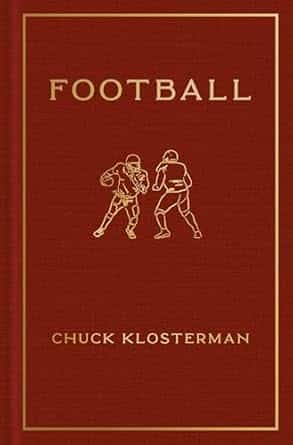
American football is so big — so braided into our weekends, our language, and our culture — that it can be hard to see it clearly as a whole.
In his new book, Football, Chuck Klosterman helps us see the game from unexpected angles, and argues that football isn’t just a sport, it’s a kind of national operating system. Chuck explains how it became the dominant televised spectacle in America, despite having elements that should count against it. We then explore football as a simulation — of war, of reality, and even of itself — and how its simulation through video games has actually fed back into the sport itself. We also talk about who Chuck thinks is the GOAT (hint: it’s not Tom Brady), and the difference between achievement and greatness. At the end of our conversation, Chuck lays out a compelling argument for why football may be headed for a steep and surprising fall.
Resources Related to the Podcast
- AoM Podcast #248: Why Football Matters
- AoM Podcast #1,061: Are You Not Entertained? The Myths and Truths About Roman Gladiators
- AoM Podcast #1,044: What Sports Betting Is Really Doing to Players, Games, and Fans
Thanks to This Week’s Podcast Sponsor
Incogni. Take your personal data back with Incogni! Use code MANLINESS at the link below and get 60% off an annual plan: https://incogni.com/
Listen to the Podcast! (And don’t forget to leave us a review!)





Listen to the episode on a separate page
Subscribe to the podcast in the media player of your choice
Transcript
Brett McKay:
Brett McKay here and welcome to another edition of the AoM podcast. American Football is so big, so braided into our weekends, our language, and our culture that it can be hard to see it clearly as a whole. In his new book Football, Chuck Klosterman helps to see the game from unexpected angles and argues that football isn’t just a sport, it’s a kind of national operating system.
Chuck explains how it became the dominant televised spectacle in America, despite having elements that should count against it. We then explore football as a simulation of war of reality and even of itself and how its simulation through video games has actually fed back into the sport. We also talk about who Chuck thinks is the GOAT (hint: it’s not Tom Brady) and the difference between achievement and greatness. At the end of our conversation, Chuck lays out a compelling argument for why football may be headed for a steep and surprising fall. After the show’s over, check out our show notes at aom.is/football. All right, Chuck Klosterman, welcome to the show.
Chuck Klosterman:
Hey, it’s great to be here.
Brett McKay:
So you have written several cultural explorations during your career and in your latest book Football, you dig into the game of American football and try to suss out how it has influenced American culture in different ways and how American culture has influenced football. The publisher’s description of the book calls football a hyperobject. What is that and why is football a hyper object?
Chuck Klosterman:
A hyper object basically is sort of this philosophical term that means something is so large and so intertwined and imbued in every aspect of society that it’s impossible to see the thing in totality that we only are really understanding the part of it that we’re engaging with. Everything around it is still happening. Everything around it is still sort of informing that idea, but it is pretty much invisible simply due to size. I mean, I suppose an obvious example would be like to say the internet. The internet is a hyperobject. It’s so large that we all understand what it is, but it is impossible to sort of understand it in an all encompassing way unless you step back and say almost nothing in specific. And I think that accurately, that’s sort of an analysis of how football sort of operates in American society, that we certainly feel like we understand it, we can see it on a one-to-one basis and really engage and do it in a really personal way, but it is involved in the larger culture in a way that is not only impossible to see, but sort of unconsciously understood even by those who don’t really care about it as a game.
Brett McKay:
So yeah, football is the most popular sport in America. I mean, you highlight the fact that if you look at the most viewed shows on TV, I think it’s the top 25 are football games basically.
Chuck Klosterman:
Well, yeah, in 2023 of the hundred most watched broadcasts in the United States that year 93 were NFL games. And then I think three more were college games
Brett McKay:
And then I mean also just the football metaphors have just seeped into our everyday conversation. I mean, we make analogies to it all the time in work, in life, et cetera.
Chuck Klosterman:
Sure. There’s obvious examples like people using things like a political football or whatever. That’s kind of the straightforward use of it. This popularity thing though, it’s actually more fascinating I think, than people accept, even though we all know it, right? There are very few, I can’t think of anybody who would be a more than casual follower of sports who would not concede that football is the most popular sport in the United States.
But its popularity, it’s like a different version of it. I mean, there are many countries in Europe or it is very obvious that not only is soccer the most popular sport in some ways it is all their sports. It is almost their combination of football, basketball, and baseball all put together to this one thing that’s really shared, and yet you would not find 93 of the hundred most popular television broadcasts in France be a soccer match. It just doesn’t happen. I mean, baseball is beloved in Japan. Yet at the same time its popularity is in no way a mirror of the way football is popular here, and that’s also particularly interesting because football is an ethnocentric sport. It’s played in the United States, Canada, a little bit in Germany here and there. There’ll be a few places that’ll play it, but it’s really just in this country and in a sense that makes it particularly reflective of our society, kind of along the idea of American exceptionalism or whatever. It’s like only in America does this thing exist and only in America could this thing have the magnitude that it does,
Brett McKay:
And what’s pretty crazy about football being the most popular sport in America. You talk about this in the book and I was nodding my head the entire time, it’s a really complicated game. You note that football is probably the only sport that you can’t play recreationally. They aren’t pickup football games either. They’re touch football games, there’s flag football, but it’s not actual pads on pad football with 22 players. I mean, I played football in high school. The last time I played football was in high school. I remember my last game as a senior. My coach said, for a lot of you guys, this is going to be the last time you played football. And I was like, wow. And it’s true. What was your experience with the sport? Did you play football when you were in high school?
Chuck Klosterman:
I did. Now I went to a very small high school in North Dakota, so I played nine man football. Now that is a version of 11 man football where on offense, you essentially remove the offensive tackles and on defense you essentially removed the cornerbacks. Okay. The idea of course is to have it be as close to 11 man football as possible. So schematically, it’s actually very similar. It’s just for schools with extremely low enrollment, people play both sides of the ball of the punter as well. But beyond that, coming from a town of 500 people where the high school is really the center of the town, even more so than any of the churches, the town is really built around its school in a place like that, and our football program was strong and it just sort of imbued every aspect of life. It’s hard to even, I can’t really imagine what the experience of high school would’ve been like without sports and particularly football involved.
Now my kids are going to have the opposite experience. It’s not going to be the way it is for them, but I mean that’s how it was for me. Then I went to college and I got into journalism and initially I was a sports reporter and I covered the football team. I then moved into this phase professionally where I was a rock critic and a film critic and more of a straightforward cultural journalist. I never stopped watching football though. That was always there. And then about 20 years ago, I started thinking about the idea of football as having a meaning that despite being impossible to escape is still somewhat underrated, particularly as a way to understand the last half of the 20th century and what you’re saying in general is it’s a very true thing.
So soccer is the most popular sport in the world. Everyone understands that. One of the keys to this is that it is the easiest sport to play in the sense that all you need is one kickable object and two teams. You can go to the most remote place on any continent except Antarctica obviously, and you can see people playing soccer. That’s very easy to do. Basketball is a sport you can play by yourself. The idea of shooting a jump shot alone in a gym, it’s not like being in a basketball game, but the mechanics of that activity are identical. Baseball takes space and a lot of guys, but yet we’ve built this whole super structure of recreational softball to simulate that through life. If you’re somebody who was a track star in high school, you can still go running. If you were a swimming star, you could still go to the pool. You could bowl your whole life.
You can play golf your whole life, but not football. You and I could go out in my yard and throw a football around. We could even get two more guys and run little patterns, play offense, defense. It has no relationship to the game for real. The only version of football that really matters is the official version. It can’t really be simulated and that should be a detriment If you were inventing football for the first time, if we didn’t have these sports and we were inventing them, the fact that it’s impossible to recreationally simulate should be a real problem. It should make people feel distant from the game, but it appears that the opposite has happened. It feels that this distance has sort of in a weird way democratized the experience of watching it, that we’re all kind of in the same position where we have this understanding that is not really inherent to who we are. It’s not our own experience. It’s just learned information that we sort of all pretend is something that we can easily sort of understand
Brett McKay:
And very few people have actually played football. I think you did the numbers. It ended up being maybe 0.2% of the population in America.
Chuck Klosterman:
Oh, way lower, way lower,
Brett McKay:
Like 0.02.
Chuck Klosterman:
There’s maybe a million kids playing in high school and then you have a couple thousand playing in college and a small number, whatever roster size times 32 in the NFL, if you include the practice squads, you got some people in Canada and that’s, it is not a universal experience in any way. It’s exclusionary by design.
Brett McKay:
So maybe we’ll get to this through our conversation, but first blush, why do you think so many people like watching football if they’ve never played football and it’s this kind of complex game that, I mean even talk about it, there’s not a lot of action in it. I mean, it’s action packed, but there’s a lot of standing around walking between downs while the chains get moved.
Chuck Klosterman:
Okay, so this is the mysterious thing, okay. I’d mentioned earlier if football was being invented now, we would see its exclusionary nature as a detriment. An even greater detriment would be seen during the theoretical pitch meeting if we’re trying to all come up with new ideas for sports is if something were to say, well, in a three-hour game there’s actually 11 minutes of action. There was this kind of famous Wall Street Journal article where they did research on all these NFL games and they realized that the average three hour NFL football telecast involves 11 minutes of activity. Now on paper, that just seems insane. If someone said, Hey, I made a three hour movie, but actually there’s only things happening in 11 minutes of it, people would be like, what is that? That’s the antithesis of what entertainment is. But what is strange is that the way those 11 minutes are broken down into these little bursts of activity with these gaps in between where you can think about what you saw, you can think about what you’re going to see next and you can think about whatever you want, even if it’s divorced from the game you’re experiencing.
That is part of almost the magical quality of football as a television enterprise. It doesn’t seem like what we should want, but, and the evidence of that is overwhelming.
Brett McKay:
You mentioned television, okay, football is a television enterprise. This is one of your main thesis in the book. It’s this line. I loved it. I have a friend who’s a media theory professor here at the University of Tulsa. He loved it. The line is this, you said “football is a purely mediated experience even when there’s no media involved.” What do you mean by that?
Chuck Klosterman:
Oh, yeah. Okay, so that’s the key point to this whole idea. Okay, so football is invented a little bit after the Civil War and the reason for this, it’s arguable, but there’s this sort of built-in belief that there were people in the wake of the civil War who was like, our sons are not going to fight wars. They’re not going to face adversity. Our society will be a failure because they’ll be too soft. We’ve got to create some simulation for this, and they kind of came up with this support of football. Now, whether or not that’s exactly true or partially true, it doesn’t really matter. Regardless for the next 70 or 80 years, football evolves into something that’s close to what we imagine now, and then it intersects with the inception of television and by chance no one made this happen. It just worked out this way.
Football is the perfect product for the television experience, and television is the perfect vessel for showing what football is. No one has ever constructed a better TV experience than the way football worked out accidentally, and it kind of begins with each kind of famous championship game between the Colts and the Giants. The greatest game ever played where even though the game was blacked out in New York, like 46 million people or whatever, for the first time saw this game, and it wasn’t that they were seeing something they’d never experienced before, they just never experienced in this way. It was the merging of those two mediums, and since then, football’s relationship to television is really the driving force between how it has become this kind of cultural monolith. Our understanding of football is through the TV experience, even for people like you and I who have played, if someone were to say to you, imagine a football game, I am guessing the first thing you imagined was the way it looks on television, even though you’ve played it that you almost imagine that shot from that midfield where you can’t really see depth and the game is being played horizontal across the screen.
You can’t even see the free safety. It’s not even the ideal way to see it if you really care, but it is the way we understand it, and this is part of the reason why I really think that in some ways football is the perfect metaphor for understanding America from say 1950 to the year 2000. It may not be going forward in part because of our changing relationship to television.
Brett McKay:
So what makes football the perfect game for television?
Chuck Klosterman:
Okay, so with almost any other sport, the idea of the televised version of that sport is how can we transmit the live experience into the TV experience? Hockey is the one game that we all sort of understand to be better live because part of hockey is the sound and the feeling of guys smashing up against the plexiglass and you just can’t simulate that on that. Now, almost every other sport, it’s kind of debatable. Baseball can be better live if it’s a beautiful day and it’s just like the ballpark is great, but it can also be in some ways harder to watch if you really care about the outcome than when you see it on television. Basketball is great if you’re next to the court, it’s bad if you’re in the rafters. The best seats tend to be actually the ones that simulate the TV camera boxing, auto racing.
Those have palpable energy and it’s like the sound of it’s incredible, but at the same time, you can’t always see everything. Golf and tennis. There’s an intimacy to being live, but it can be monotonous. All these other sports, there’s sort of like a debate, is it better live or better on television to see the actual sport. With football, there is no debate. It’s always better on television. There’s a million reasons to go to a live football game, but one of them cannot be, I need to really see what’s happening. Even the guys in the game, even the coach on the sideline cannot see the game the way a person on television can, and as a result, our understanding of this mediated event is almost like a full-time mediation of the experience that you think about football means to think about how it is presented on TV, and if you want to get down to real specific things, I mean, it’s the fact that unlike other sports that kind of happen when they happen, we know when football’s going on.
We know it’s college games on Saturday, pro games on Sunday, and there’s a Monday night game. We know this. That’s why part of the reason fantasy football that while not as maybe illustrative of the game is fantasy baseball is more popular. People like fantasy football because it’s very easy to do because you understand when you need to watch these games. There’s also the aspect of that when you’re seeing football from its televised perspective, there’s moments where no one knows what’s happening. The quarterback drops back and he throws the ball deep. There’s a split second where the camera has not followed it yet and we don’t know if the guy is open, is the guy covered? It’s this fleeting moment of complete unknown that is kind of an exhilarating rush. The starting and the stopping is a huge part of it. It seems like something we shouldn’t want, but we do. With nonstop action, say like a sport like soccer or whatever, that can be exhilarating when the play is incredible, but it can also be sort of monotonous and almost hypnotic when the action is kind of a lesser vintage and football doesn’t have that problem. The worst football game is still watchable.
Brett McKay:
Yeah, I mean, I’ve noticed in my experience, whenever I go to a football game in person, I typically spend a lot of time watching the jumbotron. You can’t see what’s going on. Like you said, it’s complicated.
Sometimes there’s a misdirection and you want to see, okay, well how did this running back end up in the end zone? Well, okay, I’m going to watch the instant replay up on the TV because from my vantage point, I completely missed it, and when I look back at the live games I’ve been to at the University of Oklahoma, I remember there’s maybe one instance where I had a great view of Adrian Peterson making this amazing 90 yard run, but that’s it. The other football games I went to, I saw some good games, the Sooners won, but I really didn’t see in person live in real time what was happening. I had to look at the jumbotron.
Chuck Klosterman:
Okay, the thing you’re saying is almost a perfect encapsulation of something I write about. So you had this one play where you see, I’m guessing, my assumption is that Adrian Peterson was running the ball and he was running right at you for whatever, right?
Brett McKay:
Correct.
Chuck Klosterman:
He’s coming at you and you were the only person maybe or maybe the people in your very close vicinity who had that specific experience as if this amazing play was actually built for your vantage point by chance because that’s where your seat were. But for the rest of the game, in all likelihood, what you were usually doing, again unconsciously, is seeing something from your seat and mentally transposing to how it would look on television
Brett McKay:
Yeah.
Chuck Klosterman:
We see these things and we triangulate it in our mind and put it into that kind of television scope, that shot from midfield kind of in the downward angle as the players are moving, sort of like I said, across the field horizontally. Now, there’s some people listening to this podcast who are probably saying, well, that’s not how it’s for me. You can’t get inside my brain. That’s not how it is, that’s true. Okay. This is not something I’m able to really prove. I can’t get inside another person’s head and say, this is how the experience is, but I’m confident that that’s how it is for most people, including most of the people who deny that this is their experience.
I think that in general, and in fact maybe in totality, the experience of a video screen of the monitor overwrites our understanding of reality. I think that’s just either a consequence or a problem or maybe even a benefit of modernity that we have now sort of experienced a mediated world so fully that the things we like most are the things that best fit into that sort of technological experience, and football is one of them.
Brett McKay:
Well, if football’s better to watch on TV or on a screen, why do people still go to live football games?
Chuck Klosterman:
Well, there’s a lot of ancillary reasons to go to an event besides, I want to see it in the most lucid way. I mean, in the same way, if you really love Steely Dan, you were never going to get a better experience than you were on the record. You were never going to hear something live that would be as perfect as the way you’d hear it on the record, but you still might even want to go see the show. I mean, you go to a football game, there’s a whole bunch of things going on. There’s the collective feeling of being with a bunch of people with the same ideas and that suddenly you have a relationship with strangers because you all kind of like the same thing, and it is interesting to be in a large crowd, there’s a palpable exchange of energy when that happens.
It might remind you of maybe having gone to a game when you were a kid and now you’re bringing your own kid. I think in some people’s mind, the ability to cheer and sort of act like a different person in a live event is extremely attractive and many live events sort of allow this to happen. These are all reasons. It’s like the idea that maybe if I yell help my team or whatever, that’s sort of an insane thing to think, but people think that, right, and that’s totally fine, but to see the game, if someone says, I’m going to the A FC championship because I really want to see what happened, I mean, that’s insane. That would never be if you really wanted to see it would be the television experience.
Brett McKay:
I was just thinking, so television has made football viewing better. You can view the game better on TV, but I do think in some ways television has made live football viewing worse. Here’s an example, so a few years ago we went to the Oklahoma State-BYU football game. It was cold, it was sleeting, it was raining, the game went into overtime and it was televised, and we were just ready to go home because we were just like, oh my gosh, we’re just soaking wet and it’s cold. But we had to do the stupid TV timeouts. It wasn’t like a timeout because the team needed a timeout. It was like, we need a timeout so we can show commercials on television for the people at home, and it just made the game longer than it needed to be.
Chuck Klosterman:
Oh, absolutely. I think the first time any kid, an 11-year-old kid who likes football goes to his first pro game. It’s always very weird to see that there are these long stretches where nothing is happening. The players aren’t even talking to each other. They’re just kind of waiting around while the sound system plays Guns N Roses or something and just we eat up two minutes and then the game starts again. That’s true. Television has made the live experience worse, but I mean, I guess there’s a lot of people who would say that that is one of the hallmarks of all technology, which is that it detracts from the organic experience. I mean that, this is probably a crazy thing to point out, but go back and read what the Unibomberi, Ted Kaczinski, was writing about. One of the things he was writing about was that technology puts a ceiling on our freedom that we can’t even recognize because we assume the ceiling is normal, that our ability to imagine or experience the world is sort of limited by our mediated understanding of it, and that’s what happens with television and all sports in a way.
I mean, it is interesting to say, go to an NBA game that’s not being televised by TNT or ESPN. When I go to a Blazers game here that’s just being shown locally, the game feels fast. They’re not building in all these breaks. It’s a better experience, but then it is sort of like a risk reward thing. I mean, it’s like if you’re from the NFL, from their perspective, what is more important, the 65,000 people who are in a stadium maybe or the 6.5 million people who are watching it at home, and in many ways subsidizing this sport in a way the people in the stadium are not. Yes, the people in the stadium are buying tickets, they’re paying for parking, they’re eating hot dogs, revenue is being generated, but all sports now, all major sports are built around the television contract with various networks and platforms, and those are the people who matter.
Brett McKay:
Yeah, so this is a perfect example of how football is a hyper object that when we’re talking about football, we’re talking about something bigger than football. I mean, in our conversation, I didn’t see this coming up, but we name dropped the Unabomber.
Chuck Klosterman:
Yeah.
Brett McKay:
There you go. Yeah,
Chuck Klosterman:
I do that a lot.
Brett McKay:
So in the book you mentioned that football is an unreality, that it’s a simulation on multiple levels. You mentioned it earlier, football is often seen as a simulation of war. The founding legends that it was started after the Civil War, people were anxious about masculinity, the whole muscular Christianity movement. Teddy Roosevelt’s strenuous life, so the guy we got to develop this game to toughen boys up simulates war, so they have experience with it. I mean, I think Dwight Eisenhower, he played football at West Point. I think he coached at West Point.
I think he even said that football’s the best game to prepare men to fight in war. What do you make of that idea of football as a good simulation of war? Is there anything to that or is that kind of overblown?
Chuck Klosterman:
Well, it’s a tricky thing. Is football the best game to prepare young men to later fight in war? I mean, among sports, it probably is. I don’t think that we look at sports necessarily as that should be their purpose, certainly not now. It would be weird in a modern context if someone wrote a book promoting the idea of football based on the idea that this could help us militarily moving forward or whatever. But the same time, it’s an interesting thing. I mean, the thing that I argue in this book is football is a simulation of war. There is no question about it, but it’s a simulation of ancient wars. It’s not a simulation of modern warfare. It’s a simulation of the way wars would’ve been fought in the 19th century or the way that they would work and the board game strati or whatever. It’s not like Don DeLillo had a book come out in 1972 called End Zone, and it’s a football book and it deals a lot with the idea of nuclear holocaust and people, they didn’t really love this book when it came out because they were like, well, it’s kind of too on the nose to say football is like war.
But he was actually arguing something that was really prescient that the other people didn’t get, which is that he was essentially saying that football’s relationship to war kind of ended with the advent of the atomic weapon, that football’s relationship to war is the way wars were once fought, and I think that is the draw. It’s not the draw that I’m seeing something that’s like a war. The draw is I’m kind of seeing a modern incarnation of military history and military history is, I mean, it’s the fascinating thing, particularly to middle-aged men.
Brett McKay:
It’s true.
Chuck Klosterman:
That as you reach a certain age as a guy for whatever reason, you tend to become more interested in history and particularly the conflicts of history and the modern version of football, even though it in many ways completely divorced from that, you can watch a football game. It’ll never come up, and yet there is a tie back to that because what’s the thing about military conflict? It’s like the stakes could not be higher. You live or you die. A mistake you make isn’t something that you regret. It means that you were killed or the people around you were killed. Responsibility is high. There’s a version of that in the football game as well where you can’t talk your way around getting leverage on the tight end. You can’t make an argument that says, I can run this guy down even though he’s faster than me in football. A lot of the sort of visceral things about being alive are present. It’s a very intellectual game. It’s a very sort of rehearsed and orchestrated game, but when two guys are running at each other and they’re going to collide, the outcome is based on physics. It’s not based on what we want to have happen. What football does in a lot of ways. Football eliminates the possibility of us saying, well, I want the world to be this way. It’s like, this is how the world is.
Brett McKay:
Yeah, I think that’s a great point that football is a simulation of war, how it used to be because now with the nuclear bomb, it’s like, well, everyone’s hosed. Even the fans, they’re hosed. You can’t do anything about it.
Or even in a smaller scale, drone warfare or whatever, so drones do real damage, but it’s almost like it would be sort of like if all wars were fought with robots, would the outcome of those wars still matter? I don’t know. There has to be sort of that human consequence and football is a reminder that human consequences are not just constructions. It’s real.
And maybe that’s why I love trick plays because it’s almost like gorilla warfare. You’re flipping the script. You’re not following the typical script. That’s what gorilla warfare their advantage is. You don’t follow what you’re supposed to do. You don’t follow the typical rules of engagement. You do something out of the ordinary. Maybe that’s what a trick play is like, ah, I love seeing that flea flicker. It might not work, but if it works, it’s just devastating.
Chuck Klosterman:
Well, because that is sort of the counterbalance where the idea that this is really just a game about size and speed, not on this double reverse. It wasn’t on this, it was schematic. It was strategic, it was intellectual. We have these sort of ideas about what the culture of football means, and very often it’s seeing a pejorative weights that the culture of football is almost like everything we’re trying to erase from the world, but it is a complicated game. It is a game based on sort of an understanding of your opponent and analytics and how much practice you’ve put into it and sort of your own pure originality and creativity. I mean, it’s football art. Well, I suppose technically not because usually when we say what qualifies something as art, there’s all these things that have to intentionality and all these things have to sort of be recognized, and football doesn’t necessarily do that, but the expression of football, the way football is as something we watch works in the same way. It is an artistic experience.
Brett McKay:
There’s a woman that wrote an essay about the forward pass, I forgot the name. It was really good, and she just talked about how it’s just the most beautiful thing in the world to watch an amazing long bomb forward pass, and it’s artistic, unintentionally artistic. But yeah, I mean, I appreciate whenever a team uses artistry. I mean, I’m an OU fan. I still think about that game. I guess it was 2007 when they played Boise State in the Fiesta Bowl and they ran the hook and lateral the Statue of Liberty. It sucked because OU lost, but I’m like, man, that was awesome.
Chuck Klosterman:
Yeah, I mean, I think it could be argued if somebody said to me, what was the greatest five minute span of football in the 21st century? It would be the end of that game. It would be the play, the touchdown, the two point conversion, the player proposing to his girlfriend in the end zone afterwards. The only time, in many ways, an upset of that magnitude has happened on that stage. I mean, obviously there have been bigger upsets, a small school beating a big school, but that was the biggest game of the year for both teams. It was almost everything that we want football to be in that little encapsulation.
Brett McKay:
Okay, so football’s a simulation of war. Another thing you talk about, and I thought this was really interesting, there’s like this reverse dynamic going on is that video game football, which is a simulation of football, has actually changed the real game of football. Tell us about that.
Chuck Klosterman:
Well, it’s strange, but in some ways, I guess it’s also predictable. There was a period in the nineties when there was a realization that the goal of a football video game or really any sports video game, basketball, baseball, soccer, all of these was an attempt to somehow find realism. This was a big part. When Madden, that football game became this kind of juggernaut, John Madden was involved with the creation of that, and his thing was, I want this game to be, I want it to look the way football looks. In fact, EA sports, when they made that game, they wanted to have it be seven on seven because it would be less stress on the computing, it would be less guys, and John Madden was like, no, it’s got to be 11 on 11 or it doesn’t count. So this whole thing became this idea.
It’s like, well, let’s try to make a football game that’s realistic. Now, there are limitations. Of course, you make a football game on a video screen, you’re going to have capabilities that don’t exist in real life, and that’s what any kid or anyone playing the football game does. What are the limits of this? What is fascinating is that many of the things that were only attempted or would’ve only been attempted in a video game in 1997 are now part of football for real.
A lot of the throws Mahomes makes, for example, in the past, they would’ve only been seen as something that could be done in a video game. You wouldn’t have seen a guy, the throws Patrick Mahomes makes in the past would’ve got a quarterback benched, and now not only does he do it, but a lot of guys do it. If you watch the Ole Miss game in their play, it was like their quarterback made three throws that to me seemed like they would’ve only happened in video games in the past, and in fact, a friend and I, we’ve been playing the college football game for years, and I used to always criticize what he was doing as being too unrealistic that that would never happen.
Now, a lot of the things that he did in the past are actually part of the way the game is played now, the idea of okay, going forward on fourth down as often as teams do. Now, a lot of people credit that to analytics. They say, well, we’ve just done the math and the value and the risk reward and all this. In some ways, that started with people whose introduction to play calling came through playing video games. I mean, those people are adults now, and they were sort of of the belief that giving my opponent possession of the ball, even if I gained 35 yards on this punt, is not as valuable as the 50-50 odds of me gaining two yards on fourth and two. These are things that start in these video simulations by amateurs, move up to the high school level, eventually are adopted by college coaches and then become part of the NFL.
Like I say, in some ways it seems strange. It seems weird to imagine that some high school kid in the nineties is affecting football now, but in another way it is predictable because that’s what simulations do. Simulations teach people of new ways to think.
Brett McKay:
Yeah, I mean, I love playing NCAA college football, and my go-to is if it’s fourth down and I’m in my own territory, like 10 yards from my own end zone, I’m not punting it. I’m just going to do a Hail Mary and see what happens, and oftentimes it works.
Chuck Klosterman:
Well, what’s weird to see, I’m kind of the opposite when I, I’ve played this game now thousands of times. I dunno how many hours I’ve spent for real, but the guy I play against, the same guy, he’s another sports writer named Michael Winery. He’s the only person I’ve ever played against in my life, I think. But it drives him crazy because I am, he feels I’m just so conservative. If it’s late in the first half and I have the possession of the ball and I’m deep in my own territory, I’ll have my quarterback take knees and go to the locker firm, and he just finds that maddening. He’s like, this is a video game. Why are you doing this? We can do whatever we want. You’re just trying to make it less fun for both of us. But I love the idea of trying to make it as real as possible.
What is interesting in society at least, or the culture of football, has advanced faster than me. I still think that way. I still think like a coach from the seventies. I still think that way. That’s the way when I watch a football game, that’s how I am, and the game itself has moved way past that. Now, if you watch, watch the Rams play whatever McVay is doing things that are far more innovative than I sort of believed were even possible when I sort of got into football, but that’s also kind of in a weird strange way, the conservative draw of the sport is that football is always about the past. In a way, it is tied to the world that we’ve left and it’s still operating in the world that we now inhabit.
Brett McKay:
Alright, so another example of the medium changing football. So television changed, football, video games have changed football. Another simulation of football that’s having an effect on the game that you talk about is fantasy football and then fantasy football. It’s kind of morphed into gambling essentially. What do you think is the appeal of fantasy football leagues? I’ve done one or two when I was in high school. I never really got into it, but some guys, they live for this stuff, and the thing about fantasy football, it is a complete simulation because you’re creating these imaginary teams of players who are not on the same teams trying to create a winning team based on real gameplay. What’s the appeal of this weird simulation of football?
Chuck Klosterman:
Well, okay, so fantasy football is really an outgrowth of fantasy baseball. Fantasy baseball starts in the seventies, late seventies and early eighties, and I mean it may have existed before that, but that’s when people started. I mean, there was a big story about it in Inside Sports Magazine. It went a long way to sort of popularizing it, and then when baseball season would end, because baseball is well suited for the fantasy realm, even though it’s a team sport, individual batting, individual pitching, they’re separate from everything else. So statistically, it actually was an accurate reflection. A good fantasy baseball team would’ve been a good baseball team, so football kind of comes out of that. Guys who play fantasy baseball are like the season’s over now what do we do? I started playing fantasy football in 1990, and that was a very, very different time for lots of reasons, but particularly for something like this, it was no yardage, no reception, nothing like that.
It was just touchdowns and field goals. All the math was done by hand from taking the newspaper on Monday and Tuesday and going through all this stuff and what that was at the time. Initially it was almost like, here’s just one more way to experience football. It was additive. You can watch the games, you can read about the games, but now you have this other thing you can kind of play your own little version of it. It was not at the time that connected to gambling, like gambling in 1990, 1991. That’s kind of like when Pete Rose was getting banned from baseball. It was still seen as something only really degenerates did because it was illegal and you have a bookie and all these things. Well, it’s not very clear that fantasy football was sort of priming the pump for this coming world of gambling we now live in.
Because what fantasy football did was something that was really novel. It could appeal to the kind of person who loved football and didn’t necessarily care about the outcome of the game that you could watch a game and care about the tight end. He was on your fantasy team and it didn’t matter to you if they won or lost. In fact, you might want them to lose because that might force the team to throw more in the fourth quarter and your tight end might have more receptions. It individualized the sport and allowed people to think about football in this different way that was divorced, sort of from what used to be the only thing that should have mattered who won or who lost you. Now see this all the time. I mean, that’s what gambling is. I mean, anybody out there, I’m not a gambler really.
I don’t really have the right constitution for it, but I really follow it because I’m really fascinated by it. There’s something very strange about picking a team to win by more than five and a half points and watching them in the fourth quarter when they’re up four and just trying to figure out ways, well, how can they get one more field goal. Here you’re watching this completely different game. It’s still the same game that you would be watching if you had no money involved at all. But now it’s a completely evolved thing where there’s a game inside the game and really the main player is you. Fantasy football sort of did that in a way without now, it was also just, I think in a lot of ways a way for people to connect through a sport even though they might have asymmetrical interest in that sport.
And what I mean by that is I’ve been in fantasy football leagues that are in an office. I’m working in an office and someone wants to start a fantasy football league, and the 12 people involved all have different levels of interest in football. There’s a few people who live and die for it and would watch it every weekend in their life if they could, and a few people who wouldn’t watch it all and only follow it because they have a fantasy team. And yet the way fantasy football operates, especially through the internet, everyone is equal. The internet does the work for you. It tells you who to draft. It tells you to start, so you don’t need to be an expert to win your fantasy league. I’m in a college football fantasy league. The league is called Chanology, we call it we named after Lane Kiffin. This was back when he was not now, this was years ago when he was a totally different kind of figure and a guy who dominates that league. The name of his team is who is Lane Kiffin. He had no idea who Lane Kiffin was when he joined this league, and yet he’s become by far the best owner in this thing because it’s not really about knowing about football. It’s being able to understand the outcome of past games.
Brett McKay:
If television has changed, football, video games have changed football. Do you think gambling, fantasy football is changing football, the actual game?
Chuck Klosterman:
Well, I don’t know if it is changing the actual game between the lines on the field. It’s changing everything else though. I think that all the sports leagues, including the NFL, understand that they need to have a relationship with gambling not just to flourish, but potentially to exist in the future. That right now, the NFL is this monolith due to wealth that is mainly acquired and accumulated through advertising that because football is so popular and because it’s a live event and it’s the only thing that if you make Pepsi or you make Volvos or whatever and you want to reach the largest possible audience and expose them to these ads, football is the best means for that. I don’t know if that will always be the case, and if that starts to change, there’s going to have to be a way to continue not just this level of revenue we have now, but to keep increasing it.
Because football can’t operate in a static sense. It can only get larger, and I think gambling might be the only way to keep that happening. I mean, I felt that one of the very, there were many very instructive things about COVID, but one of them was, it was like they still got to play all these football and basketball and baseball games. They got to still play these big 10 football games to no one in the stands. They got to do it, and it was like, wow, this is a little more fragile than I realized that the entire world can essentially shut down, but we still have to make sure Rutgers plays Iowa. It has to happen. I mean, that just shows you how much of the foundation of these things is brittle because it’s not that it’s too big to fail, it’s too big to stop. It’s got to keep going.
Brett McKay:
Yeah. Well, I want to talk about the fragility football, maybe the potential future of the game, but before, one question I want to ask because I thought it was really interesting. You have this whole chapter about who’s the greatest player of all time in football. Most people would say Tom Brady because he’s won all the Super Bowls. You make the case that it was Jim Thorpe and as an Okie, I was ecstatic to see this because growing up in elementary school, middle school, high school, you learn about Jim Thorpe, greatest athlete of all time. You hear the story of him rummaging through the trash can to find a track shoe so he could run this race and win it. He played football, he didn’t play football for very long. We don’t have any footage of him playing football. How did you then determine that he was the greatest football player of all time?
Chuck Klosterman:
Well, that’s an interesting section of the book that a lot of people bring up to me because on the surface, it’s kind of like chock full of football discussion, discussion of players, discussion of Randy Moss, discussion of Tom Brady. But in a larger sense, it is kind of an ideological point about the concept of greatness and how does one gauge that, right? If we go simply by who would be the most outstanding physical specimen to have on your team right now, it kind of becomes a completely irrelevant argument because what that’s going to mean is that the best player of all time is always going to be who is the best player right now? I mean, any average quarterback in the NFL right now, if you put him back into the 1980s, and he’s a legend. I mean, he’s going to be on par with Marino and Elway and those guys just because the way that physicality changes and skills change and all that stuff.
It’s like modernity is always going to reward whatever is the greatest thing in the moment. But that to me is kind of the wrong way to think about greatness. To me, greatness is the creation of archetypes. It’s the first elite version of something that is still contained through all the latter versions. In other words, it’s almost the invention of the idea of what being a great football player is, and that to me does seem to be Jim Thorpe. Okay, so Jim Thorpe was playing in the 1920s. It’s an 11 man sport at that time. It’s four downs. It’s six points for a touchdown. Yes, the guys aren’t wearing face masks. It’s a primitive version of the game compared to what we do now. It’s a primitive version of the game even compared to the 1950s. But yet, what was great about Jim Thorpe we’re the core characteristics of what we think about a great football player now, which is basically speed, strength, agility, the ability to understand these positions and master them to be the person other players aspire to be like that is the foundation of what a football player is. It kind of goes back to Jim Thorpe. I mean, that is sort of what I’m talking about in that section. That’s sort of the idea of that our understanding of what a great football player is or what a great football player looks like was kind of in the DNA of Thorpe, the experience of Thorpe.
Brett McKay:
I like how you make the distinction in that chapter, the difference between greatness and achievement. So you mentioned the fragility of the game. People might think, well, how is football fragile? It’s the most popular thing on television. It makes billions of dollars, billions and billions of dollars. There’s no way that this thing could go away, but you make the case. We might have a world where football, it might exist, but it’s not going to exist how it exists today. So why do you think football 30, 40, 50 years from now might not be a hyper object anymore?
Chuck Klosterman:
Well, I mean the simplest answer is that the world’s going to change, and when the world changes, large objects have a harder time transitioning than small objects. It’s like the largeness of football is both. Its sort of value in the present and its danger in the future. Like I said, football, it’s not just a football’s so big, it can’t in any ways collapse, but it’s like it needs to keep expanding. It’s only set up to become a bigger and bigger thing every year. The revenue has to go up every year, the popularity needs to go up. They need to play games in England and in Germany and in Mexico City. They need to make it larger and larger and larger because the way it is created in the amount of money it consumes, the amount of money the players consume and the franchisees consume consistently goes up.
It just keeps going up and they’re never going to go back. There’s never going to be a point where the players’ union would say like, okay, we’ll take a pay cut because it’s good for the league. That will never happen. So with the NFL and pro football, and all pro sports in general are dependent on is that the amount of money that they earn from ad revenue is always going to be able to outstrip the costs, and that every year, the contract for who gets to show the NFC and the AFC that Fox or NBC or CBS or these places, they’ll always pay more because it’s worth so much to them. But that is dependent on advertisers seeing advertising as the same value it has. Now, I think that this is going to change. I predict that over the next 40 or 50 years, there is going to be a pretty massive sea change over what is seen as the value of a commercial and the value of advertising.
We’ve never really been able to prove that advertising works at all. We know it does in terms of introducing a product to people that if someone has never ever heard of Budweiser before and they see a Budweiser commercial, now they know it exists, but then if they see 15,000 more commercials for Budweiser, it’s not going to necessarily make them thirsty. It’s just the best thing we have. We don’t know that advertising works, but there’s kind of tautology, well, the most successful places spend a lot on advertising. It must work or whatever. I think that’s going to shift, and when it shifts, it’s going to shift really fast that suddenly there’s going to be an understanding that spending a bunch of money on a commercial and then spending more money to have that commercial shown during the Super Bowl or whatever is going to evaporate, and when that happens, there’s going to be this real sort of grinding moment of friction where it’s like, well, now the NFL has to work.
We’re not going to be able to expand. We’re not going to be as much money as we used to do. We contract teams? Do we change these contracts? The players will strike. Now, there have been strikes in the past before in the eighties, but this will be a combination of a strike and a lockout because the owners will see the same thing. They’ll see, well, we’re going to lose money by playing these games, and the players still want more money. They still want to raise, so they’ll be this big stoppage. Now, if that happened right now today, there’d be a national freakout. If football was suddenly gone every weekend, people would be like, what am I going to do on Sunday? What am I going to do on? What am I going to gamble on? What about my fantasy team? What about my, it would be that might not be true, and I don’t think it will be true in 40 or 50 years because the personal relationship to football that we had for most of the 20th century is kind of disappearing.
There’s a bifurcation now between the very small sliver of people who have a personal relationship to the game and the many, many more people who just kind of see it as an entertaining distraction, an entertaining distraction they love, and which that they see as something that’s maybe intrinsic to who they are, but not in a way that sort of touches who they actually are. I guess it’s like it’ll be something like, well, I watched football. My dad watched it. He didn’t play either. My grandpa maybe did. It’ll just separate and separate and separate, so when this sort of work stop, it occurs. People are going to care much less than we would expect them to, much less than they would care today. The comparison I use in the book is how in 1920 or whatever horse racing was one of the three biggest sports, and that was because people still had a relationship to horses in all walks of life.
Even if they lived in an urban area, they had grown up in a rural area and their father had owned horses, or they had a blue collar job where horses did the labor. I mentioned out in Chicago in 1900, it was called the city of Horses. Even if you lived in Chicago, horses were everywhere. So horse racing was a natural extension of that. We had a relationship to the horse for a long time. Most people in America had some relationship to football. Even if they didn’t play, it was something that their friends played or that meant a lot in their high school or college or all these things. It was the one time their family was all together on Sunday watching the same thing. I think when that disappears, a super lucrative hyper object becomes extremely fragile.
Brett McKay:
So fewer people are playing tackle football, so people are going to have less of a personal connection to the game, and I think too, people are going to lose a connection to the game just because with NIL and portal transfers, people are just going to lose their connection to the college game. The teams are always changing. It’s all just so mercenary, so you lose that connection to your hometown team or the team you root for, and then the leagues rely on the networks paying tons of money for the rights to air football games. I think it’s something like 12 billion for the NFL. It’s billions to Air college games. And right now networks are willing to pay that money. They’re willing to pony up because the advertising is valuable enough to justify it. But eventually advertising won’t have the same ROI. So networks won’t pay as much. And the NFL its model is based on the bright’s cost going up and up and up. So when the money stops going up, it all start to collapse. And this reminds me of a guy we had on the podcast a while back ago who’s an expert on roaming gladiatorial games. And he said this is one of the reasons why they disappeared. They just got bigger and bigger and more and more elaborate and eventually they were too expensive to put on so they went away. Yeah.
Chuck Klosterman:
They were trying to do things like they would fill a coliseum with water and have naval battles on this. It was like, I’m sure that was essentially the Super Bowl of its time.
Brett McKay:
Yeah. Yeah. It’s funny because people often kind of compare football games to gladiatorial games and the same fate might happen to football, American football. Well, Chuck, this has been a great conversation. Where can people go to learn more about the book in your work?
Chuck Klosterman:
Well, I mean, if you want to learn about the book, you got to buy the book, I guess in terms of learning about it and learning about me, I don’t know. I guess all my old books, I don’t really view much social media anymore. I do these podcasts when people ask me to be on them, but yeah, I don’t dunno.
Brett McKay:
You’re a hermit. I love it.
Chuck Klosterman:
Yeah, kind of.
Brett McKay:
Yeah. Alright, well Chuck Klosterman, thanks for your time. It’s been a pleasure.
Chuck Klosterman:
Thanks.
Brett McKay:
My guest today was Chuck Klosterman. He’s the author of the book Football that’s available on amazon.com and bookstores everywhere. Check out our show notes at aom.is/football where you’ll find links to resources where you can delve deeper into this topic.
Well, that wraps up another edition of the AoM podcast. If you haven’t done so already, I’d appreciate it. If you take one minute to give us a review on Apple Podcast or Spotify, it helps out a lot. And if you’ve done that already, thank you. Please consider sharing the show with a friend or family member you think would get something out of it. As always, thank you for the continued support and until next time, this is Brett McKay reminding you to not only listen to the AoM podcast, but put what you’ve heard into action.