When you have a high-responsibility job, your work hours can readily bleed beyond the 9-to-5. You’ve got a lot of tasks that seem urgent and important and an endless number of people who need responding to. This is of course especially true in the age of smartphones and digital communication, when bosses and colleagues feel free to message you at any time — even when you’re nominally “off the clock.”
The problem of ever-expanding work hours may be more prevalent these days, but it’s not new.
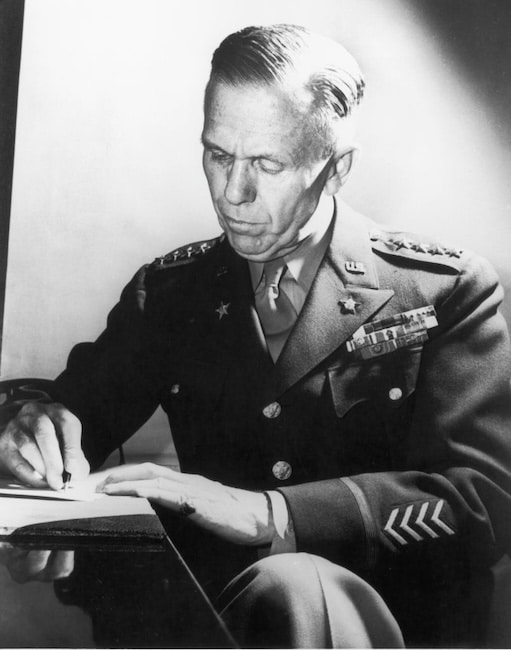
General George Marshall faced the issue almost a century ago. And found a way to overcome it.
As Chief of Staff of the United States Army during World War II, Marshall oversaw the expansion of a military ranked seventeenth in the world into the most powerful fighting force in human history. He managed nine theaters of war, helped oversee the Manhattan Project, and directed millions of personnel across the globe. His job was arguably the most complex administrative role of the twentieth century.
Day and night, there was always some issue, in some branch, in some part of the world that Marshall could be tending to, and that he could have convinced himself was urgent — the fate of democracy hung in the balance, after all!
But Marshall walked out of the War Department at 5:00 PM almost every single day and didn’t think about work until he showed up to the office the next morning.
How did a guy who oversaw the largest, most complex military campaign in human history do that?
The Marshall Plan — For Taming His Work Schedule
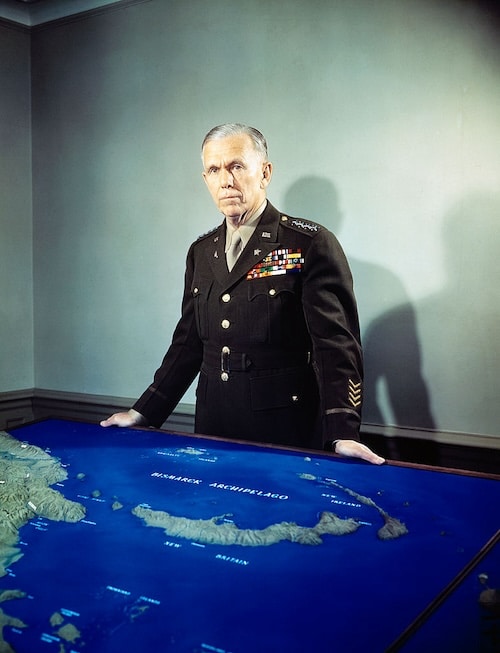
Here’s how General George Marshall kept the tentacles of his work responsibilities from expanding into an all-encompassing chokehold:
Marshall Gutted the Bureaucracy
When Marshall took over as Chief of Staff in 1939, the War Department was a mess. Over sixty different bureaus and agencies had direct access to his office, which meant he spent most of his time refereeing petty jurisdictional squabbles instead of planning a war. Marshall described himself as being “worked to tatters on minor details.”
So in early 1942, he blew the whole thing up. He directed Brigadier General Joseph McNarney to streamline the organization. The results were dramatic. The number of people with direct access to Marshall dropped from over sixty to roughly six. He created semi-autonomous commands — Army Ground Forces, Army Air Forces, Services of Supply — that handled their own training and supplies procurement.
And he established the Operations Division (OPD), which functioned as a single command post that filtered the entire war’s worth of data into a manageable stream of intelligence and proposed actions.
The OPD was the key to the whole thing. Theater commanders had to send copies of all combat-related messages to the OPD, and the OPD’s job was to synthesize that information and only bring the “broad phases of plans or changes” to Marshall. When Marshall sat down at his desk each morning, the information had already been distilled by competent people. His only job was to exercise judgment.
Marshall Demanded the One-Page Memo
Marshall had a rule: if you couldn’t explain your problem and propose a solution on a single page, you didn’t understand the problem yet. The one-page memo requirement forced his staff to do the hard thinking before they walked into his office, which meant Marshall could review dozens of critical strategic questions in the time it took other commanders to get through a single briefing.
Marshall Maintained Strict Boundaries
Marshall’s daily routine was boringly rigid, which is what made it effective.
He woke up at 6:30 AM and was at the War Department by 7:30. He’d get a global briefing at 8:00, and then he’d dive straight into strategic work through the morning.
He ate lunch and followed that up with a power nap. Marshall was a big advocate of the midday nap and pushed Eisenhower and MacArthur to adopt the habit.
After his nap, he worked through the afternoon until 5:00 PM.
At 5 PM on the dot, he’d leave the office for the day.
What did he do in his personal time?
Horseback riding. It was a non-negotiable part of his day. Marshall rode with his stepdaughter, Molly, or alone with his dog, Fleet. He specifically refused to ride with colleagues because he didn’t want “office talk” creeping into his recovery time.
After riding, he had dinner with his wife, Katherine, and was in bed by 9:00 PM.
Marshall understood that if you work yourself to exhaustion, you won’t have the mental clarity and energy to actually do the work you’re supposed to do. He was able to get more done during the time he did work because he was well-rested (thanks to the power nap and strict sleeping schedule) and refreshed (thanks to horseback riding and strict leave-the-work-at-work policy). And by standardizing his schedule, he eliminated that low-grade decision fatigue that makes you stare at your inbox for 10 minutes without actually writing any emails or causes you to snap at your kid for asking a simple question.
Even on the morning of December 7, 1941, Marshall was out on his horse, Prepare, at Fort Myer. Some people at the time criticized the optics. Why wasn’t the Army Chief of Staff at the office as soon as that Day of Infamy occurred? But Marshall understood there was nothing he could do immediately, so he took the time to get his mind right before he had to get down to business. His ability to remain “especially cheerful and optimistic” in the hours and days after Pearl Harbor was a direct product of those physical and emotional reserves he built up through deliberate rest and relaxation.
So, What Can We Steal From Marshall?
While we may not have to manage nine theaters of war, nor have Marshall’s latitude in restructuring administrative operations, I think we can use some of Marshall’s principles to tame our own workload into a more humane schedule. It’s all about working effectively when you’re “on the clock,” and actually checking out when you’re off it.
Cut the number of communications you have coming in. How many people have direct access to your time and attention? How many pings and dings do you receive?
Marshall cut his direct reports from sixty to six. You may not be able to be that aggressive, but you can identify the nonsense that eats your day without producing anything useful. Aggressively reduce the number of apps you have to check for communication. Use filters in your email so that only the important stuff shows up there. Turn off notifications from web services that you use. Use your phone’s Do Not Disturb feature and only allow VIPs to call or text you. Don’t attend meetings where you’re not needed. Get rid of the deadwood.
Organize your communications and answer them in blocks. You don’t have an OPD to synthesize your info and give you a one-page memo about it. But you can turn the intelligence you receive into a manageable stream and claw back a lot of time and bandwidth by keeping information and conversations organized into set channels.
In my conversation with business efficiency expert Nick Sonnenberg, he said that 20% of an employee’s time can be spent just looking for where information about a certain topic/project ended up. To shrink these “scavenger hunts,” he recommends designating certain channels for certain communications: text for personal matters, email for external communications with clients, vendors, and partners, and apps like Slack for internal team messages. By eliminating the search for where particular information resides, Nick’s found that workers gain back hours of time.
I also recommend establishing a “correspondence hour” — set blocks of time when you answer messages. In the morning, I glance through my emails, texts, and messaging apps and take action on anything that needs action. At night, I do the same thing. Doing this in set, consolidated blocks saves time over constantly ping-ponging back and forth through apps throughout the day.
Pick your 5:00 PM. You don’t need to literally knock off every day at 5:00 PM like Marshall did, but you need to establish a hard boundary where you take off your general’s cap and put on your personal one.
Marshall rode every evening because, without those hours on the horse, he knew he’d eventually start making bad calls with millions of lives on the line. Find your horseback riding. It could be working out, building model trains, or reading a book. Whatever. Pick something that has nothing to do with your job and do it as a way to transition from work mode to private mode.
If you’re an employee rather than a boss, it may be harder to say no to responding to messages when you should be off the clock. But try to have that boundary-setting conversation with your supervisor. And set expectations with your own behavior. If you always respond to messages in the evening and on the weekend, people will take that as the norm; if you don’t, then they won’t expect you to.
Nick also recommended keeping in mind that the more emails you send out, the more you’ll get back. So avoid the temptation to send “just one” response on a Saturday, lest you find yourself caught up in a back-and-forth that runs all weekend long. If you need to get a response off your mind, write it up, and then schedule it to be sent first thing Monday morning.
General George Marshall went on to create the Marshall Plan, rebuild Europe, and win the Nobel Peace Prize. He did all of it on eight-hour days with absolute focus, discipline, and a genuine understanding of human limits. He understood that a man’s effectiveness has a lot more to do with the quality of the work he does at his desk than with how many hours he sits there.