Our recent article about backup power got me thinking about backup light sources. For most people, their backup light source when the power goes out is a flashlight.
But flashlights come in handy even when the grid doesn’t go down. I reckon, out of all the tools you keep in your home, your flashlight is one of the biggest workhorses. I know I use my flashlight on the regular. Kid lost a toy beneath the couch? Flashlight. Trying to find the source of a leak in your attic? Flashlight. Grilling burgers on dark winter nights? You’re going to need a flashlight, bud.
Back in the day, the home flashlight was probably a big ol’ red plastic Eveready or a heavy aluminum Maglite that could serve as a beatstick in a pinch. These torches got the job done, but they had their limitations. The light was a contrast-reducing yellow, the batteries sometimes leaked, and the beam was narrow and weak.
Flashlight technology has had some serious upgrades since the 1980s. Brightness, color, and lasting power have improved dramatically.
Whether you’re investigating a bump in the night or trying to identify color-coded wiring behind drywall, here’s how to choose a modern household flashlight that gets the job done.
Things to Consider When Looking for a Household Flashlight
To choose a proper tool, you have to understand the specs. Most modern flashlights use LED (Light-Emitting Diode) technology and lithium-ion batteries, which offer a big increase in reliability over your dad’s old torch. Here are some metrics you should be familiar with as you browse modern household flashlights:
1. Lumens vs. Candela. Lumens measure the total light output. For home use, a range of 300 to 800 lumens is the sweet spot. However, lumens aren’t everything. You also need to consider candela, which measures beam intensity. A high-lumen light with low candela is a “flood” light, ideal for illuminating a broad area, such as a basement. High candela creates a concentrated “throw” beam, which is what you need to see the far corner of your backyard.
2. CRI (Color Rendering Index). This is the most overlooked spec for household utility. CRI measures how accurately a light reveals colors compared to natural sunlight. Most cheap LEDs have a low CRI (around 70), which makes everything look washed out and grey. High-CRI lights (90+) are essential for home maintenance, such as distinguishing between red and orange wires in an electrical box or spotting the first signs of water damage.
3. Battery Chemistry. The old alkaline batteries (AA, D) are prone to leaking corrosive potassium hydroxide, which can destroy a flashlight stored in a drawer for long periods. This has happened to me. Most modern flashlights utilize rechargeable lithium-ion cells. These store significantly more energy and don’t leak, making them much more reliable. A flashlight’s use of alkaline batteries, however, isn’t a deal-breaker; old-school batteries, which are convenient in being widely available and ready to give power as soon as they’re snapped in, have their own advantages.
Two Recommended Household Flashlights
I did a deep dive into consumer reports and reviews to find the best home flashlights. I then went out and bought a bunch of them to field test them myself. Based on my personal experience, here are two flashlights that I’d recommend keeping in your home:
1. The Best Overall Utility: Wurkkos FC11C
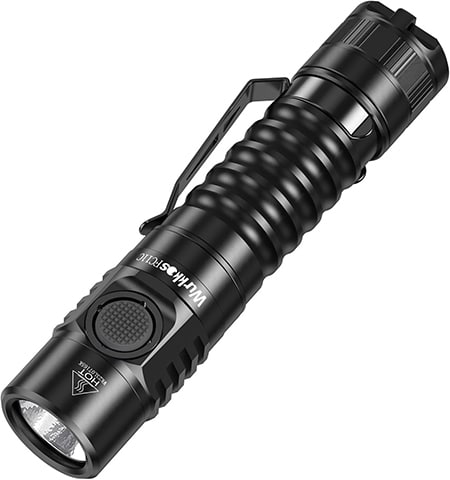
If you only buy one household flashlight, make it this one. At $30, the FC11C offers a lot of bang for your buck.
What I like about it:
- It uses a Nichia 519A LED, which provides exceptionally high-CRI light. Colors look vivid and true to life.
- It uses a “buck driver,” a bit of internal circuitry that ensures the light stays at a constant brightness even as the battery drains.
- It runs on a rechargeable lithium-ion battery, and gives you ample warning as to when it’s low on juice.
- It features a magnetic tailcap, allowing you to stick it to a fuse box or the underside of a sink for hands-free work.
2. The Modernized Classic: Maglite ML50L
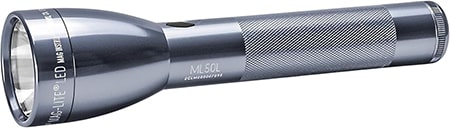
If you prefer the substantial, “baton” feel of the flashlights you grew up with, the ML50L is the modern evolution of that heritage.
What I like about it:
- It uses standard C-cell batteries, which are easy to find, but pairs them with a high-efficiency LED.
- It also retains the classic Maglite “twist-to-focus” head, letting you switch from a broad flood to a tight spotlight in a quarter turn.
- It has an eco mode that allows the light to run for 112 hours.
- It feels great in your hand.
Where to Stash Them
A flashlight is only a useful tool if you can find it in the dark. A proper household strategy involves multiple points of access:
- The Kitchen Drawer: I like to keep the hefty Maglite here for general use.
- The Nightstand: A compact light with a “moonlight” mode (a very dim setting) is essential for navigating the house at night without waking the family. So put a flashlight like the Wurkkos here next to your bed.
- On Your Fridge: Most flashlights these days have a magnet either in the tailcap or on the handle itself. Comes in handy when you need to stick your light on something metal so you can go hands-free. Also makes for convenient storage for easy access; consider sticking an additional flashlight on the fridge so you don’t have to rummage through the junk drawer to find one.
What About Headlamps?
When I was a kid, headlamps weren’t really a thing for the average consumer. If you wanted portable lighting, a flashlight was your only choice.
But thanks to the introduction of LEDs and more efficient batteries, headlamps have become a ubiquitous illumination option.
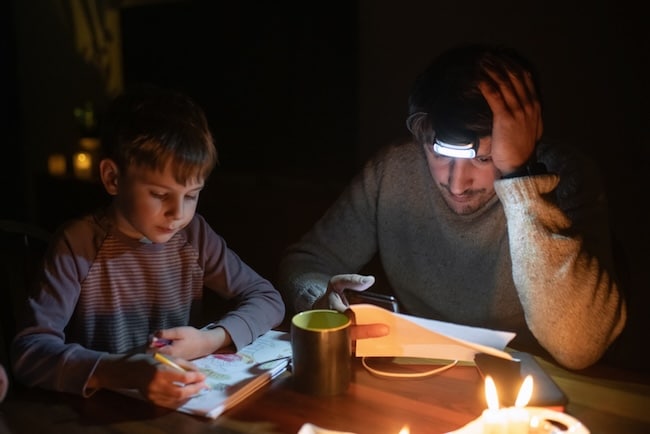
The biggest advantage headlamps offer over flashlights is that the former can be used hands-free. Strap the light on your head, turn it on, and you can readily fix a leaky U-joint under the sink and crawl through a cramped attic space. Also, the light follows your gaze.
I’ve noticed that I’ve turned to my headlamps more often than my flashlights when I need light. I like the convenience. For one thing, headlamps come in really clutch when you’re grilling at night.
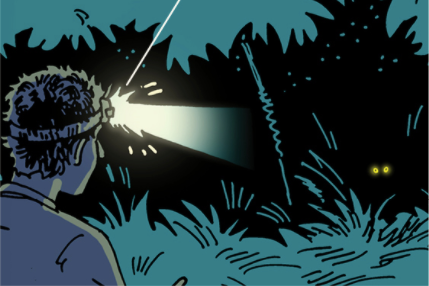
Most modern headlamps provide a flood beam, meaning the beam gives broad and even illumination.
What’s great about headlamps is that they can also be used on early morning/late night walks and while on campouts.
Here are a couple of options that are good for all-around household utility — as well as adventures beyond your backyard.
1. The Budget Get ‘Er Done-er: Petzl Tikkina
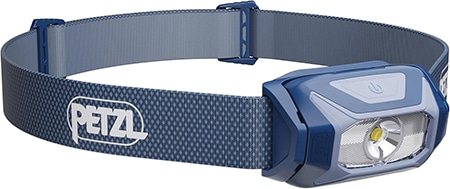
At just $20, the Petzl Tikkina is the benchmark for basic, general-purpose use.
Why I like it:
- Lightweight
- Reliable
- Easy to use; it just has one button
The one downside is that it doesn’t have a red light mode, which helps preserve your night vision and offers illumination that’s less disruptive to others. But for everyday household work, I don’t think it’s necessary.
2. The Comfort King: BioLite Range 500
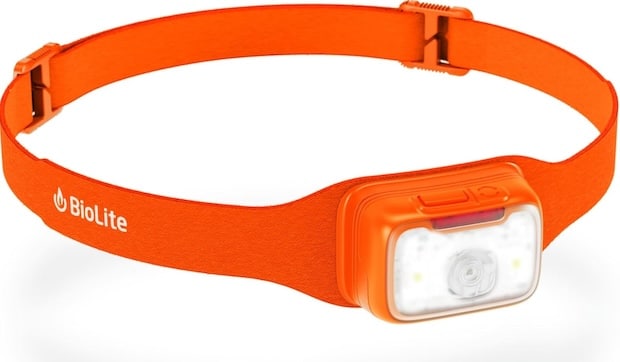
This is my go-to for backpacking. Standard headlamps can sometimes feel bulky on your forehead. BioLite’s Range is more streamlined and comfortable. How to use its multiple modes takes a little figuring out, and it’s pricey, so I wouldn’t buy this just for use around the house, but if you camp a lot, it’s worth investing in this light that can pull double-duty.
Why I like it:
- Sits flat against your forehead with a soft, stretchy, moisture-wicking band.
- Fast USB-C charging will give you an hour of light with an 8-minute charge — helpful for emergencies and last-minute needs.
- Dimmable red and white lights.
- Lock function prevents accidental turn-ons.
Putting a little thought into your flashlight setup now means that when you actually need light — whether you’re navigating a power outage or investigating an attic nook — you’ll know exactly where to grab it and that it’ll do what you need it to.