We’ve all had that feeling — you meet someone new, and the conversation just flows. You’re in sync. You click. But what’s really happening when that magic occurs?
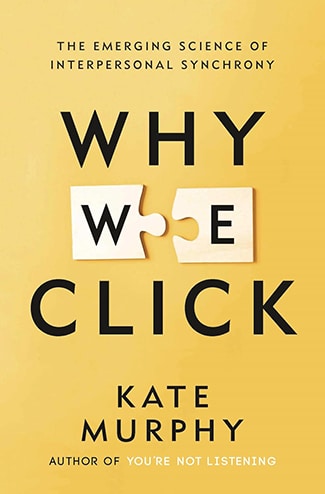
My guest today is journalist Kate Murphy, author of Why We Click: The Emerging Science of Interpersonal Synchrony, and she says this experience isn’t just a vibe, it’s a measurable physiological phenomenon and the most consequential social dynamic most people have never heard of. In our conversation, we dig into what happens when people click, why syncing with others feels so good, and how it influences everything from friendships to teamwork to romantic relationships. We also talk about why some people have a knack for connection, how you can become more “clickable,” and why video calls are the worst.
Resources Related to the Podcast
- Dying Breed article: Resonance as an Antidote to Social Acceleration
- Kate’s previous book: You’re Not Listening
- Sunday Firesides: Be Someone’s Atmospheric Getaway
- AoM Article: The Importance of Eye Contact
Listen to the Podcast! (And don’t forget to leave us a review!)





Listen to the episode on a separate page
Subscribe to the podcast in the media player of your choice
Transcript
Brett McKay:
Brett McKay here and welcome to another edition of the AoM podcast. We’ve all had that feeling: you meet someone new and the conversation just flows. You’re in sync, you click. But what’s really happening when that magic occurs? My guest today is journalist Kate Murphy, author of Why We Click: The Emerging Science of Interpersonal Synchrony. And she says, this experience isn’t just a vibe, it’s a physiological phenomenon and the most consequential social dynamic most people have never heard of. In our conversation, we dig into what happens when people click, why syncing with others feel so good and how it influences everything from friendships to teamwork to romantic relationships. We also talk about why some people have a knack for connection, how you can become more clickable, and why video calls are the worst. After the show is over, check out the notes and resources at aom.is/click.
All right, Kate Murphy, welcome to the show.
Kate Murphy:
Thank you so much for having me. It’s a pleasure.
Brett McKay:
So you got a book out called Why We Click. It’s all about that feeling that we’ve all experienced where we’re clicking with someone socially. It could be the first time we meet them and we’re just like, man, I’m on the same page with this person. I’m vibing with them. And there’s actually a name for this in the scientific literature: interpersonal synchrony. And you call it the most important social dynamic. So why is interpersonal synchrony so important?
Kate Murphy:
Well, it is the way we connect, just like you said, it is the physiological mechanism, the under-the-hood mechanism for connection and interpersonal synchrony. The way I define it is, and I still think it’s magical, that moment of clicking, but it’s the magical but now scientifically documented tendency of human beings to fall into rhythm with one another. And what I mean by that is when you gather two or more people together in a room instantaneously, usually in less than 30 seconds, they will not only begin to match or mirror one another’s gestures, facial expressions and postures, they will also start to sync up their heart rate, their respiration, their hormonal activity, their pupil dilation, all these physiological signals that we cannot detect, but we sync up to them nevertheless.
And why do we do this? We do this because when we internalize and embody one another, we are able to get a read on one another’s thoughts and feelings. And so when you smile, when someone else smiles, you get a read on their joy. When you flinch, like when you’re watching a football game and you see a quarterback get sacked and you flinch, you are actually intuiting their pain. And also when you sync up with somebody else’s racing heart, you start to feel their anxiety. So it’s really an evolutionary advantage of human beings of being able to tell very quickly, instantaneously friend or foe, what are they thinking? What are they feeling?
Brett McKay:
I think all of us have probably heard this idea that we mirror each other. So if someone puts their hand on their chin, we have a tendency to put our hand on our chin if we’re syncing up with them.
Kate Murphy:
Yeah.
Brett McKay:
But you go into the fact that there’s a lot more going on with our physiology than just that. Besides mirroring gestures, you mentioned your heart rate syncs up, your hormonal activity syncs up, and there’s also research that shows that when people are syncing socially, their brain activity, their brainwaves sync up.
Kate Murphy:
Yeah, that’s key. And that really shows that there’s been this transfer, particularly during meaningful conversations. It doesn’t happen, interestingly, during vacuous conversations, very superficial conversations — only during meaningful conversations, and I learned this when I was writing the listening book and it really got me started on this next book about synchrony. But when the listener and the speaker are really understanding one another, their neural patterns, their brainwaves start to sync up. And that is a measurable way of seeing, okay, there has been a transfer of thoughts, memories, and feelings. So that’s really critically important.
But also when you are having these meaningful conversations, particularly when you’re in the presence of another person and eye contact, we’ve always been told, look people in the eye. It’s really true because we start to mimic other people’s pupil dilation and there are all these things happening like micro expressions on your face that you are mimicking totally subconsciously and that aren’t really visible, but we’re mimicking them just the same. And it helps us again, embody, internalize one another and really feel and get in the rhythm, in the groove vibe sounds very West coast, woo, but to really get a read on the other person’s vibe, people have energy, they have negative and positive energy, and that’s how we pick it up.
Brett McKay:
And as you were talking about how we all have this desire to connect and click with people and how we want to sync up and basically almost become the same person, it reminds me there’s that myth from Plato talking about where men and women came from, and the myth was that there was a time before in primordial time where there’s these creatures that were kind of like a donut shaped, like a circle looking thing that had four arms and four legs and two heads, and they were together and they kind of connected at the belly button. They kind of wheeled around like cartwheeled to get around and then they separated.
Kate Murphy:
I know exactly what you’re talking about.
Brett McKay:
And then they separated and that became men and women, and then we just had this desire, we want to become that one person again.
Kate Murphy:
Yeah, the idea Plato had was that we’re roaming the planet looking for our missing other half that we’ve been separated from, but interpersonal synchrony tells us that what we’re really looking for is we are looking for the person with whom we effortlessly sync the person who harmonize with us, the people that we are on their wavelength. I love how all these turns of phrase things that we have said for time immemorial, being in sync, in step, in tune on the same wavelength and on the other side, discordant, that kind of thing, that those are all actually true, these things that we were feeling. Now we have the technology to actually see that’s actually what’s happening. We’re syncing up in this way and that’s what feels so good.
Brett McKay:
So syncing feels good in the moment, and then when you consistently have those clicking moments with someone, that’s what makes for fulfilling long-term relationship. What contributes to our ability to sync with others? Is there a genetic factor? Does it have something to do with our early childhood development? Is it a mixture of both?
Kate Murphy:
Yeah, I think it’s all of that. And I love that you’re bringing up the genetics because I really want to say at the outset that this is an emerging science and we don’t understand it exactly why it happens when it happens. That’s why it’s still magical. I mean, why did John Lennon and Paul McCartney click on so many different levels and were able to produce and have the impact that they did? And the same thing with all of us. When we click with somebody, it’s still somewhat magical.
But yes, I do think everything comes into play there. It’s genetics, it’s your history, it’s everything that has happened to you in life is embodied within you. And every neural twitch, everything that you do is a product of all of those pieces all the way back to when you were in utero. So I like to use the analogy that we’re all kind of like we’re made up of trillions of oscillating cells and what we’re all kind of like, are these massive symphony orchestras with all of these different instruments playing at different frequencies and and you meet another person and they’ve got their whole orchestra from all these different pieces that came together.
And it’s just a matter of whether or not you two are able to harmonize that you are able to, it’s not necessarily you’re going to start playing their song and get on their tempo entirely or they’re going to do the same to yours. What’s really remarkable is how we both somewhat accommodate to one another and play this even more beautiful tune together. And we also, the key point is we interpret it as pleasurable. So it’s not so much of putting each other in an exact common state of arousal. It’s more accommodating one another and playing this beautiful song together that we both are really in the groove, if that makes sense.
Brett McKay:
Yeah, it’s a dance.
Kate Murphy:
It is a dance.
Brett McKay:
Well, what you talk about is stuff like genetics and upbringing influences someone’s general ability to sync with people. It’s like their overall capacity to connect with people, but those things, they also influence your personality, your disposition, which also influences whether we click with people. There has to be some kind of alignment there, not that you have to be perfectly parallel and the same. You can still sync if you compliment each other in some way, even if you’re different.
Kate Murphy:
Yeah. What’s sort of cool about this is if there are so many people that we can think of who are odd couples that come together and that we never would’ve like God, I never would’ve put those two together, whether it’s friends or a romantic couple, so you can sync with people that you never thought you would sync with.
Brett McKay:
Something else you talk about is that there are certain people who are just especially good at syncing with other people.
Kate Murphy:
There are people that have, and I talk about this in the book, we have something called effective presence, and we’re all familiar with this personality and that’s sort of the general state of how we feel, but effective presence is this consistent way that we make other people feel. There are some people that just, for lack of a better word, have a really good vibe that people just sync to very easily. And you can call it charisma, you can call it a vibe, you can call it just somebody who’s just really has a compelling personality. And it doesn’t mean they’re always upbeat. It’s not just that it’s just people are drawn to them, but we all carry around an effective presence. That is something that is I think, useful to think about is how do I leave people? Am I leaving people better or worse than I found them? Are they more uptight? Are they happier after they’re around me? And what does that mean and what can I do about it?
Brett McKay:
I think that’s worth remembering that we all have this personal atmosphere that can influence how people feel and that we should be mindful and thoughtful about how we want to leave people feeling after we leave their presence. As we’re talking about this, people might be thinking that these good syncers, these people who can click easily with people, people probably think, well, they’re probably all extroverts. They’re bubbly. They’re charismatic in that sort of stereotypical way we think of charisma. But you highlight examples of individuals who have that great effect of presence and they’re not super dynamic, but people are still drawn to them.
Kate Murphy:
And I think that’s because they’re able to put them in sort of a calming cadence, for lack of a better word. They calm you down, they make you feel more secure. There are also lots of people that can just make you feel more competent or there’s something about their presence that you find pleasurable. Again, it’s like tuning into them and you find it pleasant. I also, I think it’s worth noting that we’re not going to sync with everybody. And as much as we might like to, I think we like to, we’re really not meant to. And so part of maturity is realizing that there will be people that you can really hum along with and you’re really going to click with them. And other people, you’re just, no, that’s not going to work. And it instantly, and there’s no use really forcing the issue. And it’s also, people usually have two reactions to that failure to connect is to say, first of all, there’s something wrong with that person that I didn’t connect with them. There’s something wrong. There’s something wrong with that person, or there’s something wrong with me that I wasn’t compelling enough or that’s why we didn’t connect. And sometimes no harm, no foul. You’re just not a good fit and that’s okay.
Brett McKay:
Yeah, you’re not for everybody and everyone’s not for you.
Kate Murphy:
Exactly.
Brett McKay:
Yeah. So there’s some individuals who just, they’ve got some sort of knack for clicking with a lot of people. They got that effective presence. What about individuals on the autism spectrum? Something that you hear about, it’s hard for them, people with autism to socialize because maybe they don’t pick up on cues as much. Are they still able to sync?
Kate Murphy:
That’s an interesting question. I actually found it really fascinating. There are two schools of thought about that, and one is that just having a really difficult time noticing syncing that they’re so internally directed that they have a hard time syncing with other people. There’s another school of thought is that they’re so overwhelmed by all the signals they’re receiving that they’re flooded and so they aren’t able to sync.
There’s also some absolutely fascinating literature that, and this is the case for also people who have some learning difficulties, also perhaps with ADD, but certainly autism is that their deficits in their ability to keep time, keep a beat essentially. They have a really hard time keeping a beat to music and also apparently keeping a beat with other people because we all have a rhythm. Neural patterns are rhythmic, inherently rhythmic. Everything in the universe is pretty much because atoms in and of themselves inherently rhythmic. And so the inability to keep time is an indicator and is also how they’re actually using that as a way to diagnose people who do have some of these neurological difficulties to find out whether or not that’s sort of a marker. And also it’s coming into play as a type of treatment to help people with their music awareness with rhythm, perhaps dance, to try and help with that timing deficit that translates into our ability to sync up with other people. Isn’t that fascinating?
Brett McKay:
It is. I thought that was really interesting that your ability to keep a beat with music translates over to your ability to keep a beat socially. I thought that was really interesting. But I mean, it makes sense because one of the things you see people do in groups, sometimes an organization will have people participate in a drum circle and then beating on the drums, it gets people in sync because they’re creating a rhythm together.
Kate Murphy:
Well, I think just in general, that’s the other side of this, is that when we are syncing with other people behaviorally, meaning we’re doing the same thing at the same time, particularly to a beat, to your point, it fosters feelings of rapport, of trust. People volunteer more information, they’re generally kinder and more helpful. Even babies strapped into face forward carriers and bounced in time to music are significantly more likely to favor an experimenter who is also bouncing in time to music versus an experimenter who’s bouncing out of sync or who is not bouncing at all. So there’s something about, I mean, I myself am in a line dancing class and a lot of this people in this class, I mean just really probably little else in common, but I mean, we are so cohesive and there’s such a sense of joy of doing the same thing at the same time.
You lose this sense of yourself, you become more of this larger organism moving together, and it does stimulate joy.
And if you think just even back in history, synchronized behaviors, movements have been used as a kind of social glue. Think of religion, people singing together, praying together, kneeling together, standing at the same time together and in the military marching to a beat. And also all soldiers are really pretty much on the exact same schedule, doing the same thing at the same time. And it builds this incredible sense of cohesion. It brings this feeling of emergence. So when soldiers see something happening to one of their own, it’s like it’s happening to them.
Brett McKay:
Yeah, I think we’ve all maybe experienced that. I know when I worked in a restaurant when I was in high school or I worked at Jamba Juice making smoothies and you get really busy and whenever the crew, they were just synced up and in the zone. We didn’t have to talk to each other, but we could look at each other and knew what they were going to do and what I needed to do. And it just felt awesome. This is amazing. We’re just cranking out smoothies.
Kate Murphy:
Yeah, I love that. And the same with the greatest sports teams, the ones where everybody’s cohesive and really clicking. You can see that, and those are the ones that succeed.
Brett McKay:
Another factor that plays a role in our ability to sync socially is something called interoception. What is that and what role does it play in our ability to sync with others?
Kate Murphy:
Oh, I’m so glad you brought that up. It’s really, I found this, well, I found everything in the book really fascinating, but this was a revelation to me. We like to think of our feelings come from, okay, something happened. We process what happened in our mind and that results in our feelings. But the research is really coming to show that really feelings start in our body and our brain interprets feelings from these experiences, these feelings in our body, and then we translate that to emotions. So interoception is the ability to read what’s going on in your body. It’s essentially body awareness. It’s the flip side of perception. Perception is what you’re perceiving outside of your body, whereas interoception is being really in tune with what’s going on within your body. And that’s super important because if you don’t understand the sensations and what they mean in your body, you really can’t sync up to another person or embody another person and take on their feelings and be really in tune with them.
So for example, we all experience, if you think about what does fear feel like for you? Do you feel it in your stomach? Do you feel it in your chest? Do you feel it in your head? Do you feel it in your feet? Some people feel it in their genitals. I mean, all of us have a different physical signature for fear. And if you’re not in tune of, okay, what does that mean? What am I feeling right now is that anger? And where we get into trouble as human beings is when we start to misconstrue or get detached from those inner feelings within us and what they mean.
A lot of people have a different sense of what hunger means. I mean, what the feeling is. Is it gnawing in your chest or do you get kind of irritable? People have different ways of perceiving hunger, but where we really get messed up is when we misconstrue things like you can feel a little bit irritable or lethargic and think that’s hunger when it’s really boredom and people get mixed up with that. And particularly in our culture where we’re so busy, and it’s almost a badge of pride to say you didn’t sleep when you were tired. You didn’t eat when you were hungry. You pushed yourself through when you were in a lot of pain. Exercising that detachment from your body, and you can see how this would be a problem is if you are trying to internalize, embody someone else’s feelings. And again, this is all subconscious, but if you’re not in tune with your own body, how can you be in tune with someone else’s body?
Brett McKay:
Yeah, I think that’s interesting. One of the first things you can do to help develop your own ability to click more with people is just get more in tune or more aware of your own emotions and what they feel like in your body.
Kate Murphy:
Yeah, just do an internal review because if we’re internalizing other people’s heart rate, their respiration, all of these things, and we’re not even aware of our own heart rate, you’re not going to pick up someone else’s anxiety if you’re not even aware of your own heart rate. They’ve done a lot of research with particularly heart rate, but there are lots of other things where people work on their interoception going through different parts of their body and what are you feeling? And there was one study I thought was just fascinating, where it had high frequency traders at a hedge fund, and the ones that had better interoception were better traders. They made more money and they stayed in the job longer because they had more of that sense of, okay, this is danger or what these other people are doing. I’m getting sucked into something that maybe I shouldn’t. Where they really had a sense of their own self. And again, this is all subconscious, but the fact that they had better awareness, higher awareness of their heart rate and whether it was up or down versus another person made them a better trader.
Brett McKay:
So personality can influence whether we click with someone, but there can be situations where the fit has potential, but you’re not syncing because you’re just not generally good at syncing with people. And we’ve talked about that some people are just better able to click with people and more people than others. I mean, some of that is genetic and upbringing, but there’s also things we can all do to improve our clickability. And we’ve talked about some of those things already. I mean, be aware of your own emotions, do things in a group, like some kind of physical activity together where you’re all in sync, but what else can we do to make ourselves more clickable? And you actually have a chapter on what the world of speed dating can teach us about this. So what can speed dating teach us about being open to interpersonal synchrony?
Kate Murphy:
Well, your listeners should know there’s a vast scientific literature on speed dating, which was news to me at not only speed dating, but speed networking. And they’ve done a lot of studies to find out that’s how they really figured out what is happening when people are clicking. And the people that reported a sense of attraction and they wanted to see this person, again, whether it was in a professional or a personal context, romantic context, it was that they were syncing on all these different levels. The thing that I think people can do that we discount, and of course that’s what my first book was about is to, you really want to be present, of course. And really, if you can be in person, in person, you’re going to pick up all these different signals that you don’t pick up online or in a two dimensional or even three dimensional.
If it’s virtual reality, you’re not going to pick up. Syncing is a multisensory dynamic, and so you’re losing a lot of information that helps you sync up with somebody if you’re not in person. So there’s that piece of it. But also learn to be a really good listener when you are really trying to inhabit somebody else’s narrative and really trying to understand them. And listening isn’t just being quiet. I mean, it is really trying to almost be with someone in the sense that you’re watching a movie where you’d get totally lost in the other person and to almost let yourself go in what the other person has to say, get rid of your own personal agendas and really be a good listener. That is something that helps with that neural syncing we were talking about with brainwaves. So that’s a piece of it too.
But I just think in general, what’s so powerful about this knowledge is to be aware that this is even something that happens. I mean, I don’t know if you knew this before, but I certainly didn’t know that on all these different levels we’re syncing up with other people and to try and be sensitive to that, and you kind of let yourself go with it if it’s something that’s working for you. But if you get that feeling, that discordant feeling or sort of like that needle across vinyl when you meet someone to also pay attention to that too, because you have intuited, you have felt something that’s pretty important to pay attention to.
Brett McKay:
Can you hack social syncing? Because some bit of advice you always see in magazines or blog posts is if you’re on a date or maybe even you’re on, you’re networking or a job interview, well, if you really want to sync up with someone, you should just do whatever they do. So if your date crosses their legs, you cross your legs and be intentional about that. Does that actually work?
Kate Murphy:
No. Short answer, because we are really fine tuned to authenticity. Human beings are. You talk about a superpower, we’re really, and even subconsciously, anything that’s a little bit off or that we don’t perceive as being authentic, we pick up on that. And then also when there’s a big disconnect between, that’s another thing about syncing, is to actually be authentic. Because if there’s a disconnect between what you’re feeling and what you’re doing or saying, people pick up on that, that’s sort of crossed wires. And so people, they pick up on that, whether they are aware of it or not, they’re aware of the end feeling, which is discomfort.
Brett McKay:
Yeah. Another bit of advice I’ve seen people use to try to sync up is, but if you don’t do it right, it’s a total turnoff, is using people’s name.
Kate Murphy:
Oh yeah.
Brett McKay:
Dale Carnegie famously said something like “The sweetest sound a person can hear is their own name.” And I think a lot of people hear this advice and they feel like, okay, I got to drop someone’s name as much as possible in this conversation.
Kate Murphy:
It’s so aggravating.
Brett McKay:
Yeah. I mean, I’ve had salespeople do this to me and I’m just like, okay, I know what you’re doing, and it’s just really annoying, so you can just stop it. Please stop. But I’ve also had podcast guests who say my name throughout the conversation and it sounds natural, and I’m like, oh wow, that does feel really good. Even when I think someone is doing it intentionally to be charming, it still feels good if it’s natural, but when it’s really forced, it’s irritating. It’s a complete turnoff.
Kate Murphy:
No, absolutely. There is a natural way to do it. I have a friend who’s an airplane mechanic and he’s absolutely delightful. And he does that. He uses people’s names partially it’s to help him to remember, but it’s so natural. And I mean, Dale Carnegie’s, right? It is like music to your ears when he’s authentic, he wants to know me, he wants to be friends with me. And you feel that, and when someone just drops it every once in a while, Brett. That’s right. Lemme tell you, Brett.
Brett McKay:
Yeah. Okay. So you can’t do the whole mirror somebody to sync up with them. That’s just going to happen naturally if you’re syncing up with them. What about looking people in the eye? You mentioned that eye contact is important.
Kate Murphy:
Yeah, that’s huge. Look people in the eye.
Brett McKay:
But how much is too much?
Kate Murphy:
Well, there’s creepy staring people in the eye, but I think when that happens, there isn’t a synchrony going on. The person is just in their mind thinking, I’m going to stare at this person. Do you know what I mean? There’s a difference between really looking with a sense of interest and a sense of exploration and really wanting to sync with somebody. And then there’s this, okay, I’m just going to look at you because that’s what I’m supposed to do. And also I think there are people who, everybody’s not as good at this. People have different tuners. And so some people really can try and look at somebody and it’s almost like a blank stare. And that’s where it’s creepy because you don’t, on a certain level, you know that your pupil dilation is not syncing up, they’re not syncing up with your heart rate. You feel that disconnect. So I would say when you’re looking at someone, if you’re really looking at someone with interest and curiosity, then that’s going to come across. But certainly I think people have different tolerances for intimacy and sometimes that all the signals that you’re getting from someone can be a little too much, and they need to look away every once in a while, and that’s okay too.
Brett McKay:
Yeah, that’s fine. So I mean, it sounds like if you want to be more clickable with people, it’s not so much about tactics or techniques, it’s more about an attitude or a stance you take to whatever social interaction you’re in. And that attitude is just one of presence and curiosity and wanting to know about this person. And if you have that attitude, the clickings going to happen naturally.
Kate Murphy:
Yes. If you’re compatible with the person, right? That’s important. And that’s so hard being a nonfiction writer, which I’m mainly a journalist, and now I’ve written my second book after my first, I said, I’d never do this again. But if you look at the landscape of nonfiction books, I think you’re probably more familiar with this than most people, that it is all about this hack. If you just do this and then this’ll happen, and interpersonal synchrony and the things that I write about, it isn’t something where if you do X, then Y will happen. And actually nothing about life is like that. And it’s as you said, and I think it’s really apt. It’s a dance. And so if you go in wanting to dance and you go in with that curiosity and that openness and just generosity of spirit, you will find people who are on your wavelength who will want to join in with your music, who you will play a beautiful song together or dance well together. And then there will always be people who will just sort of be on their own tempo and they’re maybe distracted. They may not even notice you or you’re just not compatible. But again, that’s okay. We’re not meant, we don’t have the cognitive or emotional resources to sync with everyone. And also what would make it special when you do.
Brett McKay:
So you mentioned one of the important things for interpersonal synchrony is you have to be with the person in person.
Kate Murphy:
Yes.
Brett McKay:
And you have this whole section about the research on our ability to socially click with people via digital mediums. What does that research say?
Kate Murphy:
Well, as I touched on earlier, synchrony is a multisensory experience. And in fact, interpersonal synchrony suggests that we have more senses than the five we take for granted. How do you sense someone’s heart rate, their respiration, their hormonal level, even these subconscious smells? I mean, we have all these pheromones that we’re throwing out that they think is responsible for why women sync up their menstrual cycle. So they’re all these things, and you’re not going to get that online. You’re not going to get this full panoply of signals that someone is throwing out that you could potentially sync up to. And that doesn’t mean you can’t sync on certain levels. I mean, we certainly see things go on viral online, or people’s outrage gets stirred up online. So it’s not like you can’t have synchrony or feel like you have synchrony with people online. But oftentimes, and people who’ve done online dating know this better than most is you might think you have a connection with someone online and then you meeting them in person and you think, oh my God, no. All you can think about is how long do I have to sit here before I can break this off without seeming rude? It’s just you really do not get the full sense of another person online.
Brett McKay:
Yeah, that’s an interesting point about online dating because it also could happen, there might be people in your in-person social circle, maybe at work or at church, where your filters on the dating apps wouldn’t have brought you to that person.
Kate Murphy:
Absolutely.
Brett McKay:
Because the filters on dating apps are very superficial, like how tall you are, money, income. But there might be people in your interpersonal social circle that you never would’ve thought you would’ve like, I want to date this person. But then you get to be around them and you interact with them and you’re like, oh, wow, I kind of like this person.
Kate Murphy:
Yeah, you swipe. You would’ve totally swiped left if you had read their profile, but then you see them in person and you totally click.
Brett McKay:
Yeah. So yeah, in-person, important. Let’s talk about this. We’re on the podcast. I don’t do video podcasts and a lot of podcasts are going the video route. I’m talking to you, I cannot see you. You cannot see me. I do all my interviews remote without video. I don’t like video. I do video calls every now and then. I don’t like it. What is it? Help me justify myself here. Why do I have this aversion to video calls and why do I prefer voice only calls?
Kate Murphy:
Well, the science backs you up on that. I mean, I’m not just trying to make you feel better. I mean, the science totally backs you up on that, and I salute you for resisting it because that is the way of the world right now where everybody’s moving to video. But the problem is that because we have this instinct to sync, looking at video is very disruptive and makes us feel ill. I mean, zoom fatigue is a real malady. And that is because the way the technology is at this point, the way that video images are encoded and decoded and buffered and all these things that are manipulated about the image, and not to mention pixelation, it distorts all these tiny little cues, these facial expressions. And then back to eye contact, you are making eye contact with your, or maybe you aren’t with your camera, so nobody’s actually looking at you.
And so you in your brain, again, this is subconscious, you are just rapidly spinning your wheels trying to do this adaptive evolutionarily entrained thing with another person to sync up with them. You’re looking for all those microexpressions, you’re looking for that eye contact and you’re just spinning your wheels trying to do that. And it ends up making people feel uncomfortable, vaguely disturbed, a little bit off. And I have never met a single person who says, oh, goody a zoom meeting. And I don’t know why it’s become something where everybody thinks is to rigor, because I mean, I’ve had people that I’ve talked to that I’ve worked with who say, oh God, I loved reading that in your book, and I hate Zoom calls. And yet they’ll schedule a zoom call with me. And I feel like, why is this? But I totally agree with you that we are able to connect and sync on a much more authentic real level just by hearing each other than getting all that faulty information that we get from the video that throws us off. And at some part of our brain is really struggling, and it makes it really hard to connect in any way, shape, or form.
Brett McKay:
Yeah, I love talking to people on the phone. I’ve been doing that a lot more lately. I’ve got a friend who’s moved and once a month I’ll take a walk for an hour and we just talk to each other on the phone and it’s like we’re together even though we don’t see each other.
Kate Murphy:
Yes, I agree. And there’s also you think there’s kind of an intimacy having someone right in your ear. There’s that piece of it too.
Brett McKay:
No, I agree. Whenever someone does a zoom call, I always feel kind of like a heel. I’ll do the zoom call, but I’ll keep my video camera off. And then the other person’s like, Hey, is your video camera not working? And I say, no, it’s fine. I’m just going to do audio only. It’s a phone call.
Kate Murphy:
Well, but let’s be honest, Brett, people are mostly looking at themselves on these calls.
Brett McKay:
You’re checking yourself out.
Kate Murphy:
They’re looking at a little image of themselves, they’re really not looking at you, or they’re getting distracted by looking at what’s that art in the background? Is that a cat crossing in the back? And then when people blur all around them and they look so peculiar with that blur stuff around them, I mean, you do kind of feel like a jerk. I have nothing to hide. It’s not that. It’s just I really want to pay attention to what you’re saying. I really want to connect with you in some way, and I want us to be productive and sync in a way that we can solve problems or get to an agreement. And the video just subverts that.
Brett McKay:
Alright, so let’s use this as a clarion call on Zoom video calls.
Kate Murphy:
Boy, if that came out of my book, I would feel like I had just accomplished something great in the world.
Brett McKay:
You have a chapter about the importance of interpersonal synchrony and romantic relationships. What happens whenever a romantic relationship is not synced up?
Kate Murphy:
Well, it’s not good. I mean, when we are not in sync with another person, we experience it as discomfort, romantic or otherwise. And I think it’s particularly painful when you have been in sync and then you move out of sync. And actually that’s not a bad thing because you do want to have periods of asynchrony in any relationship. It’s natural and healthy because that’s how you get back in touch with yourself and recalibrate and makes you better able to, when you do sync back up with the other person that you each can bring something to the dance. I like your analogy, so that’s okay. But I think a lot of times, particularly people who have anxious attachment styles, they get very upset when there is a sense of asynchrony. And so they really spin their wheels trying to what’s wrong,
Which only drives people apart. And they often will do things that provoke the person. If they’re really agitated, they will provoke the other person. So they’re agitated too, just so they’ll be in sync on that level, which is not good for a relationship. But if you really find that you’re really on different wavelengths and really feel like a real distance is coming between the two of you, go back to those things of make sure, are you spending enough time together? Are you with each other enough to establish those physiological, synchronous and also activities, those joint activities we talked about, go for a walk together. I mean, make time. So you’re doing things, having these shared experiences and these joint activities that help you sync up more readily.
Brett McKay:
Okay. That’s great advice. So make sure you’re syncing up regularly. People are busy as a couple. You can just sync up in the morning when you’re having a cup of coffee together, talk about what’s going on with your day, and then maybe at the end of the day, have another chat where you just hang out, talk about how the day went.
Kate Murphy:
Well, I mean that’s one of the greatest things about being in romantic relationships is they used to call it pillow talk, but just when you’re laying in bed at night and just talking and that quiet, and again, you’re not necessarily looking at each other, but you’re so synced up physically by proximity and just talking about your day and sharing things that really promotes that synchrony and that sense of intimacy.
Brett McKay:
So we’ve been talking about the benefits of interpersonal synchrony. It allows you to feel connected to people close. It feels good. It allows you to get stuff done efficiently and effectively. But are there downsides to being too in sync with somebody?
Kate Murphy:
Oh, yes. Because we have this instinct to sync, it makes us vulnerable to getting sucked into other people’s emotional vortex. I mean, I think we’ve all had the sense that when we are with somebody who’s just high drama, incredibly manic, that it’s exhausting. I don’t think everybody has a great emotional vocabulary, but we all can recognize someone who’s hard to be around versus easy to be around. And the people that are hard to be around are the ones that sort of sweep us up into this emotional cadence, resonance that we’re not comfortable with. And it is difficult, and it’s also difficult because when we embody and we internalize other people, it feels like it’s coming from ourselves. So I think we’ve all had the experience of why did I do that? Why did I say that? Or there was sort of a blow up and you’re like, how did that happen?
And that’s because you climb the ladder of emotion, arousal, agitation with another person because of this instinct to sync and you lost sight of yourself. You lost sight of where that person begins and you end. And so that’s why things like interoception are really important. And also just by reading this book, just to have an awareness that this is what’s happening. And when you start getting those feelings, you can kind of think within yourself, okay, what am I doing with this? I’ll give you a really good example. When I was first working on this book, or I had really gathered most of the data, I hadn’t really finished writing the book. I was invited to speak about my last book at a major university, and I won’t say which one, which will become clear in a minute. And I was invited to lunch with one of the deans, and we were at lunch and he was, let’s just say he was socially very anxious, and he was spinning and he was having a hard time looking me in the eye.
He was just kind of agitated. And as a result, I was pretty miserable. I was really uncomfortable and I was feeling really anxious, and I was feeling very socially awkward. And I realized, which is not me. I love meeting new people. And I realized, oh my God, this is what’s happening. I’ve totally internalized this guy. And once I was aware of that, I was able to pull back and do things like think about, okay, where am I putting? I realized, okay, my shoulders are hunched. Let me bring them down. Let me take some deep breaths. I even slowed the cadence of my speech, crossed my legs the other way, and I totally changed the rhythm of the encounter. And not only did I feel better and bring myself back to myself, but he started to relax. He started to sync to me. So there’s a real power in catching yourself. And it’s hard. It seems like an easy thing to do, but it’s really hard because it’s so instinctual and you become so wrapped up in the moment that you don’t realize it’s happening as it’s happening and you do the debrief kind of afterwards, you realize, oh, that would happen. But if you get good at reading yourself and reading other people, and the degree to which you are matching, mirroring that other person, it really can make a total difference in your social life.
Brett McKay:
So the Osmond’s famous saying, “one bad apple, don’t spoil the whole bunch, girl,” but you say the Osmonds were wrong. One bad apple does spoil the whole bunch.
Kate Murphy:
Yes. And I think the best example of this was an incredibly interesting study that was done in the early two thousands by Will Phelps, who’s now in Australia. He’s at University of South Wales in Australia, but at the time he was at University of Washington. And what he did is he created all of these work groups out of University of Washington business students, and he created all these work groups, but he introduced a confederate or an accomplice who was to go in and either act like a jerk, a slacker or a depressing downer, and see what happened, what the effect was on group functioning. And actually, he didn’t know Will Phelps did not know about interpersonal synchrony at the time. He was just looking for the effects. But he said, now knowing what he knows now, he would’ve done the study totally differently because if you look at the video, it’s striking that during the slacker condition, he’s leaning back in his chair, he is eating, he’s acting like he couldn’t be bothered with the task at hand.
And sure as shooting, everybody else starts leaning back. They’re starting to say things like, let’s get this over with. And they performed really badly. And the really heartbreaking one was the depressive downer one. And the guy comes in and he’s acting real depressed and really lethargic, and it’s really sad. You start seeing everyone else slow down, putting their heads down on the table, and you get this sense, and they actually verbalize it. It’s not only the task at hand was meaningless, but life in general seem meaningless. And so you can see how this contagion happens in situations, and I think we’ve all experienced where somebody new comes into a group and it just totally upsets the dynamic and pulls people in one direction or another. And there can be good apples too. It can be positive or negative, but it’s true that one bad apple, the greatest predictor of the success of a team or organization is not how stellar the best person is or even the average abilities of the rest of the people, but how awful the worst person is that predicts the success or failure of a group.
Brett McKay:
So if you’re a leader of a group, what do you do when you’re dealing with a bad apple? Do you just have to get that person out of there, or do you try to rehabilitate them? What’s the strategy?
Kate Murphy:
Well, most CEOs that I’ve interviewed are just like, yeah, you got to get rid of it. It’s going to ruin everything. But I think what they try to do more on the front end is hire very carefully.
And again, don’t interview by Zoom. Don’t rely on an algorithm that’s going to pick the right resume. As you rightly said, sometimes with dating apps, the people that you swipe left on are the people that are the right person. So there’s that. There’s also, when I interviewed Danny Meyer, he allowed me to go and I watched, I mean, you talk about synchrony in his Michelin starred restaurants, the synchrony between the kitchen and the front of the house. And there’s just a tempo. It’s a ballet in there. And I was talking to one of the managers and he said, with hiring, they typically bring in somebody and have a trial run, which I think is probably a really good idea with a lot of organizations to the degree that you’re able, because it’s to the benefit of the potential hiree as well as the employer, because they all get a sense of, am I clicking here? Is this somewhere where I can flourish? Is this someone who’s going to fit in with the vibe, the rhythm of the team? So I think more to really try and head it off from the beginning.
Brett McKay:
So you got this one chapter. I want to end on this. I thought this was really interesting. You explore our sometimes uncanny ability to sync with people from afar. So for example, I’m sure some people have experienced this where they get a feeling that someone they know who lives far away is having a hard time, or maybe something bad happened to them and they think I better check on them and come to find out something bad did happen to that person. What’s going on there?
Kate Murphy:
Well, I’m not sure, but I do talk about this in the book. And again, this is very, people don’t agree, this is highly speculative, but in the physics world, they are coming to think that our brains operate much like a quantum computer. And again, I really want to preface this, that there is a lot of disagreement among physicists, but there is a camp that believes our brains work like a quantum computer. And quantum is subatomic particles, and their behavior is very unique. And one of the things that is a factor of quantum mechanics is something called quantum entanglement. And that is where these subatomic particles, they can become synced, but then when they are separated by time and space, they maintain that synchrony. And since they think that our brains are operating like quantum computers and obey the laws of quantum mechanics, including quantum synchrony, you can see this really trippy notion that if the quantum particles within your brain are synced up and can become entangled, you can imagine how the quantum particles in another person’s brain that would sync up to your brain would be operating in that same synchronized way. And that might, and I emphasize, might explain why we are able to intuit feel, predict telepathic types of things, and we’ve all had them happen and thought, whoa. I mean, how did that happen? And you could see how that might be an explanation of why that would happen.
Brett McKay:
That’s interesting. Yeah, I know people like that. My wife is able to do this. She’ll have those moments where she’ll just be lying in bed and she’s like, I got a friend who’s having a hard time. I need to call them. And then sure enough, she calls and they’re having a hard time. I’m like, what’s going on there? So yeah, it could be quantum entanglement or it could just be the romantic. We’re just so combined that we just are on the same wavelength no matter where we are. So who knows what’s going on there.
Kate Murphy:
But I do like that there’s still some magic to this that we don’t quite understand it all. For me, there’s something intellectually as well as kind of spiritually satisfying about the fact that synchrony binds us not only to one another, but also to the universe as a whole. Because synchrony has been observed throughout the natural and life sciences, everything from the tiniest quantum particle to supermassive quasars exhibit synchronistic properties. And so it really shouldn’t be a surprise that human beings do it too.
Brett McKay:
Well, and you have a section on this. I mean, we can get a little more, let’s go more woo-woo. I like this about syncing with nature. I’ve had that experience where I’ve been out backpacking in the Rocky Mountains and I’m just staring at a mountain by this lake, and I feel like the mountain is talking to me.
Kate Murphy:
Right?
Brett McKay:
And I know it’s not talking to me, but it feels like it.
Kate Murphy:
But on some level it is. I mean, the science is pretty clear on this because, I mean, think about it. We are ruled by nature. The sun coming up, the sun coming down. We have all these internal clocks that are based on the rhythms of nature. And the research is very clear that people feel better out in nature. And they think that is because we sync up with the regular rhythmic patterns of not only what you hear in nature, but also what you see in nature, which is not what happens in urban environments. So we probably need to have another conversation if you’re actually seeing lips moving on the mountain and talking to you. But the sense of communion and feeling in sync while you’re out in nature and with the mountain, I think that’s perfectly valid and accurate.
Brett McKay:
Yeah, humans are designed to click. We love to click.
Kate Murphy:
Yes.
Brett McKay:
Well, Kate, this has been a great conversation. Where can people go to learn more about the book and your work?
Kate Murphy:
Well, I think the best way is just to go to my website. It’s www.journalistkatemurphy.com, and you can read about the book and any journalism that I’ve done, and that’s probably the best place to go.
Brett McKay:
Fantastic. Well, Kate Murphy, thanks for your time. It’s been a pleasure.
Kate Murphy:
Thank you, Brett,
Brett McKay:
My guest today was Kate Murphy. She’s the author of the book Click. It’s available on amazon.com and bookstores everywhere you find more information about our work at our website, journalistkatemurphy.com. Also, check out our show notes at aom.is/click where you can find links to resources to delve deeper into this topic.
Well, that wraps up another edition of the AoM podcast. If you haven’t done so already, I’d appreciate it if you take one minute to give us a review on Apple Podcasts or Spotify, it helps out a lot. And if you’ve done that already, thank you. Please consider sharing the show with a friend or family member you think will get something out of it. As always, thank you for the continued support. Until next time, this is Brett McKay reminding you to not only listen to the podcast, but to put what you’ve heard into action.