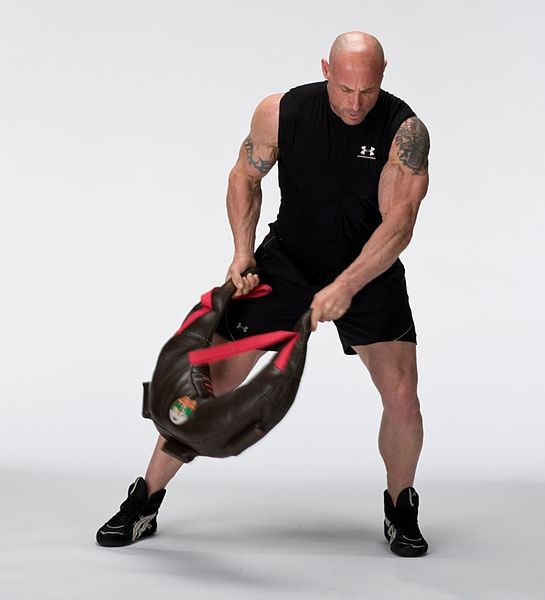
Do you feel like your physical training has gotten stagnant and boring?
Like you’ve woken up in a Planet Fitness Groundhog Day?
Same gym. Same exercises. Same rep ranges. Year after year after year.
I’m a big fan of consistency and repetition. I think there’s a virtue in being okay with and even taking joy in doing the same thing over and over again.
But when it comes to my physical training, I’ve learned over the past decade that adding some seasonality to my fitness programs yields big benefits, both physiologically and psychologically.
We’ve written before about the value of seasonality in daily life in helping you get over the “horror of the same old thing.” And we’ve offered the example of creating seasonal music playlists: you make playlists, whether for general listening or for your workouts, that consist of songs you only listen to during spring/summer/winter/fall. Putting your music into this kind of rotation builds anticipation for the return of certain albums/artists, keeps songs fresh, and adds more of a distinct atmosphere to each season of the year. The repetition is still there, but it has rhythm. It makes the year feel more textured, rather than a monotonous slog of sameness.
That same principle applies just as well to physical training, and arguably with even greater payoff.
Why You Need to Add Some Seasonality Into Your Training
Seasonal training provides focus. When you train the same way all year, your fitness goals sort of congeal into a vague, amorphous lump that provides zero focus for your effort. Without a clear focus, you try to train to be strong, lean, well-conditioned, mobile, and pain-free at the same time. None of those goals are bad; the problem is that your training never clearly emphasizes one over the others. Changing your training with the seasons gives it a focus for long enough to get things done, but not so long that you get bored with it.
Seasonal training gives your body a break. Heavy lifting is one of the best things you can do for long-term strength and health. It’s also stressful on joints and connective tissue when it’s pushed hard, week after week, month after month. Runners have the same issue. If all you do is long runs after long runs, week after week, you’re going to accumulate overuse injuries.
You can give your body a break by simply changing what you do. Change is a rest! For example, during the fall and winter, I focus on heavy barbell lifts. After a while, it beats up my tendons. In the spring and summer, I give my connective tissue a break from heavy lifts with lighter weights and more variety beyond barbells.
Seasonal training keeps motivation fresh. When there’s no shift in focus, training can start to feel like a job with no off-season. You begin to feel like Sisyphus pushing that boulder up the mountain over and over again. Training becomes a chore and not something to express your vitality. Seasonal shifts create something to look forward to without requiring constant program changes. By the end of winter, heavy lifting starts to feel stale, and you’re ready for higher-rep work and lighter loads. By late summer, volume feels played out, and the thought of moving heavy weight again is appealing.
Also, just as saving certain music for certain seasons adds texture and rhythm to your life, saving certain activities for particular seasons can do the same. It gives you something to anticipate and re-relish. When summer arrives, you enjoy returning to the pool for cardio. When fall flows in, you find joy in once again running on crisp mornings.
Seasonal training aligns with how your energy actually fluctuates throughout the year. Your schedule, sleep, stress levels, daylight exposure, and social calendar don’t stay constant throughout the year. During the fall and winter, I’m busy taking kids to basketball games and other after-school activities, so I don’t have time for super long training sessions. I need something that lasts about 45 minutes. During the summer, my schedule opens up so I have time for longer workouts. Training as if your life is an unchanging constant will only create frustration and friction. What feels like a good workout in July can feel burdensome in January. Seasonal training works with those shifts instead of fighting them.
How to Add Some Seasonality Into Your Training
Seasonal training doesn’t require complicated periodization charts or constant program-hopping. It simply means changing your primary training focus, the length of your workouts, and/or the modalities you engage in as the seasons change.
You can put both your strength training and your cardio routine into a seasonal cycle. For example, you might focus on building strength with barbells one half of the year, and then shift to emphasizing size by using machines to develop hypertrophy in the other half. And/or you might do running and indoor rowing for cardio during the fall/winter, and then shift to rucking and swimming during the spring/summer.
Here’s how I incorporate seasonality into both my training, and my diet as well:
Fall and Winter: Strength Season
From September through March, my focus is on strength and mass.
This is when I prioritize low-rep, heavy barbell work on the main lifts — squats, presses, and deadlifts. The goal during this phase isn’t variety or conditioning; it’s performance — moving weight, reacquainting myself with heavy loads, and practicing the skill of max-effort strength.
I still do accessory work and some hypertrophy training, but it’s secondary. I do a little cardio, but it’s minimal and mostly there to support recovery and general health, not to push fitness boundaries. Because, as mentioned, my schedule is busy during this time, these sessions are pretty short — usually just 45 minutes.
This is also the season when I bulk. I eat up to 3,600 calories a day and can put on as much as 15 pounds of muscle and fat during this time.
I don’t dirty bulk. I take it nice and slow. I slowly titrate up my calories during these months. When the holidays hit, I loosen up the reins on my macro tracking a bit. The timing makes sense. Colder weather naturally increases appetite. I can lean into the holidays’ many eating opportunities without feeling socially out of sync. Trying to maintain a tight cut through Thanksgiving and Christmas is possible, but it takes extra effort and is mentally expensive.
Spring and Summer: Hypertrophy, Leanness, and Movement
As winter breaks and the days get longer, I intentionally shift away from heavy, low-rep work.
Spring and summer are when volume goes up, and loads come down. I focus more on hypertrophy-style training: higher volume and more exercise variety. My joints and tendons get a break from near-max efforts on the main barbell lifts.
Mobility also becomes a bigger part of training during this season. The goal is to improve my range of motion and undo some of the stiffness that heavy winter lifting can create.
I do more cardio during the spring/summer, and because the weather allows it, more movement happens outside. I’ll ruck more. I’ll do some heavy carries. We also try to get out as a family to hike and backpack more often during the spring and summer. Got to take advantage of those long days!
I start cutting during this season, and my calories come down. I gradually work toward leaning out, usually aiming to get back to around 11% body fat. Interestingly, eating less feels easier to do in warm weather. Appetite tends to be lower. And honestly, after a bulk, cutting down to 2,600–2,800 calories a day feels like a relief. It’s nice not having to think about getting enough food every day. I do more fasting during the warmer months, too.
How to Add Seasonality to Your Training Without Overcomplicating It
Here’s a simple way to apply seasonal training to your own routine. Don’t overthink it!
Pick one primary focus per season. Choose a focus for your season and let the others play a supporting role. Maybe during the fall/winter, your focus is strength, and in spring/summer, it’s cardio/endurance. Figure out what you like and do that.
Adjust your environment. More indoor, gym-based work in winter. More outdoor movement in the warmer seasons. (Although try to get outside during the cold months too!)
Decide when the season ends. Having an endpoint prevents a productive phase from turning into a stale grind. Your training “seasons” don’t have to follow the literal seasons of the year, but I like to break up mine into spring/summer and fall/winter chunks.
Experiences that unfold in set cycles offer both novelty and familiarity — a sustainable freshness. By adding seasonal rhythms to your training, the pursuit of good health becomes easier to maintain over the long haul, more productive, and a lot more satisfying.