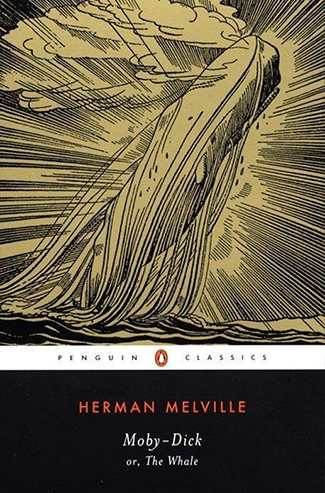
If you went to high school in America, you probably read Moby-Dick — or, more likely, you skimmed the CliffsNotes and wondered why this dense, whale-obsessed novel was considered a classic.
That was me in 10th grade.
But earlier this year, I decided to revisit Moby-Dick in midlife, and it hit me completely differently. What once seemed like a tedious story about a guy chasing a whale revealed itself to be a profound meditation on free will, perception, self-reliance, leadership, and obsession. It’s now one of my favorite novels.
To help unpack why Moby-Dick endures — and why it might be worth picking up again— I’m joined by Mark Cirino, a professor of American literature. Today on the show, we discuss why Moby-Dick was initially overlooked, the novel’s major themes, and the timeless mystery of Captain Ahab’s monomaniacal quest.
Resources Related to the Podcast
- Mark’s previous appearances on the AoM podcast:
- One True Podcast
- The Norton Library Podcast
- Mark’s Norton Library Edition of A Farewell to Arms
Connect With Mark Cirino
Listen to the Podcast! (And don’t forget to leave us a review!)




Listen to the episode on a separate page.
Subscribe to the podcast in the media player of your choice.
Transcript
Brett McKay:
Brett McKay here and welcome to another edition of the Art of Manliness podcast. If you went to high school in America, you probably read Moby-Dick, or more likely you skimmed the Cliff Notes and wonder why this dense, whale obsessed novel was considered a classic. That was me in 10th grade. But earlier this year, I decided to revisit Moby-Dick in midlife and it hit me completely differently. What once seemed like a tedious story about a guy chasing a whale revealed itself to be profound meditation on free will perception, self-reliance, leadership, and obsession. It’s now one of my favorite novels. To help unpack why Moby-Dick endures and why it might be worth picking up again. I’m joined by Mark Cirino, professor of American Literature. Today on the show we discussed why Moby-Dick was initially overlooked the novels, major themes and a timeless mystery of Captain Ahab’s monomaniacal quest. After the show’s over, check out our show notes at aom.is/MobyDick.
Alright, Mark Cirino, welcome back to the show.
Mark Cirino:
Thanks so much, Brett. Great to be back.
Brett McKay:
So you are a Hemingway scholar and we’ve had you on the show before to talk about Hemingway as a writer and For Whom the Bell Tolls. But you also teach a class about Herman Melville’s, Moby-Dick, which is your favorite novel. So if you are an American, you went to high school in America, you probably read this book, I dunno, right around 10th grade. That’s when I read it. It’s when we did American Literature. And if you were like me in 10th grade, you probably used the Cliff Notes a lot. And I wanted to talk about Moby-Dick because I recently reread it earlier this year as a 42-year-old man, and I absolutely love this novel. It’s one of my favorites now. And I hope with our conversation we can inspire some listeners to either pick it up for the first time or revisit it if the last time they read it was in high school English class. So let’s talk about big picture. Let’s talk about this guy Herman Melville, who wrote Moby-Dick, who was this guy when he wrote Moby Dick. What’s his story?
Mark Cirino:
Herman Melville was born in 1819, so he was born into the era that we really call American Romanticism, which began around that time. And he was a fairly prominent writer of seafaring narratives, type P Omo, just kind of romps in foreign lands. And with Moby Dick, he became more interested in writing in an abstract way. So in other words, he kept with the maritime adventures and ships, but instead he began to write in an allegorical and abstract way where he began to be all encompassing. And when this book was published in 1851, people just weren’t ready for it. Some people noted that it was an impressive book and so forth, but it wasn’t like it sold very much. It wasn’t like Melville became this unimpeachable bard of American letters. Melville would go on to write a lot of abstract work, philosophical, political, psychological, and then he really became more of a poet later in his life before he died in 1891, to the extent that when he died in 1891, his obituaries didn’t really say that he was the author of Moby Dick.
First and foremost, he was more the author of Typee, Omoo, these early romantic yarns. And it was only until later, maybe the centennial of Melville’s birth, so 1919 where people began to rediscover Moby Dick and say, wow, this is actually worth reading. If I can tell you really quickly, Brett, there’s one particular scholar named Raymond Weaver who taught at Columbia, who was prominent in what is now known as the Melville Revival, which is kind of the rediscovery of Moby Dick and the rediscovery of Melville himself. And my grandfather was a student at Columbia for Professor Weaver. And so he was one of the students reading this book that nobody had ever heard of or nobody thought much about, but this guy was like John the Baptist when it came to Melville. So now years later, Moby-Dick is celebrated as an unequivocal great American novel, and it just goes to show, it might get us to think about that the American literary canon is as subjective as anything else you think of Moby-Dick dropped down from the heavens as sacred text. It really wasn’t that it was discovered by some literature professor.
Brett McKay:
It reminds me of F. Scott Fitzgerald’s, The Great Gatsby.
Mark Cirino:
Same thing, a hundred percent, a hundred percent. When Fitzgerald died in 1940, he was convinced Gatsby was a failure. Gatsby was out of print and it had to be reintroduced. And then now of course it’ll never go out of print.
Brett McKay:
It’s interesting, Melville had written a lot and he was well known for his writing before Moby Dick, but today, I think most people, if they’ve read Melville, the only thing they’ve read from Melville is Moby Dick, or they might’ve read Bartley the Scrivener, and that’s about it. What do you think that is?
Mark Cirino:
So I’ve read several other Melville novels to try to answer exactly that question, Brett. I was like, why? Everyone would say Melville is one of the great American novelists of all time. Everybody would say that. And then you could ask those people who say that, okay, so name two Melville novels. And they would say, well, Moby Dick and Bartley, the Scribner, okay, Bartley, the Scribner is the short story, right? So what does Moby Dick have that the others don’t? Especially since they’re kind of covering the same terrain? And if I can just be reductive and try to figure this out, the first thing it has is Ishmael. And Ishmael is this singular narrator. He’s funny, he’s imaginative, he’s enthusiastic, he’s discursive like he goes on tangents here and there, and he’s very insightful about human behavior. So Melville had never done that before, create such a perfect narrator.
The second thing it has is Ahab, this enormous figure, this mad captain determined to get vengeance on this monster of the sea. So he’s almost godlike or royalty, he’s just larger than life. And Melville had never created such a larger than life protagonist. And also Moby Dick himself, the whale, this creature that is the object of so much fury and so much scrutiny. That is the great quest that Ahab is on. And so triangulating these three unbelievable characters within this novel creates such an alchemy, such power and mystery that none of his other books ever approached this kind of structure.
Brett McKay:
Why do you think this novel is so intimidating? I think some people, they have Moby Dick on their two read list or they remember reading it from when they’re in high school and they’re like, Ugh, Moby Dick, I can’t do that. What is it about this book or the way it’s written that makes it intimidating?
Mark Cirino:
Well, you’re going to have to tell me about how you felt about it as a 10th grader. I mean, it’s kind of long. It’s not long as 19th century American novels go necessarily. I mean, there are lots longer novels. I think the writing is pretty dense and poetic and Baroque Melville writes in a very intense way. So it can be very hard to kind of unpack some of the poetic imagery, some of the philosophical ideas. Absolutely, some of that can be difficult to unpack. Ishmael also goes on digressions as I mentioned. So there’s the very simple story, which is Ahab has been wounded by this one particular white whale named Moby Dick and has now determined to set out and avenge it. And our narrator, Ishmael happens to be on that ship, the P quad. So that’s a very simple story, just a very simple story of vengeance and actually also a holy grail story trying to reach one particular object. But at the same time, Melville layers on top of this very simple, straightforward, linear story discussions about religion and politics and commerce and law and history and psychology and philosophy and nature. So it goes on and on and on. And I think that can be very either frustrating or disorienting for lots of readers.
Brett McKay:
I think when I was in 10th grade and I was reading this book the first time I remember I’d get to the chapters where Melville would just inject these almost pseudoscientific textbooks about Whales chapter 32, where you just see it’s just basically the scientific name of the whale and the description of the whale. And I remember in 10th grade, like what does that have to do with the story? So I’m just going to skip this. What do you think is going on there? Why did Melville do that? I mean, he does that several times there at the book. I remember there’s one where he just talks about the anatomy of the sperm whale head. What does this have to do with Ahab getting Moby Dick
Mark Cirino:
On the surface? It has nothing to do with it. And chapter 32, which is called Cytology, probably has caused more additions of Moby Dick to be turned into Frisbees and launched across dorm rooms all across the United States than anything else in American literature. So Ishmael takes us on a really convoluted taxonomy of the different kinds of whales and the way they looked and their behavior. And I think this is part of Melville’s vision, of course, I’m only telling you what its effect is to me as a reader. I can’t tell you what he was going for, he never proclaimed it. But I think in addition to this narrative, he was trying to say everything about whales all at once. So he was trying to come at it from an adventure point of view. He was trying to come at it from a metaphysical point of view, a historical point of view, and in this case a scientific point of view.
I’ll tell you a couple of effects that Chapter 32 has on me. The first thing it does is it shows how engrossed and enthusiastic Ishmael is as a narrator. And that’s no small thing, Brett, if you’ve ever been talking to somebody, even if you’re not inherently interested in what the person’s talking about, if they are so obsessed and hyped up on what the story is, sometime that’s charming and engaging. And I definitely find that with Ishmael, you don’t really need to be as excited about whales as Ishmael. You just need to know that Ishmael is very excited about whales. So Ishmael is eager to tell you everything that he’s learned about whales. And the second thing that I would offer about the ology chapter is as Ishmael is offering an organizational system of whales based on how they look and how they behave, this book comes out in 1851 and in 1851, weren’t we doing the same thing about human beings? We have a hierarchy of human beings that we valued depending on how they looked and how they behaved and where they were, where they lived. If we don’t in 2025, we certainly were in 1851. And so when I mentioned earlier that the Wailing adventure is kind of an allegory or a metaphor for larger things, that could be something that’s a cytology chapter suggests.
Brett McKay:
I think for me, the effect it had on me whenever he goes into these scientific digressions about whales, it made Moby Dick the whale — I understood it more, and it also made him even more impressive in a way. I don’t know if that was the effect he was going for, but that’s what it did for me. It made the whale more impressive.
Mark Cirino:
Yeah, because he’s saying, you have to understand this thing from all its vantage points, how big its head is, what its tail is like on and on. There’s even the chapter about a whale’s penis, only to show that we have never really encountered monsters like this before.
Brett McKay:
So you mentioned the big picture outline of the book. It’s this guy named Ishmael. He hooks up with this ship called the Pequod, and he’s the book’s narrator and the ship’s captain is Ahab, who’s been injured by this whale named Moby Dick. And the book is all about Ahab trying to find this whale, essentially. That’s what it is. And then along the way, they’re doing some welling, then there’s some other things going on. But let’s talk about the main themes of Moby Dick. You mentioned some of them earlier, science, philosophy, religion. What would you say are the big themes you see throughout this novel?
Mark Cirino:
Yeah, there are a lot of themes. I think Melville touches on a lot of things. One of the elements that he’s addressing is the difference between free will and determinism, which is simply do you have control of your own actions? In the very first chapter, which is called Loomings, Ishmael is describing a kind of magnetic pole that he has to the sea. So it’s almost like he doesn’t choose to go. The sea draws him. And he’s saying that happens all the time that we’re drawn to certain places, we’re kind of sick of society and we’ve got to go into nature. And by the same token, the reason that theme is so important is because when Moby Dick injured Ahab, Ahab believes that Moby Dick sought him out personally to injure him like you, I want to get you. And so Ahab is personally insulted that one particular whale injured him.
Meanwhile, I think maybe most common sense readers and certainly Starbuck in the novel, they’re like, Ahab, that’s what whales do. It was instinct. Why would you take it personally? God designed this whale to defend itself and to attack potential threats. You just have to accept that. And so you see there’s a distinction between did Moby Dick act intentionally with a human motivation or was it just mechanical instinct? And that question gets turned around when Ahab is suggesting his act of vengeance on the whale is also instinct. He’s drawn to it magnetically, almost like the whale was drawn to him. So this kind of gets at a lot of questions about human behaviors. When do we act according to our own consciousness versus when do we act kind of programmatically? And so that’s certainly one of the themes.
Brett McKay:
So what do you think was going on in Melville’s time where he was thinking about free will versus determinism? What was happening in America at the time?
Mark Cirino:
Well, I think one of my favorite sentences in the novel is when Ishmael says, “Who ain’t a slave?” And I think that’s one of the most courageous sentences in that novel. In 1851, he says, who ain’t a slave? And some people actually were slaves, but he’s talking about something a little larger. He’s saying, okay, is slavery a legal issue or can it also be a psychological issue? Are there things that even free people in 2025 are slaves too? And then as one of his contemporaries, Ralph Waldo Emerson said, well, what if you’re a slave driver to yourself? What if you are imprisoning yourself through limitations or habits or prejudices or small-mindedness or things like that?
Brett McKay:
Another theme that you talk about and that you see in the book is this idea of objective versus subjective.
Mark Cirino:
Yes.
Brett McKay:
What’s going on there?
Mark Cirino:
Yeah. So basically there’s a juxtaposition between subjective perception, how an individual sees the truth of something and objective reality, what the empirical facts are. And this is really set up in so many ways, and I think the best way to analyze this idea is the Dublin chapter where Ahab nails up a single coin and says, whoever can spot Moby dick first. This one particular well gets this very valuable coin. And then there’s an extraordinary chapter where Ishmael describes several people starting with Ahab, going up to the delo, looking at the shapes and the figures and the symbols on this coin, and essentially interpreting it or reading it. So we might think of an inkblot test. Well, an inkblot test objectively is an ink plott. But subjectively, there might be an image or a memory that it calls up to you individually, and that the same is true for the dub. So it ends up revealing more about the person than about the coin itself. So Ahab looks at it, and you remember what he says when he sees the coin. He says, you see that that’s Ahab. Those things over there, that’s Ahab, everything, Ahab, Ahab, Ahab. So it’s the greatest expression of solipsism and self obsession, self absorption, because Ahab sees himself in everything. He’s self-obsessed.
Brett McKay:
Another chapter where you see that exploration of objective versus subjective. It’s one of my favorite chapters, one 18 The Quadrant.
And this is a scene where someone’s trying to bust out the quadrant. Sailors use this to navigate. You look at the stars and you can figure out where you’re at. And Ahab is like, I’m not having it. He’s like, I hate this thing. He says, fool. He calls it foolish toy babies play thing of hudy admirals and commodore and captains. The world brags the thee and thy cunning might. And then he says, science cursed thee thou vain toy and cursed be all the things that cast man’s eyes aloft to that heaven whose live vividness, but scorches him as these old eyes are even now scorched with thy light. And he said, level by nature to this earth’s horizon are the glances of man’s eyes not shot from the crown of his head as if God had meant him to gaze on his firmament, curse thee thou quadrant, and he dashed it to the deck.
No longer will I guide my earthly way by the level ship compass and the level of dead reckoning by log and by line, these shall conduct me and show me my place on the sea. And I think that’s a great idea. He’s like, I’m rejecting science. I’m not guiding my life by the objective science. I’m just going to use my own self to guide my life. And I read that and I can see, okay, that’s not good to reject objectivity, but at the same time, I’m kind of inspired by Ahab like I’m going to do what I want to do and not what some instrument tells me to do. I think it’s very relevant today where we have ai, people are going to chat, g gt asking chat, GBT to make decisions for them about, well, should I take this job or even about their romantic life? And I think Ahab would say like, no curse the chat GPT, and he’d smash it.
Mark Cirino:
There is definitely that to it. And this is like Luke Skywalker using the force and not putting the blast shield down. And he’s like, I’m trusting my own instinct is strong enough to solve this problem and execute this mission. And I agree with you that is inspiring. But we can see also the cautionary tale of how they can get you into trouble, how you can forsake facts and say, I got this. And there’s a difference, especially in romantic literature, capital R. So I’m not talking about romance novels, I’m talking about romantic literature. The difference in romantic literature is trusting yourself, and I’m using self as its own word, trusting yourself, which means the heart’s core, that deep inner part of you that maybe other people don’t see, maybe you don’t even see. It’s your soul trusting that which is a divine correspondence to nature and to divinity versus trusting your ego.
And so Ahab may let ego get in the way, or other leaders may let ego get in the way and they forsake facts. But I do agree with you that if you’re using instinct properly, if you’re balanced, that can be inspiring. There’s one other illustration of this, Brett, that might add a layer to it in the chart, which is not dissimilar from the quadrant. In chapter 44, Ishmael is saying essentially, Ahab wanted this whale so badly. He was so bent on this obsession that he says all possibilities would become probabilities. And as Ahab fondly thought, every probability the next thing to a certainty. And so we all know people like this, the people who they can’t see reality because they want something so badly, and because I want it to happen, I can will it to happen. So it cuts both ways because the more kind of sober, realistic people may say, wow, that’s not going to, I don’t think that’s going to work. But the fact is, don’t our heroes don’t. The really great adventurers and leaders and inventors don’t, they have this kind of little strain of hyperbole to them, this little extreme element to them. We’re going
Brett McKay:
Let’s talk about some of the characters more specifically. We’ve been discussing them kind of on the surface. I want to go deeper with this.
Mark Cirino:
Yes.
Brett McKay:
Let’s talk about the narrator, Ishmael. Moby Dick starts off in a famous way. Everyone probably knows the first line of Moby Dick. It’s “Call Me Ishmael.” What does this line do for the narrative? And what does that tell us about Ishmael that he started off this story with? Call me Ishmael.
Mark Cirino:
Yeah, that’s a question that people have been wrestling with for 150 years. What does “Call me Ishmael” mean? On the surface, it’s a really folksy introduction to our narrator who’s going to sit down and tell you a nice wailing yarn. But on the other hand, it might be a little shifty. There’s a difference between saying, my name is Ishmael and call me Ishmael. Call me. Ishmael is kind of establishing the authority of who is telling the story and who is going to be listening to the story and at the mercy of who is telling the story. So if somebody tells you, call me blank, they are kind of setting the terms of the narrative. In fact, we can go onto the second sentence of the story. He says, call me Ishmael some years ago. Nevermind how long? Precisely, so it’s already he’s telling us what to ask and what not to ask. He’s a very engaging narrator, but again, he’s also setting the terms. We might also wonder about the name Ishmael, because I dunno how many Americans are named Ishmael. This is a quintessentially American narrative, and we have American characters named Ishmael and Ahab.
Brett McKay:
Yeah, why is that? Is there something symbolic about the name Ishmael?
Mark Cirino:
There must be. So when he says, call me Ishmael, he is alluding to a figure in the Bible, the son of Hagar, who is an outcast. So when he’s saying, call me Ishmael, he might be suggesting that he serves that same kind of role in society or that same kind of role in the narrative. One of the things about Ishmael, and I think this is truly the genius thing about the novel Moby Dick or one of the genius things is that Ishmael is not the protagonist, and Ahab is not the narrator. Ishmael is kind of on the periphery off to the side observing. Sometimes you don’t even know how he has access to certain events that go on on the P Quad, but he can sometimes get into the thoughts of Ahab. Sometimes Ahab does something all by himself, even below Deck, and you wonder how does Ishmael know what is going on? Does he have imaginative powers? Does he have supernatural powers? Is he a fiction writer? Where does the truth and imagination blend?
Brett McKay:
Yeah, this reminds me going back to The Great Gatsby. It’s the same thing with Nick Caraway, the narrator, then Jay Gatsby’s the protagonist. And my son just got done reading The Great Gatsby, and he had this funny comment. He’s like, Nick Caraway is just always kind lurking. I don’t know why he’s there and these different situations, how he knows what’s going on, but he’s just kind of there in the background. I’m like, yeah, he is kind of a lurker.
Mark Cirino:
That is a great parallel. It’s exactly the same. The central phrase for Nick Caraway is you remember, and I’m sure your son just read this, when Nick Caraway is talking about this party that he’s at this really kind of seedy party in this apartment, and he looks outside and he sees kind of a bystander, and he says, I was within and without. So simultaneously, he was two places at the same time, and he was two people at the same time. And that is the brilliance of Gatsby, the way it’s narrated. But of course, Moby Dick came way earlier, and so I’m sure that Fitzgerald modeled it after Ishmael.
Brett McKay:
So Ishmael, as you said, he’s this really enthusiastic guy. He’s really enthusiastic about whaling, and he’s also kind of an outsider. What does Ishmael represent, do you think? Because Melville’s writing symbolically in this novel, so Ishmael must represent some idea that he’s trying to convey.
Mark Cirino:
Yeah, that’s a really good question. I think Ishmael might be the stand-in for Melville. I think he’s the writer of the, I think he’s the poet. And so the poetic leaps that Ishmael takes, the philosophical and psychological leaps that he takes, he’s really the poet and the novelist on the ship. Ahab doesn’t think on those terms. Ahab is thinking he must get the whale, and if this novel were to be narrated by Ahab, it probably would be very direct. It wouldn’t be much shorter. But Ishmael is more expansive, and I think it’s kind of showing what it’s like. And this goes back to the Nick Haraway thing, what it shows to be in the proximity of these larger than life figures. So Ishmael is kind of awestruck. He looks around with a sense of wonder at whales, at these great captains at all the events, the violence, and he’s sort of our standin and also Melville’s standin.
Brett McKay:
Let’s talk about Queequeg. Queequeg has always been one of my favorite characters. For some reason, I just find him endearing. Why do you think this cannibal sailor dude from the South Pacific is such an endearing character?
Mark Cirino:
Yeah, first of all, he’s great at being a harpooneer. So he gets on the Pequod due to merit, and that’s fantastic. He’s more qualified than Ishmael to get on the Pequod. He’s a great friend. He’s generous, and I think, well, you can answer why he’s endearing to you. What he’s endearing to me about is that he’s in the Emersonian sense of being self-reliant in comfortable in his own skin, which is in his own heavily tattooed skin. Imagine being a heavily tattooed Pacific Islander, observing Ramadan carrying heads in your sack in Manhattan in the middle of the 19th century. You would be extremely conspicuous. He has absolutely no embarrassment about his own actions. They give him a wheelbarrow to lug things around him. He puts things in the wheelbarrow and carries it because he doesn’t understand how wheelbarrows work, and it feels like, well, didn’t you feel silly?
He’s like, no, why would I feel silly? I don’t know how to do. This isn’t something I’m familiar with. So he’s completely at ease with who he is. I find that very inspirational. One of the great chapters in Moby Dick is called the monkey rope. And in the monkey rope, you remember this episode Brett, where Queequeg is on top of a whale carving it up, and Ishmael is on the boat tethered to Queequeg with a rope, and Ishmael finally realizes if Queequeg falls in, I fall in and if I let go, Queequeg falls in. And then he takes another step back and goes, well, isn’t this just like every human being all across the world, is that we all are connected, even if it’s not with a tangible rope, if I’m driving to work and someone swerves in, I’m done. If the pharmacist isn’t paying attention when he gives me my medicine, I overdose and I’m done. So we all depend on one another for survival. We just don’t see it on an everyday basis. And so Ishmael’s having this very physical connection, but he also appreciates this sublime metaphysical connection he has to him also.
Brett McKay:
Yeah, I love that insight. He lacks that morbid self-consciousness that a lot of westerners have, and that’s admirable. Someone who’s comfortable in their own skin. I think that really ties in. I think Melville is probably getting it at that idea in American romanticism of just what Emerson hit on. You got to be your own guy, as Thoro said, March to the beat of your own drummer, that sort of thing. And that’s admirable.
Mark Cirino:
Emerson says, anybody can be themselves in the privacy of their own room. The key of being yourself, a fully functioning human being is to be yourself out in society. That’s the challenge when conformity is really pressuring you to be like everybody else. He said, if you can maintain who you really are, really are deep down that is greatness. And Ishmael’s looking around to see like, oh, who’s doing this? Am I being, he’s kind of like jittery is in a foreign land at complete ease.
Brett McKay:
Talk about Ahab. He is one of the great figures in I’d say world literature. He’s part tragic hero, part madman. How do you think Melville wants us to understand Ahab and his obsession for the whale?
Mark Cirino:
Wow. So many ways. I think for starters, we can ask ourselves if we are Ahab at all. If there’s in common parlance, the white whale is like, Hey, what’s your white whale? It’s like, what’s the one thing that you keep trying for that you can never get? And it’s like, oh, I might be obsessive about certain things that I keep failing about or that I’m destined to fail, and I’m really driving myself crazy about it. What is your white whale? So we might all be Ahab at one time or another in our lives. Hopefully we recognize it before it’s too late. So at one point, it’s about obsession and monomania only thinking about one thing and how that, remember Brett, I hope you’re comfortable with spoilers. The way that Ahab dies I think is so crucial.
Brett McKay:
Yeah, tell us about that.
Mark Cirino:
Are we okay?
Brett McKay:
Yeah. If you haven’t read Moby Dick yet, you can fast forward. Let’s talk about this.
Mark Cirino:
Okay. Well, the manner in which Ahab dies is he’s impaled by his own harpoon.
And how symbolic is that? That what really ended up killing him was not necessarily the whale. It was his own violence towards the whale got turned on himself. I also think Ahab is a quintessential dictator. So the P quad is run in a fascist way, and so Melville is talking a lot about government and leadership. One of the aspects of the P quad is that there are people from all over the world. Almost every nationality and ethnicity is represented on the P Quad. It’s like a floating united nations, of which Ahab is the leader, is a commander, and Ahab sooner than later, gets everybody to do exactly what he wants them to do. The passion of his leadership, his charisma, his magnetism has overwhelmed everybody else on the P quad, so that his doomed insane mission becomes unanimous.
Brett McKay:
That sounds, I mean, I know this is probably not a great parallel, but it reminds me of Steve Jobs when he was the head of Apple. People would talk about how he could just because of his charisma in his just obsession with making the best product possible, he would get people to do what they thought was impossible. Oh, interesting.
Mark Cirino:
The way you’re saying it, that almost sounds like a positive application.
Brett McKay:
Well, so I mean, it was positive. We got the iPod and we got the iPhone, but the way you hear people describe working for Steve Jobs, he was a real jerk. He was awful working under him. He was mean, and he even recognized that as he was dying. He was like, yeah, I probably could have done things differently, but maybe not. Maybe he couldn’t have done things differently to get accomplished what he accomplished.
Mark Cirino:
What I think about sometimes when Ahab gives that first pep talk where he gathers everybody around and he essentially says, Hey, you know why you’re here. We’re here to kill one whale, Moby Dick. And Starbuck is like, Hey, I thought we were going to do see how many whales we could catch so we could make a lot of money. He’s like, no, no, no. We’re getting one whale. We’re going to get vengeance on the one whale who injured me. What that makes me think of is to look at a Nazi rally from the 1930s and how Hitler was so passionate filled with evil and hate and madness. You could tell the power of his insanity was greater than the emotions that anybody else in that room had. And Ahab even knows it. Ahab knows what he’s saying, might be ruinous and wrong, but he also knows there’s nobody who is his equal. Nobody wants it as bad as he does. Nobody wants the opposite as bad as he wants what he wants, so he overwhelms them.
Brett McKay:
I mean, when I read Ahab, I think Melville paints a really complicated character. On the one hand, his obsession ended up killing him and lots of other people too. But on the other hand, I mean, Melville does paint Ahab in a kind of romantic light in a way he’s got on a bad course, but there’s something attractive about this dynamism, and I feel like Melville would say there’s a role for passion, this whole American romanticism thing, but it’s got to be harnessed in the right way.
Mark Cirino:
You make a great point. So first of all, just a couple of things about that. First of all, I think there’s a moment where after Ahab kind of riles the entire Pequod up and everybody’s on his side, there’s a line that should make your heart sink, where the beginning of chapter 41, Ishmael says, I Ishmael was one of that crew. My shouts had gone up with the rest. My oath had been welded with theirs and stronger, I shouted more, did I hammer and clinch my oath because of the dread in my soul? A wild, mystical, sympathetic feeling was in me Ahab’s quench list feud seemed mine. That is for anybody, and it doesn’t have to be grandiose like politics or religion or life and death. It could be any time you went along with something that you deep down knew better then you got overpowered.
And the other thing that your comment made me think about Brett was there’s a moment where Ahab is really humanized, where he’s all by himself, at least he thinks he’s all by himself, or perhaps Ishmael’s looking on, and he leans over, he’s thinking about his wife, and he’s thinking about what his obsession and what his career as a sailor has done to his family and how he’s spent way more time out on the ocean than on land. And one teardrop drops into the water. And what Ishmael Surmises is there was more substance in that one teardrop than there was in the rest of the ocean combined because of just how long did it take that tear to form? Probably he had never done it before, but there is that, it’s kind of a yin and yang type thing where yes, Ahab is all one thing, but there’s one dot of humanity and sanity and family man where he kind of remembers who he really is.
Brett McKay:
Let’s talk about another character, really important character, the whale, Moby Dick. I’m sure lots of people have written essays when they’re in high school like, well, the white whale represents this. What do you think the white whale represents?
Mark Cirino:
Okay, so let’s take one baby step back. And I think a lot of readers of literature who were asked to read this book, let’s say in high school and 10th grade seems actually very early to read this book, but let’s say they did. And their professor, their teacher said, now we’re all going to write essays about what Moby Dick represents, what the whale represents. And a common complaint is, well, why does the whale have to represent something? Why can’t it just be a whale? Why can’t it just be? And we have to have a discussion in that class about there is such a thing as literary symbols. Things do represent other things, and we don’t really need to presume this. We don’t have to guess about this because actually Ishmael tells us what the whale represents. He says in chapter 41, which is called Moby Dick, and let me just quote a sentence or two, all that, most maddens and torments, all that stirs up the leaves of things, all truth with malice in it.
All that cracks, the sinews and cakes, the brain, all the subtle demons of life and thought all evil to crazy Ahab were visibly personified and made practically a saleable in Moby Dick. So Ishmael is saying everything bad about the world, Ahab ascribed to this one particular whale. Now, it’s very important that Ishmael is saying that is what the whale symbolizes to Ahab. The thing about a symbol is that it means different things to different people. An American flag will mean something different to an American and someone from a different country. A cross means something different to a Christian and a non-Christian, and this is the way symbols are. They mean different things to different people. We almost started our conversation by talking about the difference between objective and subjective. So we have to be very careful that the whale doesn’t mean the same thing to everybody.
Ahab is trying to make Moby Dick mean the same thing to everybody. He wants everybody to hate it as much as he does. But in fact, the very next chapter, chapter 42, which is called The Whiteness of the Whale, begins when Ishmael says what the white whale was to Ahab has been hinted, what at times he was to me, as yet remains unsaid. So for every person in the book and for every reader, the white whale probably means something different. I know that’s frustrating, and I hope it doesn’t sound like I’m equivocating, but what it really is, it’s a celebration of subjective perception over objective reality.
Brett McKay:
And so, okay, Moby Dick represents evil to Ahab and he has to kill it. What does it mean to Ishmael?
Mark Cirino:
Yeah, so exactly. So Ahab is saying, once I kill Moby Dick, everything will be better. And now we may look at that and go, what is going to happen once he kills Moby Dick? He’s going to live happily ever after. Do we really think that’s what’s going to happen? So in Ishmael’s case, in chapter 42, he takes a philosophical point of view. Chapter 42 is called the Whiteness of the Whale. And he says, do you know what really bothers me about Moby Dick? The thing that really kind of exasperates me is that he’s white, and by that it’s saying he’s blank. He has no definition. It’s his absence. He says, vague, nameless horror. So what frightens Ishmael is that he’s a white whale, and it could mean anything in that sense. It means whatever you think it means. You are projecting your own anxieties, fears, prejudices onto this blank screen.
If you’ve ever had to write something and you look at a white sheet of paper, that could be very anxiety causing. But here he’s saying, and this is kind of counterintuitive because I think our culture, we look at white as pure and clean and innocent. And here he’s saying, you know what it’s like, it’s like if you’re caught in a whiteout or an avalanche and your surroundings have no definition. In 1851, the early 19th century, if you looked at the map of America, there were white spots, there were white areas, things that hadn’t been fully settled and explored. And romantic writers, Emerson and Thoreau were like, don’t explore externally. Don’t explore the continent. Go within, explore the white spots in your own brain, the areas of your own psyche and consciousness that you haven’t thought of before.
Brett McKay:
Yeah, there’s a great line in that chapter, chapter 42, talking about how the whiteness, it’s this void, this blankness in how it’s anxiety producing sort of existentially anxiety producing. He says, this is it that by its indefiniteness, it shadows forth the heartless voids and immensities of the universe, and thus stabs us from behind with a thought of annihilation when behold, the white depths of the Milky Way.
Mark Cirino:
Incredible. That’s incredible. Yeah, if you are an imaginative person, if you can project and then you can spiral out of control because it’s just blank. There’s a line in Walt Whitman’s song of myself, which is 1855, and I might butcher it, but I’ll do my best. He says, the white topped mountains are in the distance. I fling my fancies toward them, fling my fancies toward them. So he’s looking essentially at a white easel or white canvas, and he’s like, whatever’s in my brain that is going to project onto it. And that’s scary. What Ishmael is gesturing towards is that we really, as human beings seek definition. We seek boundaries. We want things to be contained. And if the white whale is so enormous and he’s white, we don’t know if there’s any end to it. It could be just an infinite beast.
Brett McKay:
You’re a Hemingway guy. You have a podcast called One True Podcast, and it comes from this line from Ernest Hemingway in a movable feast where he describes how he writes, and he says, all you have to do is write one true sentence, write the truest sentence that you know. What do you think is the true sentence in Moby Dick?
Mark Cirino:
Well, that question is just, now I realize how evil that question is because there’s about 91 true sentences from Moby Dick. I can choose one of my many one true sentences. So as the novel goes along, and this might be a little bit of a key for people who get frustrated with some of Ishmael’s digressions, we start to see a little bit of a pattern in how Melville structures Moby Dick. What he’ll do is he’ll spend a few pages of a chapter talking about some arcane aspect of wailing or whales or the practice of wailing. And you’re saying, why am I engaged with this? Why do I need to know this? And then at the very end, maybe the last sentence or the last paragraph, Ishmael will tie it in to a larger, universal or metaphysical concept, and you’re like, oh, now I see why we’re talking about it.
And it’s absolutely brilliant. Many of these chapters are absolutely brilliant. One such chapter is called Fast Fish and Loose Fish, and this is chapter 89. This very small chapter is essentially a rule book about whaling, which is to say, what do you do when two rival ships are both pursuing the same whale? How do you know who gets it? And the short answer is, whichever ship is fast to it or attached to it, and if the whale is loose, if it’s unclaimed, then whichever ship becomes fast to it gets this whale, and you’re like, well, this is kind of interesting. I never thought that there was a rule book about wailing, but I guess there’s rule books about everything that’s kind of interesting trivia, and that’s that. But towards the end of this chapter, Ishmael begins to talk about being fast and being loose in the sense of metaphysics or your soul or your spirit or your psyche.
And then let me just end the chapter the way he does. He says, what are the rights of man and the liberties of the world, but loose fish, what all men’s minds and opinions, but loose fish? What is the principle of religious belief in them? But a loose fish? What to the ostentatious smuggling, ISTs are the thoughts of thinkers, but loose fish, what is the great globe itself, but a loose fish? And what are you reader, but a loose fish and a fast fish too? And that last sentence brings it home and kind of twists the knife in where he’s basically saying, okay, so what are things that you are susceptible to being influenced by? It goes back to a lot of the strains of conversation, Brett, that we’ve just been having, which is okay, who could come along and convince you to do something that you wouldn’t ordinarily do? And then he goes back to, but what are you fast to what has already claimed you in ways that you might not even be aware of? Like, who ain’t a slave? What are you imprisoned by? Have you ever taken a step back to say, what am I loose to and what am I fast to? It’s an absolutely brilliant way to parallel this weird, trivial law of wailing and the way we all experience life.
Brett McKay:
That’s amazing. Well, Mark, this has been a great conversation. I hope it’s inspired some people to go pick up their old copy of Moby Dick and give it a reread. Where can people go to learn more about your work and what you do?
Mark Cirino:
So I am actually hosting two podcasts. One, as you say, is Hemingway specific called One True Podcast. The other is called the Norton Library Podcast, of which there are two beautiful episodes about Moby Dick with the editor, Jeffrey Insco and I have recently published an edition of Hemingway’s, A Farewell to Arms with the Norton Library that I hope everybody enjoys.
Brett McKay:
My guest today was Mark Cirino. He’s a professor of American literature. Check out the podcast he hosts. He’s got the Norton Library Podcast, as well as One True Podcast, which is about Hemingway. You’re available on all podcast players. Also, check out our show notes at aom.is/mobydick where you can find links to resources we can delve deeper into this topic.
Well, that wraps up another edition of the AoM Podcast. Make sure to check out our website at artofmanliness.com and make sure to check out our new newsletter. It’s called Dying Breed. You can sign up dyingbreed.net. It’s a great way to support the show directly. As always, thank you for the continued support. Until next time, this is Brett McKay reminding you to not only listen to the podcast, but put what you’ve heard into action.