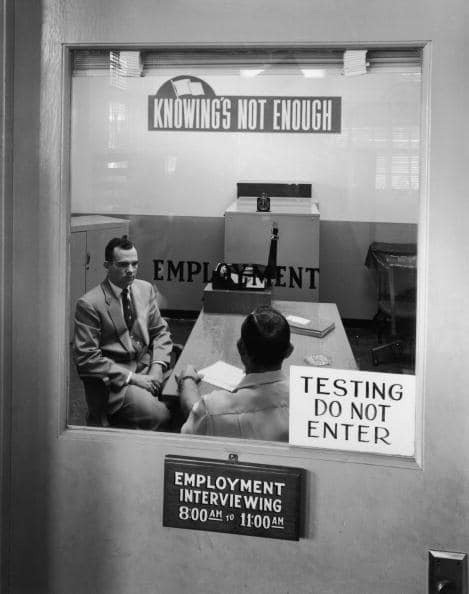
Job interviews can be nerve-racking. You have one shot to convince a potential employer that they should hire you instead of dozens (and maybe hundreds) of other qualified candidates. In this tough job market, a man has to be on top of his game during interviews if he wants a chance to land the job.
A few months ago, I interviewed for a job I had been hoping to get since I was a student in law school. I got through the first round of interviews fine. It was the kind of straightforward and traditional interview that most of us have probably experienced. I was asked questions about my strengths, my weaknesses, and why I wanted to work for this particular company. Basically, they were the kind of questions you can prepare for and have some go-to answers you can use with confidence.
I got the call-back and scheduled an interview with a company executive. Before I flew out to my interview, a friend of mine who knew this person tipped me off on the executive’s interview style. The executive liked to use behavioral interviewing to weed out candidates for positions. I had never heard of this interview style before, so I set out to research as much as I could about it, aiming to be as prepared as possible.
Here’s what I learned on the way to landing the job.
What Is Behavioral Interviewing?
Behavioral interviewing is a relatively new method of job screening. In the 1970s, industrial psychologists found that traditional job interviewing was a pretty crappy way of predicting whether a candidate would succeed at a job. And when you look at traditional job interview questions, it’s easy to see why.
In a traditional job interview an employer might ask questions like:
- “What are your strengths?” Typical banal answer: “I’m a team player who’s passionate about engaging with people to realize the mission statement of the organization.”
- “What are your weaknesses?” Typical banal answer: “Oh, I guess my biggest weakness is that I’m just so darn hard working. I never know when to quit. Oh, and I’m really hard on myself. I’m a perfectionist.” Basically, the candidate makes a lame effort to turn a “weakness” into a strength.
- “What’s your passion?” Typical banal answer: “I’m passionate about whatever the company I’m interviewing for does for business. I hear you guys make fertilizer. Did I tell you about my dog poop collection in my backyard? It’s amazing!”
- “How would you handle a co-worker who is bothering you?” Typical banal answer: “The truth is I would probably leave passive-aggressive notes on his desk, but you don’t want to hear that, so I’ll just tell you what you want to hear. I would seek to understand and then to be understood. I would kill them with kindness. And if worse comes to worse, I’d take the problem to HR.”
- Or simply: “Tell me about yourself.” Typical banal answer: “Here’s my 2 minute elevator pitch that makes me look really awesome but in no way reveals to you whether I really have the skills to excel at this job.”
These types of questions are pretty easy to answer. You just have to give the interviewer a vague reply filled with the right buzz words. These answers don’t reveal if the candidate really has the skill set needed to succeed in the job because they don’t require a candidate to give specific examples from their past when they demonstrated said skills. What these types of questions usually reveal is that a job candidate is good at telling a boss what they want to hear.
Behavioral interviewing cuts through the banalities of traditional interviewing and requires candidates to give concrete examples of when they demonstrated the skills needed for the job. Instead of asking what your strengths are, an employer using the behavioral interview process will ask a question like this:
“This job requires the ability to make quick decisions in pressure-filled situations. Can you give me an example from your past when you had to make a quick decision under lots of pressure?”
Yikes. It’s a lot harder to B.S. an answer to this question than the “What are your strengths?” question.
But the questioning doesn’t stop there. The employer using the behavioral interview method will often follow-up your initial response with probing questions to elicit more details from you. Going back to our example question on decision-making, as you tell a story of when you made a quick decision, the interviewer might stop you and ask, “What were you thinking at this point?” These types of probing questions serve two purposes: 1) they give the employer more insight about your personality and character, and 2) they serve as B.S. filters. If you’re telling a totally fabricated story, the probing questions will usually trip you up.
Behavioral Interview Question Examples
The possible number of unique behavioral interview questions is only limited by the imagination of the interviewer. You’ll face questions that focus on a large variety of skills and behavior. An employer can then multiply the number of questions he or she asks you about those skill sets by inquiring about different projects or situations you’ve experienced in the past where you demonstrated those skills. Below we’ve included a few sample behavioral interview questions to give you an idea of what you’re up against:
- What do you do when priorities change quickly? Give one example of when this happened.
- Describe a project or idea that was implemented primarily because of your efforts. What was your role? What was the outcome?
- What is the riskiest decision you have made? What was the situation? What happened?
- Give an example of an important goal that you set in the past. Tell about your success in reaching it.
- Tell us about a time when you had to analyze information and make a recommendation. What kind of thought process did you go through? What was your reasoning behind your decision?
- Tell us about a time when you built rapport quickly with someone under difficult conditions.
- Tell us about the most difficult or frustrating individual that you’ve ever had to work with, and how you managed to work with them.
- There are many jobs that require creative or innovative thinking. Give an example of when you had such a job and how you handled it.
- On occasion we are confronted by dishonesty in the workplace. Tell about such an occurrence and how you handled it.
- Describe the most challenging negotiation in which you were involved. What did you do? What were the results for you? What were the results for the other party?
- Tell us about the most effective presentation you have made. What was the topic? What made it difficult? How did you handle it?
- What have you done to develop your subordinates? Give an example.
- Describe a situation where you had to use confrontation skills.
That’s just a sampling. I recommend that you print off this mega list of behavioral interview questions. There are over 100 questions on the list. When I was preparing for my job interview, I printed them off and had my wife give me a mock interview. It forced me to think of different examples from my past that I could use when answering the questions. It was tough, but well worth the effort. During the interview, I had a stockpile of examples fresh in my mind, ready to be drawn from.
And don’t forget that your interviewer will ask you follow-up questions! As you come up with examples to use for your answers, put together as many details as you can so you’re ready for the probes of your potential employer.
How to Answer a Behavioral Interview Question
Alright, we know a behavioral interview can be a real son of a gun. What’s the best way to answer a behavioral interview question so you impress the boss and get the job?
Most guides on behavioral interviewing suggest using the three step STAR process when giving an answer to a behavioral job interview:
1. The Situation or Task you were in
2. Action that you took
3. Result of that action
Let’s take a look at the STAR process in action.
Question: Describe a situation where you had a conflict with another individual, and how you dealt with it. What was the outcome?
Answer: During college I worked on a four person team that was researching the effects of plastics on male rats. I got along with everyone quite well, except for one fellow. We disagreed strongly on the method we should use to conduct the experiments. My other teammates and I agreed on one way, but this guy wanted to do it his way. He didn’t budge at all on his position and even took passive-aggressive steps to prevent us from completing the project. (Situation or Task)
I set up an informal meeting at the local coffee shop with the guy. I simply asked him to explain his reasons for wanting to do the experiment his way. I just listened and asked questions to clarify. Some of his assumptions were clearly erroneous, but I knew pointing them out right away would just make him get defensive, so I bit my tongue. After hearing him out, I had a better idea of where he was coming from and realized that he might have some misunderstandings on some basic concepts. I didn’t think he would take too kindly to a peer correcting him, so I suggested that maybe we should set up a meeting with the professor to discuss our different ideas and to see if he had any feedback or advice. (Action that you took)
So we met with the professor. We both presented our different reasons for wanting to do the experiment in a certain way. As predicted, the professor brought up the faulty assumptions our stubborn teammate had and that his method wouldn’t be the best to use. The guy was sort of deflated, but he accepted the feedback and agreed to start the experiment using our method. (Result of the action)
There are no right or wrong answers. An important note to remember when answering behavioral interview questions is that there are no right or wrong answers. It’s often hard to tell what employers are looking for when they ask behavioral interview questions. Take our example about conflict resolution. You might think the interviewer is looking for a certain textbook method of conflict resolution. But maybe the employer’s own managerial philosophy doesn’t line up with the typical conflict resolution technique. I enjoy reading a weekly feature in the New York Times called “The Corner Office.” They ask CEO’s about leadership and what they’re looking for when interviewing a candidate for a job. Each CEO has a different rubric for what makes a good employee. So just concentrate on coming up with a concrete, truthful example that answers the question and presents you in a good light. And let the chips fall where they may.
Be honest. Don’t try to B.S. your way through a behavioral interview. If you don’t have an example for a question you’re asked, don’t try to make something up. For starters, you’ll probably get called on it with follow-up questions. But more importantly, the questions are designed to see if your skill set and personality fit with the position. If your answers aren’t what the interviewer is looking for, this position may not be the best job for you anyway, and you’d be miserable at work if you did get the job. That’s not good for anyone.
Use all your life experiences as examples for your answers. Behavioral interview questions often require you to give examples from your past work experience to answer a question. This can pose a problem for younger job candidates who haven’t held many, if any, prior jobs. To get around your lack of work experience, call on all your life experiences. Take examples from college or any volunteer organizations that you may have been a part of to answer the question.
What’s your experience with behavioral interviews? Any other advice on how to prepare for them? Share your tips with us in the comments.




{ 34 comments… read them below or add one }
I was in the process of making a major career change and advanced to the second round of the interviewing process at a large international firm. A company higher up came in, sat down, briefly flipped through my resume before putting it down and asking me, “So, do you like to drink?”
I thought that if I answered “yes” I’d be labeled a drunk and not get the job, but if I answered “no” I’d be labeled a stick-in-the-mud and not get the job. I replied, “I honestly do not know how to answer this question. I enjoy the occasional beverage in the correct setting.”
I got the job.
When I took my intro to Mechanical Engineering class last year, I remember that the professor had told us about some interview styles these employers had. He said out of experience where companies that would hire graduates in the field, like IBM, had interview questions such as why are sewer manholes circle, or how many gas stations are there in the US. The point behind them was to determine not if the possible employee knew the random trivia, or how well they could use Google, but the logic and thought process they were able to muster behind their estimate.
I would add that, in common with the traditional interview, it’s important to have the confidence to stop and think before answering a question. Though the pause may feel long to you (it probably isn’t), a potential employer will generally be far more impressed with a considered answer after a moment’s silence than a quick one with a lot of fluffing and backpedalling to add detail.
Incredible! I’m having an onsite interview with Google next week, and guess what arrives to my inbox this very morning. Are you spying on me? :).
I can say this will prove invaluable, thank you very much! This seems to be Google’s interviewing style, as in the interview format description I got they stated “You will have up to five interviews, each lasting approximately 45 minutes. You will be asked a variety of technical and behavioral questions- which you should be prepared to support with examples from previous experience.”
Now time to prepare myself.
I recently served on an interview team using this method.
Several of the candidates, who in my estimation were certainly qualified for the position, were caught absolutely “flat footed”.
Fore warned is fore armed
I was trained as a Manager to do all of my interviewing in this style.
Compared to the traditional questions, it weeds out candidates that are good at BS, and let’s those with solid experience shine. The key I found as an interviewer, was to be patient. These are not necessarily easy questions, an therefore it is important to let the candidate think about their answer. My advice is take a moment to collect your thoughts on your answer, don’t feel rushed to answer. A good interviewer in this style is expecting you to take some time to answer. Don’t worry about an akward pause when answering, The interviewer should be expecting you to pause and think through your answer.
If someone replies to me that he’s a perfectionist. I would say: “Interview over. Sorry, I don’t hire perfectionists, they are the worst procrastinators. Choose a better weakness next time”
A friend of mine did an interview at Credit Suisse bank. They interviewed three at once. He told me that when one of his mates was asked of his weakness and answered it was perfectionism, the interviewer promptly replied: “Ok, now tell me a weakness”.
Needless to say, he lost the job.
Should probably also cover the ‘case interview’. I had an interview with an engineering company when all they said was, “tell me about tourism”. I had no idea what was expected. After 20 min of my ramblings where I might have or might not have talked about the plight of the proletariat (I was in college) we shook hands and went our seperate ways. Needless to say I did not get the job. Later on I found out it was intended to be a business case. The point of the question to see how I organize and analyze complex ideas.
Gee, I guess I better not put down perfectionism as a weakness, even though it its, because it makes it difficult to declare a job task finished, even when it’s “good enough.” It’s something I’ve struggled with my entire professional career. When you’re on deadline, you have to be able to let the task go.
All I can say is I’m glad my career relies on a portfolio. Drop a sample of past work on the interviewer’s desk, and most everything else becomes irrelevant.
Oh my god, these are the worst questions they ask. They’re so hard to BS.
I’m not a man, but can I chime in anyway? I found the best way to prepare for these types of interviews is to focus on coming up with the stories rather than the questions. There are so many possible questions they could ask it would be impossible to come up with a different example for each and every one. Instead think of several experiences in your life that could each illustrate several qualities they might ask about. In the interview just tailor your example to fit their question. My other trick was to ask a lot of questions of them (about the company, the position, or theirs) when the time came. This showed I was interested enough to have come up with my own questions and ate up enough time so that we didn’t have to revisit the tough behavioral questions. I think that’s what got me my current job actually.
First of all, congratulations on landing the job.
These interview questions have become pretty standard in my industry. Our favorite: what has been your biggest mistake and what did you learn from it?
While there aren’t necessarily right or wrong answers, there are definitely answers of death. For instance, in the above question, explaining how you covered up the mistake so no one would find out (actually happened in an interview).
Many interviewers try to get you comfortable and let your guard down and share WAY too much. Be wary of this. Something mildly funny or embarrassing among your mates (that time you were so drunk you lost your car) is not interview material no matter how cool the interviewer seems.
I know that when they ask you what your biggest weakness is a lot of people try to say something that is a positive. Something like, “I work too hard.” However, I tried something different. When they asked me about my biggest weakness, I looked right at the guy and said, “Beautiful women.” He did not even smile. So I retracted, “Just kidding. I work too hard.”
For the age-old question about weaknesses, I think the best thing is to admit to a reasonable weakness, but tell them how you compensate for it, for instance “I’m somewhat disorganised so I make a point of booking things I need to remember on Google Calendar”.
Having participated in and chaired enough screening committees, the behavioral interview questions we prepare are based on the job description for the job. For example, a recent position we posted was for a person working with students from many different countries, and we knew that would result in a fair share of “conflictive situations.” The question, therefore, asked about previous experience working with diverse populations and to provide an example of how that person handled any conflicts that arose between people in previous jobs. We asked questions about previous jobs, but the candidate could easily have said that he/she didn’t have any work experience like that, however, there was a time when she was working on a project in a study group and two of the members got into a shouting match. She did this and that and they were able to get back to working cooperatively, handed in the project and got an “A”. Really, you have to see yourself in that job and answer the question with that perspective in mind.
As I was finishing that last sentence, I got a call from my boss asking if I would be willing to chair another screening committee. Great.
It’s very often good to back up what you say with an example – even if they don’t specifically ask for one, so this is useful advice for normal interviews, too. When I had an interview for a job that would involve a lot of conflict, and I was asked how I would deal with this, I used examples of dealing with difficult customers from a retail job I’d had in the past.
We learned about this stuff in an HR class in business school. Traditional interviews are by far the worst predictor of employee performance. Remember, employers want to now what KASH (knowledge, attributes, skills, and habits) you have and whether they apply to the job you’re applying for. Your “experience” doesn’t matter unless you have the KASH to back it up. Focus on what you’ve got and done and most likely you will pass the behavioral interview.
I used to use these interviews several years ago and been interviewed with this style. The team would agree on asking 6-8 of these questions, based on the qualifications, skills and attributes of a successful candidate. That will give you a heads up on the questions you will get.
My advice is to come up with 3 or 4 projects, accomplishments, conflicts, successes or failures that you have been involved with. They don’t need to be professional, but can be personal, like resolving conflicts between children, caring for the elderly, raising money for a charity,etc. Practice the STAR thing so you can hit all the bases. Don’t feel compelled to use a different experience for each type of question. Some people will be assigned to ask the same question to make sure that you have a chance to answer each one fully and that they are clear on what your answers were. You can elaborate on an earlier answer, but don’t contradict yourself. It will benefit you if the interview committee has a clear picture of who you are and how well you fit the qualifications in the posting. Whoever hits the most of them gets the job.
A couple of people on the interview committee may ask a “motivational fit” question. It typically goes like “tell me about things you liked on your last job and things you disliked about your last job.” If they don’t have the things that you like about your old job and will need to continue to cope with the things you didn’t like, you won’t be a good fit. I always follow that question by asking how they coped with the things they didn’t like.
So basically, think about times you were awesome and times you weren’t so awesome, but you learned something about yourself
This isn’t new. I’ve been using this technique for years to separate those who actually delivered from those who attended one time when their boss was out sick for that important meeting.
If you can’t describe what you did and what value you brought to the party that few others can offer then I’d be pretty sceptical. First thing, if you’re worth your salt, you need to be doing the interviewing. If after a couple of months of your new job you’re not wondering what you have got yourself into – in a challenging way – then you’ve made mistake. Probably so have they.
Stop job interviewing and start interviewing for a career. If you can’t spend some time making sure the next couple of years of life aren’t a waste then good luck with that.
My two pence.
I find it hard to believe that any interviewer still bothers to ask the lame questions about strengths & weaknesses; you learn nothing apart from the candidate’s ability to BS.
I’ve been interviewing at managerial level for many years and have always asked these “behavioural” questions, always expect a candidate to pause and reflect and often find candidates struggle to concentrate. As interviewers we need to be able to ascertain who we’re about to employ, but also need to understand that it’s hard to sell yourself from your side of the table… so asking probing and more in-depth questions are the best way.
Getting the candidate to relax is the key to getting good answers from behavioural questions.
These questions are there for us to try to analyse how you will perform in a real-work situation.
And it’s not always about the candidate’s ability to answer “right”: In my interview for my current CEO job in a UK non-profit, I lost the plot during two of the questions, couldn’t recover but didn’t BS, just plain admitted: “I don’t know; I can’t recall right now…”.
Interesting article; the “complete list” linked to is required reading!
I’ve participated in approaching 200 behavorial interviews, both as the interviewer and the candidate. As an interviewer I’m amazed sometimes that after I explain exactly what I am looking for (S/TAR) I still get imcomplete STARs. As a candidate, I have been suprised at how easy it is to ramble on and how difficult it is to concentrate on providing a good STAR. It’s definitely a good toal for assessing the soft skills during an interview.
Congrats on the job! I really dig this kind of interview but admit I have never taken part in one. I did, however, listen to a book called “Brag!” that has some great examples on the right and wrong way to answer some of these. I highly recommend it if you think you’ll be interviewing anytime soon.
I think this type of interviewing is more effective in gauging how a prospective employee will function within a company. The learning curve for new associates seems to be shorter than in the past, so there’s not much room for lengthy orientation and training sessions. I’m only 46, but I’ve already seen plenty of changes in the work place over the past 20 years. I remember several years ago, when I interviewed for a different position for my last employer, the first question they asked is to write down how to make a peanut butter and jelly sandwich. It seemed ridiculous, but it was amazing (as I later found out) how such a simple question stumped so many people. I immediately saw it for what it was: a pure mental test. No one likes mind games, but in today’s ever-changing business world, people have to be knowledgable, but also be able to think fast.
I did my share of chairing interviews too. Hiring trainees for programming jobs I always asked them to write a small program to find the highest number in a set of numbers. Most couldn’t do that, amazingly. One guy had never programmed, so I said ‘just tell me how you would do it’. He gave a perfect answer, so he was hired. Another said ‘I can not do it without a computer’, so he got a computer, and still couldn’t do it (after 45 minutes of trying). My manager wanted to hire him, because he had a great resume and aced the non-technical interview. I said no, so he failed (yes my manager actually listened to me).
I think if you want to know their personality,strategies and social skills, a game of cards or chess will do fine. All the talking usually doesn’t tell you much.
Great post! I see this technique being employed quite often, esp. in government hiring. I’d underscore the importance of 1) being honest (canned, rehearsed, b.s.’d or made up answers are easy to spot) and 2) using all of your life experiences to answer these questions. Some of the more interesting answers often come from non-work related experiences interviewees have given. It’s ok to say, “I don’t get to use that skill much in my current job (this may be a good reason you’re giving to switch) but I have had experience making decisions under tight deadlines while volunteering as a paramedic…” You can typically use the “that’s a skill I’d like to develop more in this job” once during an interview. I also think it is more important to nail the first two or three serious questions. A strong first impression can carry you a good distance. Employers, in my experience, are likely to maybe open with one soft question and then get to the things that are most important to them. We tend to front load the skills or experiences that are most important to us.
I think it is also important to have some skill in accurately accessing the primary personality type and primary sense of perception of the person conducting the interview. This allows for specifically designed phraseology designed to appeal to the typology and sense of perception.
I did hiring at a company that specialized in providing behavioral therapy, so of course we utilized behavioral interviewing techniques! I found that you learn a lot about the applicant not even based solely upon the experience they are telling you about, but in how they tell it to you (I would usually tell the person, “I’m going to give you a scenario, and I want you to give me a concrete example of that kind of scenario from your past, the action you took in that situation, and the end result of your action”. You’d be surprised at how many people would tell you only one or two of those three things I asked for. It was a good way to gauge people quickly!) So make sure you listen closely to what they are asking you, and then try to find an example that fits that as closely as possible!
I’ve had a few of these here, in the UK. Once I even got a job :) My advice is: confidence. If the position isn’t that high, chances are there won’t be too many follow-up questions. There won’t be time for them. I wouldn’t consider that a good thing. Sometimes it’s better if your potential future boss has the time to ask them. There might be some things unclear in the situation you describe and he may not get the right picture initially. So make sure you are precise enough. Make it short and simple. Not too short and too simple. The example given by Brett sounds like a perfect one. So be confident in the way you speak (not too many “buts” or “on one hand…”). Yet, make sure you don’t sound like a “I know everything” type of guy. Managers don’t like that too much.
I hope these aren’t too obvious. :)
it easy to bullshit these questions… if you are a good bullshitter
I’ve been to a few of these types of interviews. I managed to get a couple of jobs, however, recentlt, due to the nature of my current job (which is an individual contributor to the business), I have failed three interviews in a row. I believe I have been triying to use sample examples only from my current job which do not quite cut through the bone, rather than using the previous jobs and life expriences. My advice is to collect as many examples as possible – from previous jobs and general life experiences.
Tried to print your questions off but the link did not work. I realize it has been a couple of years but behavioral interviewing is still taking place. I have one next week. I would love for my wife to ask me some questions but I would really like to have a good sample. Do you think you could repair the link or email an updated link that works.
As a engineer and one who has friends in the sciences field (mainly chemists), I have to say behavioral interview questions are alive and well. Probably worse than they have ever been. It seems that employers in the public sector only use behavioral questions.
Hi.. the list of questions no longer exists.. too bad.. i was hoping to get some practice in. I’d also like to say that I’m finding alot of companies do a pre-screen over the phone now, in order to qualify for a one on one or panel interview. This initially threw me but I certainly understand the reasoning, as I used to wonder how the interviewees got in front of me when I was hiring.
Thank you for the information. Hearing all of your experiences has made me feel much more prepared.