Every Man Should Know How to Drive Stick

by Brett & Kate McKay on October 17, 2012 · 275 comments

in Cars, Manly Skills

I can still remember the day I learned how to drive a stick shift. My dad and I were looking for a car for my sixteenth birthday. I had my eye on a red Isuzu Hombre (that’s right, the make of my first car was the Spanish word for “Man”). Only problem? It had a manual transmission, and I only knew how to drive an automatic.

“Not a problem,” my dad said.

He got the keys from the salesman and we went for a test drive. My dad pulled into a cemetery that had a big, empty road that winded throughout the grounds. He stopped the car, turned it off, and got out.

“Okay, Brett-os. Your turn.”

So began my initiation into the high art of stick shift driving.

I stalled out the first time I tried to get the car started. Then the second time. And then a third time. My dad just sat there and chuckled silently to himself, while offering some fatherly pointers. Finally, on the fourth attempt, I got the little truck going. When my dad saw that I could stop and start the Hombre consistently and shift gears without grinding the clutch, he gave the okay for me to get the truck. And off I went, lurching into my new freedom.

It’s been over a decade since I first learned how to drive stick, and I’m still cruising America’s highways and byways the very same way. But the number of my gear-shifting brethren are few; after Oldsmobile introduced the first automatic transmission in 1940, the number of manual transmission vehicles on the road took a steep dive, and for the last few years have represented only about 4% of annual auto sales in the US. (Interestingly, in the first quarter of 2012, sales of manuals jumped up 3%, perhaps signaling a small comeback). While our numbers may be few, there are several reasons you should consider joining our ranks.

Why You Should Learn How to Drive Stick

You never know when you’ll need to know how.  Has your friend become inebriated and you need to drive him and his old Ford “three on tree” Bronco home? Do you need to borrow a friend’s car, and the only one available has a manual transmission? What about renting a car while abroad? Manual transmission cars are much more common internationally than in the US, so automatics are not always available, and if they are, are much more expensive.

Knowing how to drive stick means you’ll never be caught flat, clutch-shy-footed, in a pinch. A man who knows how to drive a standard transmission car can also easily drive an automatic, but the reverse isn’t true. Better to know it and not need it, than need it and not know it.

Manual transmission cars are generally less expensive than automatics. Because very few people today know how to drive a stick shift, the demand for them is low. This can be annoying if you’re looking for a specific model of car with a manual transmission and it isn’t offered. But the upside is that manual transmission vehicles are often priced lower than their automatic counterparts, and the lackluster demand for them can be a bargaining chip when you’re buying used. They tend to sit on the lot longer, so tell the salesman you’d be more than happy to take that lonely manual off their hands if they’ll drop the price some more.

So you don’t hop into a “borrowed” getaway car you can’t drive. Because a manual transmission can act as a possible thief deterrent.

Manual transmission vehicles generally get better gas mileage. Not only will knowing how to drive a standard save you money when you purchase your car, it can also save you money for years after, as they typically get better gas mileage than their automatic cousins. While it’s true that recent automatics have closed this gap, and a few models can even beat their manual counterparts, manuals still have the edge; Consumer Reports found that, on average, a stick shift can improve gas mileage by 2 to 5 miles per gallon. With gas prices as high as they are, every little bit of savings helps.

You can sometimes push start a manual transmission car with a dead battery. If you have a dead battery, but no jumper cables, you can often get cars with a manual transmission, particularly older models, going with the good ol’ push start.

Some really cool cars only come with a manual transmission. If you ever decide to buy a vintage sports car and fix it up, knowing how to drive stick will greatly expand your selection of vehicles. And if you ever win a contest where the prize is an Aston Martin V12 Vantage or a Ford Shelby GT500, you better know how to drive stick. Those cars only come with manual transmissions, and there are countless other high-end and luxury sports cars that are standard transmission only too. Why? Because guys who are willing to drop some serious coin on such vehicles tend to want the full driving experience, which is to say…

Driving stick is simply more fun! If you’ve only driven with an automatic transmission your entire life, you don’t know the fun you’ve been missing. Driving an automatic feels passive and artificial – like you’re merely pointing or steering the car instead of controlling it. With a manual, you actually feel like you’re part of the car, and you’re attuned to its vibrations and noises. Plus, manual transmissions are proactive instead of reactive – you get into the gear you need instead of waiting for the automatic tranny to hunt for the right one.

Sure, this fun factor is dampened if you do most of your driving in stop-and-go traffic, or in a city with ginormous hills. But once they go manual, a lot of guys never go back, because automatics seem like a snoozefest in comparison.

How to Drive Stick: The Basics

First: Get Familiar With Your Cockpit
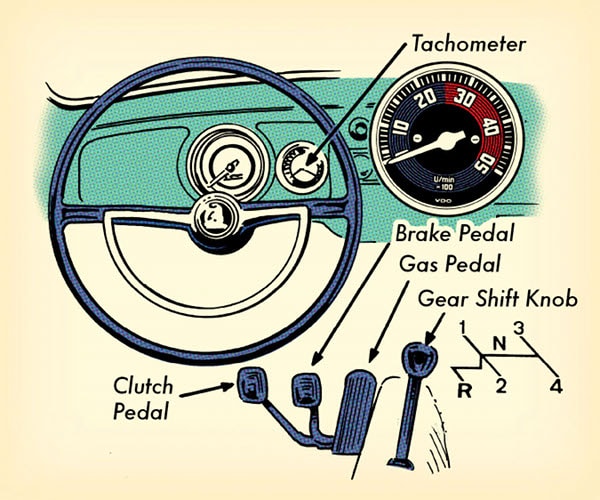
The pedals: clutch, brake, gas. The clutch pedal – absent on your automatic transmission car — is the pedal on the far left. You press the clutch pedal when you shift gears up or down. More on shifting in a minute.

The brake is the pedal in the middle; it’s used for, well, braking.

The pedal on the far right is the gas. Works just like your gas pedal on your automatic transmission.

One of the things that throws people off when driving a stick shift for the first time is the addition of that clutch pedal because you now have to use BOTH feet when driving — not just your right foot.  You’ll be using your left foot to press the clutch and your right foot to press the brake and gas pedal.

The gear shifter. Your gear shifter does just that — it shifts the gears on your transmission. Most modern manual transmission vehicles come with six gears: first through fifth gears, and then reverse gear. On the knob of the gear shift you’ll find a diagram that shows what position the shifter needs to be in in order to engage each gear.

The tachometer. The tachometer is a gauge on your dashboard that shows you how many revolutions per minute your engine’s crank shaft is going. When you begin driving a stick shift, the tachometer is a good way to help you determine when you should shift up or down. Generally, you should shift gears up when the tachometer is around “3” or 3,000 RPMs; shift down when the tachometer is around “1″ or 1,000 RPMs. After some experience with driving a stick shift, you’ll be able to figure out when to shift by the way your engine sounds and “feels.” More on that below.

Practice Shifting Gears and Pressing the Clutch and Gas With Car Turned Off

A little note before getting into the mechanics of driving stick: I highly recommend that you practice what we’re about to explain with the car turned off and the parking brake engaged. It gives you a chance to get a feel for how the gears engage and disengage and how much give or resistance the clutch has. It also allows you to get comfortable with the general body mechanics of moving the gear shifter and pressing the pedals with both feet versus just one. So after you read the instructions and before you turn on the car, practice going through the motions of shifting.

Getting the Car Going

Probably the hardest and most intimidating part of driving a stick shift is actually getting the car going in first gear. It takes a while to figure out how much you need to press down on the gas and how slowly you need to disengage the clutch for the gears in your car to catch and get moving. To prevent any frustration and self-inflicted violence, accept from the outset that you’re going to stall the car. It’s okay. It’s all part of the initiation into the Brotherhood of the Manual Transmission. The good news, though, is once you get the car moving, shifting gears is super easy.

Let’s get this car rolling.

Practice in an empty parking lot. You’re going to stall and lurch the car, so practice where there isn’t any traffic and where you have a flat surface. Empty parking lots are the ideal stick shift practice venue. It’s also a good idea to have somebody in the passenger seat who knows how to drive manual so they can provide pointers.

Press in the clutch and brake pedal, and start the car. To start a manual transmission car, you’ll always need to press the clutch while you turn the ignition switch. While you don’t need to have your foot on the brake to start the car (like you do with an automatic transmission), it’s a good habit to keep.

With the clutch pedal pushed down with your left foot, and your right foot pressed on the brake, turn the car on.
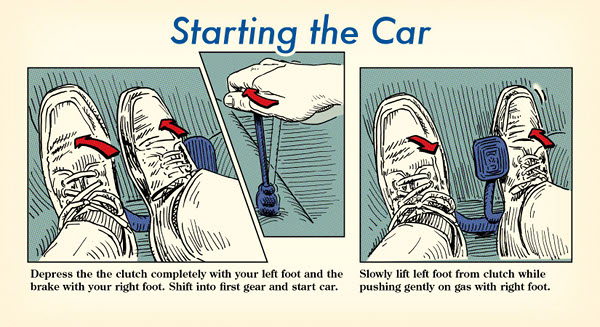
Put the car in 1st gear. If it isn’t already, push the gear shifter into 1st gear. If there’s only one thing you get from what I’m about to explain, let it be this: never shift gears without fully depressing the clutch pedal. Failing to do so while the car is on will result in a horrific grinding sound and you making regular trips (and payments) to the transmission shop. So make sure your foot is still pressing the clutch pedal all the way down before shifting into 1st gear.

To put the car into 1st gear, use your right hand to move the gear shifter up and to the left.

Make sure the gear is fully engaged. How do you know when it’s fully engaged? You’ll be able to feel it as well as see it  — the gear shifter should stay in place when you remove your hand from the gear knob.

Keep the clutch pedal and brake pushed down. Don’t take your left foot off the clutch yet or else you’ll stall out. Keep the brake depressed as well.

Move your right foot off the brake and onto the gas pedal. At the same time, start to release the clutch with your left foot. This is the tricky part when you’re first learning. Take your right foot off the brake, move it onto the gas pedal, and start pressing it…while at the same time slowly letting up on the clutch pedal with your left foot. You don’t want to stop pressing on the gas with your right foot while you do this or else you’ll stall. Keep light pressure on the gas pedal with your right foot so that the tachometer stays around 1,500-2,000 RPM while you’re letting up on the clutch with your left foot. If all goes well, you should begin to feel the gears “bite” or take hold of the spinning engine and you’ll start slowly moving forward. When you’re rolling at a steady clip, you can let up on the clutch completely. Congrats! You’ve successfully got a car moving in first gear.

If you stall, begin from the beginning. If you do stall the car, don’t fret. Just start the above process from the beginning.

Come to a stop. To stop, simply press down on the clutch with your left foot and the brake with your right foot at the same time.

Repeat until you can get the car going in first gear without stalling. Keep practicing getting the car going over and over again until you can do it regularly without stalling the car. If you do stall, laugh at yourself, and start the process over again.

Starting the car in first is basically the same process you’ll use when backing up, only the gear shift will be set in reverse. Sometimes if you’re on even a slight decline, you can get going in reverse without needing to press on the gas by simply taking your foot off the clutch.

Find a hill and practice there. Once you’ve mastered starting on a flat surface, find a hill to practice on. Starting from a standstill up a hill requires much more finesse with the clutch and gas pedals. You don’t want your first hill start to be in actual traffic with a car directly behind you. Trying to get your car going without stalling or rolling back into the driver behind you can be nerve-racking for a new manual transmission-er.

Upshifting
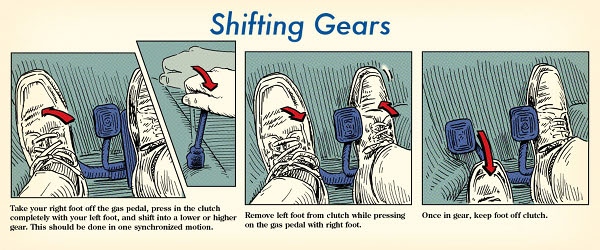
As mentioned earlier, once you can get the car moving from a standstill and into 1st gear, you’ve pretty much mastered 90% of stick shift driving. Upshifting into other gears is a breeze. Generally, you’ll want to upshift when the tachometer hits about 3,000 RPMs. It will be different for every car, but it’s a good rule of thumb. If you shift too soon, you’ll feel the car shudder, and you’ll need to downshift to keep it from stalling.

When you’re ready to upshift, just follow this pattern:

  • Take your right foot off the gas pedal and press the clutch all the way down with left foot and move gear shifter fully to next gear in one, synchronized motion.
  • Release clutch pedal while simultaneously pressing down on the gas pedal with right foot.
  • Completely let your left foot off of the clutch pedal once you’re in gear and continue to press the gas.

Downshifting

While you shouldn’t downshift to get your car to come to a stop in normal driving conditions (see below), there is a place for it in your stick shift driving arsenal. Obviously it’s needed when you’re driving in traffic that slows and speeds up as you go along. Downshift as your car slows and the tachometer drops to around 1.

Also, when you’re driving on hazardous roads, particularly on snow and ice, you don’t want to rely on your brakes to slow down lest you slide into the car in front of you. Instead, slow the car down by shifting into lower gears. If the roads are really slick, you’ll probably just want to stay in second gear.
Knowing When to Shift Gears Without Looking at the Tachometer

You’ll probably rely on the tachometer when you first start driving a stick shift to know when to shift gears. But with experience, you’ll be able to do it by how the car sounds and feels. If the engine is making a high pitched noise and it feels like no matter how much gas you give, you’re getting nowhere, then you’re in too low a gear and need to upshift. If the engine is making a low, rumbling noise and is vibrating a lot, you’re in too high of a gear and you need to downshift.

Don’t Ride the Clutch

You’ll want to avoid “riding the clutch.” What that means is avoiding resting your left foot on the clutch pedal when you’re in gear. While the light pressure of your foot resting on the clutch pedal is not enough to disengage the gear completely, it is enough to partially disengage it which causes premature wear and tear on your clutch.

Bottom line: when you’ve successfully shifted into a gear (or neutral), remove your left foot completely from the clutch pedal.

Coming to a Stop

There are two schools of thought on how one should come to a stop when driving a manual transmission car. The first method is to slow the car down by downshifting until you get to second gear and only then applying your brakes. The second method is to press on the clutch and shift the car into neutral, and then remove your foot from the clutch pedal, coasting to a stop using the brake pedal as needed.

While it’s true you can slow your car down by simply downshifting, it does cause a lot of wear and tear on your clutch and transmission. According to Click and Clack, (and this is also the way I learned to do it), it’s easier on your car to use the second method. Shift to neutral and use the brake. When you’re not able to put it in neutral, remember that you need to press in the clutch and the brake at the same time when you come to a stop.

Parking

When you park a manual transmission car, the emergency brake is your friend. You’ll want to set it every time you park your car, whether on a flat or sloping surface. For added safety, leave the car in first gear. If you’re parked on a hill, pointing downhill, put it in reverse. And no matter which direction you’re pointed on a hill, turn your front wheels so that if the car started rolling, it would roll into the sidewalk.

Well that covers the basics. There’s more to understand about driving stick, but you’ll learn most of what remains from experience, as you get attuned to listening to your car. After a while, shifting gears will feel as natural as breathing!
Any other tips for the first-time stick shift driver? Have any funny stories about your stick shift learning experience? Share them with us in the comments!

 Illustrations by Ted Slampyak


{ 275 comments… read them below or add one }

1 Brian October 17, 2012 at 11:21 pm

Love the post!!! My first car was a manual and so is my current car. My next purchase will also be a stick shift!!!

2 Andrew October 17, 2012 at 11:23 pm

When I was looking for Classic Mustangs for my first car, I was worried that I would get stuck with a great car that had a clutch, and I would not know how to drive it. So I learned, and when the right car came around (and it was a clutch), I adapted to it right away. Now I would never drive an automatic, unless I had to.

3 Randolph October 17, 2012 at 11:26 pm

In South Africa, most cars are manual (what we call stick-shift), and the driver’s licence is manual by default.

The only person I know of in my entire family who couldn’t drive stick was my grandmother, and she had a specific endorsed driver’s licence for it.

It’s interesting to see this perspective from someone who thinks stick is normal and automatic is odd.

I live in Canada now and drive an automatic, and it’s a lot easier in traffic not having to ride a clutch.

4 Caleb October 17, 2012 at 11:37 pm

And be prepared to pay for a new clutch! When I was a driving instructor we would occasionally get requests to do stick training. We never did because of the expense of having another car just for that. The demand was so more I doubt the car would have stayed busy enough. The schools that did offer it charged almost 2x the usual rate because of the cost of new clutches every other student!

5 Chuck Pompei October 17, 2012 at 11:38 pm

I learned to drive stick earlier this year after I bought my first car, a 1971 BMW 2002 4 speed. It wasn’t optimal, but with a little help from a friend and an hour or so of practice, I was able to make it home safely. Now, driving stick is second nature yet extremely enjoyable. You haven’t driven a car until you drive a manual.

6 JCCS October 17, 2012 at 11:46 pm

Good article. Only thing I’d comment on is that when you release the clutch pedal, you’re actually ENGAGING the clutch, not disengaging it.

7 Sergio Felix October 17, 2012 at 11:46 pm

Well I learned how to drive shift on a VW.

As soon as I started driving other cars I realized the VW was way more difficult than other cars but it was definitely a great choice to learn on.

8 Jake October 17, 2012 at 11:52 pm

Even after learning the basics of stick and driving for a few weeks or a few months, you’ll always have room to improve. I was driving my dad’s new manual Toyota Tacoma a few months back, and he instructed me to rev the engine very very slightly just before you start to disengage the clutch when upshifting. It helps lessen the very slight jolt felt when engaging the new gear. If you’re still working on hitting the sweet spot with the clutch/gas mix like me, this is a good tip to think about as you’re learning.

Another good tip for beginners is to know that every clutch will be different. I’ve seen that generally clutches in trucks are a bit less forgiving than clutches in cars. But clutches in general will feel different in their sweet spots and how far you have to depress the pedal as you change models and manufacturers.

9 Richie October 17, 2012 at 11:54 pm

You forgot to mention that when going from a complete stop on a hill, you must give much more gas as you disengage the clutch than when you are going from a stop on a flat surface. This was the hardest thing for me to learn.

I also love the extra control you have with a manual. And I also hate my manual in stop-and-go traffic!

I had never thought of downshifting as a safer way to stop on slick roads. Great bit of knowledge to add!

10 Jake October 17, 2012 at 11:55 pm

Woops, I meant as you “engage” the clutch when upshifting (let go of the clutch pedal).

11 Ziggy October 17, 2012 at 11:58 pm

My Grandfather passed when I was five years old, 19 years ago. When he left, he gave my dad a really old Mercury Lynx with sheep skin seat covers. That car was magnificent to me as a five year old A. because it was my Grandfather’s and B. It was now my Dad’s and we got to ride in it to baseball practice by the flight line at the Air Force base we were stationed at. Being old it often crapped out. My brother and my dad got to push this powerful beast of a hatchback down the parking lot while I popped the clutch. We would get it started I would stop it (I was unusually tall so I could reach in such a small vehicle) pull the e-brake and get into my seatbelt in the back (no carseats for five year olds in 1993). It was fun, and I have had three vehicles.
The first was a 1988 VW GOLF. $895 of awesome. Yes a Hatchback like my old man. And if you were wondering it was a manual transmission. It got totaled due to someone cutting me off and pushing it into a retaining wall (broke the frame).
The Second was a 1985 Toyota SR5. $750 of rust, painted it metallic blue and sprayed a bedliner on it. Yes it was manual as well. I was 17 and I thought you could power wash an engine while it was hot. Blew the head gasket. Replaced the engine and put in a rebuilt one. It was poorly built and threw a rod.
Third one 2003 Ford Ranger. Worth ten grand in 05, offered cash and got it for 6k great deal. Had 35k miles when I got it after 7 years it has 170k miles on it. Only problem is a stripped oil plug. And yes, It Is a Manual. After another 130k miles I hope to give it to my oldest son who is 5. He can’t reach the pedals yet, but he loves to steer and shift it while I work the pedals. Stick shifts will hopefully stay in the family as long as I’m around. Thanks for reading.

12 Greg October 18, 2012 at 12:10 am

Awesome! I’m really inspired to get a manual truck now

13 Dusty October 18, 2012 at 12:14 am

I SO agree with this article. My first vehicle was a Chevy S10 manual, and I miss it. If you really need to move on down the road, a stick shift is the way to go. I get so impatient with automatics.

14 Jimmy October 18, 2012 at 12:18 am

VW Bug or Bus. If you can get this to run well and can get into reverse every time, then you can drive everything else very well, and even have a stab at running a car with three-on-the-tree.

And the site looks amazing in the NetNewsWire’s browser on the iPad. Whoever made your site did a really good job of understanding how the tablet works with people.

15 Jaymoon October 18, 2012 at 12:31 am

I was just thinking the other day, I should really learn how to drive stick-shift one of these days… and sure enough, here’s this article!

I enjoyed reading through it, and can’t wait to get behind a manual car! I have to admit though, that as I was reading through how to go from park to first gear, I was “mock-shifting” at my desk, just to get the feel for it.

16 Daevid October 18, 2012 at 12:31 am

This is hilarious. In Australia (same as has been mentioned for South Africa) the majority of people learn on manual cars and only the really lazy or incompetent get just an automatic licence.
Good writeup anyway, though nothing can replace simple time behind the wheel.

17 Grayson October 18, 2012 at 12:36 am

I recently learned to drive stick on my dad’s solstice. I’m not ashamed to admit I stalled a good number of times (may or may not have been on the highway). I now drive a manual cooper s, and it’s the most fun I’ve ever had with a car. Switching to stick has been one of the best decisions i have ever made. Also, I have never had much respect for people who drive sports cars that are automatic.

18 Paul October 18, 2012 at 12:55 am

I learned that dragging your heel when disengaging the clutch provides more stability when learning.

When I first learned, I kept my foot in the air when disengaging the clutch, making the car jerk and making the tires squeal. After my dad told me to drag my heel, everything else just fell into place. I still use that technique most of the time to this day.

19 Eduardo October 18, 2012 at 1:03 am

You just have no choice in Brazil.

20 Pedro October 18, 2012 at 1:08 am

Another thing is when you are going downhill, gravity will cause your car to go faster. If you are driving a manual, you can just downshift and being in a lower gear will counteract the acceleration from gravity, so you can cruise downhill without picking up speed or riding the brake.

21 Chris October 18, 2012 at 1:19 am

I agree with this article. Using a manual makes driving a lot more fun. I remember first learning how to drive stick with my dad in his Jeep CJ-5. Those are great memories.

22 john October 18, 2012 at 1:35 am

very good article. yeah a stick is not the best in stop and go traffic. i actually rolled someone cause i hold hold down and shift in to N to come to a stop and was not giving 100%.

23 Bob October 18, 2012 at 1:35 am

My old man taught me how to drive with a stick in an extremely torquey diesel truck on an uphill gravel road. Sure, it sucked at first, but it taught me well in the end.

24 Tyler Smith October 18, 2012 at 1:44 am

Jimmy- I’m a valet for a hotel, and I completely agree. Driving a VW bus was hands down the most difficult thing to drive. I felt like I was an early astronaut in a janky shuttle heading towards the moon.

25 Julius October 18, 2012 at 1:46 am

Definitely an essential skill every man should know how to do. And after reading this article, I believe the person that taught me doesn’t “fully” know how to drive stick himself. Gonna have to give him some pointers. I’m especially confused about letting off the clutch COMPLETELY. From what I learned, letting off the clutch, even while in gear, stalls the car…

26 Pasqualito October 18, 2012 at 2:00 am

I never understood why apparently only europeans (Dutch myself) drive manual cars…

Personally I think that automatics are OK – when you’re 50 or older ;)

OTOH – in these old spaceships that have a couch instead of front seats, it’s very nice because you always have an arm free to throw around your darling’s shoulder.

27 Jeremy October 18, 2012 at 2:02 am

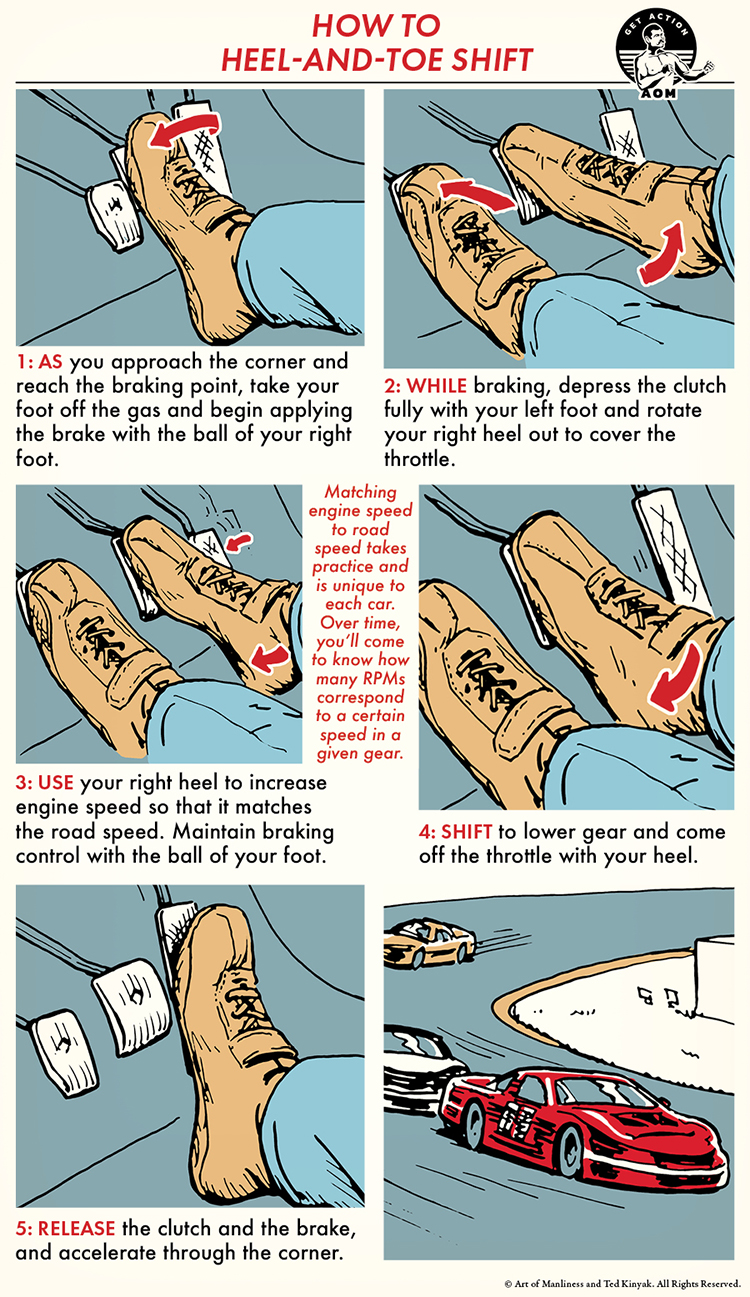
I’m going to have to call shenanigans on the not-downshifting-to-stop bit. Sure, if you’re just hauling the lever down, you’ll be forcing the synchros to do the work, but with a proper rev-matched downshift you shouldn’t be putting any additional wear on the transmission.

Also, a perfect heel-and-toe downshift right before a corner makes you feel like a boss.

28 Nick October 18, 2012 at 2:23 am

I am British, so learnt to drive manual from the outset. One of the skills my late father taught me was how to shift gears without using the clutch. This skill is about matching road speed to engine speed and gentle feeding the new gear in. I have used it twice, both times to get home late at night when the clutch has gone on the car. It is a skill worth acquiring for those middle of no where moments.

29 Tom October 18, 2012 at 2:31 am

I can confirm that in Belgium, automatics are a minority.

I’m really bad at the car-driving stuff though. I can barely concentrate on the road, let alone the shifting.

30 Aarnav October 18, 2012 at 2:37 am

Awesome. Take a bow. Highly useful for the newbies.

31 Chris Cowley October 18, 2012 at 2:42 am

In Europe the vast majority of cars are manual (the correct term my American friends ;-) ). I absolutely hate driving an auto, I always feel they take an age to change gear, waits until the RPM is too high and never makes the change as smoothly as I can, This applies not just to low-end ones, but mid-range as well.

To make is even worse, I drive a Renault Scenic – hardly a sporty car, more of a big box on wheels. If an auto cannot be as good as that piece of automotive dreariness then it is a technology that truly sucks.

32 Max October 18, 2012 at 3:02 am

Also, almost all other countries have predominantly manual transmission cars. so if you ever want to do a road trip while abroad, you’ll need to know.

33 Bill October 18, 2012 at 3:06 am

For hill starts, use the handbrake to hold the car still until the clutch begins to engage to prevent rolling backwards. Practice using this technique a bit though because it is very easy to stall the car or start burning the clutch if you don’t release the handbrake soon enough.

This is especially helpful is someone pulls up close behind you on a hill.

34 Andrew October 18, 2012 at 3:18 am

Here in Slovakia most of cars are also manual (same as other European countries). It is possilble to do your driving licence on automatic, but then it will be recorded in your driving licence, that licence applies only on automatic car.

Actually I have bit embarrassing experience with automatic transmission. I was member of team during important negotiation, when security guard came and told us that one car must be moved on. This car belonged to older lady, who was quite important person so she could not leave the room. Sha gave me the keys and asked me to move the car. You can imagine my surprise and embarrassement when I realized, that this car has automatic transmission. I sat there for a half hour and studied f…..g manual, then I stalled maybe three times, and finally I moved the car. But of course return back and ask was no option…

35 Jonathan October 18, 2012 at 3:25 am

It is always funny reading American blogs.
I in South Africa and there are very few people who cannot drive a manual car.

I have driven an Automatic twice in the past two months and it confuses me, because I have always used the feel of the clutch to adjust the seat to where I want it.

36 Eric October 18, 2012 at 3:48 am

No, thank you. I can drive a manual transmission (and ride a motorcycle, so +1 for being able to do it in 2 languages ;) but I will never go back to a manual as my daily driver.

My first car was an ’83 Datsun 280ZX, lots of fun. But I prefer the “point and drive” aspect of an automatic.

My commute is spent praying or listening to theological lectures. Paying attention to those takes my mind off of the road more than they probably should already, and they are not something I’m willing to give up. Adding in the need to pay attention to shifting gears manually again just wouldn’t work for me.

Probably not the strongest argument for an automatic, but there it is ;)

lectures, attention to those takes my mind off of the road more than it should already

37 Vince October 18, 2012 at 4:05 am

Brilliant post! I had to learn to drive stick when I moved here to Europe. As Brett said earlier, automatic transmission vehicles are far more costly and hard to find than sticks overseas. I love driving stick now and I would find it difficult to have to switch back to the boring automatic transmission.

38 Redfacet October 18, 2012 at 4:15 am

Interesting… Especially for Europeans ;-)
I would need to learn how to drive an automatic transmission car – which is still a bit easier, isn’t it?

39 Alex Smith October 18, 2012 at 4:29 am

Here in the UK manuals are way more popular. Not kid gets an automatic as his/her learner car, since we have a two types of licenses: auto or manual. Guess what? A manual holder can drive an automatic, but an auto holder can’t drive a manual….

I’m 19 and I’ve been driving for 2 years now. Shifting is second nature. I genuinely don’t think about it while driving, stop/start traffic doesn’t bother me either.

One thing to note:
DO NOT DRIFT IN NEUTRAL AS YOU ARE COMING TO A STOP (or at least don’t make it habit).
Neutral disengages the engine braking (which does a lot at 40mph+), you should gradually downshift while braking, although you can easily skip every other gear. This way, in an emergency, you have the maximum possible braking force at your disposal.

40 Stephan October 18, 2012 at 4:30 am

I knew that many Americans prefer automatic, but i did not know that the percentage of manuals is so small!
I live in Germany and here the numbers are more like 70% manual and 30% automatic.
I myself drive my old ’90 4-speed-automatic jag, but love driving manual. I guess as always, both has it’s upsides and downsides. My car being a saloon, i love to just relax and let it do the work for me, but when I drive my fathers e-type (yeah, we are kind of jaguar crazy) I enjoy the manual transmission because it is a sports car.

41 Tom October 18, 2012 at 4:30 am

Haha very interesting post. For me as a German driving a stick shift is standard. I thought that Americans would have problems with stick shift is more a prejudice than a true story. You changed my mind.

But it is definitely easier to switch from stick to automatic than the other way around. So keep practicing!

42 Andrew October 18, 2012 at 4:30 am

Sorry if this has already been mentioned but when stopping a manual you shouldn’t disengage the gearbox altogether, you should actually brake whilst the car is in gear and shift down as speed pemits without the car lurching. There’s also the school of heel and toe where you load revs between gears while braking, this means you can smoothly get into low gears quicker and either use stronger engine braking or be ready to take off again as you’ll be in a better working rev range.

43 Heath October 18, 2012 at 4:31 am

So much on this website appeals to me because it is stuff either I never learned or stuff I learned from someone other than my father.

My best neighbour/older brother type was called Monty, and he was nearly two years older than me. He had this yellow Chevette hatchback, and he taught me to drive a stick shift when I was barely fifteen. He lived outside of the city limits in a neighbourhood not much bigger than a large cemetery, and we just drove around until I got it. (He also taught me to shoot left-handed layups when I was twelve, but that is another story.)

My first car was a 1980 VW Rabbit diesel that would shake if you pushed it past 60mph. It had a hand-crank sunroof and no door handles, but I knew how to drive it, thanks to Monty. Now I’ll always have and treasure this life skill.

44 JR October 18, 2012 at 4:35 am

In the UK, manual gearboxes are the norm and automatic cars are significantly more expensive. The majority of drivers have a licence for a manual car, although, if you can’t drive one for whatever reason, there is also an ‘automatics only’ licence. I’ve driven manual cars my entire driving life and the first time I drove an automatic was on my honeymoon (a road trip from San Francisco to Las Vegas!) a few years ago. I found it painful. I was used to controlling the car precisely, and working with it rather than against it. This Chrysler Sebring hire car, with a 3.5l engine, was awful to drive. Gear changes happened later than I would’ve liked or, indeed, not at all. Want to overtake? In a manual drop a gear and accelerate with ease. In that Chrysler-made-barge, try to accelerate by putting my foot down and waiting while it slowly gained speed. This was in a car that had an engine nearly twice the size of my car at home! Same with going up hill. I know that there are good automatic gearboxes out there, but I suspect that the majority are like that Chrysler. I avoid automatics as much as I can now – hate them.

45 Robert October 18, 2012 at 4:50 am

Very nice article! In my country, Germany, it is very common and almost everyone is driving sticks. There are people who cannot and there are people just don’t want to because they’re lazy or just like the comfort in high traffic not to clutch and shift.

I drove an automatic gear and it is very comfortable but I like to “feel” the car, the mechanical, the hydraulics. I just like to shift the gears and my father has teached me, he was a taxi driver once, to shift gears without passengers knowing it (no stuttering and so on ). A lot of people can’t do it well and cannot shift smooth and have a lack of feeling for the clutch. But nevertheless they are able to somehow.

46 Savageblue October 18, 2012 at 5:11 am

Great article!

Here in Europe the norm is to have manual shift in cars.
I’ve never tried driving in an automatic gear car, but I can tell you that, once you get used to it, manual is loads of fun.

I don’t know if this is possible with automatic gears, but I’ll just list some other advantages of having manual:
- if you’re driving down some steep slopes, you may find a sign that says “brake with your engine”. Basically, this means you should go down one shift, thus creating a tension in the engine that will “sustain” the transmission to a certain extent, which will help refrain the speed of the car. This is also a safety measure to prevent you from over-using the brakes or to keep you from free-rolling downhill if your brakes fail;
- if you’re forced to make an unexpected stop, or deceleration, going down one gear (if you’re experienced, you can even go from 5th to 2nd) while stepping on the brake pedal will help you stop or decelerating more safely than just hitting the brakes, as you don’t need to totally block the wheels;
- on the other hand, if you need to make a sudden acceleration while you’re driving (not from a full stop position), engaging a lower gear will help you get the extra throttle you need to get that boost. This is also very helpful when you’re overtaking other cars;
- one of the best things about the manual shifts, though, is what we call “clutch spot” (I don’t know how to say it exactly in English). It’s that point where the gear is engaged and it is very useful for those stop-and-go moments, especially if you’re driving up a slope. When you master the clutch spot (a nice balance between the clutch and accelerator pedals), you can hold your car in the same place without having to use the brakes. This can come in handy when you know you’ll only stop for a couple of seconds before having to accelerate again. It is also very useful if you’re parking in reverse while on a downhill slope.
- last but not least, driving in manual gives you that race driver feel you won’t get in automatic, eh, eh, eh.

I apologize if my text isn’t all that clear, but my English isn’t that good when it comes to mechanics.

47 Steve Truesdale October 18, 2012 at 5:15 am

Thanks for a great article!
I learned to drive on a 76 full size ford van with a 3 on a tree. Then I learned how to back up a camping trailer in it( one time uphill between trees! – more smoke from the clutch than the campfire!)

After that initiation, everything else is a piece of cake! – except Northern Virginia traffic.

48 Vince LoGreco October 18, 2012 at 5:32 am

My first stick was a 1974 Volkswagen Beetle (love all the classic VW illustrations in this article). It was a fantastically difficult car to learn on but luckilly a good friend (my best man at my wedding) took me out in his Mighty Max pickup to a steep hill and taught me about the sweet spot on the clutch. Finding the sweet spot is simply keeping your right foot on the brake and releasing the clutch pedal until you feel it begining to stall and then press back in the clutch. Do that several times until you are certain what point it will engage and BAM you are driving a stick. I drove his truck home and was able to easily get the bug to move.
Today I still insist on a stick shift. My current vehicle, a 1998 Jeep (I seem to like driving vehicles where other drivers of the same type of car will wave at you) Wrangler just wouldn’t be the same if it was automatic.

49 Ryan October 18, 2012 at 5:34 am

I’m from Johannesburg South Africa (Great articles by the way!) and here automatic cars are very rare indeed;so we have the opposite problem i.e not knowing much about automatic transmissions. Some years ago a friend’s automatic Jaguar wouldn’t start and we thought we’d simply Tow start it (think: pumped up version of a Push start). Lesson learnt! At 140km/h (approx 90 m.p.h) without fully functioning steering and brakes,we (rather ashen faced) admitted to each other “this isn’t going to work”. .

50 Roy October 18, 2012 at 6:06 am

It still blows my mind that in the US driving automatic is the norm. In Europe, cars (not the more luxe cars) are mainly with stick. I’ve driven an automatic a couple times and it simply takes the joy of driving away for me.

I make the decision, not the car. And I love that. The extra control it gives. The feeling of having to do things when accelerating after a stop. I choose stick over automatic any time.

51 Xenocles October 18, 2012 at 6:11 am

You may think that since you have the clutch engaged this won’t matter, but you should never attempt to put the gear selector in reverse without being at a complete stop – you’ll get that same grinding noise.

52 bucky October 18, 2012 at 6:29 am

I’ve taught many a man and woman how to drive a “stick shift.” In my experience it’s best in the beginning to completely leave the gas pedal out of the equation. As most of us experienced drivers know, as well as ones of us who have had clutches that were slipping, you can start your car from 2nd or even 3rd gear if need be w/o gas depending on how gentle you are with the clutch. If you take the gas pedal out of the equation than what happens is people are more apt to get a better feel for where, when and how the clutch engages/catches. Once people get a feeling for this, and usually because first gear is the hardest gear when you first start driving stick, it tends to cause much less frustration on the part of the driver as well as the teacher.

Also, I would always recommend learning “stick” in a beater with a little bit “looser of a clutch”, she’ll definitely be more forgiving; ) I for one learned on a mustang Cobra, while my father cussed at me the whole time cause I kept peeling out or stalling, needless to say when I got good at stick, I took that car and raced it when my dad wasn’t home, if he found out at the time he would have beat my ass (we laugh about it now.)

53 Adrian October 18, 2012 at 6:38 am

Good article.

An interesting note to your very last point. It’s called “curbing your tires” to turn them such that if your brake fails, you’d roll into the curb. It’s a good idea in general and it’s law in some places; I had a friend in San Francisco that got a ticket for not curbing his tires.

54 eric October 18, 2012 at 7:05 am

Downshifting to slow down probably saved my life.

I had just learned about it before a trip to my college, I had an exam or a meeting with a professor, so I was going a bit fast, like 70mph on the free way.

It was an old VW Jetta, and as a previous commenter said they can be weird. All of a sudden, the right-rear end of the car goes down and I hear a horrible noise.

I look in my rear view and can only see sparks. My wheel came off. Not just the rubber tire so I’m on the tire well or disk, I mean there was just a metal rod sticking out.

Thinking back, I was rather calm, I even used my blinker to signal as I was getting over, not that you wouldn’t notice me.

But my brakes did not work. Probably something about not having break pressure because of the missing wheel, I don’t know anything about cars. Any way, it was a good chance to apply that downshifting method to slow down that I just learned.

Got it down to first, slow enough to pull the emergency brake to come to a stop, just in time before I ran out of median and ran into a guard rail.

I currently drive a manual Toyota Yaris hatchback. Those don’t have tachometers, so not for learners, but as the article says once you’re good enough you go by feel.

55 John October 18, 2012 at 7:10 am

You can also add “Your friends will never want to borrow your car (since they don’t know how to drive it)” to the list of benefits of having a vehicle with a stick shift.

56 Arnór October 18, 2012 at 7:25 am

In my country, you have to get your drivers education and exam on a car with a stick shift.

57 Dave October 18, 2012 at 7:27 am

My instructor told me when setting off to always have the hand brake (not sure what the US call it as I’m from the UK) engaged, find the “bite” and then simultaneous let off the hand brake and give it more power. Why? firstly so that you don’t fail the driving test :) and secondly so you don’t roll backwards (on a incline) before you’ve got the clutch/power balanced so you move forwards.

58 Richard October 18, 2012 at 7:32 am

Great article! I’ve been driving a stick for my whole life. I’ve noticed that ladies always find it attractive when you drive a stick.

One comment I have is that I failed my driving test (in Wisconsin, if that matters) because I put the car in neutral to come to every stop. Apparently the test requires you to downshift instead. Keep this in mind, new drivers! Or just take an automatic for the test.

59 Benjamin October 18, 2012 at 7:35 am

Here in The Netherlands the government recently ran an educational campaign on increasing fuel mileage. One of the main points is coming to a stop, we’re actually advised to leave the car in gear and let it roll to a stop (if you have the space on the road, coasting basically). They call it “braking on the engine”.

The logic behind this is that most cars will stop the fuel pump (or injection or whatever you call it) and keep the engine running using the motion of the wheels. If you shift to neutral the engine has to keep consuming fuel to keep running. This works out very well in most European cars, I only push the clutch pedal by the time I’ve almost come to a full stop and the engine starts “protesting” due to lack of speed. It saves a lot of fuel, saves in the wear/tear of your break pads and it also provides for a more smooth and comfortable ride. Of course, we still brake when there’s no space :)

60 Westicles October 18, 2012 at 7:39 am

I have been saying this for years! I learned on an old 98 Saturn SL2 and recently upgraded to a Mini Cooper (6 spd). Manual is just a completely different feeling. You are engaged in your driving and almost feel more connected to the car. I have no intention of ever buying an automatic car.

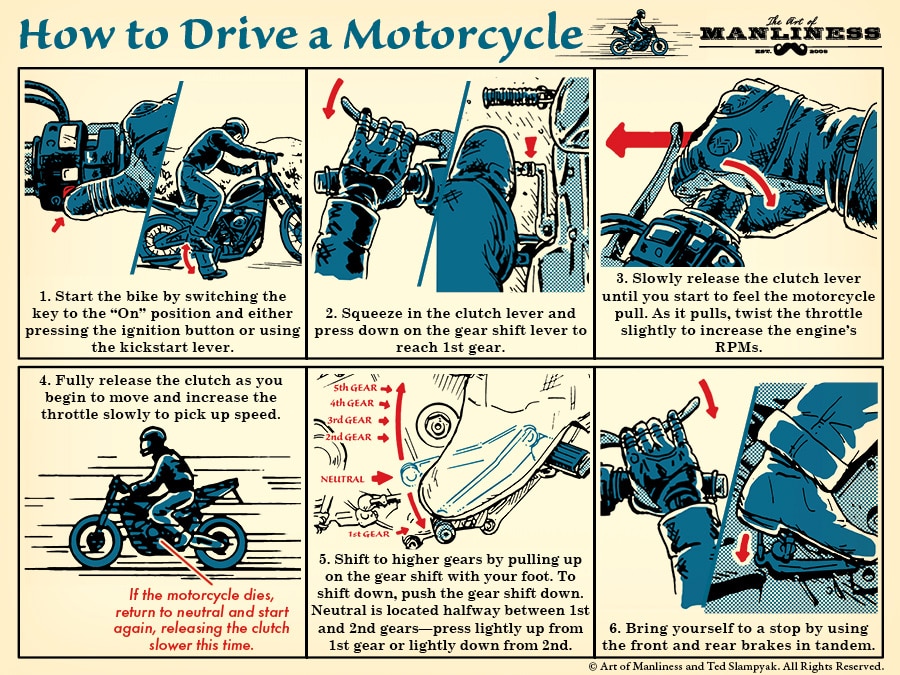
I want to teach my girlfriend to drive my car just in case of an emergency. When I learned to ride a motorcycle, PA offered classes with instruction on getting used to stopping/starting, as well as upshifting. They taught us first to rock the bike: release enough of the cluch and add enough gas to creep 1 or 2 inches, rock back, repeat.

Brett (or anyone else), do you have any exercises or methods (similar to the above) to teach someone to drive stick?

61 Dan October 18, 2012 at 7:41 am

Great article. Driving a stick is like a riding a bike, once you know you never forget. It is a skill everyone should know because when you travel you may not have an automatic and also if you borrow your friend’s truck to move it may be a stick.

Similarly, I think every man should learn how to ride a motorcycle. Never know when that may come in handy. I got my motorcycle license by taking a class and I plan to always keep it current.

62 tater October 18, 2012 at 7:43 am

In what world is it safer to downshift (thereby only using two wheels, usually in the rear) to slow down in rain/snow than use the brakes? The ONLY time I don’t downshift to slow the vehicle is when it’s slick out. If it’s slick out, and you only use two of your wheels to slow you, those two wheels are going to slip. That’s why we have brakes on all 4 wheels, and usually only power on 2 of them.

63 Dan October 18, 2012 at 7:47 am

I learned on a stick because I was sixteen, freshly minted license in hand, and needed to pick up my younger brother. The station wagon was gone, and all I had was our “awesome” 3-tone-brown 1980 Mustang (all 88HP). Of all the years to buy a Mustang… :-(

I have also been able to make all of my clutches last forever by upshifting without depressing the clutch pedal at all.

You can always slip the stick out of gear without the clutch. There is a specific RPM where the engine allows the stick to “slip” in to gear with no clutch pedal and a little pressure.

Never win a drag race, but never replace your clutch again!

64 Bailey S. October 18, 2012 at 7:47 am

My parents told me I had to learn stick so that when I went to college, if a friend got drunk, I would still be able to get home no matter what they drove. Or be able to drive in an emergency, no matter what car was available. Good advice! About half of my friends drove stick, and I ended up buying a manual for myself.

65 Andreas Ørgaard Mohr October 18, 2012 at 7:49 am

As a Dane I never tried automatic. Here almost everyone drives stick and you have to drive a stick when trying in the drivers license test. I got my first stick car field racer (Mazda 525) when I was 13. Growing up in the countryside is fun.
For you experienced stick drivers I have a challenge for you: Change gears without the clutch. You can gently put it neutral without pressing the clutch down.Then when in neutral you have to find the RPM with the gas pedal that is suited for the speed and the gear you want to put it in. Try gently to put it in – no force should be used – and you’ll feel it slip into gear when you hit the right RPM.
Obviously this is not something you do in a new car or in a borrowed car – there’s some risk to it.

66 Mark October 18, 2012 at 7:52 am

Good article. One other benefit not mentioned here: I believe that the ability to drive a stick also makes you a better driver, not only because you are required to be more cognizant of what is happening with the vehicle, but also around it. In addition, when you drive a stick, you are made more aware of the fact that you are actually operating a machine, not just “driving a car.” I believe a better understanding of the workings of that machine will result in you operating it more effectively.

My first car was a 93 Mustang LX 5.0 notchback. Rear-wheel drive, 5-speed manual, with 300lbs of torque on a light rear end. Being faced with the challenge of keeping that thing out of the ditch in Iowa winters made me a proficient driver. As a side note, I put 108,000 miles on the original clutch.

67 Anthony October 18, 2012 at 8:00 am

Driving a stick is a hard skill to learn: I’m always impressed with the people who learn it in an hour or two. It took me weeks (months?) learning on my dad’s Bronco II.

It’s a lot more fun to drive a stick; as Brett said, you’re much more in tune with the car. Unless you’re in heavy traffic, and then your left leg will start to hate you.

68 CanadianDad October 18, 2012 at 8:01 am

I’m proud to say that my wife taught me how to drive stick back when we were dating! Since then we’ve owned two manual cars, including an SUV. People get into it and say, “this is a stick shift???”
I wouldn’t have it any other way!

69 Mark October 18, 2012 at 8:01 am

One tip to those learning stick: Learn to work the clutch on flat ground without using any gas. This gets you two advantages:
1) You learn the feel of your clutch better – when your car starts to vibrate, your clutch is engaging and you know you either need gas or you need to push in the clutch so it doesn’t stall out. Being able to feel when your car is about to stall is the number 1 way to avoid stalling out.
2) You’ll learn right where your clutch engages and disengages. I’ve driven many different clutch cars that all have different engagement points, and being able to quickly determine where that point is, is vital to being able to drive that car.

My background: first car was a 1998 Honda Civic with a manual transmission – I got this car with 190K miles and put on another 50K miles – all of these were on the first clutch. As long as you adhere to the articles suggestion of not “riding” the clutch, it should last for a very long time! (Side note, if you’re engine is revving high and when you release the clutch the RPMs drop, that means you’re riding the clutch and applying too much gas. Your ultimate goal should be to provide as much gas as needed so that RPMs don’t jump when you let the clutch in or out) Second car was a new 2008 VW Jetta, 2.0T w/ 6-speed manual. This car has a spectacular clutch and after upgrading the ECU, pumps out more power to the wheels than they can handle. In addition to the VW, I recently got a 1997 Jeep Wrangler w/ 5-speed manual. This thing is a beast and is a thrill being able to feather the clutch to get over small obstacles.

Save the manuals! http://www.caranddriver.com/features/save-the-manuals-official-headquarters

70 Dave October 18, 2012 at 8:04 am

I think it would be more appropriate to say that getting better gas mileage is possible but not necessarily probable. Manual transmissions offer greater control, and can be more effiencient. However, after getting comfortable with a manual transmission, shifting can become lazy, allowing the car to rev higher than the optimal shifting rpm. This lowers fuel efficiency. Plus, letting the gears wind up is part of the joy of a manual. I would argue that manual transmissions hardly ever beat the gas mileage of their automatic counterparts (I know mine never do). That hardly matters though. When buying a car for the pleasure of driving, efficiency is measured in smiles per gallon, not miles per gallon.

71 Rod October 18, 2012 at 8:17 am

And, manual transmissions are cheaper to replace!

72 Tony October 18, 2012 at 8:18 am

On the same line as “don’t ride the clutch”, don’t ride the shifter either. It will wear out the bearings, gears, and synchronizers in the transmission prematurely.

73 Cloud Evangelist October 18, 2012 at 8:21 am

Hello, kind of funny to read for a German where you learn to drive stick shift from the very beginning. There is one small addition though that is need on your breaking section. When driving in the mountains and going downhill you do not want to constantly press the break to reduce the speed but rather shift down. That stops your breaks from overheating and you will stay able to fully stop when needed.

74 Brian October 18, 2012 at 8:21 am

Once you get good at driving stick, the next step is learning how to “speed shift” – i.e., shifting gears without using the clutch. Obviously you can’t do this in first gear starting out.

By learning the right timing based on the sound of the engine, you can switch gears without depressing the clutch pedal. One hint, sometimes giving just a slight bit of gas will help to get into the next gear.

You’ll love this trick in stop-and-go traffic.

75 Bill October 18, 2012 at 8:25 am

Awesome article. I grew up in Canada where as the years go on, manual driving is less and less of a skill people have. However, as mentioned in the article, most of the “cool” cars are standard and require you to know how to drive stick. Also, the revving sound of even the whimpiest manual car is more exciting than many automatics.

Regarding making a complete stop I will share my uncle’s professional view as a truck driver for 37 years. He was trained in the army that you never release the clutch until the vehicle is practically at a standstill. This is particularly important in highly mountainous areas like Northern Italy where he drove for his whole career. He stated that you always have control of your speed and the brakes have no chance to fail if the clutch is in.

As proof, his last truck had over 500,000 kilometres on it and he never had to replace either the brakes or the clutch. I have an early 90s golf and when I finally sold it with 280,000 kms on it, my wife and I had never changed the brakes or clutch either because we drove the way my uncle showed us. By the way, we didn’t neglect the cars, our mechanic always verified that the brakes and clutch were fine.

76 Jared October 18, 2012 at 8:29 am

It’s a lot easier to smoke the tires with a manual (if you’re into that sort of thing)

77 Chris October 18, 2012 at 8:29 am

Good article. I’ll share a tip that can save your but in a tight situation. A little back story: I was fortunate enough to have grown up in a “Construction” family. We had a lot of heavy equipment – much of it manual shift – so I learned at a very young age how to drive stick. I actually taught my step-brother – who is 4 years my elder – how to drive stick when I was 12 and he was looking to buy his first car. Anyway, I digress – here’s the tip: If you are ever stopped at a light on a steep hill and some knuckle-head rolls up behind you – almost touching your bumper – and the light turns green; simply apply the emergency brake (a hand brake works best in this situation) which will prevent you from rolling backwards; then begin to “drive” – GENTLY releasing the clutch and GENTLY pressing the accelerator until you can “feel” that the gear is engaged and you are confident that the car won’t roll backwards if you release the emergency brake; then simply release the emergency brake, while maintaining pressure on the accelerator, and drive away into the sunset. Like anything, this takes a little practice, but it works like a charm!

78 Josh October 18, 2012 at 8:35 am

When you get to be a pro at clutch shifting, ask an experienced friend about clutch-less shifting – it’s super fun and makes you feel like a manual transmission master. (This only works for shifting while moving).

79 AT October 18, 2012 at 8:35 am

I finally learned to drive a stick this summer, at the age of 44. All it took was an hour of my friend laughing at me as I stalled the car dozens of times in a parking lot until I “got” the reflexes to get into first smoothly. After that it was just a couple weeks of occasionally embarrassing moments in traffic and on hills. Learning the stick really does give a fresh perspective on the chore of driving.

80 Mike October 18, 2012 at 8:38 am

My first car was a stick shift. It was definitely more fun to drive than an automatic. Plus, it’s a good skill to have. I’ve found myself in several situations at my job where I was put on the spot having to drive a manual transmission; already having the skill saved me time, hassle, and a little embarrassment.

81 RobG October 18, 2012 at 8:40 am

Great post… I am also one of the few. I have been driving cars & trucks with manual transmissions for 30 years and have no plans to stop. From a Toyota Supra to a Jeep CJ7 to multiple BMWs, the list grows and move love affair for the “third pedal” remains strong.

82 solly October 18, 2012 at 8:41 am

I have about an hour commute each way (back roads mostly) and I have found that driving a manual makes the time fly by. My commute seems much longer in an automatic, I think it’s because when driving stick I’m “doing” something as opposed to just sitting there getting annoyed at the car in front of me. Plus driving a manual is a lot more fun and I think it’s saving my sanity.

83 Gregory October 18, 2012 at 8:43 am

I learned on a motorcycle when I was 14. I recommend this to all parents. Your kids may never need or want a motorcycle, but at least allowing them to learn how to ride a bike allows them to know how a basic transmission works, along with getting them adequately prepared for learning how to drive a manual when they buy their first car(and I’m sure we all remember that that first car was usually the one where we were worried about price most). The clutch, brake, gas combo is the same process, just with hands included instead of only feet, and I have had many friends who went on to buy motorcycles when they got older due to gas prices getting higher, and that was back when I thought $1/gal was the end of the world.

84 Bruce Williamson October 18, 2012 at 8:45 am

I learned to drive a stick when I was about 12 in a VW beetle on my grandmother’s farm. Over the years I’ve had more manual transmission cars then automatics. The last car that I bought I got because the other person who was interested couldn’t drive a stick. Also, heard that a carjacking was foiled because the carjacker didn’t know how to drive one.

Most people that I know that drive a stick wouldn’t switch to an automatic.

Few things that I’d like to add:The article doesn’t mention speed shifting i.e. not using the clutch but relying on the synchronizers in the trans to keep the gears meshed and matching the engine speed to the trans speed (Not recommended because it wears the synchronizers but you should know about it)

Downshifting is useful to slow the car down when using the brakes could be dangerous such as downhill in rain or on a snowy surface. My cars manual recommends not skipping a gear as the engine will rev too high. Always downshift into the next lower gear.

Cars with automatics transmissions today have locking torque converters so the difference in gas mileage is less and closer to 1MPG difference (at least in the vehicles that I’ve looked at online).

85 Alisha October 18, 2012 at 8:46 am

I’m not a man, but I think this article is just as fitting for women as it is for men. AND from a woman’s perspective, a guy driving a stick shift is pretty sexy. Think, James Bond or Ryan Gosling in Drive. My mom drove a stick shift when we were kids and she always told us it was important to know how so you’re never left in a situation you can’t drive a way from. She would let me shift gears for her while I sat in the passenger seat and I thought it was so fun. My sister totalled it before I learned how to drive it so I learned on a friend’s 1990 something Nissan Frontier. I already had a good base knowledge of driving a stick shift and I ride motorcycles so the clutch wasn’t too hard to get used to, but every clutch is different. One tip: If you have issues starting off in first gear is to try releasing pressure off the clutch slowly and just very lightly press on the gas until you feel the car start to pull forward and then you can evenly release off the clutch and press the gas for an even start. If you give too much gas too early you’ll rev up the engine and lurch forward once you engage the clutch and if you don’t give enough gas you’ll shudder and stall. There’s nothing like driving a stick shift. It’s so fun and you have such a stronger physical connection to the car it becomes like an extension of your body. I took a weekend vacation to Dale Hollow Tennesee and driving through the hilly windy back roads was SO fun no automatic could ever compare to that.

86 Jacek October 18, 2012 at 8:50 am

Wait a sec. You’re telling me that this is actually a rare skill in the US?:)

In Poland this is a mandatory skill without which you won’t pass the exam :)

87 Alec October 18, 2012 at 9:01 am

Good stuff!

Stick is the way to go- my 2004 Honda Civic gets better than advertised mileage, and I’m sure my intelligent use of the gears helps with that. I can get combined high 30′s for mileage while advertised was mid 30′s combined.

Keep in mind that on some old pickup trucks the 1st gear is really just a very slow towing gear and the regular gear you should start driving with is 2nd.

Also, some old (and new?) cars (Audi/Saab) have a unique way of shifting into reverse. You have to pull up on this little knob before the stick lets you put it into reverse. When I did valet parking in college this nailed me one day when I couldn’t figure out how to back up.

I also remember my Dad’s old Volvo 242 had a button in the middle of the shifter that you had to push to get into 5th gear- kinda weird and unique.

88 Isaiah J Roberts October 18, 2012 at 9:04 am

My second car was an older Nissan D21 5-speed. Loved that pickup; I’ve got many fun memories (though it was old enough I never took it cross-country to visit my fiance).

I’m now driving a ’98 VW Jetta TDI. 48+ commuting mileage, sunroof and best of all, an easy clutch! My wife is driving our automatic 2001 Olds… She hates it, but loves the V8 engine. Hellooooo 23MPG :P

89 Tim Sullins October 18, 2012 at 9:05 am

After reading this article i started to practice with an old stick shift car. What can i say, that day my car care was awful but now i know how to drive a stick shift

90 Keith October 18, 2012 at 9:05 am

Want a real challenge?
Try driving a semi (or Lorry for you on the other side of the pond). At least 10 forward gears and you only use the clutch to start and stop, up-shifting and down-shifting without the clutch (there’s a “sweet spot” that can be a challenge to find) or in some trucks you have to “double clutch” it to shift.

…If you can drive a big rig, you certainly are one step closer to achieving the Art of Manliness.

91 Brett October 18, 2012 at 9:09 am

Heh, that’s funny. My name is Brett and my uncle taught me how to drive a stick in a cemetery. Weird.

92 Ben October 18, 2012 at 9:11 am

Great article. I’m from Britain, so, as you might expect, drive a manual. I was always taught not to shift into neutral when braking, mainly as it removes one of your options for controlling the car should you need it (perhaps to suddenly pull out of the way of emergency vehicles or to bring the vehicle to a halt using ‘gear braking’ as described here). Good luck to any fellow learning to start a manual on a steep hill!!

93 Jon October 18, 2012 at 9:23 am

As pointed out earlier, it’s really amusing to read this article for a person who is used to manual. In Norway, where I live, people will look weird at you if you say you can’t drive a manual. I think it’s the same for the rest of Europe.

You can get a license only for automatic, but very few does that.

94 Doug October 18, 2012 at 9:28 am

I would love nothing more than to own a jeep with a stick shift.

My first time (and only time so far) driving stick…

I work part time for a ferry that goes from CT to NY. The last shift boat goes out at 10:00, so there’s nothing to do until 11:30 when the last boat comes in, so generally me and the guys will play cards or something similar. But this guy Danny said to me one night, “Hop in the car, you’re learning stick.” His car was souped up to the max, but he sat in the passengers seat ad taught me how to drive it. Turns out, we spent so much time driving around that the ferry boat captain called us on the radio and started screaming at us because no one was at the dock to operate the ramp for a good 10 minutes! Good memories…

95 Scott555 October 18, 2012 at 9:28 am

Couple of additional tips:

1. Fingertips or light touch only on the gear shift – if you’re muscling it you’re trying too hard. You’re sliding moving parts around, which will only absorb your abuse for so long.

2. In the winter if you’re spinning your drive wheels on launch, let out the clutch with very little or no gas.

Keep the car in gear – neutral is for when you’re starting the engine.

96 Max October 18, 2012 at 9:33 am

I’ve taught several friends to drive a stick shift and another method for starting has seemed to catch on more easily. It’s the same ideas as Mark posted above.

1. Clutch in, engage brake, shift into first
2. Disengage brake, do not touch the gas pedal
3. Very slowly take the clutch out until you feel the point where it engages the engine (this differs by car and could be anything from a lurch forward to a slight shake)
4. Once you feel the clutch engage, HOLD it there until you feel the car steadily moving forward (may be 2-5 seconds)
5. Once the car is moving, take your foot off the clutch completely and gas as needed.

Also, another vote here for stopping the car in neutral. It’s much easier sitting at a stop light without having the clutch in the whole time.

97 Dave V. October 18, 2012 at 9:45 am

This article could not be better timed! I just purchased my first manual transmission vehicle, and am very excited about it. I have a good general knowledge of how to drive stick, but reading this article helps me know to reinforce certain behaviors. It’s great to see everyone else’s stories, and point of view on this great topic. Thanks for a great post.

98 Andy October 18, 2012 at 10:01 am

In the UK, where I am from, if somebody tells you they don’t know how to drive a manual car, they are effectively saying they don’t know how to drive, period.

99 Samuel Warren October 18, 2012 at 10:11 am

I too was taught how to drive a standard by my dad. When it came time for me to teach my daughter to drive, I did what he did. I drove her five miles away from home (partially down dirt roads), and said “Take me home” then refused to get back in the drivers seat. By the time we got back to the house (40 minutes later) she was handling it like a chamnp.

100 JT October 18, 2012 at 10:12 am

Not sure about cars today since I haven’t owned a stick in over 25 years but back when I was a poor starving college student in the late-’70′s, I was able to delay the expense of replacing the starter in my Ford Pinto by always parking on a hill. Simply put the car in 2nd, turn on the ignition, let it roll, and then pop the clutch. Works like a charm. I knew it was true love when, in August, 1978, the girl who has now been my wife of 32 years went out with me on a second date after a first date experience with the old ‘push-start’ method (or ‘roll down the hill’).

Leave a Comment

Previous post:

Next post:

Site Meter