For over a century, companies have used masculinity and manliness (or idealized versions of it) to sell their wares to both men and women. When selling to women, advertisers hope to lure the fairer sex into opening their pocketbooks by using masculinity to symbolize the strength of their products or by associating their brands with virile sex appeal. Remember that Diet Coke commercial from the 90s? The one with the broads taking a “Diet Coke break” to scope out some brawny, good looking, and shirtless construction worker from their office window? Perfect example of using a masculine image to sell to women.
When men are the target audience, advertisers often take a different approach. They infuse a brand with aspirational imagery and attempt to convey the message of “If you buy this product, then you’ll obtain the pinnacle of manliness. Women will want you and men will want to be you.” So we see commercials showcasing successful, rugged, and debonaire dudes pitching products to men who are looking for some simple talisman that will magically imbue them with the manliness they feel they lack.
For the past 100 years, Madison Avenue has rolled out dozens upon dozens of brand icons that were designed to evoke this feeling of supreme manliness in consumers. Most of these brand mascots slip into the abyss of history, forever forgotten.
But a few transcend merely selling products. They become cultural icons that both influence (for better or for worse) what manliness means in our culture, while also holding a mirror to the culture’s ideals of manliness at a given time. From dapper dudes who evoked the desire to be sophisticated and upper-class to rugged men who symbolized a virility feared to be long lost, to our modern day, when advertisers rarely feel comfortable using masculinity in a earnest way and invariably present it with wink-wink irony.
Of course, smart men have always known that manliness can’t be bought, but even when advertisers don’t convince you to spend money, the best ads can simply be enjoyed as examples of effective, fun, and creative storytelling.
With that attitude, today we take a look at 11 of the most famous and manly brand icons ever created.
Dos Equis Most Interesting Man in the World
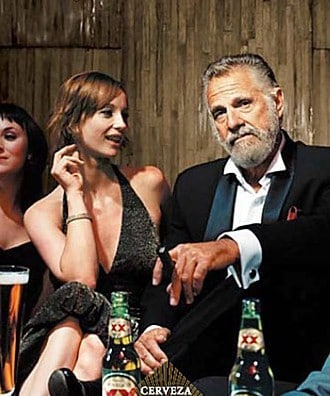
The Dos Equis Most Interesting Man in the World has become an a cult hero since the launch of this campaign back in 2006. He’s an older, bearded man, with leathery suntanned skin, and a handsome Spanish accent who takes part in adventurous and manly pursuits like Acapulco cliff diving, jai alai, and falconry.
The commercials mix together grainy, vintage footage showcasing the Most Interesting Man’s manly feats while a narrator describes our Man’s over-the-top exploits. The copy on these commercials is some of the best and most clever in ad history:
- His words carry weight that would break a less interesting man’s jaw.
- He can speak French, in Russian.
- When in Rome, they do as he does.
- His blood smells like cologne.
- His mother has a tattoo that reads “son.”
- He once punched a magician. That’s right, you heard me.
If you haven’t seen the commercials, here’s an example:
If you want to see all of the Most Interesting Man in the World commercials in one place, go here.
The Arrow Collar Man
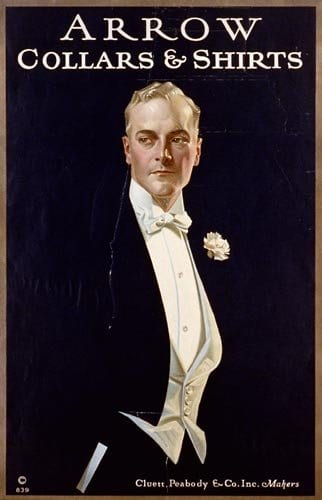
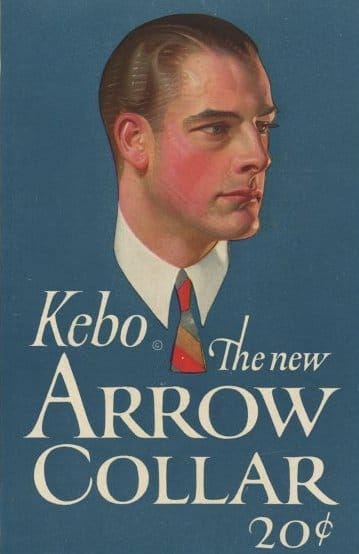
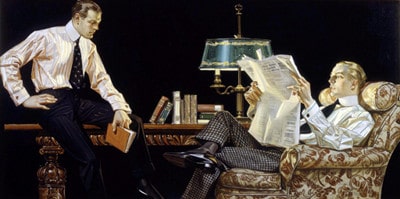
If you were a man living in the early part of 20th century America, you probably knew who the Arrow Collar Man was. Created in 1905, the Arrow Collar Man was the name given to various male models who appeared in magazine and billboard advertisements for Arrow collars and shirts. Illustrator J.C. Leyendecker was the artist behind the ads. His unique artistic style gave the Arrow Collar Man a very angular, modern, and American look. The men always had very squared-off, masculine jaw lines with perfectly coiffed hair. The ads were designed to create a feeling of success, sophistication, and masculine virility in customers.
From 1905 to 1931, the Arrow Collar Man was an American cultural icon. President Theodore Roosevelt said that the Arrow Man was “a superb portrait of the common man.” Women wrote this fictional character love letters by the thousands each week and a few even proposed marriage to him.
The Arrow Man campaign was a huge success. Whenever an ad came out featuring the Arrow Man wearing a new collar, men would be lined up outside of clothing stores to get their hands on the product. By the 1920s, Arrow was selling 4 million collars a week.
The campaign ended in 1931 and is hailed by many advertisers as one of the most successful ad campaigns in history.
The Marlboro Man
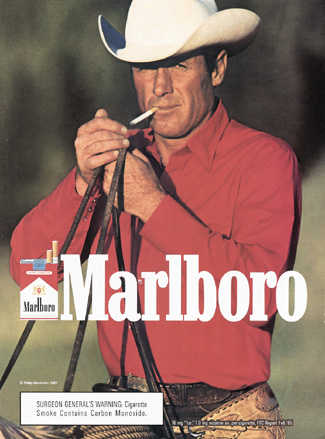
The Marlboro Man is assuredly the most successful and most controversial manly brand icon on the list. Created in 1954 by advertiser Leo Burnett, the Marlboro Man was a lone, rugged cowboy who always had a Marlboro cigarette coolly dangling from his lips.
The story of why the Marlboro Man was created is pretty fascinating. Marlboro cigarettes were some of the first in the U.S. to feature filters. But back in the 50s, filtered cigarettes (and particularly Marlboros) were considered a chick’s cigarette. So to increase sales among men, the Marlboro Man was born. In a few short months after the Marlboro Man campaign started, the womanly aura around filtered cigarettes had successfully been replaced with a manlier one, and sales increased.
The first Marlboro Men were actors dressed up like cowboys, but ad man Burnett thought they lacked authenticity. So he began a search for a real cowboy who could play the Marlboro Man. They found their man in Wyoming rancher, Darrell Winfield. Winfield played the iconic brand spokesman from 1968 to 1989.
During his heyday, the Marlboro Man could be found everywhere–from the pages of popular men’s magazines to a giant billboard in Times Square. But during the late 80s and 90s, the Marlboro Man suffered a one-two punch that resulted in his quick decline. The first blow came from the deaths of three former actors who took part in the Marlboro Man ad campaigns. All three men died from lung cancer, a disease caused by smoking. Their deaths garnered a great deal of negative publicity for the Marlboro Man, the Marlboro brand, and the cigarette industry as a whole.
The second blow came from anti-tobacco litigation, which resulted in limits being placed on cigarette advertising in magazines and on radio, television, and billboards. Because of the negative press surrounding the Marlboro Man and tobacco in general, Philip Morris discontinued the campaign in 1999.
Despite being laid to rest with other brand icons, the Marlboro Man still lives on in pop culture and continues to influence the way masculinity is portrayed in America.
Mr. Clean
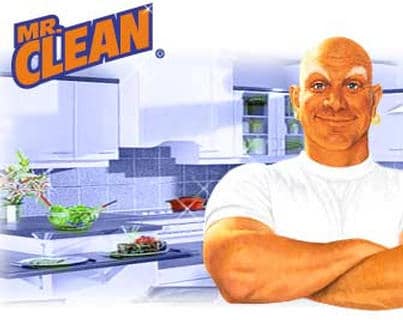
Mr. Clean isn’t a genie.
Yes, I know. The bald head, single earring, knowing smile, and folded arms are all clear genie-indicators. But the reality is that Mr. Clean is just supposed to be a badass looking dude who likes to keep things tidy. In 1958, Proctor and Gamble introduced a new home cleaner they dubbed Mr. Clean and created one of the most iconic brand icons in history. P&G wanted a strong, manly looking guy to be the face of their product in order to first, appeal to the ladies who would be buying the product, and second, to convey the message that Mr. Clean is there to kick dirt’s butt.
The original model for Mr. Clean was a retired Navy Sailor living in Florida. For most of his advertising life, Mr. Clean has been an illustration or animated cartoon. Back in the 60s P&G experimented with a live actor named House Peters, Jr. to play Mr. Clean, but it really didn’t work, so it was back to the cartoon.
Adding to his manly persona, Mr. Clean has hardly ever spoken. He’s the strong silent type. He only spoke once in one of those 1960s commercials. If he could speak, he would say, “How am I going to find time to get to the gym with all this damn cleaning I have to do?”
The Man in the Hathaway Shirt
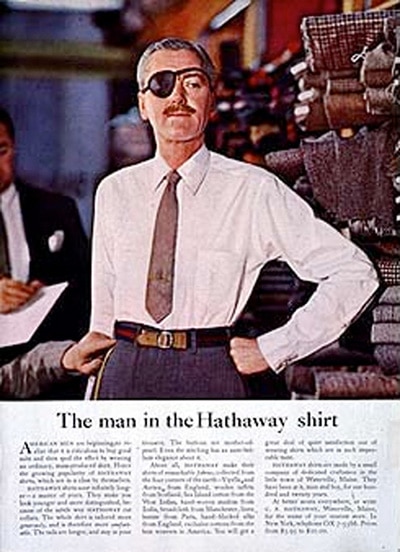
Founded in 1837, C.F. Hathaway was a little known men’s dress shirt company in Waterville, Maine. The company’s only claim to fame up until 1951 was their wartime contract with the Union army to supply uniforms for soldiers. But Hathaway shirts catapulted to success with the introduction of a debonair, silver-haired, eye-patch wearing brand icon simply called “The Man in the Hathaway Shirt.”
Created by famous ad man David Ogilvy, The Man in the Hathaway Shirt campaign ran in magazines in the early 1950s. It consisted of a photo of the hero standing gallantly in some sophisticated locale wearing a well-pressed Hathaway shirt. Underneath was a bit of text talking about his romantic life.
The first ad ran in the New Yorker in 1951 and was an instant success. By the end of the week Hathaway was out of stock on their shirts.
The key to the success of this ad was the eye-patch. It created a bit of mystery and manly intrigue about the character. What happened to him? Did he lose it during a safari? A sabre duel?
The model who portrayed the Hathaway Shirt Man was Baron George Wrangle, a Russian aristocrat who had 20/20 vision and no actual need for an eye patch. Ogilvy said he got the idea for the patch from a photo of Ambassador Lewis Douglas, who injured his eye while fishing in England.
The Man in the Hathaway shirt became a pop culture phenomenon, and his iconic eye patch was “borrowed” by other brands. It was common to see ads with babies, women, and even cows wearing an eye patch. AdAge declared the Man in the Hathaway Shirt campaign to be #22 on the list of top 100 ad campaigns in American history. His influence can still be seen today in Dos Equis’ Most Interesting Man in the World campaign.
Old Spice Man Your Man Can Smell Like
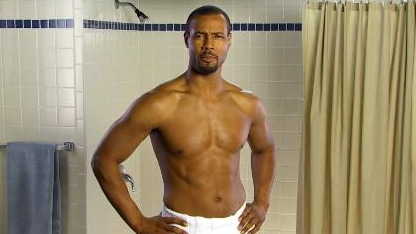
After years of being known as the favorite after-shave of grandpas, Old Spice breathed new life into their nearly eighty-year-old brand with their Man Your Man Can Smell Like campaign. Played by actor Isaiah Mustafa, the Man Your Man Can Smell Like is a sort of smug, but super cool guy who’s on a mission to tell women that “anything is possible” if they buy their men Old Spice body wash.
The TV commercial showcased some creative filmmaking. Filmed with just one single, continuous shot, the Man Your Man Can Smell Like starts in a bathroom and shifts scenes only to end up on a horse at the end. The result was a funny, and surprising bit of advertising:
What’s interesting is that the commercials weren’t even directed at men. They all start off with “Hello, ladies…” It makes sense that Old Spice directed ads for a men’s grooming product towards women. Women tend to be in charge of most small household purchases, like soap and deodorant. So using a sexy, suave dude, in nothing but a bath towel to convince women to buy Old Spice for their man is a good strategy. Despite being directed towards women, the Old Spice Guy was popular among dudes, too.
Because of the success of the Old Spice campaign, other men’s grooming brands have copied gotten inspiration from the Man Your Man Can Smell Like commercials and introduced their own cheeky, smooth, and smug spokesmen–see here and here. It makes one wonder if there is a real shortage of creativity at these creative agencies. I guess they figure that the more over-the-top the manliness of their spokesmen, the less people will notice the fact that they’re pitching dudes an anti-wrinkle and firming cream.
The Old Spice commercials have also created several spoofs, like this well done one from BYU’s library.
Commander Whitehead: The Schweppes Man
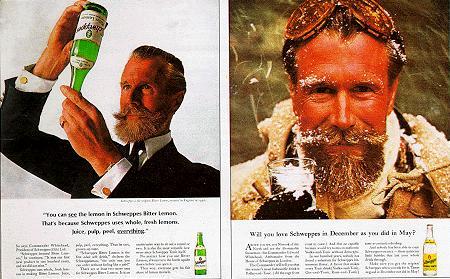
Tonic water. It’s not the most glamorous thing in the world, but with the right spokesman you can turn it into a product that aspiring gentleman all over the world want to buy. In 1955 Schweppes turned to advertising genius David Ogilvy to create a campaign for their tonic water. Instead of creating a fictional character to be the face of Schweppes, Ogilvy used Commander Edward Whitehead, an executive of Schweppes who came to the U.S. to oversee American distribution of Schweppes tonic water.
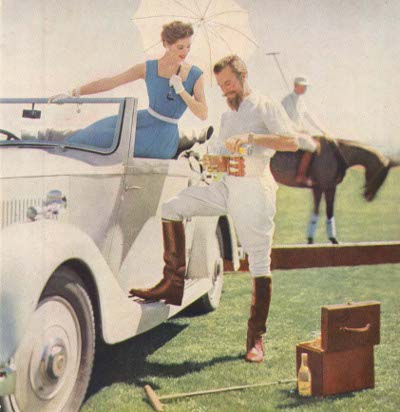
Whitehead was the perfect face to create an air of manly sophistication around the Schweppes brand. The ads played up the fact that Whitehead was a real commander in the Royal Navy during World War II. And of course his amazing beard got plenty of camera time. The ads showed Commander Whitehead taking part in various manly activities that Whitehead actually enjoyed in real life. Some showed him mountain climbing or arctic exploring, while others featured him in more sophisticated settings like a dinner party with beautiful women. Commander Whitehead was the man every man wished he could be.
The Commander Whitehead campaign ran from the 1950s though the 1960s.
You can tell the folks in charge of the Dos Equis Most Interesting Man in the World campaign took a lot of inspiration from Commander Whitehead. The distinguished gray beard, the sophisticated yet manly persona. It’s all there.
The Gorton’s Fisherman
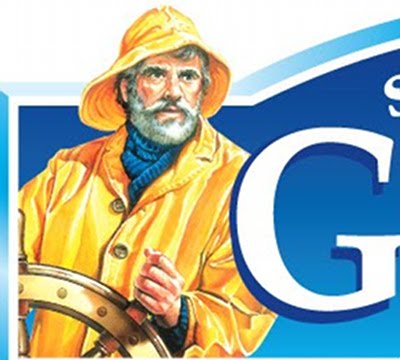
What better way to sell frozen fish sticks than to use an image of a manly looking fisherman? The Gorton Fish Company has been around since before the War Between the States, but it wasn’t until 1964 that they introduced the Gorton Fisherman as the face of their frozen fish products. Gray bearded (anybody else seeing a trend among these ad icons?) and clad in a yellow slicker, the Gorton Fisherman looks ahead with steely resolve as he guides his ship to waters filled with beer battered fish. In 1978, the company gave the Gorton Fisherman more gravitas by adding the tagline “Trust the Gorton’s Fisherman,” to their products. Yes, Gorton’s Fisherman, we will trust you. Trust you to elicit groans from children when you are removed from the freezer.
The Camel Where a Man Belongs Man
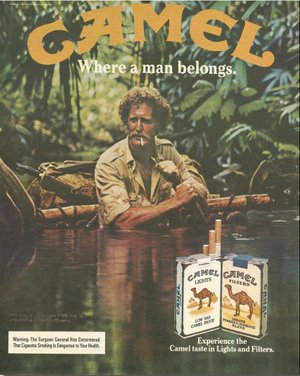
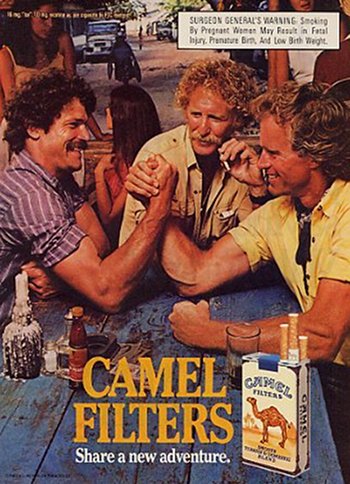
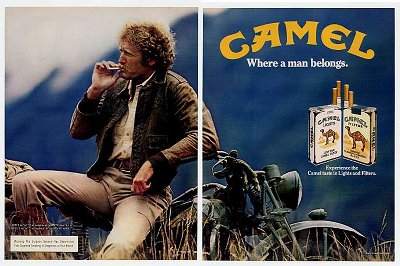
Before Joe Camel was secretly hawking cigarettes to kids, the R.J. Reynolds Company created a rugged, manly man to be the face of Camel cigarettes. The ad campaign was called “Where a Man Belongs.” It featured a brawny, mustached man with an awesome 1970s white dude afro doing awesomely manly things like fording a river in a rain forest, safariing in Africa, riding his motorcycle across the country, and watching an arm wrestling match.
The campaign ran in magazines during the late 70s and early 80s, and it had some success. When sales started to slump, Camel ditched the Where a Man Belongs Man for a cartoon camel whose nose looked an awful like a giant wiener. The switch must have worked because Camel sales picked up with Mr. Joe Camel.
John Jameson
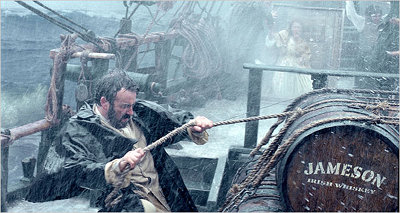
Jameson Irish Whiskey has been around since 1780. Founded by John Jameson in Dublin, Ireland, the whiskey became an international favorite by 1805.
Fast forward 200 years and the company is working hard to keep their brand relevant. You may have seen the recent Jameson Irish Whiskey commercials where John Jameson jumps into the ocean to save a barrel of his beloved Irish whiskey, battles a giant squid, and shows up at his own funeral along with all of Ireland. It’s one of my favorite commercials. I’ll always stop to watch it. It’s fun and tells a great story in under 30 seconds. Advertising at its finest.
The commercial, while exaggerated, is actually based (somewhat) in fact, according to The New York Times. First, John Jameson was a real dude. We established that. Second, while it can’t be ascertained that he sailed the world in the ship Mary to bring the world his whiskey, there is a ship called Mary that is a part of Jameson’s family history. Family diaries mention a family ship that battled pirates on the high seas, and it also appears on a Jameson family crest. Finally, the lost barrel story highlighted in the commercial is supposedly based on a true story according to the official Jameson site.
If you haven’t seen the commercial, watch it:
The Brawny Man
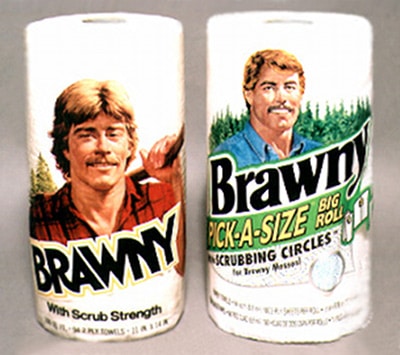
What do you do when you want to convey that your paper towel has the strength to tackle any kitchen mess? You create one of the manliest brand icons ever in the history of advertising, that’s what.
The Brawny Man has been the face of Georgia-Pacific’s paper towels since Richard Nixon resigned as President (1974, for you youngins who might not know). The Brawny Man’s masculine image comes straight out of the decade in which he was spawned–long shaggy hair, mustache, and unbuttoned shirt to show off his manly chest hair. This masculine and virile image created a score of 70% of “unaided brand awareness” for Brawny paper towels. Meaning, people could just see a picture of the Brawny Man and they’d know that he represented Brawny paper towels.
Despite the success of the Brawny Man, in 2004 Georgia-Pacific decided the Brawny Man needed a style update to convey a kinder, gentler image. First, they made the Brawny Man shave his mustache off (the humanity!). Next, they made him get a haircut. Finally, they made him cover up his glorious chest hair by making him wear an undershirt.
Here’s the Brawny Man post-makeover:
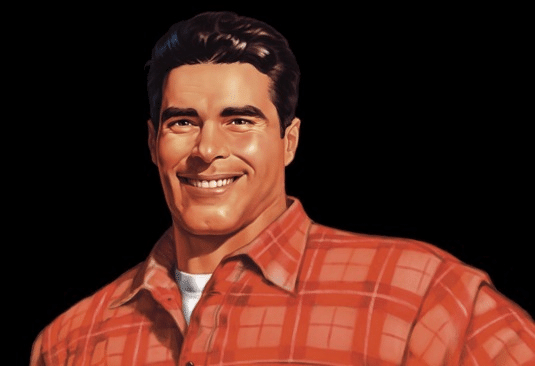
He looks like a cartoon of what’s supposed to be every woman’s fantasy man: clean shaven, barrel chested, and helpful in the kitchen.
Sure, The Brawny Man sort of looked liked a skeevy 70s porn star and probably needed a bit of an update. But come on. Did we have to remove everything manly that made the Brawny Man so awesome? At least let the man keep his mustache. Show your solidarity with the Brawny Man. Sign the petition to bring back the Brawny Man’s mustache.
What are some other famous manly brand icons? Share them with us in the comments.
***I am continually surprised by the lack of nuance with which people read things and the need for me to make disclaimers like this, but since I have already received complaints from those who misunderstood the post, here we go: this post is meant to be a fun and interesting look at the way advertisers have used masculinity to sell products over the last century. The icons listed are not necessarily being held up as men to emulate. Although if you wanted to clean the kitchen while wearing an eye patch, I bet your wife wouldn’t object. Smoking is bad. Don’t do drugs. Do not attempt to operate machinery while wearing only a towel. I think that covers it.***


{ 105 comments… read them below or add one }
Next Comments →
Don’t forget Ben Minkoff. Have you guys checked them out?
I think it is really interesting to see how our culture has viewed “manliness” over the years. Of course, it is important not to merely take these icons as a definition of what makes a man, but rather how we viewed men at various times throughout our history.
I know the Arrow Shirt man was used to guide Robert Redford’s wardrobe in “The Great Gatsby”, but didn’t the company try to reinvigorate that ad campaign with Redford after the movie came out?
No Kenny Powers? For shame.
Have we considered the the new dairy queen guy? he water ski boxes!
Traveling beyond the Anglosphere, one sees an antecedent of the over-the-top style of comical manly advertising mascots in the video game spokesman and judo master, Segata Sanshiro. His name is a play on words based on the Akira Kurosawa film, Sugata Sanshiro, and on the brand he serves, as reversing two adjacent syllables produces the command “Play Sega Saturn!”
There wasn’t much to him; a spot would feature him displaying exceptional prowess to reenact some component of a video game accompanied by his bombastic and catchy jingle, undergoing rigorous training with an oversized version of the product, or pummeling some representative of a rival pastime, concluded with a stern admonition: “Sega Satān, shiro!” In his final appearance, he gave his life to deflect a missile aimed at the Sega corporate offices.
Most entertaining, but possibly of dubious value as a window into other cultures’ pop conceptions of masculinity.
Chrysler Cordoba TV Commercial with Ricardo Montalban.
What about the good Colonel Ichabod Conk?
http://www.wetshaving.net/images/conk/conk_bay_rum_shave_soap.jpg
What about Fearless Fosdick touting Wildroot Cream Oil? You can’t go into a barbershop anywhere in America without seeing an old tin sign featuring the dandy copper!
Kieth Stone
Bruce Campbell had the Old Spice spot before Isaiah Mustafa, playing up the sophisticated gentleman side of manliness; although it certainly wasn’t played straight. His ‘Experience’ Old Spice ad is fantastic none-the-less.
How about the Irish Spring soap commercial. “Manly yes. But I (chicks) like it too”
Honorable Mention: The handlebar mustache guy in the Heineken commercial who is in an Olde Tyme bare-knuckle boxing bout. Seems like he’d be right up your alley!
The Old Spice sea captain.
Captain Morgan is missing
Don’t forget the Canadian Club Ads!
http://adsoftheworld.com/media/print/canadian_club_whisky_dads_first
http://michelle.koenig-schwartz.com/Chronicles/Media/canadianclubad2.jpeg
http://michelle.koenig-schwartz.com/Chronicles/Media/canadianclubad.jpeg
The answer to the inevitable question:
The song from the John Jameson commercial is Mozart’s Violin Concerto No.3
Link: http://www.youtube.com/watch?v=AxTiMebNmn4 The commercial part starts at 3:23 but the entire work is deserving of a listen through.
None…none can compare to the classic ‘Miller Time’ spots!
Not sure about including two smoking guys here. If anything, they encouraged men to take up smoking and die from cancer or emphysema (e.g., my grandfather who died too young) – not too manly. Some of you may think I’m overreacting here, but I’ve always abhorred cigarettes since I was young and have strong feelings about it.
CAPTAIN MORGAN – the new “Life, Love & Love” campaign is fantastic.
http://www.youtube.com/watch?v=BCRBb-wwIxo
The new Brawny Man looks like Patrick Warburton!
And here’s one of the most manly advertising icons I know of. This one is from Australia, he’s called the Solo Man. In the late 1970s until the early 1990s, Solo Man was pimping fizzy lemon drink to men through doing manly activities like white water rafting. He also had a pretty awesome moustache. When I was growing up, he was the manliest brand icon I knew of. Enjoy!
http://www.youtube.com/watch?v=6T3RS78Tp58
Those complaining about the inclusion of tobacco ads are completely missing the point of the article. The author is not saying they, or the products they represent, are examples of real manliness. Try reading the intro again.
Jerrod, in defense, the title is misleading. It conveys that all the men here indeed represent manliness.
Nice list. But, there are others… Juan Valdez and his donkey (where do you think your Colombian coffee comes) from, Or John Cameron Swazey, (Takes a licking, and keeps on ticking.
How could I forget about this!!
http://tinyurl.com/44qyz44
The Pinaud-Clubman gentleman! Found on all Pinaud-Clubman products of course, and especially the talcum powder. Manliness in it’s most ‘refined’ sense, right up there with the Arrow Shirts and Collars gents.
Real men don’t just read titles. Also, I know Brett did a video onnce talking about the difference between “manly” and “manliness.” Need to go hunting for that…
The Macho Man Randy Savage, commanding us to “Snap into a Slim Jim!”
For the Aussies, our manliness-est brand icon would have to be Chesty Bond (http://en.wikipedia.org/wiki/Chesty_Bond)
For your consideration, John West Salmon
http://youtu.be/CVS1UfCfxlU
Robert Conrad, daring you to knock that battery off his shoulder. Not sure I understand what that was about, really, but it was badass.
I remember a series of TV commercials in the late ’60s/early ’70s that featured a guy using his credit card (AMEX, but maybe Diners CLub) to get himself out out a jam with a series of merchants. In one commercial he would be buying a suit, in anther maybe checking into a hotel.
The gimmick was that he was completely busted-looking, like he had survived a jungle plane crash or something, but he still had his card. And that was all he needed to get back to civilization.
I remember my impressionable 1990′s pre-teen mind being drawn ot the old Yukon Jack liqueur comic ads from my grandpas old 70′s Outdoor Life magazines.
Tried hard to find some online, but couldn’t. Anyone know what I am talking about. You know, the ones where he has a pet wolverine?
AoM never fails in finding interesting things to bring to my attention! It’s very interesting to see how men were pitched to changed over time. The Arrow Collar man would be totally laughed at today. And the hipster irony of things like the Old Spice campaign would have totally befuddled our great-grandfathers. I think the fact that advertisers can’t pitch manliness in a straightforward way says something about us–after all, their only job is to appeal to something within us. And I guess they don’t feel like there’s anything serious inside of us to appeal to.
I appreciate the light-hearted nature of this post. However, I wanted to point out that while the “Man Your Man Could Smell Like” campaign was a success in raising brand awareness, it failed to increase sales of Old Spice products (indeed, figures for two consecutive quarters showed a DECLINE in sales immediately following the release of the first commercials). Frankly, the commercial was a boon for Isiah Mustafa and a bust for Old Spice. I know this is a bit off-topic, so I’ll stop here, but I think it should be noted when a commercial seems very creative but totally misses its ultimate mark (which is to sell more product).
Well-written and well-researched, Brett. I personally enjoy AoM’s lighthearted fare just as much as the more serious stuff.
Dairy Queen’s new spokesmen is sort of manly–has a nice stache. The ad with the shaving bunnies is pretty awesome. And the Heineken fisticuffer guy is totally AoM-y, although I guess he’s not an “icon.”
The Old Spice campaign did actually increase sales–the idea that it didn’t was based on misinformation:
http://www.adweek.com/adfreak/hey-old-spice-haters-sales-are-107-12422
There’s obviously no benefit to smoking, but “don’t do drugs” in general!? That’s just overkill.
http://www.alternet.org/story/151331/how_magic_mushrooms_can_improve_your_life_in_the_long-term?page=entire
People wouldn’t be nearly as susceptible to marketing if they took some time to enjoy and appreciate what they already have. This image-based marketing that pervades North American life is a big part of what has contributed to the decline of manliness. It tells you that your identity is based on what brands you buy, and encourages an attitude that everything is disposable; the opposite of self-reliance.
I realize that this article is meant as lighter fare, but I really do think that American marketing has badly undermined quality of life in our society, and has turned too many people into uncritical, passive sponges. Sweet beards, though!
In 2005, the new actor playing the part of the Gorton’s Fisherman, Craig Littler, also did the “Do you have any Grey Poupon” line and was also a former Saturday morning TV show star – Jason of Star Command.
Not wanting to get on my high horse, but surely this is ‘America’s 11 manliest brands of all time. The only one I’ve seen in the UK is the new Old Spice advert.
I which case, how about the infamous 80s ‘all because the lady loves milk tray’ advert with the daring James Bond-esque delivery man in black?
For the new age and as a reference to the effectiveness of today’s pervasive Hip-Hop culture, I think Sean “Diddy” Comb’s ad campaign for his “Unforgivable” cologne can be looked at for an effective “manly” message. (notwithstanding how derogatory it may be)
What is more manly than satisfying a woman?….satisfying more than 1 woman!…
What is more manly than satisfying more than 1 woman?….Satisfying more than 1 woman, AT THE SAME TIME!!!
http://2.bp.blogspot.com/_sWljLL2kw2M/TFDdCxK4UbI/AAAAAAAABPg/3AcR6DkwOoY/s1600/20060526-SEAN512.jpg
The new Brawny Man is not as manly as the original version, but he could be based on a real guy. During that switch Georgia Pacific ran a contest where guys could enter to become the new Brawny guy, then the image was introduced – so perhaps that’s the winning guy?
Greg, I think having international readers submit their iconic manly men would be a great second or third column.
As far as the tobacco…yeah. The fact that they show up here shows how much money goes into impressing people that smoking is macho. If you haven’t seen “Thank You For Smoking,” do so. Funny, but way beyond funny. I remember cigarette commercials from when they were on TV, and that has to have been 40 years ago, so I was a kid. Tobacco guys hire the best ad agencies in the universe…because they have to. PR is like make-up: if the woman is beautiful, you need a little bit. If the woman is hideous, only a lot of skillfully applied make up will make her look beautiful (or photoshop). Tobacco company PR folks try to make a corpse look like a supermodel because they have to.
I agree on the Irish Spring guy, and the OLD Old Spice guy, where women wait patiently for their men to return from the sea.
Nice article – I always enjoyed the “what sort of man reads Playboy” ads from the 60′s
I would also be very interested in finding a print of that polo player man at the top of the article – where do you guys find these things?
Thanks
The Bundaburg Rum guys. All of them. Watch the three commercials in order.
http://www.youtube.com/watch?v=XLYsdkmaHXw
http://www.youtube.com/watch?v=bRvE_fNW_N0&feature=relmfu
http://www.youtube.com/watch?v=6NsvnLDkQ2A&feature=relmfu
My father always told me that commercials were the most creative thing on television. He was right. Those three you show are great. If advertisers only knew that making me laugh is the best way to encourage me to buy their products. Such humor shows they don’t take themselves too seriously and places a human connection on an otherwise distant object.
There was another series of Schweppes ads, in the 70s if I recall aright, that featured a sophisticated older gent – was it the Commander or someone inspired by him?
He touted Schweppes Bitter Lemon, a soft drink “that children don’t like.”
This is not to be confused with the humorous ads featuring cartoon characters, supposed ancestors and other relatives of Cdr. Whitehead, in various often warlike situations savoring the “Schweppervesence” of the soft drink.
Have you ever noticed the man on the Kingsford Charcoal bag bears a striking resemblance to the ultimate man’s man Harrison Ford? Subliminal maybe?
Might as well have a blaster and a whip in each hand over the grill! Check it out!
Respect of women is a cornerstone of true manliness, is it not? Then it is unacceptable that this article uses the slang term / sexual slur “broad” in the first paragraph. I had to do a double-take to make sure I was still reading AoM! Rough language in general is something I can accept, even see as manly in the right context; but an offensive term targeted at women directly contradicts true manliness. Show some more respect.
Captain Birdseye?
Brett, apparently you’re danged if you do, and danged if you don’t.
I think it’s clear by reading the rest of the articles that are on the AoM, that terms like “broad” are used as tongue-in-cheek ways of setting the scene for the article. He isn’t actively using the term to refer to women; it’s a throwback to the era of the advertisement to which he is referring.
This article isn’t supporting these men or the brands they represent. It is simply showing a few examples of advertising in which the aura of manliness is embodied in the chosen “actor.”
Yes these are primarily American advertisements; the author lives in America.
Brilliant, as always.!
The disclaimer was pretty hilarious. Thank you for keeping a cool head despite petty complaints.
But how could you forget this spin off of the Old Spice commercial. Featuring the manliest of monsters, Grover! Yes manly. If Superman is manly, than surely SuperGrover is manly as well.
http://www.youtube.com/watch?v=zkd5dJIVjgM
I reckon the Guinness ‘Surfer’ advert deserves inclusion on this manly list:
http://www.campaignlive.co.uk/thework/news/930129/Guinness-surfer-Abbott-Mead-Vickers-BBDO/
i *love* the man in the hathaway shirt. that is fine advertizing.
I signed the petition. The new Brawny man is a travesty.
Terry Tate, Office Linebacker
I believe it was a campaign for Reebok.
You neglected to mention the Dewar’s Highlander!
I agree with the “Your Dad” campaign by Candaian Club needing to be added to the list. It really does speak to AOM type topics such as men manning up and not being metrosexuals. I don’t even drink Canadian Whiskey, but I was enticed to go out and buy a bottle.
@F1Atlanta-
I really like those Playboy ads as well. I’d love to do a similar campaign for fun: “What kind of man reads the Art of Manliness?”
The header image is taken from a Commander Whitehead ad for Schweppes. We find stuff just by google searching like crazy. Try things like “Vintage+whatever you’re looking for.” Or “1950s+whatever you’re looking for.” If you’re looking for a print, try googling variations of “Commander Whitehead Schweppes ad.”
@Cody-
Indeed! Whenever we do a more lighthearted post, there is always consternation on a variety of fronts–from those who think the site should always be serious, to those who read the post very literally and without a sense of humor. But I never intended the site to be all serious, all the time! In people’s defense, I think that they get used to the serious articles and reading things literally, and have trouble changing gears for a post like this. But that’s a basic part of being a good, critical reader.
RE: Dos Equis: Around 2006, a buddy moved to Switzerland and then to the U.K. for approx. 5 years. During one of his visits back to California, he pointed to a Dos Equis billboard and asked “who’s that?” Without fail or pause, all others in the car responded “That’s the Most Interesting Man in the World.” That’s marketing.
Loved the Geico Insurance Commercial featuring R. Lee Ermey as a therapist, I get a good chuckle whenever I see that one!
I like the James Coburn Schlitz Light commercials from the ’70′s. Check em out on youtube.
“He bowls… overhand.” The narrator for the World’s Most Interesting Man really helps make those ads memorable.
Recently, Dos Equis has branched him out a little, with the actor offering quick manly aphorisms to the viewer who desperately wants to be “the life of parties he’s never attended.” My favorite is “on Going Dutch” – “When you pay only for yourself, you get what you pay for.” Surprisingly thought-provoking for a beer advert.
How do you forget Captain Morgan
Fantastic post!
The United States Marine Corps has always had excellent advertising, and VERY manly, to boot!
Who can forget the iconic WWI recruiting posters like “Tell THAT to The Marines!”:
http://www.grunt.com/tell-that-to-the-marines-poster
…or the 1980′s poster “We don’t promise you a rose garden”:
http://www.grunt.com/catalogsearch/result/?q=ROSE+GARDEN+POSTER
In particular, I like some of the more current USMC advertising with the slogan “Earned, never given”.
love the Jameson commercial, great!
flemingfiles.blogspot.com
Brett, I think it is absolutely disgusting that you have the audacity to write things that overreactive people will take too seriously based on their completely missing the point. You are rude, insensitive to the highly sensitive, and downright dirty birdy. It’s times like these that I am reminded of the great Robert Mitchum (via Family Guy): “Of course you can hit a girl in the face. They have faces, don’t they?”
Jeez people…relax.
TravisP, Thanks for the comments on the perpetually offended. With that in mind, I’d like to offer up an aftershave commercial from my early youth (late 60s early 70s). It wasn’t too effective because I can’t remember the brand and it isn’t still out there, but I believe it was called Hai Karate. It offered a scent apparently like the Marvel villian the Mandrake lets off, and as soon as the actor used it, the whole commercial remainder was him fighting off women like Prof. Cluseau (sp. Pink Panther) fighting of Katu (sp?). I also like the Robert Conrad commercials with the battery.
I don’t buy the Jameson commercial. I think a barrel full of alcohol would float.
I thought the Carlton Draught ad was hilarious for regular guys, not the most interesting or the toughest. Funny nonetheless. You can see it here: http://www.youtube.com/watch?v=pRDcbPAe2g4
I’m sorry Brett, but you have fallen down on this one.
I don’t hold the likes of the Dos Equis guy, the Old Spice Guy and the Schweppes guy as manly. They are, in point-of-fact, laughing-stock parodies of what it is to be manly, and thus should be excoriated by you!
Gee, you forgot the “iconic” kid who hasn’t showered in a week or washed his clothes in a month, but blithely hoses himself down with some dumb-ax body spray and ta-da — women are all over him!
Why don’t you instead, write about how today’s advertisements portray most men as either helpless neanderthals or fratboy buffoons?
@nightfly,
I agree about the narrator in The World’s Most Interesting Man commercials; he probably has more to do with the greatness of those commercials than the actor (although he’s very good). That’s why they were able to start doing the ads on the radio and still make them effective.
Brucifer, you’re right about men in today’s commercials. Half of the ads on tv today portray men as moronic, bumbling fools with their wives or another woman being the voice of reason? Take note when watching tv because there are so many like this.
Don’t forget the Moxie guy:
http://www.vegastrademarkattorney.com/2008/01/trademark-lawsuit-with-lot-of-moxie.html
There is a misconception that this is Ted Williams. It is not, although Ted did advertise for Moxie. And he struck some pretty manly poses while doing so.
I recall from many years ago a convincing man who spoke for cheap meat pies. He was, like Colonel Chicken (AKA Harland Sanders), a Kentucky Colonel-type character. The product line was Morton’s Pot Pies: chicken, turkey, and beef. The manly “colonel” spoke and my mother bought the pot pies. I ate them and thought of the TV commercial while I ate.
For a different take on the Old Spice schtick, check out:
http://www.youtube.com/watch?NR=1&v=zkd5dJIVjgM
I’m glad you wrote that disclaimer, because before reading it I was going to give you a piece of my mind!
In all honesty, brand icons do nothing for me. All I see are a bunch of marketing guys throwing a nerf ball around in an office, thinking about how to manipulate the public’s perception of reality.
Now, on the other hand… Don Draper?
The Kokanee Ranger needs a spot on that list: http://www.youtube.com/watch?v=xrehBj8gowk
Lol ….. ‘Mr. Clean’ is called ‘Meister Proper’ in germany :-)
It seems that they amazingly changed the whole brands name, depending on country.
[-> http://www.meisterproper.de/
Great article. The John Jameson commercial is one of my favorites, as well.
I don’t get the dislike for the new brawny man. Yes, he dropped the mustache, but he gained a very 1950′s style manly look. He kinda looks like a ’50′s era lumberjack or steelworker now. Clean cut, trustworthy, and strong. Much better than the “’70′s porn star” or “Grizzly Adams” look he had previously. I like it MUCH better. A mustache would ruin the new look.
I LOVE the quotes about the Dos Equis guy. That cracks me up! It’s definately intended to be humor, but such great humor!
I love the Old Spice commercial. It’s freaking hilarious.
I don’t use body-wash, lady-scented or no. I use soap, so the ad doesn’t really appeal to me marketing-wise. It doesn’t appeal to my wife, either, because she knows if she bought me any sort of body-wash, my response would probably be “What is this crap? Where’s my soap?” :-)
In general, I don’t often find myself making purchasing decisions on anything based on ads; I’m more a word-of-mouth kind of buyer. When I was a kid, I used Old Spice deodorant mainly because my grandfather does.
But, then again, I’m weird.
Thank you for pointing me towards a petition to re-stache the Brawny Man. It must be done.
Agree with Mr. O above. USMC has always been in the manly marketing market. One of my favorites of all time was the image of a Marine with his sword flicking about 2 inches from his ear, after crawling through fire to get to the sword to start with.
ummmmmm…..I guess “manly” has a couple different interpretations, but I’m pretty comfortable that my gaydar is accurate on Mr Clean’s sexual orientation (with a close second to the Brawny guy). Doesn’t impact his effectiveness, but I think the commentary in the article is a bit misdirected. Maybe living in Chelsea & Sydney has jaded my outlook……
Do they still do those Foster’s “Austrailian for beer” commercials? Those were funny and manly.
Have you seen the recent Heineken handlebar moustache commercial? I loved that one.
Thanks for the trip down memory lane.
One brand man I had hoped to see, though he was a lesser one, was the Silva Thins 100′s man. The commercials were in breathtaking black and white, probably on purpose. He wore a black sport coat and a white turtleneck with dark wraparound sunglasses, smoking his Silva Thins cigarette. When whatever beautiful woman he was invariably with helped herself, he’d leave her for the affrontery.
The commercial I remember most was him riding a motorcycle and the woman in a sidecar. At a light she reached into his jacket pocket and took out the pack. He looked at her, took the pack back, reached down, pulled a release and drove off leaving her and the sidecar at the light.
I applaud the disclaimer. Might as well put some of that law school expertise to use.
I just read your disclaimer.It’s pretty funny, though I’m not sure why you’re “surprised” that you have to make them. This is the internet, for God’s sake. One would think you’d be used to people who have no reading comprehension skills.
Anyway, great article. I do love me some Old Spice and Dos Equis commercials.
@claude – I don’t remember seeing the ads before I left the states in a long while. I’ve been here in Oz for a year and a half and do not believe I’ve even seen Fosters in a store. Some of the pubs in very touristy areas will have it for the tourists, but the average Aussie will not drink it.
While not the epitome of manliness – Boag’s Draught has some great advertising down here: http://www.youtube.com/results?search_query=boag%27s+it%27s+the+water&aq=f
Be like Mike.The Nike-Jordan ads are by far more successful than all of your examples combined ,twice over. If there is any manly athlete a guy wanted to be,esp in basketball –the incredible athletic ability,the amazing will to win,the numerous accolades and records set,the sense of style,the global appeal– it had to be MJ.And moreover,he was not fictional.
The Captain Morgan commercial where he does the flip off the ship sold me. That and the old Guinness ones with the two brothers “Brilliant!”. I’m not 21 yet, but when I’m of age I know which two beverages I’m trying out first, and will probably convince myself I like. Not really, but I’ll give them more of a chance.
The Jameson commercial reminded me, one of the guys in my band sent out “The Greatest Scotch Commercial Ever”. 2 teams of international Ruggers on the pitch, Scotland and the All Blacks. The All Blacks are gesticulating through the traditional Haka, all grimaces and body slaps. The Scots remain stoic, shirtless in the rain. Finally, the New Zealanders are done, the captain of the Scots squad looks back at his mates, they all bend down and lift up their kilts, to the awe of the All Blacks.
Makes me want some Laphroaig.
I second the HeIneken Beer commercial with the handlebar mustache. I swear I was watching an AoM commercial at first. He even strikes the fighter pose. Of course it isn’t iconic, yet. But seems to hit the manly part well.
http://www.youtube.com/watch?v=XFdBK4gdYcA&sns=em
I read the article on creating a “Man room” prior to reading this. I now have a strong desire to use some of these advertising icons to decorate that space.
Enjoyed this for what it was, a lighthearted look at men in advertising. Honestly, I like the Brawny Man post makeover more than the original. Somehow the 50′s ish look just seems more classic and timeless.
I rarely let myself be influenced by advertising if I can help it, but one of the very first things I tried after turning 21 (after having a martini, shaken, not stirred) was a glass of Jameson. I mean, how hardcore do you have to be to jump into the ocean during a storm only to show up at your own funeral a month later?
A more regional, but bob catterson olds, mr. noooobody.
.
The guys in the current viagra ads- “at the age of knowing?”
Those guys seem to project having it together
.
the teamsters who used to be on the levi strauss patch
.
I prefer the original Brawny Man, by far !
The new Brawny Man looks like a metrosexual douche dressed down for the weekend.
As a philatelist (student of and dealer in postage stamps for collectors) I look upon stamps as miniature “ads” of sorts, in that they depict a “product” (a country) and some of its salient features (historical events, cultural icons, etc.) that invite one to explore further, either through research, or a personal visit, or both.
In 1965 a US stamp was issued to commemorate Winston Churchill. The image of the stamp is derived from a famous 1941 photo of Churchill taken by photographer Yousuf Karsh. Just before Karsh took the photo, he grabbed Churchill’s cigar out of the latter’s mouth and immediately took the picture, thereby immortalizing Churchill’s indignant scowl, which, dropping context, was re-interpreted and promoted as a riveting, visual display of resolute determination in the face of the enemy.
Look for the photo inside the Wikipedia entry for Churchill, and judge for yourselves.
As an aside, Alexander Nels Elofson’s First Place photo in the AofM “Put up Your Dukes” contest, while very impressive, does not capture the essence of manliness as Churchill’s spontaneous expression and posture do in Karsh’s photo (to say nothing of the manliness that Churchill conveyed in his speeches !).
A great article. Love some of the stories behind the campaigns and brand icons. Funny seeing the common traits.
Next Comments →