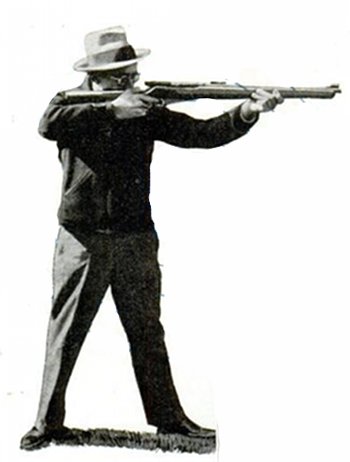
From some men, learning how to properly and safely fire a rifle is a skill they picked up when they were just knee high to a grasshopper. These guys probably got a .22 for their 12th birthday and spent summers in the woods plinking tin cans and squirrels and autumns hunting deer with their dads and grandpas.
Me? I wasn’t one of those guys.
But lately I’ve been wanting to learn how to fire a variety of firearms. I’m sure there are other men out there who, like me, went their entire life not ever shooting a rifle, but now have the desire to learn. It might be because he wants to take up hunting. Maybe he’s interested in home protection. Or perhaps he’s just interested in marksmanship as a hobby in and of itself. Whatever your reasons are for wanting to learn how to fire a rifle, you need to know how to do it safely and correctly.
A few months ago we did a post on firing a handgun safely and correctly. This time we’ll focus on how to shoot a rifle. So I headed back over to the U.S. Shooting Academy here in Tulsa, OK to talk to Mike Seeklander, Director of Training at the Academy. He explained the very basics of firing a rifle and today I’ll share what I learned with you.
The Four Cardinal Safety Rules of Firing a Rifle
Just as he did when we talked about firing a handgun, the very first thing Mike brought up were four rules, that if followed strictly, will keep you and others safe so you can have a good time firing off a few rounds.
1. Always treat every firearm as if it were loaded. No ifs, ands, or buts. Even if you know the gun is unloaded, still handle it as if it were loaded.
2. Always keep the firearm pointed in a safe direction, a direction where a negligent discharge would cause minimum property damage and zero physical injury. The safest direction to point a gun is always downrange (as long as there aren’t any people downrange!).
3. Always keep your trigger finger off the trigger and outside the trigger guard until you have made a conscious decision to shoot.
4. Always be sure of your target, backstop, and beyond. You want to be aware of what’s in your line of fire. This isn’t usually a concern if you go to a professional gun range. They make sure that people and property stay out of the path of the guns firing downrange. Where this becomes a concern is when you go shoot with your buddy out on his property. This is especially important when firing high powered rifles as their bullets travel further than bullets fired from a handgun.
Listen to Mike: “Ask your friend what exactly is beyond the target and backstop you’re shooting at, especially when you’re shooting into a wooded area. Don’t just settle for, ‘Oh, don’t worry. There’s nothing back there.’ Ask specifically if there are any houses, property, etc beyond your backstop. Err on the side of being overly cautious.”
Types of Rifles
Rifles are high powered firearms typically used to hit targets at long distances. Rifles are designed to be fired from the shoulder. Grooves, called rifling (hence the name rifle), are cut into the barrel of a rifle. Rifling makes the bullet spin as it leaves the muzzle, making the bullet much more accurate and stable in flight.
There are a variety of rifles out on the market that serve different purposes. Here’s a quick rundown of the most common.
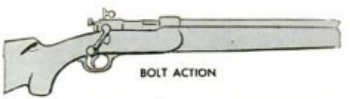
Bolt action rifles. Hunters often use a bolt action rifle like the Winchester Model 70 which requires the shooter to manually open and close the breech of the gun to eject a spent casing and load a new one.
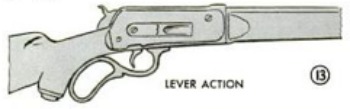
Lever-action rifles. If you’re a fan of Westerns, you probably noticed the cowboys in the films firing lever-action rifles. Lever-action rifles use a lever located around the trigger guard area to load fresh cartridges into the chamber of the barrel when the lever is worked. The most famous lever-action rifle of the Wild West was undoubtedly the Winchester rifle, a favorite firearm of badasses like Bass Reeves.

Semi-automatic rifles. A semi-automatic rifle fires a single bullet each time the trigger is pulled, automatically ejects the spent cartridge, and automatically chambers a new cartridge from a magazine. Most modern semi-automatic rifles are made from lightweight synthetic materials that make them easy to hold and carry. The most popular semi-automatic rifle is the AR-15. Here in the United States, there are no federal restriction on civilians owning AR-15s, though some states, like California, do place restrictions on ownership. Other states, such as Texas, have no restrictions and even allow semi-automatic rifles for hunting. The rifle Mike used in our photos was a JP-15.
How to Stand When Firing a Rifle
There are two common stances when firing a rifle: bladed-off and a squared, “athletic stance.”
Bladed-off stance. A bladed stance is when your weak-side shoulder is facing the target. So if you’re right handed, your left shoulder is facing the target; if you’re left handed, your right shoulder faces the target. It sort of looks like how a baseball batter would stand in the batter’s box. Here’s Mike, showing a bladed stance:
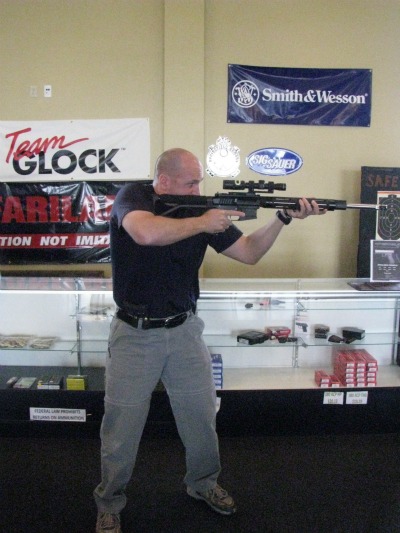
Bladed-off Stance
Many first-time shooters stand in a bladed-off stance when firing a rifle. They probably saw their favorite cowboys or action heroes in movies take this stance, so they assume it’s the best way to stand. Mike says that while a bladed stance is good for competition shooters who need precision in their aim, it’s not a great stance for shooters in more tactical situations that require rapid shots with minimal muzzle rise.
Squared or athletic stance. Mike and the folks at the U.S. Shooting Academy teach their students to assume an athletic stance when firing a rifle. Square your shoulders up with the target. Stand with your feet shoulder-width apart on a straight line. Stagger your strong side foot about six inches behind your weak side foot.
Place the buttstock of the rifle near the centerline of the body and high up on the chest. Keep your elbows down.
Here’s Mike now showing the athletic stance:
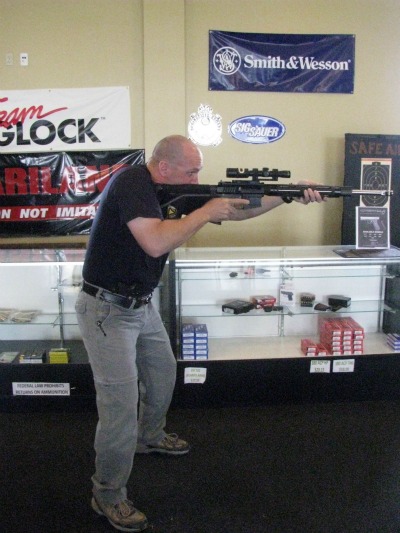
Athletic rifle stance
The biggest advantage of the athletic stance over the bladed stance is that it helps in reducing the effects of recoil when firing a rifle. Think about it. If you’re a lineman in football and you want to resist the other guy pushing you backwards, what stance would give you more balance? Being squared up with the other guy or standing sideways with just one of your shoulders towards him? Squared up, of course.
Another advantage the athletic stance has over the bladed stance is that the athletic stance allows you to track a moving target better. A bladed stance limits how much you can twist your body. An athletic stance allows you to swivel right or left much more easily.
Mike recommends an athletic rifle stance for most shooting situations.
How to Hold a Rifle
Trigger Hand Grip
Rifle with pistol grip. If your rifle has a pistol grip, like the AR-15 or JP-15, center the grip in the “V” at the junction of the thumb and index finger of your trigger hand. Grip the gun high on the back strap (the back strap is the back of the grip on the gun). Like so:
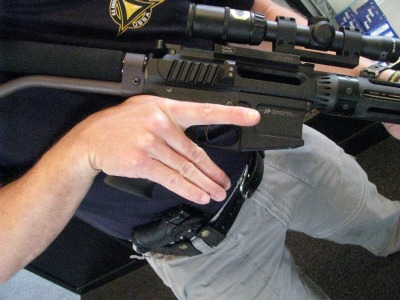
Rifle without a pistol grip. Most bolt action or lever action rifles don’t have a pistol grip like the AR-15. What they typically have instead is a crook between the stock and the trigger guard. Like so:
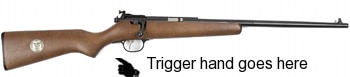
With these sorts of rifles, center the nook in the “V” at the junction of the thumb and index finger of your trigger hand. Grip the gun high on the nook.
Support Hand Grip
The support hand should grip the forestock (or handguards if you’re shooting an AR-15) of the rifle roughly midway down the length of the rifle. Here’s Mike demonstrating for us:
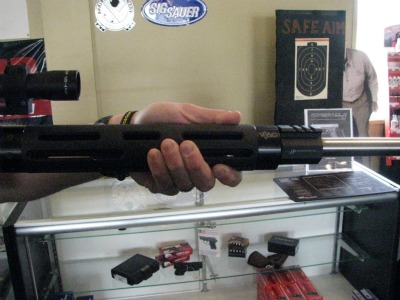
Putting your support hand further forward on the forestock will give you finer control over the muzzle when aiming, which you want when precision is key. The disadvantage of putting your support so far out on the forestock is that it’s a little less stable.
Bring the rifle to your head and press your cheek firmly into the stock. Keeping your head up, bring the rifle to your head. Place the buttstock of the rifle near the centerline of the body and high up on the chest. Press your cheek firmly to the side of the stock of the gun, like so:
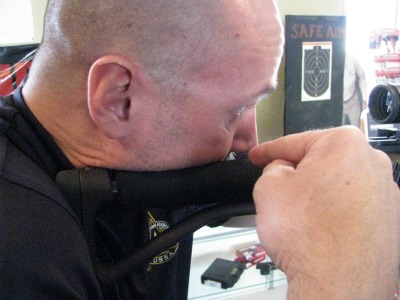
Mike demonstrating proper cheek lock.
You’re now ready to aim and fire your rifle.
How to Aim a Rifle
Rifles can have different kinds of sighting systems depending on what you’re using your rifle for. What sighting system a rifle has also depends a lot on the preference of the shooter. Three common sighting systems you’ll see on a rifle are: open sights, aperture sights, and scope sights.
Aiming a Rifle with Open Sights
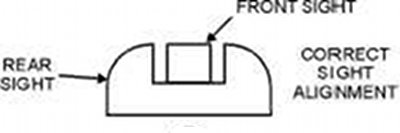
Aiming through open sights.
Open sights use a notch of some sort as the rear sight. They come standard with most rifles. We talked about how to aim with open sights in our post about firing a handgun. The same principles apply here. I won’t repeat what I wrote, so refer back to that post for tips on aiming a rifle with open sights.
Aiming a Rifle with Aperture Sights
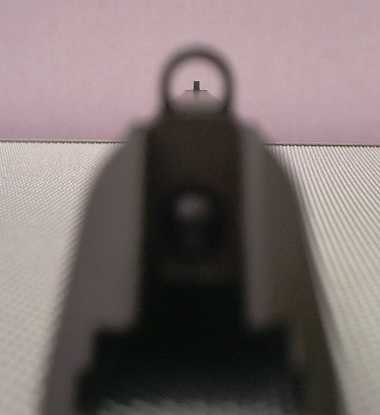
Aperture sight
Aperture sight (or peep sight) rifles have a similar front sight to open sight rifles. The difference is the rear sight. Instead of an open notch, the rear sight is a small ring mounted close to the shooter’s eye. There are different kinds of aperture sights, the most common being the ghost ring sight.
Aperture sights allow you to acquire your aim more quickly and more accurately than when using open sights. One of the problems with open sights is that it forces the eye to focus on three objects at the same time: the rear sight, the front sight, and the target. This is impossible to do, so one of the points of focus will be blurry. Aiming an open sight gun requires the shooter to know which object needs to be blurry and which objects need to be in focus. Focusing on the correct points can take precious time.
Aperture sights speed-up getting a correct sight picture by removing one of the objects in the shooter’s line of sight, specifically the rear sight. Looking through the rear ring causes your eye to automatically center on the front sight at the muzzle of the gun, thus providing you with a more accurate aim, acquired more quickly compared to using an open sight.
To aim with an aperture sight, simply look through the rear ring sight, attempting to only focus on the front sight and the target. The ring will blur until it is almost invisible (hence the name, ghost ring sight).
The front sight should be centered in the rear ring. The greater the distance to the target, the more perfectly you need to center the front sight in the rear ring. A closer sight requires less sight precision. Aim your front sight right underneath the point you want the bullet to hit. Before firing, shift all your focus to the front sight.
How to Aim a Rifle With a Scope
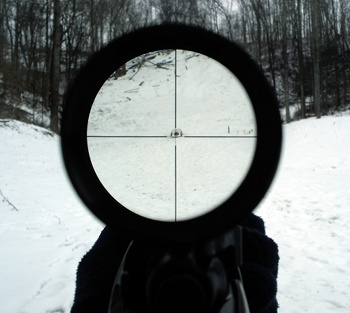
Scopes provide the most accurate and easy sighting on a rifle. They allow the shooter to magnify their target for better target definition at long ranges. A scope’s most useful attribute is that everything in the shooter’s field of view is in the same optical plane. Translation: there’s no need for your eye to balance focusing on multiple objects like you do with open sights and aperture sights. You can keep both the crosshairs and the target in focus. Just aim your cross hairs at your target and shoot.
Well, I wish it were that easy. A novice shooter might notice that despite a steady hand, all their shots end up nowhere near the crosshairs of the scope. For maximum accuracy with a scope, you have to “zero” it. Zeroing a rifle is a somewhat technical process for a beginner shooter and warrants its own article explaining how to do it. I’ll do a follow-up article on how to zero a scope in the future.
Trigger Management (aka Pulling the Trigger)
To fire a gun, we often use the popular phrase “pull the trigger.” However, to fire a gun properly, you don’t actually want to pull the trigger, but rather press it in a controlled fashion so you don’t disrupt your sights. Managing the trigger on a rifle is similar to doing so on a handgun, so here’s a review of the basics we covered last time:
1. Press, don’t pull. Instead of pulling the trigger, press (or like my dad likes to say “squeeze”) the trigger straight to the rear. Apply constant, increasing reward pressure on the trigger until the weapon fires. Ensure that you’re only applying pressure to the front of the trigger and not the sides.
2. Take the slack out of the trigger. Squeeze the trigger to the point you start feeling resistance.
3. Surprise yourself. Keep pressing the trigger straight to the rear until the gun fires. Don’t anticipate when the gun will fire. You sort of want to surprise yourself as to when the gun actually discharges.
Have any other tips for the first time rifle shooter? Share them with us in the comments!
Editor’s note: This article is about how to fire a rifle safely and correctly. It is not a debate about gun rights or whether guns are stupid or awesome. Keep it on topic or be deleted.
_____________________________________________________________________________
Special thanks goes out to Mike and the crew at U.S. Shooting Academy for their help on this article. Mike along with the U.S. Shooting Academy Handgun Manual were the sources for this article. If you’re ever in the Tulsa area, stop by their facility. It’s top notch and the staff and trainers are friendly, knowledgeable, and super badass.


{ 120 comments… read them below or add one }
Next Comments →
Breath control, natural point of aim, follow through… All that good Marine Corps stuff! Oorah!
If you have never shot a gun before, work up in caliber size. Start with a .22 or .223, then when you have mastered the process you can go to larger / magnum cartridges.
If your first shot is a .338 Laupa magnum, it will not only hurt you, but you will also develop flinching and other bad shoot behaviors that will affect accuracy. (Exhibit A: http://www.youtube.com/watch?v=-EVqT3XEzss )
That’s a good primer for beginners. Regardless of any individual’s opinion on guns, United States history is closely tied to the rifle and early Americans’ ability to shoot it accurately. I would recommend taking a look at Project Appleseed (http://www.appleseedinfo.org/) for some history and attend an event to get a feel for what marksmanship is all about.
“These guys probably got a .22 for their 12th birthday”..
WHAT? what kind of second rate parent would do such a thing ? Deprive a kid of a rifle that long, I mean. I got my first .22 rifle (a used 550 Remington) when i was FIVE. Never had any issues or problems.
I still have it in the gun cabinet by the way.
Range etiquette needs a big mention here.
Going to an outdoor range means understanding some pretty simple rules that a lot of instructors don’t go over.
When someone yells “cease fire” stop shooting. Immediately. Clear your firearm by either opening the bolt or the lever or by dropping the magazine and ejecting the round. Set your weapon down on the bench or rest with the muzzle down range.
Usually cease fire is declared before the range goes “cold.” The range goes cold when people want to check their targets, look at their grouping, put up new targets or do anything down range.
When the range is cold and people are down range DO NOT TOUCH YOUR FIREARM. This will get you told, loudly, directly and somewhat coarsely to put your weapon down and leave it alone. We aren’t trying to be mean, but having some bozo accidentally crack off a round when you’re down range tending a target is an experience that’ll make you wish you’d brought a change of trousers.
If you have adjustments to make to your sites or your scope wait until the range is declared “hot” before handling your weapon. Remember when making these adjustments to keep the muzzle pointed downrange at all times.
Remember that you can declare a cease fire at any time for any reason. But doing so every few minutes can get distracting as some shooters will take several minutes between shots. If there are range officers, they typically will declare cease fires and determine the range hot and cold.
What do you do if you’re right-handed, but left eye dominant? You can’t still lock the cheek in and look down the sights at the same time…
Brett, I had NO idea you were here in Tulsa! I’ve subscribed to your great blog for a few months now but then you said today “U.S. Shooting Academy here in Tulsa,” and I was stunned!
In the months’ worth of firearms courses and training I’ve had over the years, a class I had with Mike Seeklander was one of the most memorable given how world-acclaimed he is as a shooter. I am thrilled you are tackling rifle shooting. To top off your skills and to become a TRUE Rifleman, check out the Appleseed project some day soon. (http://appleseedinfo.org/index.html)
@James,
You shoot left-handed. Welcome to the world of southpaws.
James, I am right-handed, but left eye dominant. I have to shoot left handed. It took getting used to, but it is worth it.
“WHAT? what kind of second rate parent would do such a thing ? Deprive a kid of a rifle that long, I mean. I got my first .22 rifle (a used 550 Remington) when i was FIVE. Never had any issues or problems.”
I have to agree by my 12th birthday my present was an SKS. .22 aren’t good for anything but small game and people/kids new to shooting (but I would go with at least a .223 for learning).
@James Your dominant hand has very little to do with shooting. Like others have said, you will have to shoot left handed. I myself am left-handed but right eye dominant as far as rifles are concerned. Pistols are another story all together. I can shoot either hand with a pistol as you should keep both eyes open any way.
Don’t underestimate the .22. You can do a lot of good shooting with them – all the way to the Olympic Games. And at a reasonable price, too.
I still use the old Mossberg .22 target rifle that my grandpa handed down to me. The scope I bought is second rate, but I can hit a squirrel at 75-100 yards, so it works. I think most kids should start with a .22, mainly because most little kids I know don’t like loud noises. A .223 is a good starter round for recoil, but it is a surprisingly loud round. You don’t want to scare a little boy away from the joys of shooting because the rifle is loud. I wish I could get an AR-15 with a 6.8 upper for deer hunting, but sadly rifles are expensive.
Wonderful, and very timely. Learning to shoot a rifle accurately is one of my resolutions for this year (every free person should be a rifleman–I was falling down on my responsibilities!). Thanks for the basic tutorial. I’ll be trying the squared-off stance on the next range trip.
For those of you that are cross eye dominant, you can also try sticking a piece of tape over your dominant eye to force your weak eye to focus. I know several people that this works very well for.
Just a small nitpick, I’m from California and I own an AR pattern rifle and several AK pattern rifles. While we do have to make some bizarre modifications, they are in no way genuinely restricted here as long as the model of rifle is not banned by name. Those of you living in what we call “Free States” may find our laws troubling and confusing, but we’ve made huge strides here to educate local and out of state gun owners about our laws so we can all get along together.
People interested in shooting should find a local group and find someone willing to take them to the range. It can be dangerous and down right unfun for a new shooter to go to the range with no experience. And buying a rifle with no prior experience can lead to a shooter buying a gun that doesn’t really work for him or her.
For anyone in California, http://www.calguns.net is an indispensable resource. For anyone who has a rifle and wants to get better, the Appleseed Project is a wonderful training program for Americans that not only teaches good technique, but the rich history of American Riflemen.
Cheers to AoM for doing an article on proper rifle use. I’m glad to see you guys doing an article like this.
I would like to point out to any potential new rifle shooters that you should NOT replicate Mr. Seeklander’s support-hand grip with a “traditional” rile which has a stock only under the barrel. The (wood or synthetic) part of the rifle is all your support hand should touch; the barrel can get EXTREMELY warm as you shoot. On an AR-15, which has a handguard that completely encircles the barrel, the grip he demonstrates provides additional control of the rifle during recoil and target transitions, which goes right along with his squared-off “athletic” stance.
One comment on the open sights picture.
That might be the sight picture on an AR-15 (not sure, don’t have one), but most rifles I’ve been behind have a V-notch for the rear sight. In that case, I was taught to center just the top of the front sight post in the bottom of the notch.
Happy to read this post. The only time I handled a rifle was on a cruise ship years ago while skeet-shooting (?) off the stern. Very satisfying, especially after a retired cop showed me what I was doing wrong!
Along the lines of what Cameron said, Here in New Jersey we also have an “assault weapons” ban, but because those bans were all based on marketing rather than on any functional difference between guns–”assault weapon” doesn’t actually mean anything–a man in any part of the United States usually has the option of an AR-pattern rifle if that’s what works best for him. In this state, for example, the only difference between an illegal AR-15 “assault weapon” and an unrestricted Colt Target rifle is that the legal rifle doesn’t have a flash suppressor or a bayonet mount.
Do some research, and ask at your local gun shop. They’ll have plenty of experience with the workarounds needed in your state. The AR platform is ergonomic, easy to use, and ideal for many people; don’t feel like you have to write off the option if your state has an AWB.
Oh, that reminds me, it wasn’t mentioned in the article, but rifle sights are generally sighted in one of two ways. With one method your target will sit “on top” of your front blade, with the other your front blade will cover the target. It’s important to know which method your rifle has been sighted with and which one you’re most comfortable with!
Don’t underestimate the bladed-stance. This is the way I was taught to shoot and by the age of 15 I could hit a 3-foot steel gong at 650 yards open-sighted using a Springfield model 1861. Take your time, control your breathing and slowly squeeze whilst your lungs are empty and you should be able to shoot true.
Rifle marksmanship is a very enjoyable man skill. I’m one of those fortunates the author mentioned early on, acquiring my own .22 when I was 9 years old, before heading over into cowboy action and long range gong shooting. One of the best experiences lately, was watching one of my college buddies, who was from a suburban Massachusetts area with no shooting experience, overcome his initial hesitance and start to really enjoy shooting. We taught him with a single shot bolt action.
Also Aussie, my hat’s off to you for a 650 yard shot with an infantry rifle musket. I compete against them in gong shooting with my trusty hawken, and that shot is no mean feat.
I think the bladed-stance is much better with heavier sporter stock rifles like M1As, Bolt Actions, etc… I find the modern style rifles really uncomfortable to hold in that stance.
Just my two cents, but I’d like to comment on the statement that you should “surprise yourself” when you fire the gun, which is a rather common tip.
I think the idea here is that you don’t want to anticipate the shot – and the recoil – and flinch, sending the shot off-target. While “surprising” yourself can certainly help you avoid this, I think it’s kind of a poor practice.
A responsible shooter needs to be in control of his gun at all times. This means that he needs to know exactly when he is going to shoot – it shouldn’t be a surprise for him. Not only could it be potentially dangerous to “surprise yourself” (though if you observe the other standard rules it’s very unlikely), but I think it creates bad habits. Instead of trying to avoid flinching by “surprising yourself”, far better to learn simply not to flinch.
Seen some points before this one but follow through is really important. I coached small arms in the military and that one trick can make a so so shooter a good one. Breathing natural point of aim are other points that are critical as well as body position. The further the target the more these things add up to a hit or a miss.
Repeating the process well helps more than anything. The more you do it the better you get but only if you are doing it right. Seen some very frustrated people doing it wrong lots but a little coaching goes a long ways. It is easy for a coach to see what you are doing that is messing with your aim where it is hard for you to feel what you are doing wrong.
Here’s an exercise my dad made me do till I got it right.
Cock the rifle (putting a dry fire shell in if you can. Make sure it is not a live cartridge.Make sure the gun is not otherwise loaded.)
Have someone balance a penny on the front of the barrel or front blade of the site.
Squeeze the trigger and keep the penny balanced as the firing pin drops.
If the penny falls, tighten up your stance, or practice squeezing the trigger.
Some heavier caliber guns may have problems with this depending on the firing mech. Dad taught me on a Winchester Bolt Action 22 and a Semi-auto Remington 22 then a 243 Win. Also, he would occasionally put dud cartridges in, just to see if I was jumping.
Breathing is VERY important to a big chested guy like me. I always inhale, exhale, then hold at the end of the exhale to correct my sites, then squeeze.
Safety, Safety, Safety! Use the pinkish-gray thing between your ears. Keep your booger hook off the trigger until the weapon is on target…that was already touched on but always worth another mention.
Know thy weapon before taking it in the field. For a “green” shooter, or a seasoned shooter with a new weapon, spend at least an hour or two with the weapon and the manual, WITHOUT ammo. Get intimate with it. Know how it operates.
Responsibility. For me, shooting is a fun and an awesome experience, I don’t care if it is shooting the kids with a squirt pistol. But keep in mind that firearms were originally designed for one purpose…and they each do that well.
Saturday night specials are the devil…there’s a reason they only bring $75.00 retail.
Know what thy weapon is chambered to fire and don’t use handloads that are over the weapons safe chamber pressure…they may go splode and may or may not take your hands or face with them.
“How did you learn to shoot like that?”…”I read a book…it came with the gun.”
Can someone also go over how the shooting range’s work?
There are lot of people who come to me and ask me that they want to own a gun, where should they start. Go to schools, get licenses, firing range needs gun or will they supply one etc etc.
I was presented one when I was 12 and thats it. Have been hunting since then, never went to an firing range.
If you are new to firearms and trying to get into the shooting sports, look up your local Izaak Walton League. The offer orentations, as well as contact information for instructors. Further more, they are a family organization, and as such they will always welcome strangers into the great tradition of shooting sports.
@spiderman
The most common around my area go like this:
Indoor Range: Most have weapons, ammo, targets, and shooting gear (ear and eye protection) onsite for sale and or use on their range. They are usually busy so be prepared to wait for a lane, or take the day off and go during the week when most people are at work. Most if not all the ranges in my area offer classes for beginners and seasoned shooters alike. I highly recommend classroom and live fire instruction for beginners. They also offer hang gun carry permit classes in my area as well.
Outdoor Range/Gun Club: Usually you have to be a member or be sponsored by a member to use the range, but they offer a lot of different ranges that an indoor range cannot provide. i.e. Long Distance, Skeet/Trap, Unknown Distance, etc.
As far as starting out, it is not illegal to own a firearm in my state so long as you are not prohibited by a mental condition, violent crime conviction, etc. Ask around in your area for a gun shop recommendation. I’m sure there is one in just about every area that stands out either from customer service, price, or other services like gunsmithing. Some of the big department stores also carry a selection of firearms. They sell name brand weapons and usually have a limited supply of ammunition and range gear. I recommend a gun shop because there is always someone “manning the till”. If you are lucky, a range in your area may offer firearms for sale, quality instruction, and range time. That would be the way to go for the first timer I think.
As far as permits/licenses, check your state and local laws. Most states have a website with a section on carry permits if they are permitted.
I did a bit of digging, came up with the following…
http://www.scribd.com/doc/32939278/Us-Army-International-Rifle-Marksmanship-Guide
http://www.scribd.com/doc/432351/USMC-MCRP-301A-Rifle-Marksmanship
Also, if you are not familiar with the basics, contact the NRA. They can refer you to an instructor in your area.
Another odd tip. Wear something with a tight collar and watch the path of the rounds when they eject, especially on semi automatic weapons. A spent casing is HOT. Listen to your instructors.
One of my all time favorite Father’s day gifts…3 of our 5 kids and their spouses/others at a shooting range with lots of ammo and guns.
https://picasaweb.google.com/jim.wildman/FatherSDay?feat=directlink
Good article, now that both rifle and handgun shooting has been covered an idea for an article would be proper cleaning and maintenance of your weapons.
Glad to see you are getting into rifle shooting. It is loads of fun and in my case is what keeps meat in the freezer. I shoot anything I can get my hands on but I am a rifleman first. One tip to add, get a rifle that fits you as that will aid both your enjoyment and your marksmanship.
I generally stick with the bladed stance. I’ve never come across an AR style rifle that had enough recoil to require me to change my stance. Plus in a tactical situation it offers a narrower profile and I’ve never had a problem tracking targets from this stance.
The four fundamentals of marksmanship are something I’m always aware of, steady position, breath control, aiming (sight picture), and trigger squeeze.
this is really helpful, the first gun i shot was in a las vegas shooting range, it was a .50 cal desert eagle, loved it, as it turns out i am going camping for may long with some buddies who have shot lots before and i being a TOTAL ammeture when it comes to shooting could not have found this post at a better time, this way it will look like i knida know what im doing and will also ensure that they are not uneasy around someone who doesn’t really know gun safety, thanks AoM, love the posts
I was one of those fortunate souls. I spent many fall afternoons getting off the school bus, grabbing my .22 and heading to the squirrel woods across the road from the house. As has been mentioned, breathing is so important. I take a big breath, exhale, take another breath, let half of it out, hold it, and then squeeze the trigger. As many can attest to, once you get good, you really can challenge yourself with those longer, tougher shots. If you can’t hit a squirrel in the head with a .22 at 50 yards at the bare minimum, you ain’t trying. If you really want to have some fun, try predator calling. There’s nothing like shooting a coyote that came in to your hand calls. It is truly an adrenaline rush like no other, but that is a topic for another time.
Jeff Cooper’s Art of the Rifle (around $25 from Amazon) is an excellent primer on the basics of rifle shooting. It doesn’t replace range time but the pictures and general information are excellent.
I’ve been shooting for 25 years, everything from miniguns and cannons down to .22′s and i still re-read it because you can never go over the basics enough.
Sam, you have good taste in muzzle-loaders mate. I’m glad that there is someone else on here that has an appreciation for these old beauties. I still believe to this day that learning how to shoot with muzzle-loaders is what made me so accurate. I still will never forget the first one I shot though – the only match-lock rifle in Australia. Nothing like the kick of a .68 to shock the shit out of a seven year old lol.
A few random facts from the perspective of a former Marine.
1. Shooting stance. The Marines used to teach that bladed off stance as the standard for everybody. A few years back they decided to dump it and now teach everybody to use that squared up “athletic” stance. Does that make one better than the other? Nope. The decision actually had nothing to do with hitting your target. The point of the old stance was that being angled actually made you a narrower target, and thus a little bit harder for the enemy to hit. They switched to the new stance when the new body armor came out. Since the new vests have that big bullet resistant plate in in the front, making you square up to the target keeps the armor plate out in front of you, protecting you from the bad guy’s fire.
2. Dominant eye. A fine concern for target shooting, but for combat shooting its best to learn to shoot with both eyes open. This helps you keep better awareness and move to your next target more quickly. I can only guess that this same ability would be very useful in something like hunting, or anything else where you have moving or multiple targets.
That is never touch someone else’s weapon without permission and always assume it is loaded.
“Whatever you point a weapon towards is something you’re ready to kill.”
– Grandpa, formerly of the Marine Security Guard Battalion
Grandpa taught me the rifle, with the Remington Model 77 that I still have in the closet; blade stance with the sling looped tightly under my left elbow, with the Weaver 22 Tip-off scope and without. This rifle hold 17 rounds of .22 long in the tube magazine. He never let me load it all up. He’d hand me one round at a time, and watch me do it by the numbers, again and again and again: Lock, unstance, check lock, check chamber, check decock, accept round, check lock, load round, check lock, take stance, cock, aim, unlock, exhale, reaim, fire, lock, unstance . .
There is some part of me in the back of my mind that is very, very sure that if I ever once mishandled a weapon the old bastard will dig himself out of his grave, find me, and jack slap me up and down the street. And, this is a man who never even raised his voice to me.
Love you, Grandpa. Miss you a lot.
I meant to say, it’s a Winchester Model 77. The Remington I inherited from him is the Wingmaster 12 gauge pump shotgun.
Excellent article. I, too, am one of those ‘fortunate sons’ who grew up, alondside his 4 brothers, hunting & shooting, everything from .22′s to 30-06′s to shotguns. We kept the ‘meat pot’ full during every season, hunting everything that was legal & edible. I still own every weapon my father bought me and lots of additions to the rack.
I learned to shoot rifles from the ‘bladed’ stance, tried the ‘squared’ during my IPSC/tactical/trap/sporting clays competition days, and settled on a hybrid utilizing an approximate stance angle of about 45 degrees. this allows near maximum flexibility, while keeping the off-hand in a position to advance on the foregaurd for accuracy or retreat toward the action for maneuverabilty.
Once the four ‘rules’ are imbedded in your brain, the best training is practice, and the best practice is live fire at a proper range. the comeraderie is irreplacable, as are the physical results/proof of your endeavors.
Lastly, i will pass on this bit of wisdom that was belatedly given to me: “there are two types of shooters in the world- those who have experienced an accidental dischare & those who are going to.” If you shoot long & often enough, it will probably happen to you. ALWAYS be certain of your muzzle & anticipate the worst that can happen.
“never point your weapon at anything you do not want to DESTROY/see die.” – i cannot emphasize this enough. (all i killed was a mirror, but that was enough)
Couple of comments from my old Green Beret Weapons Sergeant days. The squared stance is best if wearing body armor. This presents the front of the body armor to the enemy. If you are wearing a ceramic plate, It keeps the plate at the front. When using sights on any weapon, pistol or rifle, the front is the key. It should always be in focus. The target will be fuzzy. Concentrate on the front sight and you will be much more likely to hit the target. Overall very good article!
You forgot perhaps the most important safety rule:
“Keep the weapon on safe until you are ready to fire.”
Right now people could follow the rules you put up and still be walking around with a loaded weapon on fire. Very dangerous.
Great post sir.
I grew up in a small town with lots of forest, lakes and nature nearby where my old man, my grampas, and all my uncles (My dad came from five brothers, all of them men’s men) taught me to shoot a gun. Your four cardinal rules are dead on the money, and “squeeze don’t pull” is the other big one too. For a guy who wasn’t “raised that way”, it seems you’ve got it down pretty well.
I live in a big city now, and getting out and firing my gun isn’t nearly as simple as it once was, and it’s unfortunately been way. too. long. since I shot a deer with my dad.
Anyway, it was great to read this, and get a little glimpse back into the world in which I was raised. Thank you.
I would say that keeping the safety on until you’re ready to fire is always a good idea. I forget many people grow up without using firearms their whole life.
These days, the plates are reinforced steel (the ESAPI) as ceramic tends to crack if dropped or landed on hard. Steel also takes repeat hits better.
The bladed stance is fine for noncombat use, but a friend of mine is in a wheelchair for life after he took an AK round in the spine through the side of his armor because of the bladed stance in ’03. They learned quick, just not quick enough in his case.
Great article I just had one nitpicky point I didn’t care for. The four rules you gave I feel are kinda wishy-washy. I prefer the more hard nosed version of.
1. All guns are always loaded.
2. Never let the muzzle cover anything you are not willing to destroy.
3. Keep your finger off the trigger until your sights are on the target.
4. Identify your target, and what is behind it.
Its really just the first two in the article I have issue with I feel they create mental wiggle room that leads to negligent discharge. With the first one in the article it allows the thought that the gun is unloaded which when the person is on top of their game and following the rules is OK but all it takes is for him to be tired or distracted and thinking the gun is unloaded for trouble.
And I don’t like the second because the way its worded makes it sounds like a negligent discharge is OK as long the gun isn’t pointed at someone. A negligent discharge is never OK at the least its mentally damaging to the people involved. Most shooters I know who’ve had one say its the scariest moment they’ve ever had with a gun. I’ve not experienced one as a shooter but I have as a bystander and I can tell you it’s freaking scary. Depending on the ‘where’ it could also be financially or legally damaging. Plus if you follow rules 1 and 3 negligent discharges are avoidable. (The one I was near happened when rule 3 was violated)
I was taught to focus on the front sight while keeping the rear sight and target just slightly out of focus.
Nice to see a discussion rather than an argument. This is great.
I’m not sure about safeties (safetys?). If the gun is always loaded, I always felt that a safety was an easy way to mentally unload the gun…a bad thing. Reminds me of the survivorman episode of The Office where Dwight was using a deer rifle with scope to keep an eye on Michael. As he explained…”This is okay…the safety is….oops…[click]…on…”
Personally, I think every household should have experience in rifles and shotguns. I’m still agnostic about handguns. I enjoy shooting them, but I don’t have them around the house…the kids are older now but I just didn’t want to worry about it. Even locked up, anyone who has kids knows that child-proof is a joke. Not a criticism of those who do, mind you…just a personal choice. Rifles and shotguns…no problem.
Does anyone else think Hoppes Cleaning Solvent would make a great cologne? Man, that stuff takes be back…
D
Oh yeah…here in Wisconsin, where deer hunting is the second most popular religion behind the Packers, there are always half a dozen fatalities every season. Usually a few of them are heart attacks (not surprising), but there are always a few tragedies… a family member kills another one…a man shoots himself when he pulls his .270 up to his tree stand with a rope and it goes off…a drunk friend shoots another drunk friend… With the exception of the heart attacks, it’s all preventable.
@Ben Sheldon-Tarzynski
Many firearms are designed and meant to be carried with a round in the chamber and the “safety” off. Most firearms these days have passive safeties, like the glock trigger, and the beaver tail safety on a 1911.
The only safety that matters is your trigger finger. No gun ever goes bang without someone pulling a trigger, and you should not depend on any mechanical aid to prevent you from pulling the trigger at the wrong time.
Safety’s are great for transportation, but in that case it should already be unloaded and bolt open anyway.
@Chris L – “No gun ever goes bang without someone pulling a trigger,”
I have to respectfully disagree. We had a hired man that worked for us years ago describing an incident during his childhood when his dad parked his truck on a hillside. There was a double barreled shotgun that was loaded sitting in the seat. They got out of the truck and the gun slid across the seat to the downhill side and one of the hammers hit the open door on the downhill side and it hit the firing pin and set the gun off. it blew a hole in the upper truck door just inches from his dad. One can never be too careful. ANY gun with a round in the chamber is a potential mishap away from going off. Look at all those so called incidents with those Remington 700s on Dateline that fired when the bolt was opened and no hand near the trigger. Most of these had trigger adjustments. I’ve never had that happen to my 700s, but it is always on my mind. Never trust your life to a safety AND ALWAYS keep the gun pointed in a safe direction, especially when loading and unloading. D-C
Very good post, sir. The public needs to be informed about firearms. Personally, I don’t subscribe to the “discharge should surprise you” theory. In my experience, if you don’t know when the weapon is going to fire, you’re more likely to flinch or jump. I like to know exactly when it’s going to fire, so when I’m on target, I smoothly but swiftly haul back on the trigger.
@ D Bar C:
I am not aware of the Rem-700 incidents you referred to, but I have to point out that it is impossible for a bolt action rifle to fire while the bolt is open. As I’m sure you know, the entire firing mechanism is contained within the bolt itself, so if the bolt is open, (short of some sort of anomaly with your ammunition) it is impossible for the weapon to discharge. That being said, I completely agree. You cannot trust the safety. That is simply another fallible piece of technology.
Its also important to remember to control your breathing. There are a few ways to do it, but most people take a dew deep breaths and then fire after you exhale. I often breath normally and allow my breaths to bring my sights onto the target. Just let your breathing move your sights slightly up and down and then fire when you are lined up. Often people try to hold their breath and this is a mistake, it starves your muscles of needed oxygen and makes you shaky.
Just take your time, visualize the shot, and put the bullet where you want it.
You should never rely on mechanical safeties. The only thing you can rely on is your common sense and good judgement. The first rule of gun safety- “always treat every firearm as if it were loaded and ready to fire” … is the number one rule to follow. Never transport a gun with a round in the chamber. That’s an accident waiting to happen, no matter what anyone says.
Hey Brett,
Thanks for a really appropriate article!
Just a couple of things:
First, almost all of gun safety should be reduced down to the statement, “You are responsible for the bullet that you fire, until it comes to rest”. All of the statements about backdrops, loaded guns, etc. eventually arrive at that fact. i.e. If you pull the trigger, you own the bullet until it stops. All of the other safety rules are about not putting yourself in that position of responsibility. On occasion, a loaded gun is accidently fired through mechanical failure. Seems like responsibility here belongs to the person that put the loaded gun in the position to be fired. This is akin to an automotive brake failure that causes a fatal accident being traced back to the mechanic that incorrectly installed the brakes.
Second, you missed a couple of common types of rifles: 1) pumps, 2) single shots. You will no doubt hear from some Remington 760 fans regarding the pump action. You will also hear from some Ruger #1 shooters regarding single-shots. Also, I am sure there will be some Marlin fans that will contest the Winchester claim to lever action fame!
Third, just my personal preference, I kind-of wish Mike had not used an AR copy for the pictures. That gun is not appropriate for most non-military uses.
In terms of hunting, we humans have developed technology that can kill any animal instantly. (Actually, we can obliterate cities, if we want.) The AR is a military rifle designed originally designed to wound (.223 cal.) not kill, the enemy soldier. The point here is to give the game animal a fair chance. I doubt that TR (Teddy Roosevelt, for you newbies) would have hunted with an AR.
And, if you are worried about defense of the US in some future Armageddon, I suspect that a few well-placed shots from grandpa’s Model 700 will be worth numerous “spray and pray” clips from an AR.
Lastly, I suspect that your Dad’s words about “squeezing the trigger”, were really about “squeezing your whole hand” during the shot. This really has to do with getting a firm grip on the gun and pulling it into your body while pulling the trigger.
Thanks for a great site!
The actual 4 universal safety rules are even easier to remember: treat, never, keep, keep.
1. Treat every weapon as if it were loaded.
2. Never point a weapon at anything you do not intend to shoot.
3. Keep your finger straight and off the trigger until ready to fire.
4. Keep the weapon on safe until you are ready to fire.
Just relying on the safety to keep a weapon from discharging isn’t enough. Mechanical failures happen much more than people here seem to realize. The M240 machine gun was recently removed from service for exactly that reason – a large number of them had flaws in the firing system that were causing negligent discharges through no fault of the operator.
And as for pulling the trigger, remember that the trigger itself should never be more than halfway down the first segment of the trigger finger, 1/4 down is best.
I wish to comment on Bigeds thoughts here:
“Third, just my personal preference, I kind-of wish Mike had not used an AR copy for the pictures. That gun is not appropriate for most non-military uses.
In terms of hunting, we humans have developed technology that can kill any animal instantly. (Actually, we can obliterate cities, if we want.) The AR is a military rifle designed originally designed to wound (.223 cal.) not kill, the enemy soldier. The point here is to give the game animal a fair chance. I doubt that TR (Teddy Roosevelt, for you newbies) would have hunted with an AR.
And, if you are worried about defense of the US in some future Armageddon, I suspect that a few well-placed shots from grandpa’s Model 700 will be worth numerous “spray and pray” clips from an AR.”
I am glad a AR15 was used. There is no more fully functional, all around useful rifle a new shooter could buy other than a .22LR. Hunting and shooting are two entirely different things. Very few hunters are shooters. A shooter goes to the range often to expand upon marksmanship skills and all the nuances that will help them hit the target faster, more accurately, and or will train these traits while under self imposed duress.
A hunter hardly ever tackles marksmanship in the manner that a CMP or XTC shooter practices. A hunter hardly ever approaches shooting the way a 3 gun competitor does. A hunter can be a shooter, but all too often I see (or read) of hunters who badmouth “assault” rifles because they don’t have a place among sportsmen.
This is foolish. They in fact do have a place among sportsman. The rifle has everything a hunter could want in a rifle. Lightweight, accurate, reliable, and self serviceable. If .223 isn’t your round then buy one chambered in whatever caliber you want. Furthermore AR15′s have EXCELLENT sights that will go a long way in teaching new people the fundamentals of shooting. The only negatives are that the rifle is not allowed in some states to take game (PA and semi autos) and some people like to see wood on their rifles in regards to aesthetics.
As far as Armageddon… you do know that AR15′s are routinely shoot out to 600 (or more) yards right? Not only is as accurate (or in some cases MORE accurate) than daddy’s old Remington 700 in the closet, but you have 30 shots in reserve to boot.
The AR15 is America’s rifle. If you want ONE gun, make it one that can defend your home and family, that won’t limit your ability to you learn as you shoot, and choose one that is exciting and interesting to (potential) new shooters. That rifle is the AR15.
I am no marksman, but I intend to become one. The AR15 is the RIGHT tool to lead me to that goal.
Brian
@Chris L – “No gun ever goes bang without someone pulling a trigger,”
I have to EMPHATICALLY disagree. I used to hunt with my Dad’s old Winchester Model 94 .32 Special. This gun had the half-cock notch safety. The hammer haldway back was “safe” and the hammer fully back was “ready to fire”. But what happens at 3/4 back? I’ll tell you…BANG.
I was hunting with a few of my brothers in 2004. I was walking through a thicket, with the sling on my shoulder and the barrel pointed to the sky, when all of a sudden…BANG. A branch had pulled the hammer to 3/4 and let go. The bullet went straight up. Fortunately, the branch didn’t tilt the barrel toward my head. My ear was ringing, but I was alive. I could just as easily blown the top of my skull off. It would likely have been considered a suicide but I would have know it was death by stupidity.
My brothers and I have short-hand names for various hunting spots. That place became known as “the place that Bill killed himself”.
That was the last day I carried that gun.
Sometimes as I’m falling asleep, the memory of that day will creep into my head. Let’s just say that I don’t sleep well those nights.
Accidental discharges … it is going to happen. What to do? Follow the outline above because your round will, at least, be going down range … an area already considered “safe.” Remember, you are legally liable! So, pray it is the neighbor’s cow or pet and compensate handsomely.
As for stance … the simple truth is you have to be competent at both. Clearly, learning the “blade” technique should be mastered first. Why? Angle of repose and developing muscle memory. In other words, you want your body at rest when you shoot. Think of yourself as a pitcher in the “show.” Over the course of the season, your pitching coach has wanted you to throw that ball at precisely the same place, day in and day out. He wants you so bored, you aren’t even thinking about throwing a this, that or another pitch. It is just another thrown ball even if it does mean the difference in the series.
It is a shame you don’t have access to a Marine range during “qual” week. It is an eye opener. Dingers lying to each other trying to psych each other out because they take such intense pride when they “keyhole” a target. (They just put another round through the same hole or so very nearly so, the marker still fell out of the target.) No kidding, you can do it too. Just remember to think.
Now, all of the division champs on the KD courses (Known Distance, 200, 300 and 500 yards) do the same thing, place your body perpendicular to your target and raise your hand and extend it completely palm flat pointing at the target you are not looking at! Now, turn your head and look down range, is your outstretched hand centered on the Bull? If not move your rear foot in either direction and do it again until you get it right. (Come hell or high water, do not move your feet once you get it right.) Now, you are ready to shoot because all you have to do is concentrate on your sight picture, sight alignment and breathing. Squeeze at the near bottom of your breath. (It takes practice.) The point is, your body is in repose–no muscle tension because you have turned yourself into a bipod! Neat! This method works for rifles, pistols and especially medium machine guns if you had to tote them in the service like I did about a century ago. Muscle strain and it’s elimination is always the goal. I’m a lefty so my right hand goes out for a rifle and the left hand is out for my pistol.
When I shoot a pistol, I use the same method and because of the incredibly more complex body dynamics, I usually go with a squared off stance so I can use both hands to better control the heavier caliber weapons during a rapid fire string. “Snubbies” are a different world but the concept is the same, close your eyes point the weapon at the target. If you are “on,” you will be very much pleased with the string of fire you turn in even if your hand does hurt using a high-performance “snubbie” ammo. If you are off, square up again before you fire the next round, time is on your side at the range, you paid for it. Remember, a single pulse beat in one wrist will move the barrel of the weapon 1/32 of an inch. You could have a 3,000 buck race gun and at fifty yards, you have just “scared” your target but still missed it completely!
I hope this helps.
M
Modern handguns have drop safeties and other mechanisms that prevent discharges when the trigger is not pulled. Older handguns, many rifles, and many shotguns do not have these same safeties. Thus the importance of rules 1 and 2.
However, regarding Dateline and Remington 700s, that was a total smear job. I hate to say it, but if your knowledge of firearms is based on what you see on television and in films, you are badly misinformed.
For a great way to learn rifle shooting, go to an Appleseed class. They are free for many people, and very inexpensive for others. http://www.appleseedinfo.org They mix rifle marksmanship lessons with stories about the American Revolution. They are non-political other than encouraging people to take part in the political process (they don’t even have a stance on gun control).
To biged that doesn’t like AR rifles. Don’t confuse the original caliber with the rifle platform. One can purchase various ‘uppers’ for the AR so you can hunt without using the 223 caliber. Also, depending upon what you are hunting, the .223 can be appropriate. If your only interest is hunting large game animals, than maybe an AR is not appropriate for you, but for many other shooting sports and self-defense, an AR can be an excellent choice. This is also true for smaller women; many shoot ARs but cannot handle the large caliber bolt actions that you seem to prefer.
Oh, hats off to Michael who had an excellent post! The Appleseed instructional method is similar to the old school Army and the current Marine Known Distance teaching methods. Also, it is using the bladed stance since Appleseed is about marksmanship rather than combat.
The squared off method is the current Army method, as it is designed for close range combat rather than long distance accuracy.
Add in the fact that the ‘to wound’ thing is a myth and always has been. The Army adopted the M16 after a study about wound lethality, they found (when used properly) the 5.56 was far more lethal in it’s loading at the time than the 7.62mm M80 ball it replaced. If you do your job it does its, as many people around the world have found out.
As to ‘assault’ rifles, all current modern bolt actions trace their lineage back to the Mauser 98, which before the AK47 was the most common military rifle in the world (including our Springfield copy), and almost all modern lever actions trace their lineage back to the Henry and Winchester 1866, both designed specifically for the military market. Hunting, shooting and warfare are inextricably linked and always will be. The fact it took 20-30 years for the AR to make the switchover is a little different due to market saturation, but it’s not new.
There have been a number of interesting comments about the merits of particular rifles in the article and as responses. While the AR15 is a great rifle to shoot and can do the job in a number of roles it can also teach some poor shooting habits. Many of us that started shooting and hunting at a young age began with a single shot. I taught my kids to shoot with a single shot and still feel like it offers the best foundation. If a rifleman, hunter or shooter, can hit the mark with one shot a 30 round magazine with 29 in the stack is just extra weight. Practice from different shooting positions with the intent of making the first round count is a good shooting habit.
One other important note is to always shoot with hearing protection. Even a .22 can damage your hearing with repeated exposures. Save your hearing and make yourself a better outdoorsman.
Thanks for a really sensible, well structured feature.
Great article here! Would love to se more like it in the near future. I do think that it should be supplemented by one of the articles written by AoM subscriber Ed Harris. Ed was a staff writer for years with the American Rifleman magazine. He also has worked as an engineer with Sturm Ruger. Ed also has been an advisor to the firearms divisions of the FBI and CIA, IIRC. Further, Ed has penned articles for a plethora of fireams books. He truly is a gentleman, a fascinating author, and one heck of a nice guy!
Great article, with lots of great advice, in the comments as well as the main post itself. All I’ll say is, for you guys intent on arguing about what should and shouldn’t be in the article in terms of hardware…come on, fellas! You know guns are like cars; every man’s taste is different. We can (and will) argue the AR15 vs. the [insert-your-weapon-of-choice-here], but it will come down ultimately to every man’s preference. I’ve fired a lot of rifles in my time, and some are better than others, but I enjoyed them all. Personally, in rifles, I’d love a Sharps, or a Dragunov, or a Garand, or even a Winchester or Marlin lever-action chambered to match my pistol.
And I eagerly await the shouting-down I’m about to receive for my “poor” choices. :-D
I CANNOT stress enough the importance of the tips and techniques listed in this article. Brett, I’m really glad you took the time to write and post this. As someone who has been shooting since about age 8 (I’m 20 years old now), I’ve always advocated safety and precaution in regards to firearms. Any punk kid can hold a gun sideways. It takes a MAN to respect the power that a firearm posses, and to ALWAYS treat it with the respect it deserves. I’m really glad you went to a proper school to learn firearm safety. Unless you have a close family member who is military trained (my dad and grandfather in my case), that’s really the best way to go. Not certain how various police academies and districts handle weapons training, so if anyone else wants to chime in on that?
In any case, this is a great article. My one concern is the response in the comments regarding the trigger finger as a safety. While I agree that the safest place for any firearm is in the hands of someone with years of gun-safety experience, your finger is not the first safety. The first safety is your attitude towards the weapon, and WHERE YOU POINT IT. This is where rule number 1 comes into play: a gun is always loaded. Period. There are too many tragic stories to act any other way. Respect that rule, and we can all enjoy shooting comfortably. Once you get the safety down, learn some technique. Again, any fool can pop off 20 rounds in rapid succession and look like Rambo. I want to see the guy who takes 5 minutes to line up his shot, fires once, and nails the bullseye from 600 meters out. That’s pretty darn cool.
- Peter
Great article! Every man should learn how to handle a weapon. The theory is the same no matter what weapon system your using. Kind of like riding a bike (Just a little more deadly!)
Great article Brett. As one of those country boys whose been shooting since I was ten, This article has many good tips that any novice shooter could use. Anyone out there who wants to learn or improve would do well to pick up a decent .22 though. It’s a great caliber to practice with (especially due to the ammo price difference). While I might get some comments from this, I personally use a Remington Nylon 66 .22 for target practice. It’s a lightweight model that shoots very well for beginners or the more skilled marksmen.
I have to expound on Brad M.’s comment on breathing…He is absolutely correct about keep breathing, but it might be easier for some beginners to imagine their breath coming and going in waves..and then shoot in the valleys or peaks. I’ve had buddies that shoot remarkably well, on the out-breath OR in the in-breath..Either is fine, the point is CONSISTANCY.
Breathing is important too. You should exhale to your natural respiratory pause and hold there. You shouldn’t hold for more than 8 seconds though.
Only one thought. I can’t stress enough thte importance of taking an experienced shooter with on that first time out. Not only can they be invaluable in assisting with proper technique as well as acting as a gentle (or not gentle) reminder of safety.
My favorite saying is, “Every bullet has a lawyer attached to it, so make sure that your bullets never go anywhere where the lawyer could cause you mischief.”
As others have no doubt said, if you are beginning shooting, a .22LR rifle is an excellent start. Ruger’s 10/22, or several excellent models from Stevens, Mossberg, or Marlin offer a good starter rifle. If you’re starting out in firearms in general, buy a .22 that is similar to the large rifle you may wish to eventually buy. Also consider, for example, .22 conversions for AR-type rifles. Build familiarity with your firearm’s operation and get cheap trigger time!
Regarding sights, I am very pleased with the peep sight I installed on my .22. The Ruger 10/22 and the AR rifle family offer innumerable means to personalize your rifle. Don’t be distracted my tacti-cool add-ons, though. Unless you have a specific need, don’t waste money on rails or attachments.
Great article. Thanks.
I noticed one thing though in the photo of the peep sight. Yes, the ring is blurred, but, if you just look at the front post, the illusion of a ring or ghost of a ring can be faintly seen surrounding the post starting at the sharp ridges of the blade mount. I always thought that was the ghost ring because it wasn’t really there. It’s an optical illusion.
I hope this helps and I hope you can see it too. Otherwise it’s just my imagination.
Dave
AR15 is easy to use, the pistol grip is very comfortable for me, I can aim better than that without a pistol grip,
If you’re in a self defense situation, no scope. Get rid off this picture. Learn how to shoot with both eyes opened. I don’t like that stance because you can’t move fast with both feet on the same line. When you learn how to shoot, after you learn the basics you describe, you absolutely have to learn to shoot in a dynamic, in motion, context.
You missed out the most important bit…
Practise a lot!
Get in a lot of practise standing, then move onto kneeling, then lying prone, then the awkward stuff (shooting up high whilst kneeling, shooting far to the left while prone etc)
I learnt to shoot a rifle with single shot air rifles in the UK, where legal power restrictions mean you NEED to understand the curve of flight, the effects of aiming uphill and downhill, the optical illusions of shooting over water etc.
Now add in a twangy recoil and a slow action time (the time between trigger release and muzzle exit) and you really do learn about the effect different stances will play on the recoil angle.
Get to the stage you can hit a bunny in the head at 40 yards plus from ANY position (often from inside a bush) and something like the AR15 will seem an absolute luxury. You also learn fieldcraft and stalking, because 70 yards was about the limit…
When a friend let me shoot 8 rounds through his 22(3?) centerfire he was as amazed as I was. Every shot through the same hole at 75 yards. I said to him, ‘This thing is too easy. The moment the trigger breaks there’s already a hole in the target. You can’t miss with it”
Same thing with air pistols for plinking. Recently in Thailand I had a go with some .45 auto. Don’t think it was an actual 1911 but the same kind of thing. Put the first 3 rounds straight through the center of the black at 25 meters – until the instructor told me not to put my left thumb under the slide and have it pointing forward. After that my shots sprayed all over the target, as I spent years as a kid controlling recoil my way, thankyouverymuch. :o?
My point is practise, practise, then practise some more, preferably with something that recoils like crazy and only fires one shot.
Do that and an AR15 will feel like a laser pointer.
A.
The 4 firearms habits ( What pros do)
1. Keep my finger straight and off the trigger until I’m intentionally firing.
2. Control and know where the muzzle is pointing.
3. Know the condition of the firearm.
4. Be sure of my target and my environment.
Great article!
@ biged
I have to agree with Lothaen. You’re really blowing the AR platform out of proportion. The reason they used the AR-15 platform is because it’s one of the most popular, accessorized, and well rounded guns to shoot in today’s market.
And what classifies a gun as “not appropriate for most non-military uses?” So we should ban all Beretta 9mm’s? 1911′s? because they are or have been used by the military.
The AR-15 rifle and it’s similar platforms are and can be used for a multitude of “non-military uses.” I’ve had one for years and I love it. I use mine primarily for home defense and having fun at the range. AR-15′s are tough, low recoil, good shooting guns like many other “military guns.” Don’t let the media hype you out of buying something the “military” uses. A gun is a gun it just depends on what YOU want to do with it.
I don’t see a mention of “dominant eye” problems. If you have a left eye dominant person, they will be forced to close their left eye to sight with their right eye if they learn to shoot from their right shoulder. If they forget to close the left eye when they shoot from the right shoulder, they will miss every time.
To find out which eye is dominant, make a circle with your thumb and index finger. Focus on a spot on the wall at least 10 ft away. Without moving your hand, look at the spot with the right eye closed, then with the left eye closed. Which eye can still see the spot? That is your dominant eye.
There are now special sights developed (by the military) that make this a non issue, but if you have any of the open sights mentioned here and you are just learning to shoot, you can still decide if you want to shoot right or left handed. Many people are awful shots because they simply forget to close that left eye when they shoot right handed. It throws their aim way, way off.
Bottom line is that you should go to an instructor for basic beginners info. and you need to shoot at a range every couple of months. There ARE people who should not own guns…those are the people who have no clue how to use them.
Also, if you have guns around, make sure your kids take the Eddie Eagle Safety Course for kids offered by the NRA. Hiding the gun won’t do it. A kid who can find Santa’s hiding place for gifts can certainly find a gun. Make sure the biggest barrier to your kid or grandkid playing with a gun is the strong training in his own mind!
Good article.
Just a few thoughts. Tactical stance? If you are in a shootout, the athletic stance will get you a dirt nap quick. Always minimize your profile.
Shooting practice … most folks do it completely incorrect. I am just talking about practicing for home invasion, or human opponents. If you plink away in your yard or at a range, you are not adding to your survival rate one iota.
Those situations are ones of high stress … very high. Here is a tip to “mimic” the true conditions you will be faced with.
Place the weapon down facing the targets. Take a few steps back and do as many jumping jacks as you can … get that heart RACING. Then take up the weapon and immediately fire down range. I know you will get very different results than you are used to.
Practice that way, and when you can hit black consistently with your heart pounding … you will increse your odds at walking away.
One of the reasons why the police have a terrible track record with accuracy. They practice incorrectly.
The ” Appleseed Project” is the best rifle marksmanship program out there. Check out their website. Two days of training for a pittance. Great for kids. You will also learn the story of Lexington and Concord. Bring 400 rounds and be prepared to learn how to hit targets out to 500yards. Become a “Rifleman” and begin your journey as a renewed American.
Thanks for a very useful article. Another article, clearly explaining how to properly adjust each of the type of sights mentioned for maximum accuracy, would be greatly appreciated.
Many mentions of truly venerable guns are mentioned here however, I will take my Remington Supermag any day. Let’s face it, if you’re in a self defense situation a rifle is not the best choice; you’re going to be nervous and will probably fire at the first chance and more than likely miss. God only knows where the bullet will end up, maybe in a neighbor’s bedroom. A shotgun’s energy will disapate quickly after encountering a wall or what ever. And as for body armor, it will stop a round from most weapons however, a slug will hit with enough force to incapacitate an opponent. Speed of fire? A pump in the practiced hand can deliver at the rate nearly equal to a semi auto. To each his own but I’ll stick to my 12 gauge. Safety first. Safety first. Oh, and did I mention safety first?
Practice makes perfect so spend some time at a range if you can, the more you shoot the better you’ll get. Most North American rifles will tend to send a bullet up and to the right. Aim slightly low and slightly left of your target and control your breathing. After firing rounds keep track of where you aimed and where the round went and adjust your fire accordingly, always shooting the same weapon will help, just like every pair of golf clubs is slightly different, so is every rifle. Also take care to handle and store the weapon carefully it will preserve the gun and the accuracy of the sight, as well as giving you peace of mind.
A very good article. Kudos on the safety tips. I am appalled at how many adults keep their fingers on the triggers, especially when chambering a round, with both pistols and rifles. VERY foolish and dangerous! Kudos also on the proper term for the thingamajig what holds the rounds: the “magazine.” One point of correction, however: when aiming, one should not try to focus on the front sight and the target. One should focus only on the front sight: let the target go blurry. This goes for rifles and pistols.
Practice makes permanent; it is only “perfect” practice that makes perfect. Practice bad technique and the only thing that your practice yields is permanent bad habits. BTW, +10 on learning rifle marksmanship via Appleseed. What they teach works.
This brings back some days I may have to answer for. If there is a Saint Peter and pearly gates, and Saint Peter is a ground squirrel, a beer can or a toy soldier, I’ve got some real trouble ahead. The ground squirrel holes caused cattle to break a leg every year or two, so we were asked to clear the area of ground squirrels. Gun safety is an extremely important thing to teach a child so they understand firearms whether they intend to ever have one around or not.
Excellent post. However, it probably should have been mentioned that the “athletic” stance makes you a better target than the “blade” stance in a defensive situation.
Cheers! Stu.
Thanks for posting basic rules for firearms safety. I always start off a shooting session with newcomers by going over a variation of these same rules.
@Bob K:
It sounds like you know just enough to be dangerous. While opinions on guns and shooting are as varied as the people that shoot them, you really should do some research and take factors outside your own world into account before you start making blanket statements.
First, good practice makes for good shooting habits. Shooting a firearm well is a skill that suffers from attrition. Building good skills requires practice; regular practice. This requires pulling the trigger and sending rounds down range; and that requires shooting at targets on a range. Stress-innoculation shooting is definitely an excellent way to condition yourself to shoot under high stress situations, but you have to be able to shoot properly and accurately first. You can get your heart rate soaring all you want, if you can’t hit what you are shooting at it won’t do you any good. EVERYTHING that comes with shooting a gun well boils down to the BASICS, and those are developed shooting at targets on a range.
Second, while some police do not train on stress shooting and non-static tactical shooting, MANY DO. I’m not sure where you got your statistics from, or if you even bothered to check on any, but the “terrible” track record you reference is woefully inaccurate. And while stress shooting (getting your heart rate up to simulate the physiological affects that the adrenaline your body produces in a real-life shooting situation against an adversary) is vital to preparing for an armed conflict, you shouldn’t assume that it will make you a deadly accurate shooter in one. No one knows how they will react or shoot when real bullets are flying back at you until they are in that situation, and that’s a whole new dynamic.
Lastly, tactical shooting (the “athletic stance”) has come down from our military combat troops and from law enforcement. Typically, we are wearing body armor of some sort or other, and if we have to take rounds we would rather take them in the armor; so we put the armor toward the threat. For us, a bladed stance is the most susceptible stance because of the exposed armpit area and any possible opening in the overlap area on the side of our vests. The athletic stance allows us to move, pivot, turn and fire in the most natural position. That’s why it’s so effective, and that’s why we use it.
Talk to any firearms instructor worth his/her own weight and he/she will tell you there is no magic pill or special trick to shooting well; it’s being so good at the BASICS that they are second nature. BASICS are essential, and they are developed on a range (or even a static environment using an unloaded gun for dry fire).
Good article Bret! Keep them coming.
Another thing your article neglects to mention is trigger types. Single stage and Two stage triggers.
The trigger you describe is a two-stage trigger – you can pull the first stage without firing. This first stage s relatively loose. You will feel a slight bit of resistance that you need to pull past to fire.
A single stage trigger fires as soon as you pull it. There is no “Slack” to speak of, and if there is, then it’s bad. Slack in a single stage trigger means that you won’t actually know at which stage your rifle will fire….
As well, the concept of squeezing the trigger is to actually use your whole hand to tighten your grip to squeeze evenly. you don’t jerk the trigger with your index finger. Jerking motions shake the rifle and reduce your ability to aim.
Likewise, breathing control has a lot to do with being accurate. Start aiming, breathing normally. once you have your target in your sites, exhale fully. the Rifle will drop slightly. Take in a deep breath – your rifle will rise slightly above your target. Exhale slowly, and when you have let out half your breath, and the target is in your sights again, hod your breath for a maximum of 3 seconds and take your shot during this time. you will have a much steadier shot due to you having lots of oxygen in your lungs and body (Prevents Muscle Fatigue), a reduced heart rate from relaxing deep breaths, and a still position from holding your breath for a short moment, so your breathing doesn’t affect movement.
Another mention of accuracy – learn to shoot with both eyes open. The dominant eye post above is good, as you should always learn to shoot with your dominant eye – your target will be more clear, and you will be more accurate. But closing one eye, while providing mental focus, will also cause your dominant eye to be under more strain. This will result in your eye tiring quicker, cause tear ups, or dry eyes, and will distort your view. If you need the mental focus benefit of only using one eye – Use a blinder. Cover your safety glasses over the non-dominant eye, with a piece of paper, or other material to obscure the vision without totally blocking out light. Some sights are designed to have a blinder placed on them as well.
Hearing protection will really help a beginner enjoy the experience. It will also alleviate some of the shock or flinch beginners often develop when the rifle fires and will make them a better shot.
I cannot believe the trigger management section said nothing about breath control. When I was in the Marines I spent a lot of time on the range, and that was undoubtedly the most important issue in accuracy. Yes, keep the front sight post in focus; don’t focus on the target. But if you’re fighting your sling by pushing or pulling the rifle, you’re going to be off.
By firing during the natural respiratory pause, you can make sure muscle tension or tension on the sling are out of the equation. Breath in, breath out, settle into the pause. Is the clear tip on blurry black? If no, adjust and try again. Once you’re set in a position where, without strain, you’ve got a clear tip on blurry black, you’re ready. Breath in, breath out, slowly apply pressure to the trigger, and boom. A shot in the black.
Obviously this only applies to slow fire.
As a shooting sports instructor, the only real criticism I have is when you mention left or right handedness determines how you hold the rifle. In actuality, it is left or right eye dominance that determines which side to shoulder your rifle on.
A lot of the guys in the comments are getting way to specific or in depths or personal/circumstancial in the “advice” for beginners. My advice, hook up with an experienced shooter. You probably already know someone who shoots, even if just barely. Shooting can be a good excuse to build a friendship.
1. ASK QUESTIONS. Good questions, bad questions, smart questions, dumb questions. Ask too many questions. Ask about facts, ask about myths and rumors. Ask about that thing you read once or that thing you saw in a movie. Help us help you. The more you talk the better.
2. PRACTICE, PRACTICE, PRACTICE! Practice really does make prefect. Don’t necassarily practice to hit the bulls eye; at first practice for consistency. Practice the fundamentals. Practice for what’s called grouping. Then that experienced shooter you’ve paired up with should be able to adjust you or your rifle to move your groups on target. Once you’re on target, practice more. And then practice some more.
Don’t get discouraged if you suck your first few trips to the range, chances are you will. No one becomes a sniper or competition shooter their first time handling a gun.
YOU NEED TO PRACTICE AND HAVE PATIENCE. I know my firearms inside and out and use them for defense purposes and competition. To become skilled, you need to practice, and it takes time. Having someone teach you is your best bet as there are many little technicalities that go into firing a rifle outside of the basic sight line-up, stance, trigger pull, etc.
My father always told me: “A man who only knows one rifle is a dangerous man”
Next Comments →