How to Fire a Handgun Safely and Correctly

by Brett on August 31, 2010 · 126 comments

in Gun Skills & Safety, Manly Skills, Tactical Skills

I grew up around guns my entire childhood. My dad was a federal game warden, so seeing him holster up or clean his gun are some of my boyhood memories. Despite being around guns, I never really took an interest in them. I’m not sure why. I guess I just saw them as my dad’s work stuff. Nothing to get really excited about.

A few months ago, I had a sudden urge to shoot a gun. I called my dad on the phone. “Hey Dad. I want to learn to shoot a handgun. Can you teach me how?”

He was sort of surprised.

“Why do you want to learn to shoot a gun all of a sudden?” he asked.

“Oh, I don’t know. It’s just something I think I should know how to do.”

So my dad took me, my brother, and my wife, to the gun range and showed us how to fire a gun.

It got me thinking. I know I’m not the only man out there who has gone their entire life without shooting a gun. For some of these men it’s a deliberate choice. They don’t want anything to do with guns and that’s cool.

But I’m sure there are a lot of men out there who have never fired a gun, but like me have the desire to do so. Or maybe you never shot a gun, but got invited to the gun range by some buddies. You want to go, but you don’t want to look like an idiot when you handle the gun. You’d like to have an idea of how to fire a gun safely and correctly before you go.

To get the lowdown on how to shoot a handgun safely and correctly, I headed over to the United States Shooting Academy in Tulsa, OK and talked to Mike Seeklander, the Direct of Training at the Academy. He explained the basics of firing a handgun so a first-time shooter could do so safely and semi-accurately (the accuracy part will take some practice!).

The Four Cardinal Safety Rules of Firing a Handgun

The very first thing Mike brought up were four rules, that if followed strictly, will keep you and others safe so you can have a good time unloading a few rounds.

1. Always treat every firearm as if it were loaded. No ifs, ands, or buts. Even if you know the gun is unloaded, still handle it as if it were loaded.

2. Always keep the firearm pointed in a safe direction, a direction where a negligent discharge would cause minimum property damage and zero physical injury. According to Mike, even the most experienced gun handlers break this rule all the time. They’ll take a gun and start pointing it all over the place while exclaiming, “Ah, sweet bro, this gun is kickass.”

“They don’t even know they’re doing it,” says Mike, “which makes it even more dangerous.”

The safest direction to point a gun is always downrange (as long as there aren’t any people downrange!).

3. Always keep your trigger finger off the trigger and outside the trigger guard until you have made a conscious decision to shoot.

4. Always be sure of your target, backstop, and beyond. You want to be aware of what’s in your line of fire. This isn’t usually a concern if you go to a professional gun range. They make sure that people and property stay out of the path of the guns firing downrange. Where this becomes a concern is when you go shoot with your buddy out on his property.

“Ask your friend what exactly is beyond the target and backstop you’re shooting at, especially when you’re shooting into a wooded area. Don’t just settle for, ‘Oh, don’t worry. There’s nothing back there.’ Ask specifically if there are any houses, property, etc beyond your backstop. Err on the side of being overly cautious,” says Mike.

How to Grip a Handgun

Alright, let’s get down to business. How do you hold a handgun?

For beginners, Mike says a two-handed grip is a must.

1. The gun hand (your dominant hand) should grip the gun high on the back strap (the back strap is the back of the grip on the gun).  This gives you more leverage against the weapon which will help you control recoil when you fire the gun.
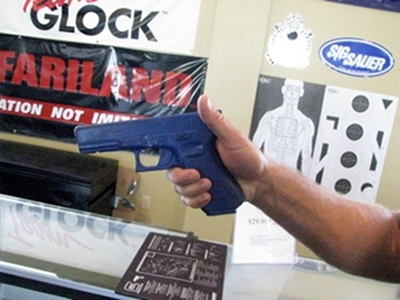
Mike showing how to hold the gun high on the gun’s grip with your gun hand.

2. Place your support hand (your non-dominant hand) so that it is pressed firmly against the exposed portion of the grip not covered by the gun hand. All four fingers of your support hand should be under the trigger guard with the index finger pressed hard underneath it. Here’s Mike demonstrating for us:
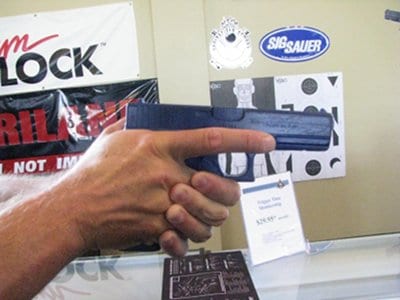
Fingers of support hand directly under the trigger guard. Notice Mike’s trigger finger is on the outside of the trigger guard. Safety first!

Like you did with your gun hand, you should place your support hand as high as possible on the grip with the thumb pointing forward, roughly below where the slide meets the frame. Look at the back of your hands. There should be a distinct fit, like the fit of a puzzle, with your gun and support hand, like so:
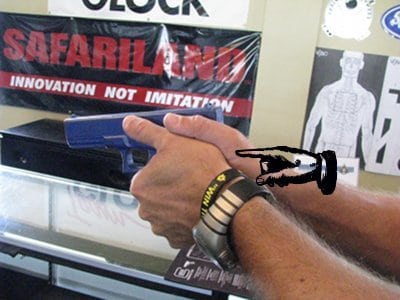
Notice how your hands fit together. Just like a puzzle.

Assume the Extended Shooting Position

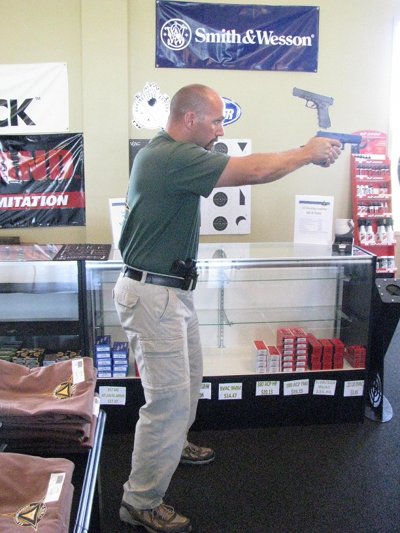
Stand with your feet and hips shoulder width apart. Bend your knees slightly. Mike calls it an “athletic stance.” It allows you to fire the weapon with stability and mobility. Raise the weapon toward your target. Here’s Mike showing us how it’s done:
How to Aim a Handgun

Use your dominant eye. You want to aim with your dominant eye. To figure out which of your eyes is the dominant one, perform a quick eye test by forming a one inch circle with your thumb and index finger. Hold the circle at arm’s length. Look at a distant object and look through your circle so that the object appears in the center of it.  Keeping both eyes open, bring your circle toward your face slowly. Your hand will naturally gravitate toward one eye. That’s your dominant eye.

Align your sights. Your handgun has a front sight and a rear sight notch. Aim at your target and align the top of the front sight so that it lines up with the top of the rear sight. There should also be equal amounts of empty space on both sides of the front sight.
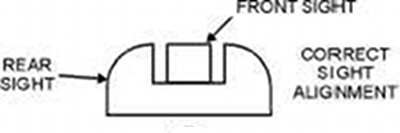
Proper sight alignment

Set your sight picture. The sight picture is the pattern of your gun’s sights in relation to your target. When you’re aiming a gun, you’re looking at three objects: the front sight, the rear sight, and your target. However, it’s not possible to focus simultaneously on all three objects. One of the objects will inevitably be blurry when you’re aiming. When you have a correct sight picture, your front and rear sight appears sharp and clear and your target appears to be a bit blurry. Like so:

Correct sight picture. The sights are in focus and the target is blurry.

According to Mike, the further away your target is, the greater the need for a clear focus on the front sight.

Trigger Management (aka Pulling the Trigger)

To fire a gun, we often use the popular phrase “pull the trigger.” However, to fire a gun properly, you don’t actually want to pull the trigger, but rather press it in a controlled fashion so you don’t disrupt your sights. Here’s a brief and very basic rundown on proper trigger control when firing a gun.

1. Press, don’t pull. Instead of pulling the trigger, press (or like my dad likes to say “squeeze”) the trigger straight to the rear. Apply constant, increasing reward pressure on the trigger until the weapon fires. Ensure that you’re only applying pressure to the front of the trigger and not the sides.

2. Take the slack out of the trigger. Squeeze the trigger to the point you start feeling resistance.

3. Surprise yourself. Keep pressing the trigger straight to the rear until the gun fires. Don’t anticipate when the gun will fire. You sort of want to surprise yourself as to when the gun actually discharges.

And there you go. Now you can go fire a gun at the gun range and look like you know what you’re doing. However, none of the information in this article can replace the instruction and supervision of a professional instructor. If you’ve never fired a gun before, we strongly suggest you visit a firing range and talk to an instructor who will walk you through the process.

Have any other tips for the first time shooter? Share them with us in the comments!

Editor’s note: This article is about how to fire a gun safely and correctly. It is not a debate about gun rights or whether guns are stupid or awesome. If you try bringing up that dead horse around here, your comment will be deleted. I will show no mercy. Keep it on topic, please.

_____________________________________________________________________________

Special thanks goes out to Mike and the crew at U.S. Shooting Academy for their help on this article. Mike along with the U.S. Shooting Academy Handgun Manual were the source of this article.   If you’re ever in the Tulsa area, stop by their facility. It’s top notch and the staff and trainers are friendly, knowledgeable, and super badass.
{ 126 comments… read them below or add one }

1 Tom August 31, 2010 at 9:36 pm

Good article. If I may expand on it:

http://video.google.com/videoplay?docid=-4584332856867071363#

This is a video of Todd Jarrett describing in 4 minutes how to shoot a pistol. One of the clearest explanations given on video for shooting a semi-auto pistol.

2 J Scott August 31, 2010 at 9:52 pm

Does that dude really have a gun in the front waistband of his pants? Does he consider his junk to be “downrange”?

3 BRZ August 31, 2010 at 9:56 pm

@ J Scott

He has a pistol in a holster in the front of his pants, yes.

This should bring out some awesome comments.

Good article Brett.

4 John August 31, 2010 at 9:57 pm

Some tips for your first time shooting:

1. Go with someone who knows what they’re doing, and who you trust. An instructor is best (even if they’re not instructing) because they’re trained to be aware of YOU and to focus on keeping you safe. Barring that, find somebody with lots of firearm experience but more importantly, can keep calm and worry you and the safety of everyone involved. I’ve seen a few men who take a new shooter out and are too interested in showing off to stay focused. The “mentor” MUST have the safety of the group in mind (without being rude about it) to keep the experience positive.

2. For your first time shooting, pick an easy gun to shoot. DO NOT make anything “magnum” your first gun. A .22 caliber rifle is perhaps the easiest to shoot, followed by .22 pistols (semi-auto will be easier [at first] than a revolver). After you’ve shot the .22 a bit, try a full-size pistol in a light caliber (9mm, maybe .45; ,38 for a revolver). Remember, a bigger gun means LESS recoil compared to a smaller gun in the same chambering. (My friend made this mistake. We went to a range with rentals, and he picked the smallest gun — a compact 9mm Glock — in the case, thinking it would be the easiest to shoot. He was surprised when my full-size .45 was easier to control.)

Now, I’m not saying that every new shooter is a wimp and can’t handle anything but peashooters. But there is a lot going on in your head when you pick up a firearm for the first time, and the last thing you want is more recoil than you expect, which can end up with the gun pointing in an unsafe direction. Once the experience is a little less new, and you’ve calmed down a bit, THEN try the things that say “magnum,” “express,” or what have you.

3. There are two things to keep in mind: safety, and fun. Stay safe, and shooting should be fun. (That’s the other reason to avoid difficult guns the first time . . . keep it fun. Eventually, once you feel more comfortable, they’ll be fun, too.)

4. If you want to keep at it, try a basic course. The NRA, whatever you think of them politically, has a great training program. Your local gun club probably offers basic courses on a regular basis. Hang around and see what people are shooting (and try out as much as possible) before tossing down the $300+ that a decent firearm can cost.

In conclusion, I invite everyone who reads this blog to try shooting at least once. Please do it SAFELY!

5 MD August 31, 2010 at 9:58 pm

I teach pistol safety classes, and when it comes to shooting stance, the easiest way for people to remember that “athletic stance” is to keep your shoulders over your toes.

6 Andy August 31, 2010 at 9:58 pm

If you look more closely, it’s in a holster, not the waistband. That’s perfectly safe–the only way the gun can fire is if the trigger is pulled( modern, well made guns do not “go off” by themselves), and the trigger is covered bty the holster.

7 Collin August 31, 2010 at 10:10 pm

You really covered it in the article. Which I loved, because I feel that EVERYONE should try shooting at least once. Of course, I feel everyone should try pretty much everything once (with a few exceptions. I don’t condone none of them fancy illegal drugs.)

8 Bill August 31, 2010 at 10:19 pm

My name is Bill, and I approve this post. good examples to show. Except that your thumbs need to be pointed at your target and remember to put your thumb in a position to easily reach the safety.

9 CA August 31, 2010 at 10:19 pm

When shooting a semi-automatic handgun, ALWAYS ensure that your hands are clear of the slide and its path of travel. If you do not you will receive some nasty cuts and bruises, and quickly end your shooting day.

10 Mike M. August 31, 2010 at 10:20 pm

John brought up several of my biggest pieces of advice. Start with a .22 – or a good air pistol. Forget playing macho games…shooting is about control. To shoot really well takes the fine motor skills of a neurosurgeon.

Dig up either a certified instructor or someone with serious competitive credentials – NRA Expert or the equivalent.

One thing about shooting – it’s the sort of sport you can be seriously competitive in in your 50s and 60s. There aren’t too many other sports that are true lifetime activities.

11 Spencer August 31, 2010 at 10:26 pm

Yet another good post. I think you should feature firearm skills more often. Aside from being dead useful, shooting is, to my mind, a truly manly art. I know there are a lot of people out there who would just say that I’m odd, backwards, and probably a sociopath for owning guns. Let them. I still maintain that there is nothing like the feeling of a good 1911 in the hand, or the thrill of lying on your belly in the dirt with the sharp smell of gun oil and burnt powder in your nose, watching a perfect shot hit a target at 500 yards.
Keep it up.

12 Jim August 31, 2010 at 10:26 pm

Take a really good look at his thumbs. I’ve shot rifles and shotguns alot, but the first time I shot a semi-automatic pistol, my left thumb crept up and on the 3rd or 4th round, the slide took a nice chunk out of it. I have the scar to prove it. Slow and careful is the fun way.

13 john August 31, 2010 at 10:36 pm

I am not sure if this is true with all guns but when i teach people how to shoot rifles I teach them to take a deep breath right before the start the process of shooting then I tell them to aim and let about half of their breath out then hold it (to help steady their sight picture) and then pull the trigger then let the rest out during the follow through since it only takes about two seconds to pull the trigger and after you pull the trigger keep the target in the sight picture until after it hits the target allowing the bullet to exit the barrel completely

14 J.D. Tuccille August 31, 2010 at 10:45 pm

This is a great piece. Shooting is not just “manly” in a macho way, but it’s important because it implies the assumption of responsibility for your own safety and the safety of your loved ones (a responsibility that women can assume too, of course — especially given the equalizer role of firearms).

15 Derek August 31, 2010 at 10:52 pm

The four cardinal rules also apply to rifles, including the BB rifles my son got to shoot at Cub Scout Camp. I’m just saying… don’t limit them to handguns.

16 Josh August 31, 2010 at 10:53 pm

Fantastic article. Too many people don’t understand firearms, and the more literate people are about them, the safer everyone is.
Having only shot rifles and shotguns I’m now curious about pistols.

17 Matt August 31, 2010 at 11:05 pm

Don’t get frustrated if you don’t see immediate results. Just like working out, you’re not going to be able to run a 10k or bench 200 lbs after just getting off the couch. I learned to shoot on shotguns and went round after round before finally hitting my first clay target. In Texas, the Concealed Handgun course has students shoot at 3, 7 and 15 yards. Start with your targets as close as possible, then when you feel comfortable with that, move it out a little farther.

If you’re a little uncomfortable around guns, taking it apart and seeing it’s just some metal pieces fit together to form a tool will demystify it from a deadly weapon.

And it can’t be said enough. Don’t go out and shoot a .44 mag because it’s Dirty Harry’s gun, and gosh darnit, you’re a manly man and can handle that kind of firepower! If I’d have learned to shoot rifles with a 30-06, the recoil would certainly have been unexpected and every time I’d pull that trigger I would have flinched and my shot would be off. There’s nothing unmanly about starting off with a .22 or 9 mm. If you feel comfortable with that after a while and get conditioned to shoot that correctly, feel free to jump up to something that makes bigger holes.

But finally and most importantly, invest in some good ear protection. There’s nothing manly about losing your hearing because you saved a few bucks with the cheapo ear muffs. Even .22′s are loud (145 dB, equivalent to a jet engine at 100′) and will cause hearing loss.

18 John S. August 31, 2010 at 11:07 pm

Great article! I’m glad you started with the safety rules – follow those four rules faithfully and it’s almost impossible to have a serious accident. Great advice (for the most part) by the commenters too. One note: If you can help it, don’t have a handgun be the first gun you shoot. When I teach shooting (I am not a professional instructor), I usually start a new shooter with long guns (rifles, shotguns, etc.) and then move them up gradually to handguns. The reasons for this are simple. Not only are long guns dramatically easier to control, they also are better for teaching basic safety. For example, very few new shooters will point a rifle directly at you – it’s heavy, and the length of the barrel is a reminder of where it’s pointed. On the other hand, in my experience almost all new shooters (and many experienced ones) will point a handgun directly at you without even noticing (repeatedly). Starting with rifles helps you build good safety habits before you move to harder firearms.

Finally, it’s hard to overemphasize the importance of having a skilled and experienced instructor when you’re first starting out. Having someone who knows their way around a firearm and who can correct you when you handle it in a way that is not safe (and believe me, you will) until you build up good habits is a lifesaver (literally).

19 Matt August 31, 2010 at 11:32 pm

They teach this in the army: BRASS. Breathe. Relax. Aim. Squeeze. Shoot.

20 Heather August 31, 2010 at 11:37 pm

I have a simpler way of determining your dominant eye. Instead of moving your arm back to your eye, just close one eye and then the other. With your dominant eye open, the circle you’ve made with your fingers won’t move, but the circle will move when you close your non-dominant eye.

Knowing your dominant eye is important for any kind of aiming or throwing. Many people assume they are right-eyed dominant when in fact they are left-eyed. Once they realize that, their aim improves.

21 Chuck September 1, 2010 at 12:00 am

I second a comment further up. The NRA pistol marksmanship course is a FANTASTIC way to get familiar with shooting pistols. It provides more structure than just going to the range to shoot at stuff, and will result in skills development rather than “just don’t hurt yourself” abilities.

22 Josh Crocker September 1, 2010 at 12:12 am

I was JUST about to blog on this very topic, but my favorite site (this one) beat me to it! Ahh bugger! Not to worry, you’ve done an excellent job on this one, and I actually learned a few things (like how to fix my two-handed grip on the pistol).

Thanks for sharing!

- Josh

23 Greg M September 1, 2010 at 1:51 am

I agree- proper ear protection is a must.
My father is an expert marksman having competed for many years in his youth.
He always had trouble hearing my sister and I while we were growing up, and now can hardly hear his grandchildren. Still a great shot, though!

24 Jeff September 1, 2010 at 2:37 am

Brett, EXCELLENT article covering the foundations. It is always great to hear people learn the sport, and you summed up the basics better than even some of my most experienced shooter friends or myself could have.

One thing that was overlooked was a good follow through after your ‘surprise’ trigger break. A shooter may have the urge to look downrange immediately after discharging the round to see if the round hit, but one should ride the trigger back for an efficient trigger reset and stay on that front sight.

It’s like prayer…I couldn’t explain to you how it works, but know through personal experience that it does.

25 Liam P Burke September 1, 2010 at 5:35 am

I have to say… I am glad to see that the people posting on this article are all compliments. I quit reading comments after the first gun post due to the absurdity of them. Lets just hope this one doesn’t make it around the community. The worthless bater group would shred and mock it.

26 Liam P Burke September 1, 2010 at 5:36 am

* Worthless Banter

27 Liam P Burke September 1, 2010 at 5:42 am

Also a tip on aiming… Don’t try to aim. When you are in the “ready” position with you finger along the side for “safety” use that finger to “point and shoot” The other way to train for that is tape a laser to your finger “aim” by pointing then turn on the laser to see if you are accurate.

28 Doc September 1, 2010 at 6:00 am

Excellent beginning article! Thank you. If I might recommend a small book that goes beyond this article and will be of value for EVERY shooter: Defensive Use of Firearms 2nd edition by Stephen P. Wenger. Published by Paladin Press. Outstanding little book. He adds a 5th rule, “Always maintain control of your firearm.” In this day and age that, too, is an important rule. Again, great article, keep up the good work!

29 Bevan September 1, 2010 at 7:40 am

Lots of good advice. I will also second the “start with a small caliber” comment. The key thing is to teach technique and safety first and make it fun. You load up a beginner with a hard to shoot or large recoil handgun and they will develop a distaste for the sport of handguns or at least the bad habit of the “flinch” that takes longer to train away. I have trained many a Newbie in handguns. You start sober and serious
about safety, then move to the operations of each handgun (the safety, the slide release, proper hold, reloading the weapon, clearing jams, and “making safe” before handing over the firearm) and then ease up into teaching stance, breathing, and posture.

30 The Counselor September 1, 2010 at 8:24 am

If you can use a gun that has a laser sight on it, this can help demonstrate the importance of proper breathing techniques for the beginner since he/she can see how much the barrel actually moves—just from the simple act of breathing—while it is being held. Good ear protection is also important, whether you’re shooting indoors or outside. It’s always louder in real life than in the movies. I also echo the “start with a small calibre” comment—once you’ve got the basic skills down you can start trying different types. I also agree with Matt that taking the gun apart (provided you can put it back together!) is a good way to demystify the firearm aura.

Great article!

31 John Sifferman September 1, 2010 at 8:54 am

You did the right thing – went shooting with someone who knows how to shoot. And I second the advice at the end of the article. Get professional instruction, and don’t think that reading a well-written, informative article makes you an expert in deadly weapons.

32 Brian E September 1, 2010 at 9:00 am

Well, all the pertinent stuff has been said and repeated, so I’ll just say thanks for a great article. I wish I had started shooting with a .22 instead of a .45. Then I wouldn’t have had to correct a flinch I quickly developed. Also, I’m glad the comments have all remained positive. Let’s hope they stay that way (fingers crossed).

33 Chris Elliott September 1, 2010 at 9:19 am

Great article, I’ve been to that academy and they know what they are doing. One thing I try to do and IMO wish others would do, is that if you buy your kids toy guns. Do them the favor of teaching them not put their finger in the trigger until they are ready to shoot. I know it sounds crazy but you would be shocked to see how many adults will keep their finger on the trigger while just holding a gun. Habits are easier not to start than to break.

34 Promethean Sky September 1, 2010 at 9:20 am

Weather or not you like or approve of the use of firearms, I believe that EVERYONE should be taught safe handling techniques. I would go so far as to suggest that safe handling should be taught in schools. Replace the ‘wow’ factor with “Wow, this could really hurt someone.”

35 Native Son September 1, 2010 at 9:52 am

ONE MAJOR SAFETY POINT MISSING FROM ARTICLE.
Shooting glasses and Ear protection are MUSTS!
I learned to shoot in the “cotton ball in the ear” days and my hearing hasn’t been the same since the early 1960s.Couple of minor points, to add to this nice introductory article.
1. When learning to shoot, you want a range with a VERY FUSSY RANGEMASTER. You won’t remember everything every time, and range safety rules do vary.

2. To be any good, you will need to practice. A lot. Not shooting hundreds of rounds a week, but consistently and well enough to be familiar with your firearm.

3. A Manly and practical reading suggestion: Read “The Old Man and The Boy” by Robert Ruark. Follow up with his “Horn of the Hunter” and “Use Enough Gun.” Good stories, but a LOT of firearms safety tips.

36 Shane September 1, 2010 at 9:54 am

WRT ear pro:

Plugs at a minimum, muffs are recommended. There have been recent studies that suggest ear plugs may not be enough. Hearing damage may still occur through bone conduction and ear muffs offer greater protection against that.

WRT technique:

Natural point of aim is where your body naturally points. Take aim. Close your eyes. Take a breath. Open your eyes. You should still be on target, if not, your stance is off. Adjust you not the gun.

Respiratory pause is where you want to shoot. Take aim. Take a breath. When you exhale you will hit the “bottom” and have a slight pause before inhaling. This is where you execute your trigger pull.

Trigger reset is performed as part of your follow through. After firing keep the trigger pulled to the rear and your sights on target. Release the trigger slowly and only enough to reset the trigger. You will hear and feel a click when this happens. It will help on follow on shots not just with speed, but with accuracy as well.

37 Jared September 1, 2010 at 10:05 am

I am greatly amazed at how in depth this post is. I agree completely with everything said in it. I’ve been in the Army for 9 years this month and they teach all these same principals. The only one they teach us that wasn’t covered is how to fix a malfunction. A malfunction entails any problem that occures when attempting to fire a round downrange. Most are a double feed (when two rounds try to go in the chamber at once), stovepipe (when the round is caught by the bolt and pushed up against the chamber), or a pop and no kick. We call it SPORTS (Slap the magazine upward to ensure a proper seat, Pull the charging handle or slide, Observe the chamber and clear any round or fouling, Release the charging handle or slide, Tap the forward assist or ensure the slide/bolt is properly seated in the full forward position and squeeze off another round while aiming in a proper and safe direction). Now in the case of a pop and no kick, DO NOT PREFORM SPORTS!!! The powder in the round burned but not enough to allow the bullet to let go of the casing. If you preform SPORTS the round could explode causing personal injury and we don’t want that. What do you do? Hold the weapon in a safe direction and have an instructor take over for you and He/She will fix the problem. If you are out alone, place the weapon on the ground with the barrel pointing in a safe direction and leave it for 30 min. As much as it sucks leaving your weapon 100 yards away for 30 min it is a better bet than getting yourself hurt. By this time it should be safe to eject the round and properly dispose of it. Don’t keep it as a momento or play with it, you will get yourself hurt.

38 Cameron T. September 1, 2010 at 10:14 am

As someone who is hearing impaired, let me further stress the importance of good ear protection. Often the head phones aren’t enough. Use the little foam earplugs AND the head phones. And don’t forget hearing protection if you’re not shooting but just at the range!

Also, I would like to see an article like this but geared toward rifles. I actually think a rifle would fit better with the tone of this site, being an older and somewhat more nostalgic weapon.

39 Todd Helmkamp September 1, 2010 at 10:19 am

I have to agree with Promethean Sky that its a good idea to learn about gun safety even if you don’t like guns.. Not too long ago, there was some idiot that lived near me who found an un-shot round in his yard. Worried that his kids would find it and get hurt, he decided to try to neutralize it by hitting it with…. a rock. Yeah, a rock.

Needless to say, it discharged and he shot himself in the stomach. With just basic knowledge about firearms, he could have avoided a lot of trouble.

40 CoffeeZombie September 1, 2010 at 10:30 am

Once when we were visiting my grandparents, my grandfather was showing us the revolver that he keeps in the pocket of his recliner in case he ever needs it. In this case, it had a hammer that was entirely inside the gun (so it couldn’t accidentally be pulled back and let go).

My brother’s girlfriend asked, “Does it have a safety?”, and my grandfather replied, “Sure; it won’t shoot unless you pull the trigger.” :-D

Another thing to consider in regards to the “start them on a low caliber” suggestion is the trigger pull weight (I think that’s what it’s called; how hard you have to squeeze to move the trigger).

In the few times I’ve been to the range, I’ve shot a revolver or two (double- and single-action modes) and semi-autos, and I’ve noticed a major difference in accuracy. My best accuracy has been with the semi-autos (which were lower caliber–9mm–, which helped), but the single-action mode on the revolver (shooting .38 Specials) gave me better accuracy than double-action, because of the trigger pull (in single-action mode, it felt like a hair trigger).

I believe the reason for this is the anticipation of the shot; in double-action mode, I tend to have more opportunity to anticipate the shot than in singe-action, and so I subconsciously move my aim down in a misguided attempt to compensate for the recoil.

On the other hand, the instructor in the NRA class I took (with my wife and parents) suggested I should focus on shooting the revolver in double-action mode to better learn to control it.

Another thing I learned in the class was that the only reason you should ever need to “rack” (that is, pulling back the sliding part on the top and letting it go) the gun is when you first insert a new magazine and there’s no round loaded in the chamber, since the purpose of the slide is to 1) eject the cartridge currently in the chamber and 2) load the next cartridge. If you rack the gun with an unspent cartridge loaded, you’re only wasting ammo.

One last comment, regarding gun safety; if you own/carry a gun, you better be 1) able to shoot it, and 2) willing to shoot it. No matter how good a shot you are on the range, if you’re not willing to use the gun in a self-defense situation, it becomes a liability for you and your family.

41 Jack September 1, 2010 at 10:47 am

2 things…

The shooter’s right hand is gripping way too high. The web of his hand will get cut (or as others have put it – bitten by the slide).

Second – Even if the shooter had the pistol in a holster, it is an absolutely unacceptable method of carrying the pistol in front and over your crotch.

Otherwise – good article.

42 Brucifer September 1, 2010 at 11:03 am

And the next thing chaps, is to see to it that the woman/women in your life also learn how to shoot. This does two things. One, it helps them provide for their own defense. And secondarily, it will quickly remove them from the ranks of the rabid anti-gun crowd seeking to take away our firearms rights.

A world of caution though. You, as the BF/Husband are not *necessarily* the one who should teach her. As noted above by John, there is often ego attached. I’ve seen too many men trying to “teach” females by doing such things as showing-off their own supposed prowess. Or worse, handing the female a weapon too powerful for her to handle (at first) so they can laugh at her reaction to the recoil. Bad show.

A BF/Husband often also makes the mistake of buying their lady what is sometimes considered a “lady’s gun”; a small, light snub-nose or other sometimes called ‘mouse-gun.’ While good for concealment, these however, are not the best instruments for anyone to learn to shoot with.

Also, one must prepare for the ‘worst’ …. she becomes a better shot than YOU!

I’m frankly quite proud of the fact that each of the women I have ever taught has proved to be a competent shooter, … quite often a better shot than I.

43 Enigmaingr September 1, 2010 at 11:43 am

Post 13 covered it but I just wanted to emphasize proper breathing. I was an MP in the active duty Army for 5 years so I’ve had the chance to shoot a time or two. Once you get in a good stance and grip (as shown), look for that “Easy E” (sight picture). Align the trigger with the meaty part of your right index finger (NOT the first joint crack like a lot of people mistakenly do – this will cause what is known as trigger pull and throw off your aim). Ideally, you want to take in the slack of the trigger as you are exhaling; You should fire when your diaphragm is at its most relaxed state.

Also, good tip by one of the posters about watching where you place the thumb of your left hand. You don’t want your thumb in the way of the slide unless you want a piece of thinly-sliced thumb meat. It’s sharp and moves quickly and yes, I’ve seen it happen.

If the above techniques fail, or you find yourself in a clash with a rival gang, just take the pistol in your right hand, cock it to the side, and fire. You’ll hit something – probably an innocent person – and you’ll look cool doing it.

44 ZZ September 1, 2010 at 1:25 pm

Ohhh, OK, so you’re saying that we SHOULDN’T hold it sideways and repeatedly jerk the trigger back while grimacing threateningly and shouting “Die Scumbag”?

No WONDER I never hit anything! Thanks…

45 Michael Moore September 1, 2010 at 1:40 pm

“Weather or not you like or approve of the use of firearms, I believe that EVERYONE should be taught safe handling techniques. I would go so far as to suggest that safe handling should be taught in schools.”

I had hunter’s safety training in class and went shotgun and rifle shooting with my 6th grade class. We also got days off for deer season since so many kids would skip to go with their families anyways. This was in Upper Michigan, about 1993 at a public school.

Growing up, I assumed that’s what all schools did. :-)

46 R J Vincent September 1, 2010 at 3:41 pm

Great posting. I’ve always wanted to learn to shoot a gun. Only time I ever did was on a shooting range back in the mid-60′s at a YMCA camp(!) on a family vacation. I did okay. Once I can afford it and get in a little better shape, I plan to learn how to shoot. I’ve picked up some of what’s mentioned from friends who were in the military but never had the chance to get to a range for any instruction. Looking forward to it.

47 Hondo September 1, 2010 at 4:51 pm

If you’re left handed be sure your eyes are protected since they spent casing will eject straight at your face on many occassions. Best thing to do is learn to shoot right handed if possible.

48 John September 1, 2010 at 6:36 pm

A great post, Brett! The fundamentals are important for the novice and veteran alike. As Kyle Defoor of TigerSwan says, “There is no such thing as ‘advanced tactical skills’ – there is only perfect execution of the fundamentals under stress.”

49 Brian September 1, 2010 at 7:16 pm

I often advise people, if possible, to learn safe gun-handling skills on a rifle or shotgun before moving on to handguns. The longer firearms (the stock and the longer barrel) are much more manageable, and the direction it’s pointed is obvious. Once a bit of skill and confidence is gained (.22′s are perfect) a handgun becomes much less scary to a first-timer.

50 Mark P September 1, 2010 at 7:18 pm

A lot of friends ask me to teach them to shoot or how to do it correctly. Now I’ll just send them a link to this page. Great article.

51 Bill Jeffreys September 1, 2010 at 7:50 pm

Very good article. The only thing I would add is, on your grip, the thumbs should point towards the target as well. You can also get some dummy rounds and practice pulling the trigger without moving the sight picture when the hammer falls.

52 Steve Gerl September 1, 2010 at 11:50 pm

Mike Seeklander was on Top Shot, and anyone on that show is a boss. Great article!

53 Moriarty September 2, 2010 at 2:41 am

Second – Even if the shooter had the pistol in a holster, it is an absolutely unacceptable method of carrying the pistol in front and over your crotch.

Sigh.

54 Manuel September 2, 2010 at 4:45 am

Important advices here. A collegue of mine nearly got shot at work because of misuse. If your gun is tuck just get the charger out and pull the sleeve backwards. You’re set.

55 Michael T September 2, 2010 at 10:54 am

When I learned about guns, back when it was still “cool” to smoke a butt, drink a beer, and go hunting for anything that moved *shudder*. I learned a simpler way of remembering that first rule. (Which *IS* the most important.)

“There is *no such thing* as an unloaded gun.”

56 JG September 2, 2010 at 11:37 am

Good article. Shooting can be fun when it is done safely.

57 Bryan Schatz September 2, 2010 at 12:55 pm

This came right in time. I’m on my way to the Watsonville shooting range today for the first time… I don’t think I’ve ever even held a gun.

58 steve September 2, 2010 at 2:09 pm

great article!

did anyone else try the dominant eye test (the way brett suggested, and the way heather suggested in the comments) and find that their dominant eye changed depending on which hand they used to make the circle?

59 Promethean Sky September 2, 2010 at 3:06 pm

Absolutely. My dominant eye seems to be opposite of which hand I use for the circle. Though I seemed to have more visual overlapping when I used my left hand, which would mean overall that my left eye is stronger.

60 Canadian A September 2, 2010 at 3:38 pm

Great article.

Writing from Canada, where pistols are quite restricted, I’d like to add some comments:

– Buy a semi-auto CO2 pistol from Wal-Mart first and practice with it. It’s cheap, un-restricted, not loud at all, and exactly the same moulds are used in producing many of the new ones. Great fun and you can shoot it in your basement.

– Once you’ve shot several hundred comfortable shots out of the air pistol, go to a rental range and bust out the Glock. Doesn’t cost much and allows you to go all Rambo without the hassle. If you’re good on an air pistol, you’ll be good on a Glock; the 9mm has almost no kick and is a riot to shoot. Not terrifying at all after the first couple rounds.

– Read the sniper manual put out by Paladin Press. If you’re training in shooting people (which with a pistol you’re generally doing), you might as well learn where to shoot them.

– Then, in my opinion, buy a shorty shotgun. At least you can use it in bear country, and it’s probably safer overall then any pistol would ever be in a defense situation. Far more stopping power, far less danger of over penetration, far easier to aim, and usually way less paperwork. However, I can really see a use for a pistol in a car console — but you haven’t been able to do that here since the 70′s.

61 Joe September 2, 2010 at 4:56 pm

Great article! I’m retired Army so I spent a lot of time at the range with a variety of weapons. My wife is also ex-Army and can handle a gun as well as I can. When my sons were of the appropriate age, I taught them both the safe and correct way of handling a firearm.

One more rule you should add (even though this goes without saying): Alcohol and firearms do not mix. Ever!

62 Rich Saunders September 2, 2010 at 5:05 pm

Real men don’t use guns. Anyone knows that. Leave it to the soldiers and police.

63 marko September 2, 2010 at 7:43 pm

Keep repeating to yourself, “Focus on the front sight.” Your front sight should be crystal clear, but your rear sight may be a little blurry.

64 Patrick September 2, 2010 at 7:57 pm

@Rich, real men makes those decisions for themselves.

65 rogerthat September 3, 2010 at 1:10 am

@Rich: soldiers and police aren’t real men?

66 Gene September 3, 2010 at 1:39 am

I don’t remember where, but I saw an article where someone lost the end of their thumb when they griped a revolver so that their thumb was in line with the front of the cylinder. Hot gases escape under very high pressure there, and the large caliber revolver put out enough force when it discharged to cut off his thumb. I hadn’t heard of this before but have since kept it in mind when shooting revolvers. If true this is something to be aware of. Anyone else heard of this?

67 tionico September 3, 2010 at 1:44 am

Great article, great comments. A couple of things…. I used to think holding my breath at the TOP, or stopping at the MIDDLE, was good… until I attended an Appleseed weekend shoot. They teach to fire at the BOTTOM of your breath, the “respiratory pause”. Far more predictable. Once I learned this, and the “natural point of aim”, suddenly my accuracy improved dramatically. Five inch groups are now one inch, consistently. Any position. I HIGHLY recommend the Appleseed program.. long guns only, but the basic techniques apply to ALL firearms. Non-profit organisation.. appleseedproject dot org.

I’ll also second the statement that EVERY gun is loaded is one step closer to no accidents. Treating it “as if” it is is not quite as drastic.
Smallbore to start is also great…. shooting is shooting. ALL weapons have a trigger, all say BANG, all are deadly, all take skill and practice of proper technique to shoot well.

the best way I’ve learned to determine your dominant eye is to put the hole in a sheet of white paper, then look at some distant object whilst bringing the paper toward your eye. Use both hands to hold the paper to avoid bias. It will inerrantly and repeatedly come to your dominant eye.
In helping the Ladies learn, and find a handgun well suited for them, let THEM try a number of options, do NOT pressure for a given choice. You have no idea how that thing feels in HER hand. She does. So many times I’ve known of women to get entirely put off of firearms by someone putting THEIR preferences upon them. Don’t. Take her to a large gunstore with a not of options on offer, have her handle, heft, feel, play with, a lot of options. Don’;t buy anything yet. Then, have her try some of the ones she felt most comfortable with in live fire. Borrow, find a rental range, whatever it takes. Make sure SHE can try a number of options, and let HER decide. I’d not even let her know what costs what…. it MUST fit her well and intuitively “work” for HER, else she will fight the thing and not learn proper control, and certainly won’t carry it with a mind to actually USE it if the need arises.

68 JMAN September 3, 2010 at 3:08 am

YES! Finally a primer where they show the tried-and-true method for firing a handgun: arms forming isosceles triangle, support hand molded against the knuckles of the firing hand, forward stance. So many people are getting into shooting using convoluted grips and stances that they saw somewhere that they never learn the fundamental methods that are shown here and used by military and law enforcement as basic knowledge. Personally, I clamp down the thumbs to the side, but I have seen many people point the thumbs off of the frame, so that obviously is preferential for a lot of people. Also very good that the author mentions trigger control as proper trigger control can mean the difference between hitting the target and missing it completely (and an extremely easy mistake to make).

I would suggest investing in snap caps myself to alleviate uneasiness around recoil and set good habits in place so that people don’t push the gun in one direction or another because they want to counteract recoil or blink from anticipating the blast or just pull the trigger to “get the shot over with”. I’m skeptical about the “surprise yourself” method though. In my experience I don’t flinch when I’m taking a long, measured shot. But when I try to let it surprise me almost without fail I start flinching. I guess it’s different for different people

69 Just a Firearms Instructor September 3, 2010 at 3:49 am

Things that should have been mentioned…More grip contact w/ firearm = more control. Also, the more stable the shooting platform( benchrest, prone), the more control. And follow through (getting your sights right back on target) was not addressed. Golf, Baseball, Hockey, Basketball all have follow through, and so does shooting…

70 Mul September 3, 2010 at 6:22 am

Is anyone going to mention that Mike Seeklander was on Season 1 of Top Shot on the History Channel? He was the first contestant retired.

71 Martin Fox September 3, 2010 at 7:10 am

Don’t buy that “be surprised” stuff. I always strive to know exactly when a firearm will shoot. The gun is always moving, ask any paper punching target shooter. I don’t want a surprise when a shot goes off somewhere beyond the 5 ring.

72 JdL September 3, 2010 at 8:50 am

I have a question about absorbing recoil. I’ve had good success holding my wrists more rigid than my elbows, so that most of the recoil is absorbed by the elbows. Does this jibe with what is considered best practice?

73 David C. September 3, 2010 at 9:17 am

Great Article! In case anyone reads this far down:
1) search around to find a pistol or rifle club you can visit. MOST of the time such clubs are full of very nice, middle-class people (men AND women) who are all smiles and willing to share their sport with all comers (my club [ http://www.pinetreepistolclub.com/index.asp ]also has a “basic pistol” class for beginners where typical classes are 40% female).
2) Try to learn with easy-to-shoot firearms. I’ve been shooting for 30 years and am a much better shot with a 1911 (my preference is the rarer, lighter-recoiling 9mm version) than with a Glock because the trigger of the former is much easier to manage for me.
3) Be patient. My sons were amazed, when they were first taken to the range, how difficult it is to shoot a pistol accurately. Everyone watches TV and movies and thinks it’s easy stuff. Shooting a pistol well is a lot like playing basketball well. Nobody excels at first, but getting better is fun.
4) To see if you are jerking the trigger or flinching, have your “teacher” set up the gun with an empty chamber a few times. If the gun moves drastically when you press the trigger, expecting it to fire, and it’s actually not loaded (but you did not know that), then you are anticipating the recoil and will need to “dry fire” (i.e. without the gun being loaded) while holding it steady to try to get yourself out of that habit. This is a good exercise for all but the most expert of all shooters because we all can develop “shot anticipation” movement in our hands.

74 David C. September 3, 2010 at 9:33 am

@Gene,
The “lost a thumb” story may be apocryphal but it is true that hot propellant gases escape on a revolver at the cylinder gap (the front of the cylinder where the bullet jumps from the chamber in the cylinder into the barrel) under very high pressure. The only way you’d get your hand near that is if your support hand is NOT wrapped around the grip with your firing hand, but is instead cradling the gun in front of the trigger guard. Holding a revolver this way would be a very bad idea.

As a side-note, guns have both recoil (physical movement opposite the direction the bullet flies) and blast (more than just noise, it is a physical shockwave spreading out from the end of the barrel after the bullet leaves it. In general, the higher the pressure, the more blast and pressures vary widely between calibers of gun. 357 mag revolvers are very “blasty,” almost worse than the larger magnums, and lots of people find shooting “blasty” guns (or being on the range near someone who is shooting one) a bit punishing, especially at an indoor range. Lower recoil, lower “blast” calibers include .22LR, 38 Special, and 9mm Luger. 45ACP is a bit more recoil but being a low pressure round, not real “blasty.” Steer clear of little guns in 32ACP and 380ACP because they are often particularly difficult to shoot well and many specimens exhibit poor target accuracy (they’re mostly meant for very-short-range defense).

75 Talbot September 3, 2010 at 10:26 am

Just one comment – I’ve been very hesitant instructing new shooters with Glocks – they not for the inexperienced IMHO. The trigger is atypical and there is no safety. The flat top is dis-similar to most other handguns as well.
Disclaimer – I carry a Glock -but I’m very aware of it and use holsters that hide the trigger. The flat top of the weapon is to me, very helpful,but has made it difficult to shoot revolvers – I ended up selling my .357. That said, I love my Glock and it remains the item I’d most like to send back in time to my younger self.
Talbot

76 Moriarty September 3, 2010 at 11:06 am

@Martin Fox,

I believe the author is trying to describe the “compressed <a href="Visit W3Schools “>surprise break” of the Modern Technique.

@Gene
No, it won’t blow your thumb off, but it will scorch a hole right through clothing should you rest the cylinder gap against it when firing. (Google “creedmoor pistol position”)

77 CoffeeZombie September 3, 2010 at 11:52 am

@Gene Generally, I think what other posters are saying is correct, that the revolver is held like a semi-automatic and this should prevent anything like what you’ve mentioned, it’s been a while since I’ve been to the range, but I *think* there might have been a slight variation on how you’d hold a revolver vs. a semi-auto.

On a related note, I’ve also seen revolvers with a short grip that makes a two-handed hold like what is described in the article impractical. In such a case, you should hold the revolver in your right hand like normal, and the left hand grips the bottom of the grip/your right hand with the palm up. You *can*, IIRC, hold a revolver with a normal grip this way as well, but *never* hold a semi-automatic this way. There is, or so I’ve been told, the possibility thay a misfire or other malfunction can cause the magazine to be blown out of the gun, and having your hand in the way in that case would be…very bad.

78 Garry Reed September 3, 2010 at 12:25 pm

When I was first learning how to shoot a handgun, under professional tutelage, all my shots were hitting low and left of where I was aiming. Even with my instructor’s help I just wasn’t getting it. Then one day I saw a TV show where one woman was teaching another how to shoot a handgun (in an enclosed bunker without eye or ear protection – that’s Hollywood for you) the teacher kept saying “your trigger finger must work independently from all of your other fingers.” And that’s when I finally got it. As I pulled (squeezed) the trigger I had also been “gripping” the trigger just like my other 9 fingers, and my dominate hand kept pushing my shots down and left. Once I gripped only with 9 fingers and relaxed my trigger finger so that only it moved (working independently) I began hitting my target. It’s one of those things that is apparently so obvious to a pro that the pro forgets to mention, or stress, it.

79 Shadowex3 September 3, 2010 at 5:54 pm

Regarding the thumb story (and the article’s grip), his thumb was NOT removed but he DID blast off a significant amount of meat and nail from at least half of his thumb… a three second google search for “revolver thumb” can bring back all the gorey details (including pictures). I’ll spare everyone’s appetite and not link directly to anything.

A good grip is a nice high and tight grip with proper off-hand position… but it really is important to emphasize to new shooters that the slide of a semiautomatic WILL treat their hand like deli slicer treats sandwich meat if they get in its way.

80 Aaron September 3, 2010 at 11:19 pm

one techniqe ussa has terribly wrong is the way they have you find your dominant eye you can easily get the wrong results by making a circle with your index finger and thumb since you don’t block enough peripheral vision outside the circle your dominant eye will be end up being the one you happen to circle the object with and line up with. You need to focus on a small distant object and bring your flat, open hands in from the sides gradually blocking surrounding objects untill all you can see between your two hands, in the small diamond shape between thumb pockets is the object focused on. Then slowly bring your hands toward your face to find which eye is dominantly focused on the distant object.

81 CW September 4, 2010 at 10:22 am

The Grip:

Believe it or not, many people do not think about how to grip a handgun. For an auto pistol especially, the grip makes a big difference and with your fingers resting one on top of the other aling the slide, is not in my opinion the best method.

I choose to use the “modified” Weaver Stance, others prefer the Isralie method called the Isosceles. I’ve been taught both and still prefer the Weaver Stance and grip position,

The Modified Weaver as the name implies is a modified version of the original Weaver. The stance is related to the Weaver and may be a better alternative for most people. In this stance, the body is held identically to the Weaver (at a 45-degree angle to the target with your dominant hand and foot back), but the gun hand is locked out at the elbow straight as if you where to point your finger at the target. Thus reduces trembling, and allows most people to maintain a steadier hold than the traditional Weaver.

82 gunbunny September 4, 2010 at 3:06 pm

My 2 safety tips:

1) “The gun is always shooting.” — my rifle coach in high school. Right now, my guns are shooting holes in their cases, through the wall of my house, and into the air.

2) “Keep your booger hook of the bang switch until you’re ready to shoot to kill.” — my USMC Drill Instructor, Parris Island, SC. Doesn’t matter if you’re killing paper, pop cans, deer, or bad guys, the rule still applies.

oh, and @Rich (#62): Real men know how to respect the comment rules as posted by the author of the piece.

83 TK September 4, 2010 at 3:19 pm

DOOD, I LIVE IN TULSA, OK. Nobody ever talks about that place, like it doesnt exist but it truly does. Thank you for making that happen. Oh and great writeup, will definitely check the place out.

84 Josh September 5, 2010 at 9:44 am

“2 things…

The shooter’s right hand is gripping way too high. The web of his hand will get cut (or as others have put it – bitten by the slide).

Second – Even if the shooter had the pistol in a holster, it is an absolutely unacceptable method of carrying the pistol in front and over your crotch.”

@ Jack – I carry either a glock 27 or a smith and wesson 642, in front and over my crotch, about 345 days a year. It’s perfectly acceptable because it’s my gun, and my crotch.

85 Jim September 5, 2010 at 9:36 pm

Great post. Always like to see new people trying shooting and learning basic firearms safety. For those asking about revolvers and grips; the grip for a revolver is nearly identical to that presented in the article with the exception that you cross your thumbs. The thumb on your supporting hand goes over the thumb on your dominant hand. I’ve always preferred wheel guns. Keep up the great work Brett.

86 P.M.Lawrence September 6, 2010 at 4:53 am

The version of treating every gun as loaded that I heard was “more people have been accidentally shot by unloaded guns than by any other kind”.

Also, some guns have magazines on top or under the barrel and eject downwards, which would affect the allowable grip. Some are even pistols, like the one Calico offers/offered (I’m not sure if they still do).

87 Jordan M. Poss September 6, 2010 at 10:45 am

Excellent article. Gun safety seems to be a lost art, even among gun owners. I’m always astonished when I go to the range and see people swinging rifles, pistols, and shotguns all over the place with no regard for what they’re pointing at and whether the weapon is loaded. I’ve had friends and members of my family killed because of careless gun-handling.

88 John C September 7, 2010 at 9:43 am

A well written article..simple and to the point.

I would like to add to the comments on introducing others to shooting. PLEASE make it a SAFE, fun and non-threatening experience. Women are the easiest to teach, and, IMHO, are better shots…better fine motor skills? My wife thinks the Y gene interferes with hearing. :-) Being patient, confident and professional is paramount. Don’t “show off.” Make the event about them and not about you. Remember, every person that sees firearms in a more positive light may be one less vote for the opposition-to-liberty crowd.

For JdL, I didn’t see an answer to your question regarding “absorbing recoil.” Both wrists and elbows should be “locked” so that the firearm recoils against a solid line of bone. Any “limp wrist” or “limp elbow” can potentially cause a semi-auto to fail to cycle properly.

89 ThomsonsPier September 8, 2010 at 6:51 am

This is a very interesting article. A query: my dominant eye is short sighted: my other is not. What is the correct procedure here, other than wearing corrective lenses?

90 Willy Wonka September 8, 2010 at 7:40 pm

First time I fired a gun an experienced shooter next to me and my friend showed us a little trick at getting over anticipating the kick of the gun when firing. Without me looking, he loaded a few rounds into the barrel (this only works for revolvers obviously) but he didn’t say or show us where there were any rounds and where there weren’t any. When finished loading, he handed me the gun and then I went to aim and fire at my target. Funny enough, I immediately anticipated the kick with my first shot, jerked the gun, but there was no round loaded. This of course would have caused me to miss my target had there been a round loaded there. So it made this learning experience not only fun but a great way to get over anticipating the kick and really focusing on keeping steady and still with your aim. To no surprise, later on during our session while doing this repeatedly, whenever a live round was in the barrel, my shots were tightening up on my targets!

91 Jenkins September 9, 2010 at 4:34 pm

I would say that every man ought to know how to handle a gun safely, even the ones who have consciously decided not to have anything to do with guns. On top of that you should teach your children as well.

You never know when you or your child will encounter a firearm. Having nothing to do with firearms ever, means you won’t be prepared to handle the situation when it arises. You should know firearm safety and teach it to your children.

92 Mike September 10, 2010 at 4:46 pm

It is good advise not to start shooting with too big of a round.

For my first time shooting I went with a S & W .357 Magnum.

I’m a bigger dude, 6′ 1” 245lbs, so I figured I could handle it. I considered the advice from others and online talk about how powerful they are before deciding, I had to see for myself.

People around me at the range where using 9mm’s and 45s probably and since it was my first time shooting I was a bit nervous. The power from those handguns made me wince a bit each time someone fired a shot. Eventually I tuned them out so I could concentrate.

When I fired the first magnum round, I freaked out! The force just threw the other end of the barrel where ever it wanted to go.

Now It’s hard to get me excited, but shooting that gun gave me an amazing rush of, not quite fear, but definitely a heightened instinct of danger and alertness saying,
“You should NOT mess with this thing.”
The sonic wave blasting from that thing was felt in the core of my being. You will KNOW if someone has fired a magnum.

At the same time an epiphany rushed over me with that first shot. I understood in that instant of what guns can do. I was enlightened to what a gun was beyond anything that video games, government policy, hearing of gang shootings, or pellet/BB gun practice could allow.

Anyone who has not fired a gun cannot have an intuitive understanding of why you DO NOT point them at anything you don’t want destroyed.

Each time I knew I was firing a magnum round I cringed before firing, I just couldn’t help it.
I knew to try and relax, but I still anticipated it. I tried 38 specials to calm myself a little, they helped.
I think I actually prefer them. It’s better to be able to hit a target with less powerful rounds than to miss with a single shot from a show-stopper.

I couldn’t wait to be done shooting that box of magnum rounds. But now I can’t wait do it again! Definitely keep your magnum rounds separate from your 38 specials. It’s not a pleasant surprise to fire one when you are expecting a 38 special.

One thing though about starting with a magnum size round is most hand guns recoil won’t bother as much while moving down the scale of power.

One thing to watch out for is the blast that comes out the sides of a revolver due to space between the cylinder (where the bullets are) and the barrel (where they fly from) not the most comfortable experience when that stings the back of your hands and is right in your face.

To summarize, shooting a magnum is comparable to launching a metal ball bearing through a 6 inch metal pipe using an M80. Keep in mind you are doing it all while trying to relax and hit something accurately despite knowing an explosion is about to happen a foot from your face.
Manly?
A sport?
Heck yes it is!

93 Steve Fabert September 14, 2010 at 9:26 am

I am surprised at the tone of some of the critical comments. I thought the purpose of this website was to recapture important aspects of the lost art of manliness. This is not a matter of Wild West versus the rest of the world. It is a proper discussion of a useful practice that once was practiced by most young men.

The carrying and use of handguns is a lost art in Europe. A century ago it was common and routine for European gentlemen to have a pistol or revolver in their pocket, their luggage, or their automobile. The practice was erased by the same forces that exterminated most of the young men who held traditionally masculine values. Most of the masculine fellows died in the world wars.

If you believe that only the police need to know how to protect you and your family, good luck to you. All of the women and children with whom I am acquainted value the services of their men as personal bodyguards. Just as you can rely on the garage to change the oil in your car, or you can do it yourself, you can pay the public servants to do it for you, or take pride in being able to defend yourself and your family.

For those who are enamored of statistics, I recommend looking into the dangerous nature of bicycles. Many more children are maimed or killed using bicycles than are harmed by accidental exposure to handguns. http://www.cpsc.gov/cpscpub/pubs/344.pdf

94 Bob September 14, 2010 at 6:29 pm

I just taught a new person to shoot. It was an item I auctioned off at a school fundraiser. Some additional tips:

1. Sit down alone with the new shooter AWAY from the range in a quiet location where you can go over the fundamentals of safety and operation of the guns to shoot. You won’t be able to hold an effective lecture/demo time with muffs on and guns going off next to you. Do not load ammo into the gun off the range!

2. It takes practice to put ear plugs in properly. I find it helps to reach behind your head and pull up on your ear, to straighten the ear canal. Then you insert the compressed plug, hold it in, and let it expand. If done properly, you should hear the noise level decrease dramatically.

3. Plugs AND muffs are highly recommended, especially at indoor ranges.

4. For the first target, use a paper grocery bag. if needed, tape it to the bigger target. If the new user can keep the rounds on the paper bag, that is fine for a new shooter. Many folks think they failed if they don’t hit the center of the target, but this is not realistic for a new shooter.

5. Best starter guns are mid-size revolvers or target/plinking guns in 22LR, like Browning Buckmark. Larger guns in small-medium calibers have very little recoil. Worst are small guns in large calibers. I have a bug 38/357 with a heavy 6″ barrel. It is great with 38′s. I also have an aluminum-frame 2″ snubbie, which is uncomfortable to shoot; I don’t let newbies use it.

I’ll be ordering the Art of Manliness book for me and my son.

95 John Can September 16, 2010 at 10:29 pm

An old range safety officer advised me and my buddies to never use the safety switch on a gun. “More people have been accidently killed by safeties than any other feature of a firearm,” he said. He was adamant that it only lends a false sense of security, and that you’re better off just being more careful and confident with guns.

96 Aaron G September 17, 2010 at 3:14 am

Thank you for the excellent tips.

I am looking to buy my first gun very soon. I have not decided on what exactly yet, but I have decided it would be a semi-auto handgun. I have friends in law enforcement, so I am hoping to get some pointers from them. I will of course take a gun safety course (as required by my state law). I am not unfamiliar with firearms, but my interest was always casual if not apathetic. I suppose I even might have had a less than favorable opinion how gun ownership is often portrayed and/or marketed. Now that I am older, and personally know level headed and responsible gun owners my opinions have changed. This will be the first gun I personally own. I am no longer hesitant to embrace a part of my culture I often overlooked.

I am not trying to be political about this, so please understand my meaning.
I feel like I am somehow re-connecting to a tradition I have largely missed out on; one reaching way back to my countries earliest stirrings. This week was “Constitution Week”, so I am more reflective on these topics than I usually am. I started carrying a copy with me, and I have been reading it. Although not the best narrative ever written, I am consistently surprised how I am affected by what is actually in there.

I appreciate the article, and the tone in which it was written. Informative, on topic, and free from excessive macho nonsense. I am looking forward to reading many more articles on the subject and putting a few downrange myself.

97 dirtyWarrior September 17, 2010 at 11:50 am

If you haven’t fired a gun your whole life, you’re not really a man yet.

98 William Miller September 19, 2010 at 10:53 am

Long time reader, first post.

I feel compelled to point out a few things I noticed in this article. First let me say, reading about firing a gun and actually pulling the trigger are two different things. I just Stephen Hunter’s I, Sniper, that doesn’t mean I’m Bob Lee Swagger. You need personal instruction, by a qualified professional to handle a firearm propperly.

Second, the grip used in the article has some fundamental flaws. The shooter, I think his name was Mike, He’s going to lose a lot of skin off his thumbs shooting with his digits riding the slide. Not only is it bad for your thumbs but it creates drag on the slid and you will end up with a lot of stovepipes. For anyone who doesn’t know what a stovepipe is, that’s when the shell gets caught by the slide sticking stright up and leaking smoke, like a stovepipe. The thumb of your left hand, the support hand, should be together with your fingers under the trigger guard. That leaves room for the thumb of your right hand, shooter’s hand, to sit just beneath the slide.

Side Note: The slide is the part of the weapon that will slide back allowing the shell casing to be ejected from the weapon.

The second thing I noticed was that Mike has a pistol shoved down the front of his trousers. That, more than anything, is what tipped me off to amature hour. Mike should not be teachign anyone how to handle firearms. He needs to take some classes on the subject himself.

Never, ever, ever, put a gun down the front of your pants. You are not Wyatt Earp! This is not the wild west. Buy a holster! If a gun goes off in the front of your pants you are going to lose the family jewels. If you have a holster that tucks inside the waistband, put it at the back of your pants. Much better to take a round through the glutes than to get the wedding tackle shot off. This all falls under the heading of REALLY common sense.

I come from a long line of gun owners. If my father ever saw me with a gun stuck in the front of my trousers, he’d have punched my face in! Not literally, but he’d have given me an ear full and more.

99 Jasanna September 20, 2010 at 12:51 pm

This was awesome to learn, as I’ve never shot either. Not against guns, I’ve just never had the opportunity. They are way too strict about guns here in california…

http://www.etsy.com/shop/SoliloquyShoppe

100 Jason Poppenger September 22, 2012 at 7:23 pm

Great article on the basic fundamentals of hangun manipulation.

A couple of comments reference William Miller’s post:

1. “the grip used in the article has some fundamental flaws” – Acutally, this is a proper combat grip (high into the backstrap and both hands creating equal pressure on the weapon), especially when running a Glock, or any semi-auto handgun for that matter. His thumbs are actually putting pressure against the side of the frame, not the slide. I know it looks as if he is riding the slide with his thumbs, but he’s not; trust me. And there is not one serious instructor in the tactical training community that advocates placing your support hand thumb together with your strong hand under the trigger guard. Poor control and lack of consistency = POOR performance in a fight. Don’t do it.

2. “Mike has a pistol shoved down the front of his trousers” – This is actually a common carry position known as ‘Appendix Carry’. It has gained much popularity in recent years and is a viable and very fast carry position, one that I use myself from time to time, depending on circumstance. And his handgun is mounted in a quality holster, supported by a quality belt. One goes with the other.

Hope that clears up some rather dubious advice / comments that could otherwise dissuade someone from properly carrying and deploying a weapon in a combat scenario.

And most importantly, please obtain some QUALITY combative training; i.e., Gunsite, Trident Concepts, Thunder Ranch, etc. (Not some inept ccw training).

Reference winning a gunfight, I quote Jeff Gonzales, “The secret to winning is simple. Master the fundamentals and then execute them faster than your opponent.”

Jason Poppenger

Leave a Comment

Previous post:

Next post:

Site Meter